


Community
Wales ‘lacks powers’ for child poverty payment, ministers claim

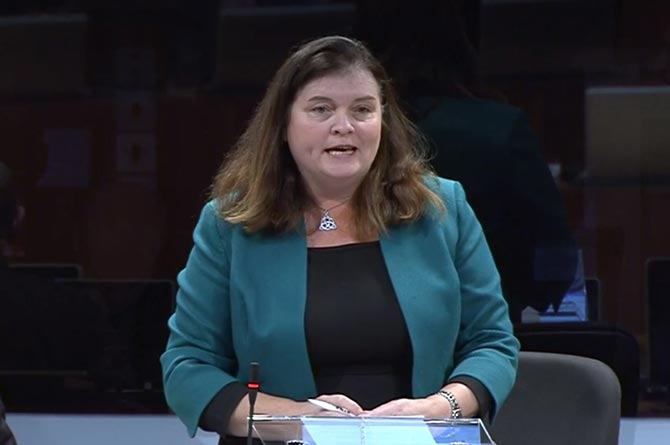
THE WELSH Government has rejected calls to copy Scotland’s direct payment to address child poverty, arguing Wales does not have the required powers over the welfare system.
The claim was made in response to a Plaid Cymru debate, which urged ministers to introduce a similar direct payment to tackle Wales’ “stubborn” 32% child poverty rate.
Plaid Cymru’s Sioned Williams said: “I’m sick of it, to tell you the truth. I’m sick of standing up here and talking about this… we owe it – all of us – to the people we represent to do better.”
The shadow social justice secretary drew a parallel with a successful free school meals campaign, suggesting ministers’ scepticism about a child payment is similarly misplaced.
She told the Senedd: “We pushed for free school meals, which we were also told rather dismissively were not affordable, credible or deliverable – until, of course, they were.”


But Conservative Altaf Hussain dismissed Plaid Cymru’s proposed child payment which would see £10 a week paid to about 15,000 children whose parents receive universal credit.
He said: “Rather than focusing on tackling the root causes of child poverty, Plaid have decided to opt for headline-catching gimmicks. And it’s not even their own idea.”
Dr Hussain added: “They’re stealing the ideas that have not even worked.”
He said the Scottish child payment is now nearly three times higher than when introduced, costing £114m between April and June this year yet a key child poverty target was missed.
Calling for a focus on economic inactivity instead, the surgeon-turned-politician told the Senedd that soaring childcare costs present a “huge barrier” to work.
Rhun ap Iorwerth rebutted the criticism, pointing out that Scotland is the only UK nation where child poverty is expected to fall – because of the direct payment.
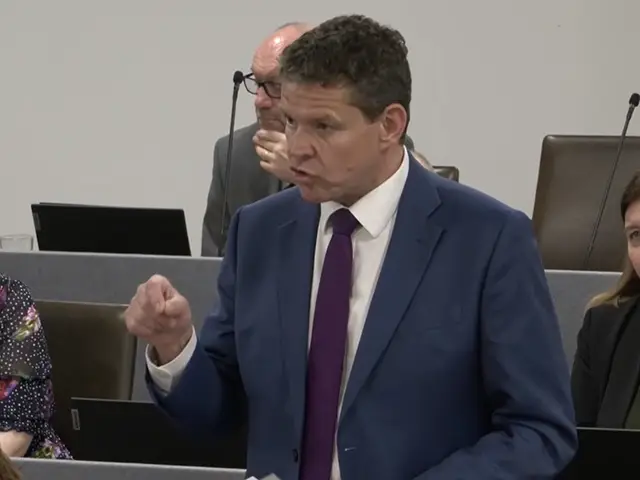
Recognising a lack of powers, the Plaid Cymru leader pointed to a “workaround” using the Government of Wales Act 2006 to introduce a payment. His party argued the real obstacle was getting the UK Government not to penalise recipients by cutting their universal credit.

His colleague Cefin Campbell, who represents Mid and West Wales, highlighted the crisis of rural poverty, which he said is often hidden and presents different challenges.
The former lecturer described families in rural Wales as facing a “triple squeeze” of rapidly rising living costs, low wages and unreliable public services.
Mabon ap Gwynfor – Plaid Cymru’s shadow health secretary – reframed the issue as a public health crisis, calling poverty the strongest determinant of health outcomes.
He warned the gap in healthy life expectancy between the richest and poorest parts of Wales is nearly 17 years, with disadvantage “built in before a child has reached the school gates”.

Labour backbencher Jenny Rathbone highlighted practical difficulties, reminding the Senedd of a Welsh basic income pilot scheme for care leavers.
During the debate on October 1, she warned the benefits of that scheme were “effectively nullified” when the UK Government cut recipients’ existing welfare payments in response.
Responding for the Welsh Government, Jane Hutt insisted tackling child poverty is an “absolute priority” but argued most of the policy levers lie with Westminster.
The social justice secretary pointed to free school meals for all primary pupils and expanding childcare as evidence of the Welsh Government’s commitment within its powers.
Ms Hutt stated “we simply don’t have the devolved powers” to legislate for a similar direct payment but she pointed to research under way on devolving the administration of welfare.



Giant puppet begins historic journey marking 850 years since the first Eisteddfod
MIST swirled around St Davids Cathedral on Friday evening as a giant Lord Rhys puppet emerged from the fog to begin a journey celebrating 850 years since the first recorded Eisteddfod.
Accompanied by traditional musicians and followed by crowds of spectators, the towering figure cut an imposing sight against the backdrop of the ancient cathedral.
The procession marked the start of Taith yr Arglwydd Rhys (The Journey of Lord Rhys), a cultural pilgrimage retracing the legacy of the Welsh prince whose gathering of poets and musicians at Cardigan Castle in 1176 is widely regarded as the first recorded Eisteddfod.
As fog drifted across the city and church towers faded into the background, the scene felt more like a chapter from Welsh folklore than a modern-day celebration.
The giant puppet, accompanied by fellow performers and musicians, travelled from St Davids Cathedral to Oriel y Parc before beginning a wider journey through west Wales.
The travelling celebration will visit communities across Pembrokeshire and Ceredigion before culminating in Cardigan, where Lord Rhys originally staged his famous cultural gathering eight and a half centuries ago.
Video and photographs shared by DrifterStDavids captured the remarkable atmosphere, with many describing the spectacle as one of the most memorable cultural events seen in St Davids for years.
Photo caption: Lord Rhys emerges from the mist outside St Davids Cathedral as celebrations begin to mark the 850th anniversary of the first recorded Eisteddfod
(Pic: SmallWorld – Video: Drifter St Davids)

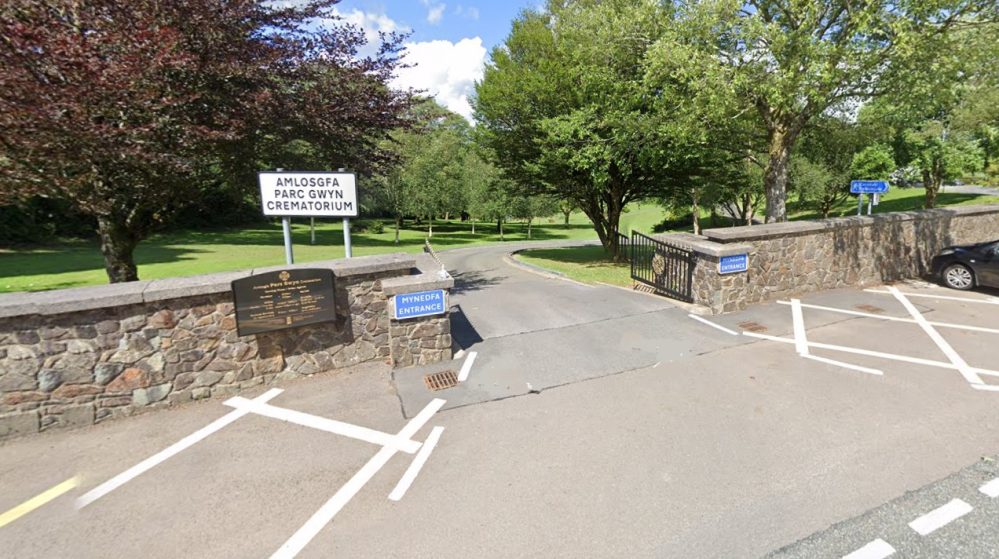
A RECENT decision by senior Pembrokeshire councillors on a review in the way crematorium services in the county will be delivered is to be revisited following a ‘call-in’ by members of the Conservative group.
At a special meeting of Pembrokeshire County Council’s Cabinet to be held on June 22, members will consider a May Cabinet decision on crematorium services in the county.
A report for members says at the March meeting of the council’s Services Overview and Scrutiny Committee it was resolved to recommend that Cabinet undertake a review of fees and charges at Parc Gwyn Crematorium, with particular regard to the cost of direct cremation, and that Cabinet commission a comprehensive review of the crematorium’s future operational model, with the findings to be reported to the committee for consideration and scrutiny prior to any final Cabinet decision.
At the May meeting of Cabinet, members agreed to review fees and charges at Parc Gwyn along with a review of service delivery, efficiency and value for money, excluding alternative operating models, the report says.
An extraordinary meeting of Services Overview and Scrutiny Committee was held in response to a call-in from 11 councillors, all member of the council’s Conservative group, saying the Cabinet report materially altered the original scrutiny recommendation, the decision was not supported by sufficient evidence or benchmarking, financial considerations relating to “surplus” and “profit” were improperly weighted, alternative operational models were prematurely excluded, and that further scrutiny is required.
That committee agreed the matter be referred back to Cabinet for reconsideration.
The report for Cabinet members says: “Members who requested the call-in were dissatisfied with the way the issue was presented to Cabinet in regards to the second recommendation, which although was presented in full in the Cabinet paper, the officer recommendation removed the element relating to the review of the operating model.
“Members queried if Cabinet were given a fair opportunity to consider the merits of a full operational review. It was suggested that the officer report led Cabinet towards their conclusion by recommending against the operating model review.
“Whilst referral was made to the call-in not being in relation to privatisation, members in the previous services overview and scrutiny committee meeting had discussed this as a potential future option which resulted in the recommendation to review the operating model.”
The report says there “are well-established and unavoidable cost factors associated with any change in delivery model,” adding: “Should Cabinet now agree to include this aspect of the recommendation, Members should be aware that this will require the commissioning of an external consultant to carry out the review, expected to cost an estimated £30,000, financed from existing crematorium reserves.”
Members are recommended to review the previous decision.
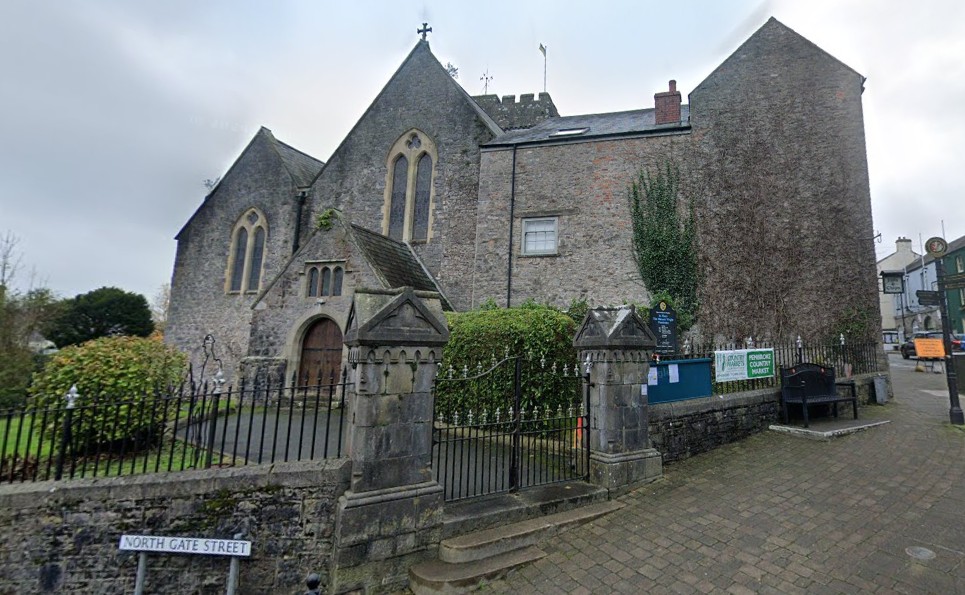
A CALL for works at a historic Pembrokeshire town centre church to make it more accessible has been submitted to county planners.
In an application to Pembrokeshire County Council, The Parochial Church Council of St Mary’s Church, Pembroke, through agent Arnold Bartosch Ltd, is applying for the removal of existing steps with replacement steps and a ramp at the grade-I-listed church.
A supporting statement says the church, heavily restored in the 19th century, “is thought to have been built for Gilbert de Clare, first Earl 1138-48 or his son Richard Strongbow, 1148-76, but is likely to be contemporary with the major building at the castle by William Marshal, first in Pembroke between 1204, and 1219”.
Of the proposed scheme it says: “The current access consists of a sloping pathway and three steps up. The steps deny access to the church for wheelchair users and those with impaired mobility. The proposed arrangement will provide a level platform allowing access for all into the church and churchyard.”
It adds: “The existing access from the churchyard into the West Porch also consists of steps. The proposals will include for the installations of a new landing at the west doorway which will provide access for all into the church.”
The west entranceway was itself listed back in 2005, as grade-II.
The supporting statement adds: “The access should be altered as it currently restricts access for all. The alterations will improve public access of the church whilst retaining the grade-II-listed piers and gates. The alterations will be carried out to a high standard befitting a grade I Listed Church setting and grade-II-listed gates and railings.
“The relocation will involve minimum disruption and no loss of historic fabric. We believe this proposal is acceptable and a reasonable part of the site’s evolution concurrent with modern requirements and can be justified as minimal harm.”
The application will be considered by county planners at a later date.
A successful fundraising campaign was held at St Mary’s for the restoration of three church bells and associated works, with a blessing of the bells service and dedication taking place back in May attended by the Rt Revd Dorrien Davies, Lord Bishop of St Davids, new mayor of Pembroke Cllr Jonathan Grimes and Mayoress Cllr Deborah Willcocks.
The three new bells dedicated were the Lingard Family Bell, the Rogers Family Bell, and the Morgan Bell.



Community58 minutes ago
Lord Rhys emerges from the mist in St Davids
Giant puppet begins historic journey marking 850 years since the first Eisteddfod MIST swirled around St Davids Cathedral on Friday...


News23 hours ago
Tragic tribute paid to Haverfordwest man after A4075 collision
FAMILY REMEMBERS “KIND AND LOVING” CALLUM HANSON THE FAMILY of a 22-year-old man from Haverfordwest who died following a road...

News2 days ago
Motorcyclist, 22, dies in A4075 crash in Pembrokeshire
A 22-year-old woman remains in hospital after two-vehicle collision A MOTORCYCLIST has died following a serious two-vehicle crash on the...

Community2 days ago
Why police will be visiting every home in Pembrokeshire
New operation aims to knock on more than 257,000 doors across Dyfed-Powys over the next three years DYFED-POWYS POLICE has...


Crime2 days ago
Prisons at breaking point: MPs warn Wales is paying the price of a failing system
Frozen healthcare budgets, overcrowded jails, homelessness on release and mounting pressure on staff are undermining rehabilitation across Wales, according to...


News3 days ago
Brexit at 10: How Britain was sold a dream that cost us dearly
A decade after the referendum, the promised benefits remain hard to find while the economic costs are increasingly difficult to...


Crime3 days ago
Worcestershire man jailed after violent attack on woman in Tenby
Defendant was already serving a suspended sentence when serious assault took place A WORCESTERSHIRE man has been jailed for more...


Climate3 days ago
Offshore wind ‘could bring new generation of jobs to Milford Haven’
Pembrokeshire ports and Celtic Sea projects placed at centre of Wales’ green energy ambitions MILFORD HAVEN and Pembroke Dock could...

Community4 days ago
Police officer hailed hero after midnight sea rescue in Milford Haven
PC swam 100 metres offshore to save distressed woman heard calling for help in darkness A DYFED-POWYS POLICE officer has...


Local Government4 days ago
Security privately arranged by Mayor at Beating of the Bounds
HAVERFORDWEST TOWN COUNCIL has confirmed that security personnel seen at this year’s Beating of the Bounds were privately arranged and...
-

 Community6 days ago
Pembrokeshire Chess Club crowned Welsh champions
-

 Crime2 days ago
Milford Haven man jailed for breaching domestic violence protection order
-
Local Government4 days ago
Security privately arranged by Mayor at Beating of the Bounds
-

 News2 days ago
Crash on Freeman’s Way causes school-run chaos across Haverfordwest
-

 Crime4 days ago
Man wanted by court after failing to attend hearing over alleged shop thefts
-

 Crime4 days ago
Man jailed after admitting strangulation and assaults
-
 Crime4 days ago
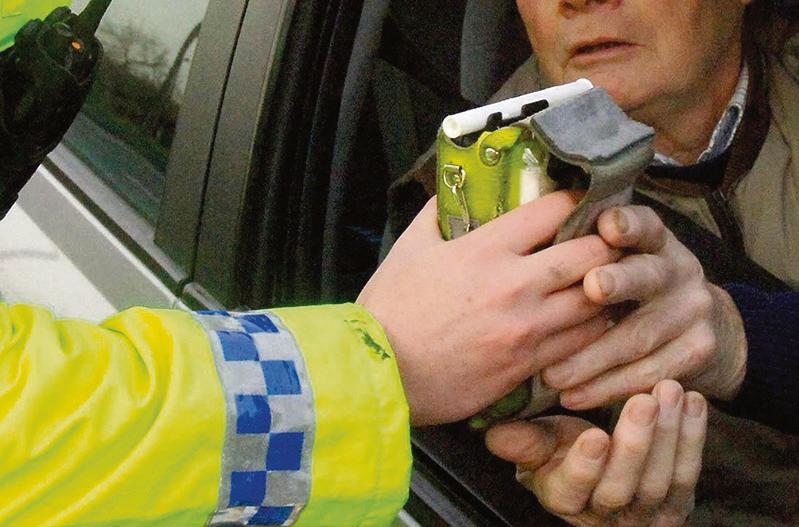
Man banned from roads after drink-driving offence
-
 Crime4 days ago
Man sentenced over stalking campaign and lock knife offence