


Health
Older patients ‘prematurely’ moved to care homes to free up hospital beds


OLDER patients are being “prematurely written off” and discharged into care homes simply to free up hospital beds, a Senedd committee has warned.
Senedd Members found a focus on “patient flow” rather than outcomes meant temporary moves often became permanent, stripping older people of their independence.
John Griffiths, who chairs the Senedd’s local government committee which held an inquiry on hospital discharges, said improving step-down care needs urgent attention.
He warned: “We heard the push to free up hospital beds is often driving older people into residential care prematurely, with no focus on rehabilitation and access to therapy.
“We all know that a hospital is not an appropriate environment for people to recover but neither is a residential home without a focus on recovery.”


The committee was alarmed by evidence of people being “prematurely written off” through the practice of routinely and inappropriately discharging older people into care homes.
Mr Griffiths, the Labour Senedd Member for Newport East, said: “What may initially be seen as a temporary measure often becomes permanent as they lose independence.
“People shouldn’t be removed from acute hospitals into care homes just to free up hospital beds, important though that is.
“They need appropriate intermediate care with therapeutic and nursing input. We need to focus on patient outcomes – not just patient flow.”

He concluded: “To see any real change in hospital discharge, we urgently need better partnership working across health and social care, and greater parity between these important sectors.”
Mr Griffiths expressed disbelief that fax machines and paper-based systems are still being used in 2025, with patient information held on disconnected IT systems.
And Lee Waters, a fellow Labour backbencher, described performance on digital as woeful.

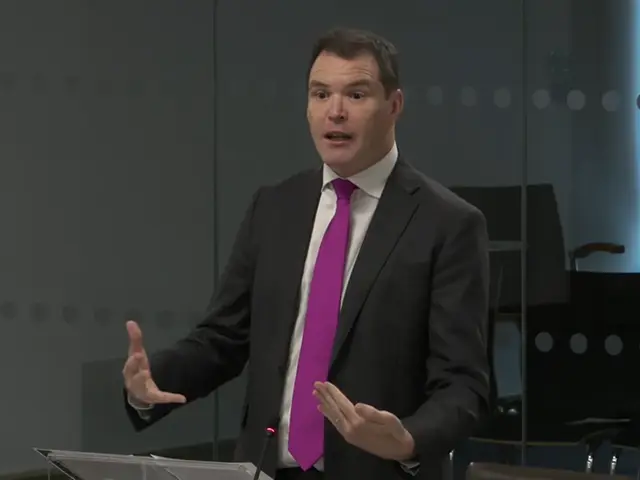
He warned: “Digital Health and Care Wales is behind on progress on all of its major programmes, and is in special measures, and is in complete denial.”
Mr Waters criticised the Welsh Government’s response to digital recommendations for containing “weasel words”, arguing ministers were refusing to mandate best practice.
The former minister said: “The Kremlinologist in me decodes that as, ‘We are not going to do anything different from what we are currently doing’.”
The Conservatives’ Joel James warned of a lack of consistency leading to wide variation across Wales’ 22 councils and even within health board areas.

Mr James told the Senedd: “It is simply not acceptable that people in Wales face a postcode lottery in the care they receive.”
The former councillor also highlighted the plight of unpaid carers, arguing the entire system would struggle to cope without them plugging gaps in provision.
Plaid Cymru’s Mabon ap Gwynfor echoed concerns about a “divided nation”, calling for a national care service to bring councils and health boards together.
He said: “Regional partnership boards look different in one part of Wales compared to another and operate inconsistently across the nation, something that is contrary to the rhetoric of fairness and dignity in care that the government is so keen to highlight.”

Dawn Bowden, Wales’ minister for social care, welcomed the committee’s report and confirmed the Welsh Government accepted all 18 recommendations. She said £30m has been invested this year to boost council services that support hospital discharge.
Ms Bowden rejected claims that paying the sector the real living wage – a Labour Senedd manifesto pledge – was merely “aspirational”, with 84% of the workforce receiving it.
She insisted the government is “holding regions to account” for delivering best practice and would be meeting partners in the coming weeks to ensure improvements.
Ms Bowden committed to a “rapid review of intermediate care practices” to strengthen reablement efforts and help people stay at home.
In closing, she told the Senedd: “Leaving hospital is not the end of care but the start of recovery, independence and a healthier Wales.”




Candidates say residents must be heard after emergency services decision
PLAID CYMRU candidates for the Ceredigion Penfro constituency will host a public meeting in Pembrokeshire to discuss concerns over the future of services at Withybush Hospital.
The event will take place at 6:30pm on Monday (Mar 31) at Letterston Village Hall, giving residents the opportunity to share their experiences and concerns following Hywel Dda University Health Board’s decision last month to remove emergency general surgery from the hospital.
Campaigners say the move will force many patients requiring urgent treatment to travel further for care, raising fears about the potential impact on patient safety in rural west Wales.
Elin Jones, Plaid Cymru lead candidate for Ceredigion Penfro, said: “Withybush is such an important hospital for the community and residents of Pembrokeshire. The decision to remove its emergency general surgery will severely weaken the life-saving capacity of this hospital.
“Plaid Cymru has long championed small rural hospitals such as Bronglais and Withybush. We need to ensure these hospitals remain strong local services within our communities. Withybush should have the basic life-saving and everyday treatment services it needs to function as a full general hospital.”

Kerry Ferguson, Plaid Cymru candidate for Pembrokeshire within the Ceredigion Penfro constituency, said the recent success of a public petition had demonstrated the strength of local feeling.
“It’s great to see that the online petition calling for Welsh Government intervention to restore emergency surgery and essential services at Withybush has reached its target, meaning it will now be debated in the Senedd,” she said.
“We are extremely disappointed by the Health Board’s decision to remove emergency general surgery at Withybush. Increased journey times for anyone in need of urgent medical treatment will put lives at risk. We need government intervention now to overturn this decision.”
Residents across Pembrokeshire have continued to raise concerns about the future of services at the hospital, which has long been a focal point in debates about healthcare provision in rural west Wales.

PEMBROKESHIRE’S two Members of the Senedd have written jointly to the Welsh Government’s Counsel General seeking legal advice on possible ways to challenge decisions made by Hywel Dda University Health Board affecting healthcare services in the county.
Paul Davies MS and Samuel Kurtz MS have asked the Counsel General, Julie James MS, to outline what legal mechanisms may exist to scrutinise or challenge the health board’s decision-making process, particularly in relation to changes impacting services at Withybush Hospital.

Their move comes amid growing concern from residents, clinicians and community groups about the impact of service changes on patient safety and access to care, especially in a rural county where travel times to alternative hospitals can be significant.
Public concern has also been reflected in a petition calling for intervention over the future of services at Withybush Hospital. The petition has now attracted more than 11,000 signatures and continues to gain support.
Having passed the required threshold, the petition can now be considered for debate in Senedd Cymru.
The two MSs say the level of public backing highlights the strength of feeling locally and the need for greater scrutiny of decisions being taken about healthcare provision.
Paul Davies MS said: “Residents across Pembrokeshire are deeply concerned about the cumulative impact that changes to healthcare services could have on patient safety and access to care in a rural area. The fact that more than 11,000 people have signed the petition highlights just how strongly people feel about this issue.”
Samuel Kurtz MS added: “People deserve confidence that decisions affecting vital healthcare services have been taken properly and with full consideration of the impact on local communities. We have therefore written to the Counsel General to seek advice on what legal avenues may exist to challenge these decisions and what powers the Welsh Government has to intervene where serious concerns have been raised.”
The MSs have also asked the Welsh Government to clarify what role it can play in reviewing or intervening where there are significant concerns about the governance and decision-making processes of a health board.

THE WELSH AMBULANCE SERVICE is preparing to host its bi-monthly Board meeting – and the public are invited.
Join the meeting on Thursday 26 March via Microsoft Teams to hear senior leaders cover a full agenda, including approval of the Integrated Medium-Term Plan for 2026-29, which outlines what the organisation will prioritise and deliver, how it will use its resources and how it will continue to improve care for the people of Wales over the next three years.
Board members will approve the initial revenue budget for the year ahead and receive an update on current financial performance.
The Board will also hear from Mr Clarke from Cwmbran, who describes an experience of trying to access help via 999 for his late father who was terminally ill.
There will also be an opportunity to pose a question to the Board.
Chair Colin Dennis said: “Board meetings give you the opportunity to really get to know our ambulance service, with a clear view of how important decisions are shaped and the processes behind them.
“They also create a forum to hear directly about ongoing work, explore how we can strengthen support for the Trust’s staff and patients, and connect with the people responsible for shaping those decisions.”
Click here to watch the Board meeting on Thursday 26 March 2026 from 9.30am.
This link will be active from 10 minutes before the meeting starts.
To pre-submit a question, please email [email protected] by no later than Wednesday 25 March 2026.An agenda will be available on the Trust’s website in the days prior to the meeting.



Education4 hours ago
New facilities open at Portfield School as redevelopment reaches key milestone
THE FIRST phase of a major redevelopment programme at Portfield School in Haverfordwest has been completed, marking a significant step...


News5 hours ago
£377m spent saving blast furnaces months after Port Talbot closure
Government intervention keeps UK’s last primary steelmaking furnaces running THE UK GOVERNMENT spent £377 million to prevent the closure of...


Sport1 day ago
France crowned Six Nations champions after extraordinary final-day drama
Ramos penalty in Paris seals title as Ireland fall just short and Wales end losing run FRANCE were crowned 2026...


News1 day ago
Fishguard linked to allegations in Many Tears Animal Rescue investigation
Claims about puppies arriving through Pembrokeshire port emerge as licensing probe continues FISHGUARD has been named in allegations linked to...


Local Government2 days ago
Investigation confirmed after inspectors visit Many Tears Animal Rescue
Licensing authority declines to comment as police confirm attendance at Carmarthenshire rescue centre AN INVESTIGATION is underway following a visit...


Business3 days ago
Work set to begin on £50m hydrogen plant in Milford Haven
A MAJOR new hydrogen production facility worth around £50 million is expected to begin construction in Milford Haven later this...


Education4 days ago
Manorbier school closure approved while insurance claim still unresolved
Council confirms negotiations with insurer ongoing following 2022 fire PEMBROKESHIRE COUNTY COUNCIL has confirmed that negotiations with its insurer over...


Crime5 days ago
‘Knife attack’ at Spittal property leaves man in hospital
POLICE have arrested a woman following what is being described as a ‘knife attack’ at a property in Spittal on...


Community5 days ago
Pembrokeshire to receive its first banking hub in Pembroke Dock
LINK, the UK’s Cash Access and ATM network, has today announced local people and businesses in Pembroke Dock will benefit from a new banking...


Health6 days ago
Future of Withybush Hospital petition sparks urgent call for Senedd debate
CALLS have been made for an urgent debate in the Senedd over the future of services at Withybush Hospital as...
-

 Health3 days ago
Welsh Ambulance Service to host bi-monthly Board meeting
-

 News2 days ago
Rayner and Lammy visit Wales to discuss justice and community safety
-

 Local Government5 days ago
Register now to vote in May’s Senedd election
-
News1 day ago
Fishguard linked to allegations in Many Tears Animal Rescue investigation
-

 Crime6 days ago
E-bike rider who sped through pedestrian alley sentenced by court
-

 Crime6 days ago
Driver caught with three illegal drugs in system on way to MOT test
-

 Entertainment6 days ago
How the Cheltenham Festival Captivates Racing Fans Every Year
-
Health6 days ago
Future of Withybush Hospital petition sparks urgent call for Senedd debate