


Climate
Pembrokeshire Coastguard volunteers praised for Monmouth rescue work


Broad Haven and Dale crews joined overnight response as Storm Claudia battered Wales
COASTGUARD volunteers from Broad Haven and Dale were among those praised for their role in rescuing residents during severe flooding in Monmouth as Storm Claudia brought chaos across Wales.
The HM Coastguard Area 13 Flood Team, made up of officers and trained volunteers from across South and West Wales, worked through the night on Friday and Saturday (Nov 14–15) to evacuate people trapped by rising water.
Among those deployed were Simon Ashton, from Dale Coastguard, and Daniel Church, from Broad Haven Coastguard. The pair joined colleagues from Penarth, Cardigan, Mumbles, Port Talbot, and Porthcawl as part of a multi-agency response involving fire, police, and ambulance services.
A message from NCI Wooltack Point commended the local effort, saying: “Well done Simon & Dan, teamwork all round.”

Major incident declared
A major incident was declared in Monmouth in the early hours of Saturday after “severe and widespread” flooding affected the town and surrounding communities. Firefighters and coastguard crews carried out rescues, evacuations, and welfare checks throughout the night, as up to a month’s rainfall fell in just 24 hours.

The Fire Brigades Union said fire and rescue services were “stretched to the limit” as Storm Claudia triggered more than 80 flood-related callouts overnight across South Wales.

Tireless efforts
HM Coastguard said its flood teams worked “tirelessly through the night” in difficult conditions, rescuing stranded residents and supporting emergency partners on the ground.
Area 13 Flood Team members included:
Rhodri Wake (Area Commander), Tom Larkin and Steve Matthews (Senior Coastal Operations Officers), Richard Hoyle (Chepstow), Keith Smith (Penarth), Richard Davies (Cardigan), Ricki Criger (Llantwit Major), Ellie Goss (Mumbles), Simon Ashton (Dale), Patrick Martin (Port Talbot), Jonathan Runnels (Porthcawl), Daniel Church (Broad Haven), and Mark Parkin (Duty Coastal Officer).









VISITORS to this year’s Royal Welsh Show are being encouraged to use public transport as organisers look to ease congestion and promote more sustainable travel.
The show takes place at the Royal Welsh Showground in Llanelwedd, Builth Wells, from July 20 to 23, and is expected to attract thousands of people from across Wales and beyond.
The Royal Welsh Agricultural Society said rail and bus services would provide convenient options for showgoers, with free shuttle buses running from Builth Road railway station to the showground, which is just over a mile away.
Discounted admission
Visitors travelling on the Heart of Wales Line with a valid rail ticket will be able to buy discounted show admission tickets from conductors and ticket offices along the route.
The discounted prices are £35 for adults and £11 for children. Children under 16 can travel free by train when accompanied by a fare-paying adult.
Transport for Wales said rail services would connect visitors from across Wales and the borders, including routes from Cardiff through some of Wales’ most scenic countryside. TrawsCymru bus services will also provide another option for those travelling to the event.
Family activities
Transport for Wales and Network Rail will also have an interactive stand at the show, offering family-friendly rail safety activities and entertainment.
Activities will include VR headset experiences, story time sessions, badge-making classes and rail safety performances. Builth Wells Male Voice Choir is also due to visit the stand on the first day of the show.
Children under 16 travelling to the show by train on the Heart of Wales Line will be able to collect a free activity sheet on board and hand in their completed artwork at the Transport for Wales stand for a chance to win a prize.
Visitors are being urged to plan their journeys in advance through the Transport for Wales website and journey planner.
Travel encouraged:
Visitors to the Royal Welsh Show are being urged to consider rail and bus services this year (Pic: RWAS).


CALLS have been made for an immediate moratorium on industrial-scale solar and windfarm developments in Wales amid concern over the loss of productive farmland.
The Welsh Conservatives say the Welsh Government should pause major renewable energy schemes and urgently review the planning rules for Developments of National Significance.
Party leader Darren Millar MS said Future Wales 2040, the national planning framework, gives too much weight to large-scale renewable energy projects and risks allowing solar farms and windfarms to be built at the expense of food production.
Planning row
The row comes as Wales faces pressure to increase renewable energy generation while also protecting agricultural land, rural landscapes and farming communities.
Under the Developments of National Significance process, major infrastructure projects, including some large renewable energy schemes, are decided by Welsh Ministers rather than local councils.
Supporters say the system is needed to deliver clean energy and reduce reliance on fossil fuels, while critics argue it can leave communities feeling that decisions are being taken out of their hands.
Mr Millar said: “In opposition, the now First Minister campaigned against industrial-scale renewable developments in his own constituency for fear of the impact it would have on valuable farming land. Now in government, he needs to act accordingly to protect prime agricultural land.
“The current planning framework is fundamentally flawed. Future Wales 2040 creates an assumption in favour of industrial-scale solar farms and windfarm developments across great swathes of rural Wales, putting productive farmland at risk.
“We support renewable energy and recognise its role in achieving energy security and reducing emissions, but those developments should not be at the expense of Wales’ food security.
“Renewable developments should be appropriate in scale and sensitive to their environment, making better use of the roofs of buildings and car parks.
“The Welsh Government should introduce an immediate moratorium on industrial-scale solar and windfarm developments and undertake an urgent review of the planning framework for Developments of National Significance so Wales can take a more balanced approach to Wales’ energy future.”
Climate targets
The Welsh Government says renewable energy is central to meeting Wales’ climate targets and improving energy security, but that projects must go through the planning system before consent is granted.

Supporters of large-scale renewable schemes argue they are needed to cut emissions, reduce reliance on imported energy and help stabilise electricity supplies. Some farmers and landowners also see renewable projects as a source of income at a time when the agricultural sector is under pressure.
However, opponents say the scale and location of some proposals risk damaging landscapes, reducing food-producing land and leaving rural communities with too little say over major developments.


A PEMBROKESHIRE wind turbine scheme which was recommended to be refused over a lack of information on how it may affect bats, which led to it being previously withdrawn, has gained some breathing space to address the issue.
In December of last year, in an application recommended for refusal at Pembrokeshire County Council’s planning committee, Constantine Wind Energy Ltd sought permission for a 76-metre-high wind turbine at Summerton Farm, Sageston.
Back in 2024, an application to replace a current 60.5m high turbine on the site with one up to 90 metres, or just under 300 foot, at the site was refused on the grounds its height and scale would have a detrimental impact on the visual amenity of the locality, with the additional clause of failing to comply with supplementary guidance.
A report for committee members on the latest application says the smaller turbine than previously proposed, representing a 16-metre increase in height from a previously granted turbine “would not be sufficient for it to become an overbearing feature in the landscape,” with no objections from either the Council Landscape Officer or Natural Resources Wales.
However, concerns were raised by the council ecologist that the applicant’s Preliminary Ecological Appraisal Report was incomplete, with a bat survey not included.
It was recommended for refusal on the grounds that appraisal report, and technical note, “do not adequately address the impact of the proposed wind turbine on bat activity in the area”.
At the December meeting, members heard the scheme had been temporarily withdrawn to deal with issues raised, the application returning to the June meeting, again recommended for refusal on a lack of information on the potential impact on bats.
A report for members ahead of the June meeting says the application was withdrawn from the December agenda to allow the applicant time for consideration of the Council Ecologist’s request for further survey work.
It said the applicant had started a bat survey programme, with further surveys due to take place in July and September, the applicant asking for the matter to be deferred in November.
At the June meeting, Richard Grisk, on behalf of the applicants, referenced the additional surveys, calling for a further deferral, saying it would be far most cost efficient and effective for all parties, the applicants intending to resubmit an expected to be near-identical scheme, other than the bat reports, if it was refused.
After a great deal of deliberation on the matter, Cllr John Cole, who had initially proposed a deferral, moved the scheme be decided by officers under delegated powers.
This would allow them to either approve or refuse after the bat reports have been received.

Members, by 10 votes to four, supported the delegated decision, expected later this year.



Community9 minutes ago
Police officer hailed hero after midnight sea rescue in Milford Haven
PC swam 100 metres offshore to save distressed woman heard calling for help in darkness A DYFED-POWYS POLICE officer has...


Local Government6 hours ago
Security privately arranged by Mayor at Beating of the Bounds
HAVERFORDWEST TOWN COUNCIL has confirmed that security personnel seen at this year’s Beating of the Bounds were privately arranged and...


Business1 day ago
Celtic Freeport five-year plan puts Milford Haven at centre of green energy future
Strategy promises investment, skilled jobs and new supply chains, but major barriers remain over grid connections, planning and delivery THE...


Education1 day ago
Closure of Ysgol Clydau approved after emotional council debate
COUNCILLORS WARNED RURAL COMMUNITIES WILL REMEMBER DECISION PEMBROKESHIRE councillors have voted to close Ysgol Clydau following an emotional debate over...


Education1 day ago
Manorbier school closure process to continue after narrow council vote
Questions remain over insurance, rebuilding costs and possible legal action by Diocese PEMBROKESHIRE councillors have voted to press ahead with...

Community2 days ago
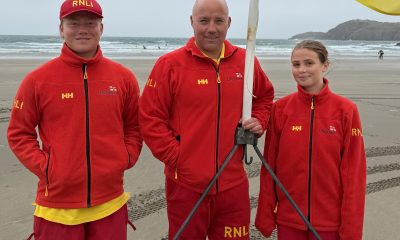
The father, son and daughter lifeguard trio saving lives in Pembrokeshire
A FATHER, son and daughter are preparing to help keep beachgoers safe on the Pembrokeshire coast this summer as part...


Community2 days ago
Beating of the Bounds brings music, boats and tradition to Haverfordwest
CENTURIES-OLD CEREMONY DRAWS FAMILIES TO THE RIVERSIDE HAVERFORDWEST’S historic Beating of the Bounds returned on Sunday (Jun 14), with boats,...


Community2 days ago
Milford Haven School pupil praised after stepping in during real-life emergency
A YEAR 11 pupil at Milford Haven School has been praised after putting his first aid training into action to...


Community2 days ago
River festival brings crowds to Haverfordwest
A CELEBRATION of the River Cleddau brought crowds into Haverfordwest on Saturday (June 13) as the town’s River Festival returned...


Charity2 days ago
Voices at the Castle hailed as unforgettable night after weather setback
Russell Watson headlines spectacular charity concert at Pembroke Castle A SPECTACULAR evening of live music at Pembroke Castle has been...
-

 Community2 days ago
Pembrokeshire Chess Club crowned Welsh champions
-

 Crime5 days ago
Pembroke Dock teenager sentenced over train strangulation attack
-

 Education4 days ago
Diocese threatens legal action as Manorbier school closure battle intensifies
-

 Crime5 days ago
Man accused of six rapes including alleged Haverfordwest offence
-

 Local Government4 days ago
Taxi suspended after county-wide licensing checks
-
Local Government6 hours ago
Security privately arranged by Mayor at Beating of the Bounds
-

 Crime5 days ago
Brothers found guilty of causing death of Welsh dad in ‘reckless’ race
-

 Crime4 days ago
Currys worker denies stealing £2,500 of store stock