


News
Trump tariff threat reignites ‘NHS Trump tax’ row as Lib Dems urge retaliation


THE WELSH LIB DEMS have urged the UK Government to scrap what they brand an NHS “Trump tax” and to coordinate with European allies on countermeasures after Donald Trump announced a 10% tariff on UK goods from Saturday, February 1 — linking the move to his demand that the United States should acquire Greenland.
Jane Dodds MS, leader of the Welsh Liberal Democrats, said Wales would be among the parts of the UK most exposed to a tariff shock, warning that key sectors including advanced manufacturing, steel, food and drink, and life sciences are particularly vulnerable to rising trade barriers and market uncertainty.

She also argued the Greenland threat should not be treated as a routine trade dispute, describing it as economic coercion aimed at the sovereignty of Denmark — a democratic NATO ally — and a dangerous precedent for global security and international law.
Dodds said: “Donald Trump is trying to bully the UK and ransom the sovereignty of Greenland… That is economic coercion, and it cannot be met with appeasement.”
Call for coordinated retaliation
The Welsh Liberal Democrats are calling on Prime Minister Keir Starmer to work “in lockstep” with European partners to prepare a coordinated package of countermeasures and retaliatory tariffs, saying economic bullying must be met with a firm and united response.

They argue that acting alongside Europe would strengthen the UK’s hand and reduce the risk of Britain being picked off in bilateral disputes.
Dodds said: “We must also work in lockstep with our European partners to prepare a robust package of countermeasures and retaliatory tariffs to hit Trump and his cronies where it hurts… Britain is strongest when we stand alongside Europe, not when we act as a doormat for a bully.”
Wales’s exposure to a tariff shock
Although tariff announcements tend to be framed in national terms, the Welsh Liberal Democrats say the impact could be highly regional, hitting areas where export-reliant industries are concentrated.
Wales has major employers and supply chains linked to manufacturing, steel and food production, and the party warned that any sudden increase in costs for exporting to the United States could make Welsh products less competitive overnight — while uncertainty alone can chill orders and investment.

The party’s argument is that Wales has more to lose than most if the dispute escalates: fewer alternative markets for some producers, greater exposure to supply chain disruption, and less resilience in communities where one major employer underpins large parts of the local economy.
What is the ‘NHS Trump tax’?

At the heart of the Liberal Democrat intervention is a long-running row over medicines pricing and UK–US trade policy.
The Liberal Democrats have previously used the term “Trump tax” to describe what they say would be billions of pounds in additional pharmaceutical costs to the NHS, arguing that UK policy risks inflating the price of medicines and effectively transferring money from public health budgets into higher drug costs.

Dodds said: “This Government is still planning to hand over £3 billion a year in a so-called ‘Trump tax’ on our NHS through inflated pharmaceutical costs. With health and care services in Wales under immense strain, that is indefensible. Scrap the Trump tax and put that money into frontline care.”
However, the £3bn figure and the way it is presented remain disputed. Ministers and some analysts have previously challenged claims of an annual “tax” of that scale, arguing the numbers depend on assumptions and timeframes, and that the NHS retains protections on medicines pricing.
In short: the Liberal Democrats say the policy is a costly concession that should be reversed immediately — while the Government is likely to argue that the characterisation is politically loaded and that NHS safeguards remain in place.
Greenland: trade spat or geopolitical coercion?
By tying tariffs to the question of Greenland, the Liberal Democrats say Trump is pushing beyond normal trade leverage and into geopolitical coercion — a framing designed to increase pressure on the UK Government to respond not just economically, but as a matter of democratic solidarity.
The party says the UK should treat the Greenland threat as an issue of allied sovereignty and global norms, warning that failure to stand up to it could invite similar pressure tactics elsewhere.
But ministers may calculate that cooler diplomacy is more effective than public escalation — particularly given the UK’s long-standing security relationship with the United States, the role of NATO, and the reality that trade wars can rapidly damage businesses and consumers on both sides.
The Government may also argue that the UK must keep channels open to reduce the risk of tariffs widening beyond the initial 10% or spilling into other areas such as defence procurement, services, or strategic cooperation.
Why the Lib Dems say Europe matters
The Welsh Liberal Democrats say this crisis underlines the case for closer UK relations with the European Union, arguing that coordinated action would carry more economic weight and send a clearer message than unilateral UK measures.
They also point to Canada as an example of a democratic ally willing to stand firm and prepare countermeasures, arguing that deterrence — not concession — is the only language Trump respects.
Dodds said: “Canada has shown you do not deter Trump by pleading. You deter him by standing firm and being ready to act. The Prime Minister should do the same and defend our economy, defend our allies and defend our values.”
The political test at Westminster
The row sets up a high-stakes balancing act for Labour: projecting toughness against “economic bullying” while avoiding an all-out trade war that could rebound on UK consumers and exporters.
If the UK Government declines to pursue retaliatory tariffs, it risks being accused of weakness. If it retaliates too aggressively, it risks triggering further escalation.
For Welsh Labour in particular, the pressure is twofold: demonstrating it will stand up for Welsh industry and jobs, while also holding together a coherent UK-wide trade and foreign policy stance.
What happens next
The immediate question is whether the tariff threat becomes policy on February 1 — and whether it is confined to a narrow range of goods or becomes the opening move in a broader trade confrontation.
The second question is how the UK chooses to respond: quietly through negotiation, publicly through retaliatory tariffs, or in tandem with European allies in a coordinated package.
For the Welsh Liberal Democrats, today’s message is blunt: scrap the policy they say inflates NHS medicines costs, stand with Europe, and treat Greenland as an allied sovereignty issue — not a bargaining chip.
For ministers, the challenge is to protect Welsh exporters and UK consumers while navigating a dispute that mixes trade, diplomacy and security — and to do so without conceding ground on principles that democratic allies consider non-negotiable.












A HAVERFORDWEST man has been jailed for seven years after being convicted of raping and indecently assaulting a girl during the 1980s.
Alan Pyart, aged 60, of North Court, Haverfordwest, was found guilty following a trial at Swansea Crown Court earlier this year.
Pyart had denied raping and indecently assaulting the victim, who was under the age of 16 at the time of the offences.
The case returned to court for sentencing after being adjourned for more than two months so that a further psychiatric report could be prepared.
Judge Geraint Walters sentenced Pyart to seven years in prison for rape and four years for indecent assault. The sentences will run concurrently, meaning he will serve an overall custodial term of seven years.
Pyart was also made subject to an indefinite restraining order and will remain on the sex offenders register for life.
He had previously been remanded in custody while awaiting sentence.
Reporting restrictions are in place which legally protect the identity of the victim.
Detective Inspector Sarah Totterdale, of Pembrokeshire CID, praised the victim for coming forward many years after the abuse took place.
She said the case demonstrated the lasting effect sexual abuse can have on victims and their families, adding that it was never too late to seek justice.
DI Totterdale said: “I would like to commend the victim for the immense courage she has shown in coming forward and speaking about what happened to her all those years ago.
“Abuse of this nature can leave deep and long-lasting scars, but it is never too late to seek justice.

“We hope this conviction and sentence sends a clear message that Dyfed-Powys Police will pursue offenders, no matter how much time has passed.”
She encouraged anyone who has experienced sexual abuse, either recently or in the past, to contact police, saying they would be listened to, supported and taken seriously.
Information about reporting rape and sexual assault, as well as details of available support services, can be found through the Dyfed-Powys Police website.

GOODWICK Sea Scout Group has praised its young members, leaders and volunteers after they helped brighten up the area outside the group’s headquarters.
The team rolled up their sleeves ahead of the town’s recent Wales in Bloom judging, clearing overgrown vegetation and transforming an old boat into an eye-catching flower bed filled with colourful plants.
The group said the work had made a real difference to the front of the hall and thanked everyone who gave their time to help.

A spokesperson said: “Our Scout group worked hard to tidy up the front of our hall in time for the town’s Wales in Bloom judging.
“Well done to all the young people, leaders and volunteers who helped.”
The group is now hoping to build on the improvements and would like to hear from anyone with gardening experience who could volunteer to help care for the land surrounding the hall.
Anyone interested in lending a hand is encouraged to contact Goodwick Sea Scout Group directly.

Rhun ap Iorwerth says he will press the new Prime Minister for powers over policing, railways and Wales’ natural resources when the two leaders meet.
FIRST MINISTER Rhun ap Iorwerth has said he believes Andy Burnham is more willing to listen to Wales’ demands for further devolution than his predecessor, Sir Keir Starmer.
The Plaid Cymru leader is expected to hold an introductory meeting with the new Prime Minister on Thursday, following a telephone conversation between the pair earlier this week.
Mr ap Iorwerth said he hoped the change in leadership at Westminster would provide an opportunity to take Welsh devolution to the “next level”.
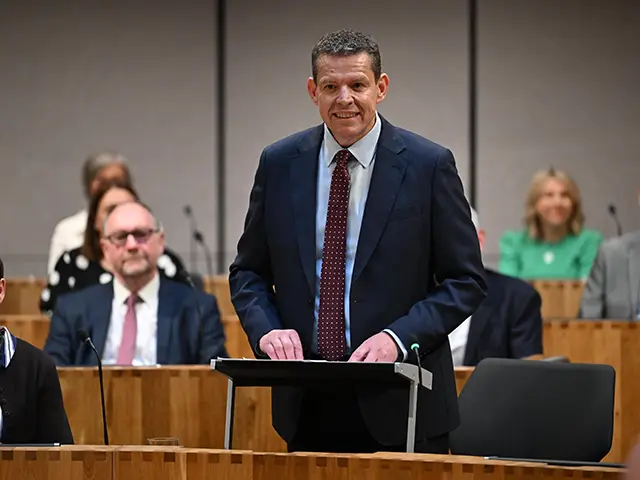
Speaking to BBC Radio 4’s Today programme on Wednesday, he said: “I had a conversation with Andy Burnham yesterday, congratulated him on becoming Prime Minister, and we both made it clear to each other that we wanted to have a positive relationship, a constructive relationship.
“I know that he understands devolution for Manchester. I want to help him understand what devolution means in Wales and what tools we need to make it work better.”
The First Minister said his government had been elected with a mandate to seek greater control over policing and justice, rail services and funding, as well as Wales’ natural resources.
He said: “There is a list, if you like, of things that we need to devolve now in order to move the story of Wales, the story of devolution, on to the next level.
“It’s clear that we now have a Prime Minister who is open to listening, perhaps in a way that Keir Starmer wasn’t, and I’m eager to do everything that I can to make the case for Wales.”
A planned meeting between Mr ap Iorwerth and Sir Keir failed to take place before the former Prime Minister left office, with the First Minister previously blaming “chaos in Westminster”.
Plaid Cymru formed the Welsh Government in May after ending more than two decades of Welsh Labour rule at the Senedd election.
Mr Burnham has extensive experience of devolved government after serving as Mayor of Greater Manchester, where he repeatedly called for greater powers and funding to be transferred away from Westminster.
However, the new Prime Minister has sought to play down the prospect of major constitutional reform.

During conversations with the leaders of Wales, Scotland and Northern Ireland on Tuesday, Mr Burnham said his immediate focus would be on “practical measures” rather than constitutional changes or further independence referendums.
Mr ap Iorwerth supports Welsh independence but has said his government will not seek to hold an independence referendum during its first term.
Thursday’s meeting is expected to focus on the working relationship between the Welsh and UK governments, as well as funding, transport and the future balance of devolved powers.



Crime11 hours ago
Haverfordwest man jailed for seven years for historic rape and sexual assault of girl
A HAVERFORDWEST man has been jailed for seven years after being convicted of raping and indecently assaulting a girl during...


News16 hours ago
Burnham more willing to listen on Welsh devolution, says First Minister
Rhun ap Iorwerth says he will press the new Prime Minister for powers over policing, railways and Wales’ natural resources...


Crime20 hours ago
Women jailed after man chased through Milford home and attacked with knives
Kelly Rees receives further 27-month sentence while already serving prison term for notorious taxi robbery TWO women have been jailed...


Crime21 hours ago
Mother headbutted and clawed police officers after threatening social worker
Court shown body-worn footage of violent confrontation at Goodwick property A COURT has been shown police body-worn footage capturing the...


Crime2 days ago
Man, 37, found dead following major police response in Pembroke Dock
Death not being treated as suspicious as police make statutory referral to IOPC following active investigation A 37-YEAR-OLD man has...


Community2 days ago
Household Cavalry drum horse returns home to Pembrokeshire for final farewell
Dyfed Willa Rose, who became Major Juno and the first mare to serve as a Household Cavalry Drum Horse, was...

News2 days ago
Jo Stevens out as Welsh Secretary as Burnham reshapes government
Cardiff East MP repeatedly visited Pembrokeshire to champion clean energy jobs, but her successor inherits unresolved questions over Milford Haven’s...


Crime3 days ago
Teen cleared of attempted murder but guilty of GBH after Milford teacher stabbed
Jury returns 11-1 majority verdict on charge of causing grievous bodily harm with intent, with sentencing set for September 3...


Community3 days ago
French troops march through Fishguard as Britain’s last invasion returns to life
Battle scenes, cavalry displays and a surrender procession brought one of Pembrokeshire’s most extraordinary stories back to the streets MUSKET...
News3 days ago
Andy Burnham promises new politics as he enters Downing Street
New Prime Minister admits politicians have “not been good enough” as he sets out a ten-year plan for Britain and...
-

 Crime21 hours ago
Drunken rail passenger tried to headbutt police after being refused travel
-

 featured2 days ago
From a father-and-son project to an award-winning campervan business
-
Crime20 hours ago
Women jailed after man chased through Milford home and attacked with knives
-
Community2 days ago
Household Cavalry drum horse returns home to Pembrokeshire for final farewell
-
News16 hours ago
Burnham more willing to listen on Welsh devolution, says First Minister
-

 Entertainment2 days ago
Robin Hood: A magical show by young talent at The Torch Theatre
-
Crime11 hours ago
Haverfordwest man jailed for seven years for historic rape and sexual assault of girl
-

 Community1 day ago
Senior councillors to consider call for ‘impartial investigation’ into Manorbier school closure