


News
Climber dies and two injured in St Govan’s Head fall

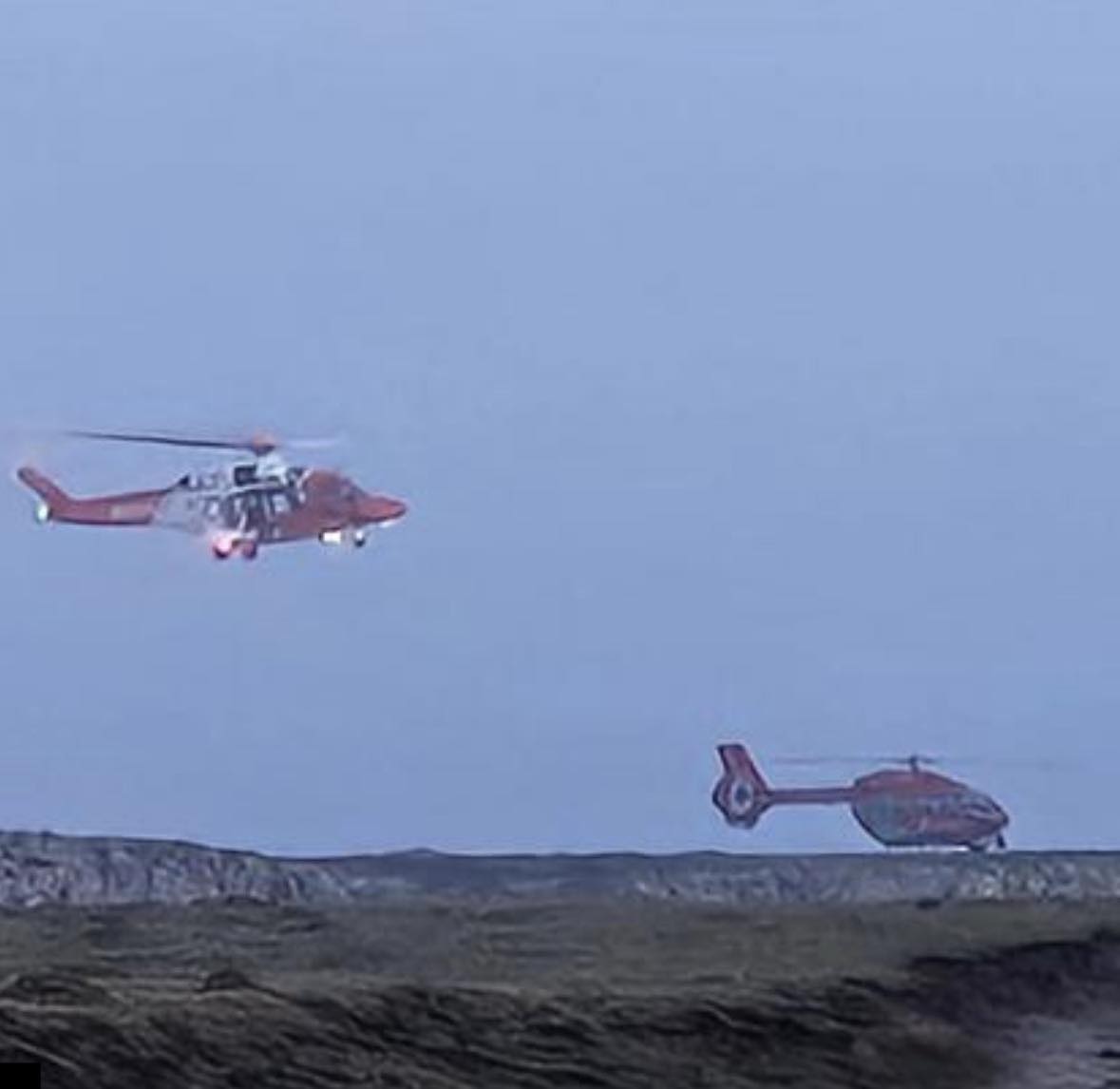
Major air and sea rescue launched as coastguard, lifeboat and helicopters scramble to Pembrokeshire cliffs
A PERSON has died and two others have been injured following a climbing incident at St Govan’s Head on the Pembrokeshire coast.
A major multi-agency rescue operation was launched on Thursday afternoon after concerns were raised for the welfare of three climbers near the cliffs.
Dyfed-Powys Police confirmed one casualty was pronounced dead at the scene, while two others were taken to hospital with injuries not believed to be life-threatening.
A police spokesman said: “Dyfed-Powys Police were contacted by the ambulance service around 4.25pm, Thursday February 12, reporting concerns for the welfare of three individuals at St Govan’s Head, Pembrokeshire.
“Officers were deployed to the location alongside multiple other agencies.

“Two were taken to hospital for treatment for injuries not believed to be life threatening. Sadly, one person was pronounced dead at the scene.”
The force added the death is not being treated as suspicious and the person’s next of kin have been informed.
Earlier, witnesses reported a significant emergency presence along the coastline, with multiple helicopters seen overhead and the Angle all-weather lifeboat operating offshore.
A spokesman for HM Coastguard said the alarm was first raised at about 4:00pm.
Teams from Fishguard, St Govan’s and Tenby were sent, alongside an HM Coastguard helicopter, an Irish Coastguard helicopter, Wales Air Ambulance and an RNLI lifeboat from RNLI’s Angle station.
St Govan’s Head, within the Pembrokeshire Coast National Park, is a popular but exposed climbing and walking location known for steep limestone cliffs and strong seas.
Photo caption: Rescue response at St Govan’s Head during Thursday’s incident












Darren Millar calls for assurances that Welsh cases will be properly examined, as first local investigations are named in England
WELSH victims of group-based child sexual exploitation must not be left on the margins of the national grooming gangs inquiry, the Leader of the Welsh Conservatives has warned.
Darren Millar MS has called on the Welsh Government to seek urgent assurances that cases from Wales will be properly examined by the statutory inquiry chaired by Baroness Anne Longfield.
The inquiry formally covers England and Wales, but the first named local investigations are London, Oldham, Bradford and Keighley. No Welsh area has yet been listed as one of the first local investigation sites.

Mr Millar said that has raised serious questions about whether Welsh victims and survivors will be given the same level of scrutiny, particularly where devolved public services may have failed to identify or protect children at risk.
He said schools, councils, social services, health boards and safeguarding partnerships in Wales must be prepared to answer difficult questions about what was known, what was missed and whether vulnerable children were properly protected.
Mr Millar said: “The grooming gangs scandal was not confined to a handful of towns in England.
“We know organised child sexual exploitation happened in Wales, Welsh victims suffered appalling abuse and there are serious questions about whether public bodies did enough to protect vulnerable children.
“Victims deserve confidence that no stone will be left unturned in uncovering the truth.
“If the UK inquiry is not going to investigate Wales, then the Welsh Government must establish a Wales-specific inquiry into the role of devolved public services, including schools, health boards and local authorities.
“There is evidence that vulnerable children have been failed by the very institutions that should have protected them. It is unforgivable that warnings were ignored and victims were dismissed because people avoided having uncomfortable conversations that could have raised the alarm about safeguarding concerns.
“Lessons must be learned to ensure these horrific crimes can never happen again.”
The call comes amid renewed UK-wide scrutiny of group-based child sexual exploitation and the repeated failure of public bodies to act on warnings from victims, families and frontline professionals.
The statutory inquiry was established after Baroness Louise Casey’s national audit into group-based child sexual exploitation and abuse. It will examine how children were targeted, how institutions responded and whether public bodies failed to act because of poor practice, weak leadership, cultural sensitivities, or a failure to treat victims with credibility and care.
The inquiry has powers to compel evidence and require witnesses to give testimony. It is expected to look at failures by local authorities, police, health services, schools and other public bodies.
Although Wales is included in the formal England and Wales remit, the inquiry has made clear that it will not investigate every area where abuse may have taken place. Victims and survivors outside the named local investigation areas are still able to share evidence.
That distinction is now central to the political argument in Wales.
The Welsh Conservatives say it is not enough for Wales to be technically covered by the inquiry if Welsh cases are not examined in detail. They argue that Welsh victims need public confidence that the inquiry will follow the evidence into Welsh institutions where necessary.
The issue is especially sensitive because child protection, education, social services, health boards and safeguarding arrangements are devolved responsibilities in Wales. Policing and criminal justice remain largely reserved to Westminster, meaning any proper examination of Welsh failures would need to look at how devolved and non-devolved bodies worked together.
Wales has already featured in previous national scrutiny of child sexual exploitation. The Independent Inquiry into Child Sexual Abuse included Swansea as one of its case study areas when it examined child sexual exploitation by organised networks.
That inquiry found concerns around the way cases were identified, recorded and understood. It said examples of exploitation by networks or groups should have been identified by police and the local authority.
The Welsh Government has previously argued that an England and Wales inquiry is the best way to examine the issue, rather than setting up a separate Wales-only process. It has also published a 10-year strategy for preventing and responding to child sexual abuse in Wales.
That strategy is intended to improve prevention, strengthen professional responses, support children and families, and provide help for adult survivors.
However, the Welsh Conservatives say a safeguarding strategy cannot replace accountability for historic failures.
They argue that victims need answers about whether warnings were missed, whether agencies failed to share information, whether children in care were properly protected, and whether professionals wrongly dismissed victims instead of recognising exploitation.
Campaigners and specialist support organisations have also warned that any inquiry must remain focused on victims and survivors rather than becoming a party-political row.
They have stressed that child sexual exploitation can take many forms, including online grooming, trafficking, abuse by groups or networks, criminal exploitation, familial abuse and abuse by people in positions of trust.
Mr Millar said Welsh victims must not be treated as an afterthought.
The Herald has asked the Welsh Government whether it has sought assurances that Welsh evidence will be considered by the inquiry, and whether Ministers would support a Wales-specific investigation if no Welsh area is selected for detailed examination.

PEOPLE across Pembrokeshire, Carmarthenshire and Ceredigion are being encouraged to discover the wildlife on their doorstep as Wales Nature Week returns this July.
The annual celebration takes place from July 4 to 12, with more than 80 events across Wales, including a strong programme in Pembrokeshire, Carmarthenshire and Ceredigion.
This year’s theme, In Your Neighbourhood, focuses on the wildlife, green spaces and everyday nature that can be found close to home, from beaches and wetlands to country parks, nature reserves, gardens and community spaces.
In West Wales, events include seashore activities on the Pembrokeshire coast, conservation work at Broad Haven, a guided walk at Teifi Marshes, a family nature day at Pembrey Country Park and the Ceredigion Nature Festival in Aberystwyth.
Natural Resources Wales said the week is designed to encourage people of all ages to get involved, spend time outdoors and take simple steps to help nature recover.
Prys Davies, Executive Director of Strategy, Policy and Evidence at Natural Resources Wales, said: “Wales Nature Week is a fantastic opportunity for people of all ages to get involved and make a difference for nature.
“We’re encouraging everyone to take a closer look at the nature on their doorstep, and to take simple, practical steps to help it thrive. Whether that’s creating space for wildlife at home, getting involved in local projects, or supporting conservation work, every action counts and adds up to real change.
“We’re facing a nature and climate emergency, and the need to act has never been clearer. Healthy ecosystems underpin our food, our health and our economy, and they need our support to thrive. Wales Nature Week is a chance for all of us to play our part.”
Local events include a Balsam Bash at Morfa Wetlands in Carmarthen on Friday, July 4, from 10:00am to 1:00pm. Volunteers will help tackle invasive Himalayan balsam and protect an important wetland habitat.
On Saturday, July 5, a guided walk at the former Pentremawr Colliery in Pontyberem will explore how nature has reclaimed the historic industrial site. The free event runs from 10:00am to 12:30pm.
Families in Pembrokeshire can take part in a Junior Seashore Safari on the Pembrokeshire Coast on Saturday, July 5, from 2:00pm to 4:00pm, with young explorers invited to discover the marine life living along the shoreline.
A Volunteer Conservation Day will also take place at Slash Pond Community Nature Reserve in Broad Haven on Sunday, July 6, from 10:30am. Volunteers will help with practical conservation tasks, including habitat management and boardwalk maintenance.

On Wednesday, July 9, the Wildlife Trust of South and West Wales will lead a Wales Nature Week walk at Teifi Marshes Nature Reserve in Cilgerran from 1:30pm to 3:00pm. The walk will give visitors a chance to learn more about the reserve’s habitats, wildlife and future plans for the visitor centre.
One of the biggest local highlights will be Gone Wild at Pembrey Country Park on Saturday, July 11, from 11:00am to 4:00pm. The free family event, with parking charges applying, will include outdoor activities, nature challenges, scavenger hunts, den building and stalls from organisations working to protect wildlife in Carmarthenshire.
Ceredigion will also host one of the headline events, with Ceredigion Nature Festival taking place in Aberystwyth on Saturday, July 11, from 10:00am to 4:00pm. The free festival will bring together conservation groups, artists, researchers and community organisations to celebrate the county’s wildlife and landscapes.
The week ends locally with a Nature Bingo Walk with Sea Watch in New Quay, Ceredigion, on Sunday, July 12, from 11:00am to 1:00pm. Participants will explore the coast while spotting and identifying local wildlife.
Further West Wales events continue later in July, including a BioBlitz Festival at the National Botanic Garden of Wales in Llanarthne on July 18 and 19, where visitors will help record as many species as possible across the garden and Waun Las Nature Reserve.
Full event listings and booking details are available on the Wales Nature Week website.

From young recruit to respected veteran, Phil Lees-Griffiths leaves lasting legacy
A TENBY firefighter whose career has spanned almost four decades has been honoured on his retirement after 37 years of service with Mid and West Wales Fire and Rescue Service.
Photographs shared to mark the occasion show Phil Lees-Griffiths’ remarkable journey from a young firefighter at the beginning of his career to a respected and experienced member of Tenby’s fire crew, reflecting nearly four decades of commitment to protecting local communities.
Tenby Town Council has paid tribute to Phil’s dedication, courage and professionalism, describing his retirement as the end of an era for the town’s emergency services.
Mayor of Tenby, Cllr Dai Morgan, said: “Today, we celebrate not just the retirement of a firefighter, but the remarkable career of a man who has devoted 37 years to protecting the people of Tenby and our surrounding communities.”



Crime1 day ago
Judge calls pensioner a ‘dirty old man’ as he avoids jail for exposing himself to women
Judge says 75-year-old Stewart Laugharne behaved ‘disgracefully’ as he avoids jail but is ordered to sign sex offenders register A...

Health1 day ago
Stroke services consultation reaches halfway point as public urged to have say
HYWEL DDA University Health Board is urging people to take part in its consultation on the future of stroke services,...


Business1 day ago
Welsh firms eye share of £5bn defence drone boom
WELSH defence and aerospace firms could be in line for a share of billions of pounds in new military spending...


Community3 days ago
Thousands line Cardigan streets for Lord Rhys homecoming parade
THOUSANDS of people lined the streets and quayside in Cardigan on Saturday as the town marked 850 years since Lord...


Crime4 days ago
Dyfed-Powys Police rated only ‘Adequate’ in organised crime inspection
A WATCHDOG has rated Dyfed-Powys Police only “Adequate” in its response to serious and organised crime, despite praise for the...


News4 days ago
Two taken to hospital after aircraft ditches in Cardigan Bay
Coastguard helicopter spotted two casualties after light aircraft came down off west Wales coast TWO people were taken to hospital...


Sport5 days ago
Long Course Weekend gets underway in Tenby as thousands head for county
Three days of swimming, cycling and running begin with The Wales Swim at North Beach THOUSANDS of athletes and supporters...


Climate5 days ago
Welsh waters, Westminster profits: Crown Estate row reignited in Wales
PLAID CYMRU has renewed calls for the Crown Estate to be devolved to Wales after figures showed income linked to...

News5 days ago
Reform MS: ‘I felt like shouting get out of the water’
Paul Marr says children playing in streams at Pembrokeshire beaches deserve better protection from pollution risks REFORM UK MS Paul...
Health6 days ago
Senedd backs call to rule out hospital downgrades after heated NHS debate
Reform UK amendment passes as West Wales hospital fears remain central political issue THE SENEDD has backed a call for...
-

 Crime7 days ago
Haverfordwest father stole groceries amid cost-of-living struggle
-

 Crime7 days ago
Woman sentenced over neglect of child at Haverfordwest property
-

 Crime6 days ago
Police appeal after reported rape at Young Farmers rally
-

 Crime7 days ago
Dock woman given mental health treatment order after supermarket thefts
-

 Crime7 days ago
Grandmother banned after cocaine drug-drive offence
-
Crime4 days ago
Dyfed-Powys Police rated only ‘Adequate’ in organised crime inspection
-

 Entertainment5 days ago
Torch cuts children’s cinema tickets to £5.25 for summer
-

 News2 days ago
Biker dies and woman seriously injured in Black Mountain crash