

News
Party leaders on the spot in BBC programme live from Pembrokeshire College


Audience in Haverfordwest pressed politicians on the NHS, tourism, education, AI and trust in politics
PEMBROKESHIRE was thrust into the heart of the Senedd election campaign on Wednesday night (Apr 8) when BBC Wales brought its Your Voice Live: Ask the Leader programme to Pembrokeshire College in Haverfordwest. Three party leaders — Darren Millar of the Welsh Conservatives, Jane Dodds of the Welsh Liberal Democrats and Rhun ap Iorwerth of Plaid Cymru — each took the stage in turn to answer questions from a live studio audience.
The programme gave each leader just under half an hour to respond to whatever the audience wanted to ask, and the result was a lively, often sharp exchange focused on issues with particular relevance in Pembrokeshire and west Wales.

Healthcare under pressure
The strongest theme of the night was the state of the NHS.
Darren Millar was first to face the audience and was immediately challenged by Chloe Richards, an NHS nurse, who said the service was at breaking point and asked what his party would do in its first 100 days to fix it.
Millar said Wales was facing a genuine health crisis and argued that a Welsh Conservative government would declare a national health emergency and increase bed numbers in hospitals and community hospitals. He said ambulances were being delayed because patients could not be moved through the system quickly enough, and insisted that restoring capacity was the immediate priority.

But the answer did not go unchallenged. Richards told him that, while she agreed the NHS was in crisis, she did not feel he had explained how the staff shortages needed to support more beds would actually be solved.
That set the tone for much of the evening. Other audience members raised the lack of integration between health and social care, long ambulance waits, and the pressure on frontline staff. One woman described waiting four-and-a-half hours for an ambulance for her mother while fearing she may have suffered a stroke.
Millar replied that the biggest problem facing ambulance crews was the inability to hand patients over quickly outside busy hospitals, and repeated his claim that Wales needed urgent action rather than small-scale reform.
Tourism and the cost of living
The debate then moved on to jobs, tax and the cost of living, with clear local relevance for Pembrokeshire.
Millar set out a tax-cutting programme, including a proposed cut to the basic rate of income tax, a cap on large council tax rises and opposition to future fuel duty increases. He said the money would come from cutting waste, reducing bureaucracy and scrapping what he described as unnecessary Welsh Government spending.
Tourism quickly became part of the conversation. Lavinia Bourne challenged him to say more about how communities dependent on tourism and farming would be supported. Another audience member cited a sharp fall in furnished holiday lets in Pembrokeshire and Carmarthenshire and asked directly whether the Conservatives would abolish the tourism tax.
Millar said they would. He argued that tourists were being unfairly blamed for wider housing problems and said overnight visitors were vital to local pubs, shops, restaurants and the wider rural economy. He made clear that he saw tourism as a positive force for Wales and not something to be punished.

Trust, accountability and Reform
The mood of the audience grew tougher as the discussion turned to trust in politics.
Martin Jones asked why communities should believe yet more promises before an election when earlier promises of investment had failed to materialise. Presenter Nick Servini also challenged Millar’s attempt to portray the Conservatives as outsiders in Welsh politics, pointing to the party’s long record in government at Westminster.
Millar responded that Wales had been held back by decades of Labour rule in Cardiff Bay, backed at times by Plaid Cymru and the Liberal Democrats, and argued that devolved powers were strong enough to deliver real change if used properly.
Reform UK also hung over the exchange. Asked why right-leaning voters should back the Conservatives rather than Reform, Millar said there was only one Conservative party on the ballot paper and attacked Reform over standards and credibility.
His final questions focused on younger voters. When first-time voter Joshua Robson asked what his number one priority for Wales would be, Millar said it was fixing the NHS first, then getting Wales back to work and improving the economy. Robson then pointed out that young people rarely spoke positively about the Conservatives, leaving Millar to end with a direct appeal for younger voters to join his party.
Jane Dodds puts social care at the centre
Jane Dodds began with a question from Gillian Davis, who raised the intense pressure on GP surgeries and asked what could be done about closures, shortages and poor access.
Dodds said GPs were on the frontline of healthcare and needed more support, more funding and more incentives to stay in local communities. But it was clear from the outset that her central argument was about social care.
She said social care was the key to easing pressure across the entire health system. In her view, too many people were ending up in hospital unnecessarily, while too many others were stuck in beds because there was no care package in place to get them safely home.
That point was reinforced by a retired NHS worker in the audience, who said too many people were being admitted to hospital when they did not need to be there, and too many others were staying in acute beds long after they should have gone back into the community.
Dodds said there were 1,400 people in Welsh hospitals who should not have been there that evening, but who were unable to leave because they were waiting for assessments or carers. She argued that properly funded social care would ease pressure at both the front and back doors of hospitals, reduce delays for ambulances and help tackle corridor care.
Pressure on GP surgeries
The discussion around primary care then took on a strongly local and practical edge.
Davis, who works in a GP surgery, said a team of about six receptionists had dealt with around 2,500 calls in one day after the bank holiday. She said that patients trying to get a telephone appointment with one GP partner were already being told to wait until June, with face-to-face appointments taking even longer.
It was one of the clearest illustrations of the strain facing frontline services and reflected what many in Pembrokeshire will recognise from their own experience of trying to access local healthcare.
Dodds accepted that social care alone would not solve the pressure on GP practices. She said more money had to go directly into front-line services, more GPs had to be trained and rural communities needed stronger incentives to attract doctors. She also acknowledged the abuse that some reception staff face from frustrated patients and said it was unacceptable.
Would voters accept a tax rise?
One of the most politically risky moments of the evening came when Dodds was pressed on how she would pay for her plans.
She accepted that the Welsh Liberal Democrats could be the only party in the election arguing openly for a tax rise. She said that if the Welsh budget did not provide enough money for social care, her party would support a temporary increase of one penny on income tax, ring-fenced specifically for that purpose.
Dodds defended that position by saying it was dishonest for parties to promise tax cuts while also claiming they could protect public services. It was one of the clearest dividing lines of the night, and it set her apart from Millar’s tax-cutting pitch.
AI, social media and schools
Dodds was then asked how Wales should prepare young people for a future shaped increasingly by artificial intelligence.
She took a generally optimistic view, saying Wales should not fear AI but should get ahead of the changes it will bring. She said the country should consider creating a centre of excellence on AI, with training and courses to help young people prepare for the jobs of the future.
But audience member Janetta Warden was clearly uneasy. She said she worried AI could become an extension of the damaging aspects of social media and that children were already relying too heavily on technology to do their thinking for them.
That led into a wider exchange about education. A school governor from Pembroke said he was less concerned about AI than about the basic standard of education in Wales, arguing that schools should be aiming for the top rather than falling behind.
Dodds agreed that education was fundamental to Wales’ future. She linked good schools to stronger communities, better jobs and the hope that more young people would be able to stay in Wales rather than feeling they had to leave.
Plaid Cymru challenged on local healthcare
Rhun ap Iorwerth’s appearance began with a question that could hardly have been more relevant to west Wales.
Gemma Davies asked about the long distances many patients have to travel for hospital care and what could be done for those who do not drive. Ap Iorwerth said the issue involved transport, local standards of care and the need to rebuild confidence in services closer to home.
He said Plaid Cymru wanted to reduce waiting times now while also building a more sustainable health service for the future, with stronger primary care through GPs, dentists, opticians and pharmacists helping people earlier before hospital treatment became necessary.
Withybush concerns raised
Davies then made the question far more personal and local.
Pregnant with her first child, she said she could choose to give birth in the midwife-led unit at Withybush Hospital, but that doing so brought real anxiety because the unit was not consultant-led and because of concern about what would happen if complications arose and urgent transfer was needed.
It was one of the most powerful moments of the programme because it went straight to a concern that has echoed around Pembrokeshire for years: whether local people can still feel fully confident in the care available close to home.
Ap Iorwerth responded sympathetically and accepted the importance of maintaining confidence in local health provision, while also recognising that some specialist services would always have to be provided elsewhere.
Confidence, jobs and a national partnership
As his section continued, ap Iorwerth touched on a wider range of Plaid Cymru priorities, including health, waiting times, education standards, better jobs and childcare.
When he was asked to boil it all down to one central aim, he said that if he became First Minister he would want to look back in four years and say he had helped raise confidence in what Wales could achieve together.
He said he did not believe in a government that imposed things on people, but in one that worked in partnership with them. Asked whether a Plaid Cymru-led government would serve only Plaid voters, he replied that it would govern for all of Wales, regardless of how people voted.
Audience keeps the pressure on
If the three leaders were the stars of the broadcast, the Pembrokeshire audience was the driving force.
This was not a tame or passive crowd. Questioners repeatedly challenged vague answers, rejected political slogans and dragged the discussion back to the realities of life in west Wales. Healthcare dominated, but the questions also ranged across tourism, rural economies, housing, trust in politics, education and the future facing younger generations.
Several of the strongest moments came not from the politicians but from audience members describing real experiences: an NHS nurse frustrated by broad promises, a woman left waiting hours for an ambulance, a GP surgery worker overwhelmed by thousands of calls, and an expectant mother worried about the risks of maternity care far from specialist support.
For Pembrokeshire viewers, that local dimension was what made the programme stand out. National party leaders were not debating in the abstract. They were being asked to respond directly to problems people here know well.
Second programme next week
The Haverfordwest debate was the first of two BBC Wales specials ahead of the Senedd election.
The second programme, featuring Welsh Labour, Reform UK and the Wales Green Party, will be broadcast from Llandudno at 8:00pm on Wednesday, April 15.
BBC Wales’ visit to Pembrokeshire College turned Haverfordwest into a stage for one of the key election debates of the campaign. Darren Millar made the NHS his central theme, promising a declared health emergency, more hospital beds and a strongly pro-tourism, tax-cutting agenda. Jane Dodds put social care at the centre of her argument, openly defending the possibility of a temporary tax rise to fund it and calling for more support for GPs, schools and communities preparing for technological change. Rhun ap Iorwerth was pressed hardest on local healthcare and distance from services, with Withybush Hospital emerging as a powerful local concern, before setting out a broader message about confidence, partnership and national ambition. Through it all, the audience ensured the debate stayed rooted in Pembrokeshire realities rather than party scripts.
The programme is available to view on Iplayer.


Owner says she has done nothing wrong, but RSPCA says it cannot comment on ongoing enquiries
GREENACRES Rescue has confirmed that two dogs removed from a Milford Haven property earlier this year remain safe in its care while an investigation continues.
The Herald first reported in April that police had attended a property in the Precelly Place area following welfare concerns raised by neighbours.
At the time, Greenacres confirmed that two dogs had been admitted into its care and said it would be working with the local authority, police and RSPCA while enquiries were carried out.
The rescue has now issued a further update after renewed speculation on social media prompted a number of enquiries from concerned members of the public.
Greenacres said it had deliberately remained largely silent since the dogs first arrived in order to protect the integrity of the ongoing investigation and any potential legal proceedings.
With the permission of the RSPCA, the rescue said it was now able to provide a brief update to reassure those who had been worried about the animals’ welfare.
Greenacres confirmed that both dogs have remained safely in its care since the day after they were removed. During that time, they have received veterinary treatment, appropriate nutrition, rehabilitation and ongoing support from the rescue’s experienced team.
The charity said it understood public frustration that more information had not been shared sooner, but stressed that investigations involving alleged animal cruelty can be complex and may take considerable time to conclude.
Greenacres said: “As an independent, self-funded rescue, Greenacres Rescue has no greater legal powers than any other member of the public.
“Throughout every stage, the police and the RSPCA are required to act within the powers and procedures set out in the Animal Welfare Act.
“Whilst this can be frustrating for everyone involved, these legal processes are there for good reason and must be followed.”
The owner of the dogs has contacted The Herald and has asked us to report that she denies any wrongdoing. She says she has been told there will be no further action against her.

However, the RSPCA has said it is unable to discuss ongoing enquiries about specific individuals or what action may be taken.
A spokesperson said: “We’re grateful to people who report their concerns to us but we cannot comment any further as we are unable to discuss ongoing enquiries about specific individuals and what action may be taken.
“We understand how frustrating that is for animal lovers but releasing information could prejudice a future investigation or could lead to us being fined.”
Greenacres has confirmed that the Belgian Malinois has now been legally surrendered into its care. The rescue is currently assessing the most appropriate long-term plan for her future.
However, she is not available for direct rehoming and will continue to undergo further behavioural assessment and rehabilitation. Greenacres said it is working with experienced specialists to ensure the best possible outcome for the dog.
The smaller crossbreed dog remains under seizure by the RSPCA and police and continues to form part of the ongoing investigation. Ownership has not yet been transferred, and Greenacres said that position is likely to remain unchanged until the investigation and any related legal process has concluded.
The rescue has also clarified that it has not been involved in the rescue or care of any cats or kittens believed to be connected to the property. Questions about those animals should be directed to the RSPCA.
Greenacres added that a lack of public updates should not be mistaken for a lack of action.
The rescue said: “Much of this work happens behind the scenes and, by its very nature, cannot be shared publicly whilst investigations remain active.
“Our priority will always be the welfare of the animals and ensuring that ongoing legal proceedings are not compromised.
“Please be assured that both dogs are safe, are receiving the care they need, and remain a priority for everyone involved.”
Greenacres thanked the public for their support, patience and understanding while the relevant authorities complete their investigation.
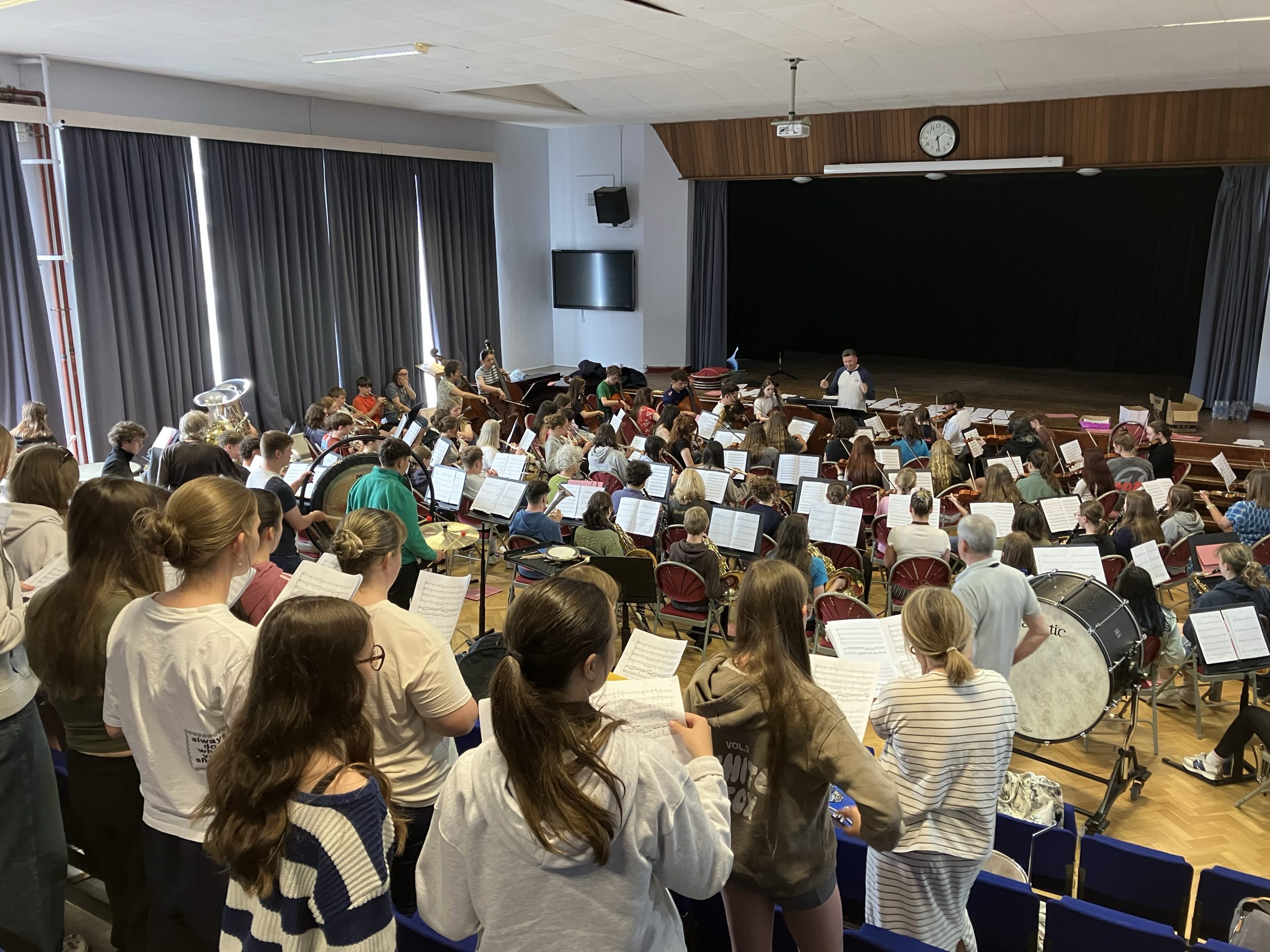
NEW Paul Mealor work, with words by Menna Elfyn, will be performed by 150 young people from Carmarthenshire, Ceredigion and Pembrokeshire
A new composition by internationally acclaimed Welsh composer Paul Mealor will bring this year’s National Eisteddfod to a spectacular close, as 150 young musicians from across west Wales take to the Pafiliwn stage.
Côr a Cherddorfa’r Tair Sir, the Three Counties Choir and Orchestra, will perform Angerdd a gerdd, a new work specially commissioned from Professor Mealor, with words by celebrated poet Menna Elfyn.
The concert will close the Pafiliwn programme on the final Saturday evening of the festival, bringing together young performers from Carmarthenshire, Ceredigion and Pembrokeshire for what organisers say will be one of the highlights of the week.
Côr y Tair Sir was originally formed following the creation of Dyfed in the 1974 local government reorganisation, becoming well known across the region and beyond. It has now been revived especially for this year’s National Eisteddfod, with support from the National Music Service of Wales and sponsorship from the Gwendoline and Margaret Davies Charity, Gregynog.
Rehearsals began in the spring, with pupils meeting regularly to prepare for the performance.
Professor Mealor said he had been delighted by the response from the young musicians.
“One hundred and fifty young people came together to rehearse my new work, to Menna Elfyn’s powerful words, and it sounded wonderful from the very first rehearsal,” he said.
“It’s a challenging piece for young voices, but I’ve been hugely impressed by their commitment, and I’m certain it will be a thrilling experience for the audience on the night.”
Mealor, who was born in St Asaph and raised in Connah’s Quay, has long-standing links with Wales’ musical tradition. He studied composition with Professor William Mathias at the University of York and has credited Mathias as the inspiration behind his musical career, particularly his passion for choral music.
The new work will also showcase the words of Menna Elfyn, one of Wales’ leading poets. Since the publication of her first poetry collection, Mwyara, 50 years ago, she has produced numerous volumes of poetry, children’s books and anthologies, while also writing for stage, radio and television. Her work has received widespread critical acclaim and many awards.
As well as marking the end of the festival week, the concert will celebrate the National Eisteddfod’s rich musical heritage and give a new generation of performers the chance to present a major choral work on one of Wales’ most prestigious stages.

Classical music will feature prominently across the Maes this year, with events taking place at Y Stiwdio and Encore.
Among the highlights is a performance of Atgof o’r Sêr, Memory of the Stars, composed by Robat Arwyn with words written especially for Bryn Terfel. First performed at the 2001 Denbigh National Eisteddfod, this year marks the 25th anniversary of its premiere.
The eight-song cycle will be performed by recent winners of the Osborne Roberts Memorial Prize, including Steffan Lloyd Owen, Meinir Wyn Roberts, John Ieuan Jones, Llinos Haf Jones, Dafydd Jones, Siriol Elin, Joshua Mills and Lisa Dafydd.
Another highlight will be a rare opportunity to hear two songs by composer Meirion Williams, marking the 50th anniversary of his death.
On behalf of the Eisteddfod, musician Sioned Webb and Steffan Prys explored the archive of the late soprano Ceinwen Rowlands, with the assistance of Maredudd ap Huw at the National Library of Wales.
Sioned spent time in London during the 1980s researching and completing an MA dissertation on the life and work of Meirion Williams, but she was unaware of the Ceinwen Rowlands collection at the time.
This year she discovered two previously unperformed pieces in strict Welsh metres, cywyddau by Siôn Cent and Huw Morys, also known as Eos Ceiriog. She edited them for performance with the assistance of Eurig Salisbury.
It will be the first time the two songs have been heard in more than 80 years. Nerys Williams, the composer’s daughter, has been invited to attend the Eisteddfod and present the scores to Tŷ Cerdd.
Betsan Moses, Chief Executive of the National Eisteddfod, said: “There’s a strong programme of classical music across the Maes this year. We’re delighted to welcome so many former competition winners back to perform, celebrating the connection between competing at the Eisteddfod and their career in music.
“We’re also using Rhosygilwen, near the Maes, as the venue for our music prelims during the week, and everyone is welcome to come along and enjoy the performances.
“The Pafiliwn event on the final Saturday evening promises to be one of the highlights of the festival. It is wonderful to give classical music such a prominent place at its heart, while offering talented young local musicians the chance to be part of a unique experience, working alongside one of Wales’ best-known composers and bringing the words of one of our leading poets to life through music.
“It will provide a memorable finale to a week of music and creativity.”
Eisteddfod Genedlaethol y Garreg Las will be held in Llantwd, north Pembrokeshire, from August 1 to 8. Further information and tickets are available at eisteddfod.cymru.

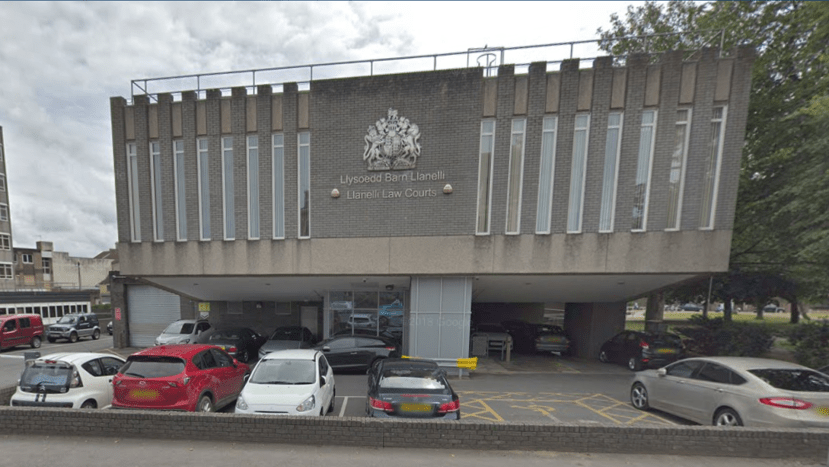
A TENBY woman has been fined after magistrates found she permitted an uninsured driver to use a car in Pembroke Dock.
Christy May Brown, aged 38, of Bush Terrace, Jameston, Tenby, was not present when her case was dealt with at Llanelli Magistrates’ Court on Wednesday (Jul 8).
The court heard that on November 1, 2025, Brown permitted Robert Christopher to use a Vauxhall Astra, registration KW08 KRD, on Ferry Lane, Pembroke Dock, when there was no insurance in force covering third-party risks.
The offence was proved in her absence.
Brown was fined £120 and ordered to pay a £48 victim services surcharge and £120 costs. Her driving record was endorsed with six penalty points.
Magistrates also dealt with a second matter, relating to Brown permitting Christopher to drive the same vehicle otherwise than in accordance with a driving licence. The court heard that he was a provisional licence holder, driving unaccompanied by a qualified passenger, and that no L-plates were displayed on the vehicle.
That offence was also proved in absence, but no separate penalty was imposed.
The court made a collection order and Brown was ordered to pay the £288 balance at £24 per month from August 5.
The case had earlier been reopened under section 142 of the Magistrates’ Courts Act 1980, with a sentence imposed on May 20, 2026 set aside and a previous licence endorsement removed.



Crime10 hours ago
Teacher stabbing trial: The first week of evidence
Jury hears accounts of alleged planned classroom attack, teacher’s fear she was dying, and boy’s words after leaving school A...


Community13 hours ago
Haverfordwest Castle refurbishment reaches new heights as roof goes on
Major milestone reached in project to transform historic gaol building into flagship visitor attraction A MAJOR milestone has been reached...


Business2 days ago
Pembrokeshire lands £98m share of Wales marine energy boom
New industry report says county has received the second highest level of marine energy investment in Wales, supporting more than...
Crime2 days ago
First aider tells jury teacher was “crying, shaking” after classroom stabbing
A SCHOOL first aider has told a jury that teacher Vicki Williams was “crying, shaking” and in “complete shock” after...

Crime2 days ago
Teacher feared she was dying after Milford Haven classroom stabbing
A TEACHER allegedly stabbed in the head at Milford Haven Comprehensive School told a jury she feared she was dying...


News2 days ago
Farage to resign as MP and fight Clacton by-election amid finance row
NIGEL FARAGE has announced he will resign as MP for Clacton and stand again in the by-election he intends to...
Crime3 days ago
Teacher tells jury there were ‘no issues’ with accused pupil hours before ‘stabbing’
Milford Haven teacher gives evidence as trial of 15-year-old continues at Swansea Crown Court A TEACHER allegedly stabbed at Milford...


News3 days ago
Major incident stood down after fire at Impala Terminal in Milford Haven
Fire involved decommissioned oil tank containing residual crude oil and around 60 cylinders A MAJOR incident declared during a fire...

News3 days ago
Large fire breaks out at Impala Terminal in Milford Haven
Black smoke seen for miles as emergency services respond to incident at former Puma Energy site A LARGE fire has...
Crime3 days ago
Prosecution outlines ‘planned attack’ as Milford Haven teacher stabbing trial opens
Jury hears teenager allegedly brought kitchen knife into school before teacher was stabbed in the head THE JURY in the...
-
 Education7 days ago
Education secretary vows to tackle ‘root causes’ of antisocial behaviour in schools
-

 Education6 days ago
Ysgol Glannau Gwaun celebrates prestigious Gold Active Travel award
-
 Community7 days ago
Closure-threatened Stepaside school expected to remain open
-
 Education7 days ago
First Minister pressed on biological sex, additional learning needs, and NHS jobs
-

 Farming3 days ago
Pembrokeshire slaughterhouse given urgent improvement rating after audit failure
-

 Entertainment2 days ago
Swing and big band classics heading to Torch Theatre
-
News3 days ago
Large fire breaks out at Impala Terminal in Milford Haven
-

 News3 days ago
From boccia to boxing: ALN multisport events give youngsters chance to try activities