


Education
Last stand to save Ysgol Clydau as village launches fresh fightback


Campaigners say this is now the crucial stage in the battle to stop the closure of the rural Tegryn school, with every formal objection required to be logged and answered before a final council decision.
THE BATTLE to save Ysgol Clydau has entered its most critical stage, with campaigners urging residents to lodge formal objections before the May 11 deadline in a last-ditch effort to stop the village school from being shut.
In a fresh appeal posted on Sunday, Save Ysgol Clydau – Cadw Clydau yn Gadarn said the school was “at the heart of our community” and warned supporters that earlier consultation responses do not count at this stage.

The campaign said: “A local school is at the heart of our community. It means less time travelling and more time together, friendships that last a lifetime, and a place where every child feels they belong.
“If you haven’t already, please submit your objection to the closure of Ysgol Clydau – previous responses do not count, and every single objection must be recorded and answered.”
That message marks a new phase in the fight over the future of the Tegryn school, after Pembrokeshire County Council formally published its statutory notice to discontinue Ysgol Clydau from Aug 31, 2026.

Under the proposal, the school’s catchment area would transfer to Ysgol Bro Preseli from Sept 1, 2026, if councillors approve the closure.
The issue is already highly charged. Members of Pembrokeshire County Council voted by the narrowest of margins in March to move the closure process forward, with the proposal passing by just one vote.
That slim majority has emboldened campaigners, who believe there is still everything to fight for if enough people object during the formal notice period.
The council says the closure is the most appropriate response because of surplus places, concerns over the condition of the buildings, the long-term sustainability of education in the Preseli area, and value for money.

But for families and supporters in Tegryn, the argument is not simply about budgets or buildings.
They say the loss of Ysgol Clydau would strike at the heart of the community, forcing young children to travel further, weakening local ties, and removing a school that many see as central to village life.
Campaigners are also likely to point to the fact that Ysgol Clydau is a rural school, a category that carries added significance in school reorganisation cases in Wales.

The school’s supporters argue that once a rural school is lost, the wider damage can stretch far beyond the classroom, affecting the Welsh language, village identity, and the long-term future of the community itself.
That argument is strengthened by the school’s recent reputation. Ysgol Clydau has been described by inspectors as a happy, caring and welcoming community, with pupils feeling safe and supported.
For opponents of closure, that raises an obvious question: why shut a school that is valued by its children and families?
The latest Facebook appeal makes clear that campaigners now see the statutory objection process as the decisive battleground.
Supporters are being told to email [email protected] or write to County Hall before May 11, with campaigners stressing that each objection must be formally considered and answered.
The final decision is expected to return to councillors in June, setting up what could be a dramatic showdown over the future of one of Pembrokeshire’s rural schools.
For now, the message from Tegryn is simple: this is the stage that counts, and the fight to save Ysgol Clydau is far from over.



A PUBLIC consultation is to be held on discontinuing two schools in the Tenby area, including Greenhill comprehensive, with the aim of establishing a new 3-19 community school.
In a report before Pembrokeshire County Council’s meeting of July 16, members were asked to back a public consultation into establishing a new 3-19 community school in the Tenby area, discontinuing Tenby Church in Wales VC School and Ysgol Greenhill comprehensive.
Back in December councillors backed authorising the Director of Education to commence statutory consultation on establishing a new 3-19 school, a split site initially, but as part of an investment to rebuild/extend Tenby’s Greenhill site, or on a new site.
It included a consultation with the St David’s Diocese to discontinue Tenby Church in Wales Voluntary Controlled School, and to discontinue Ysgol Greenhill before the report before members in July.
A report for members, presented by the council’s deputy leader, and now Cabinet Member for Education, Cllr Paul Miller said that, since the December meeting, St David’s Diocese responded by conditionally supporting the Tenby VC School element, subject to the newly established 3–19 school retaining a religious character, either as a Voluntary Aided (VA) or Voluntary Controlled (VC) school.
The report added: “In accordance with the decision of council at its meeting on December 12, and the statutory requirements of the School Organisation Code, consultation has been undertaken with the St David’s Diocese.
“In relation to the council’s proposal for Tenby VC School, the comments received from the Diocese do not provide any reason not to proceed with general consultation.”
It added: “As most pupils within the cluster attend community primary schools, it is recommended that consultation be undertaken on the basis of establishing a community primary school.
“It should be noted that, whatever the decision, this would merely reflect the preferred option outlined within the general consultation document.
“Members would still be required to give due consideration to feedback received as a result of the consultation, which may include a preference by consultees for a different governance model.”
Members, by 41 votes to two abstentions, backed the formal consultation, which had been moved by Council Leader Cllr Tessa Hodgson.
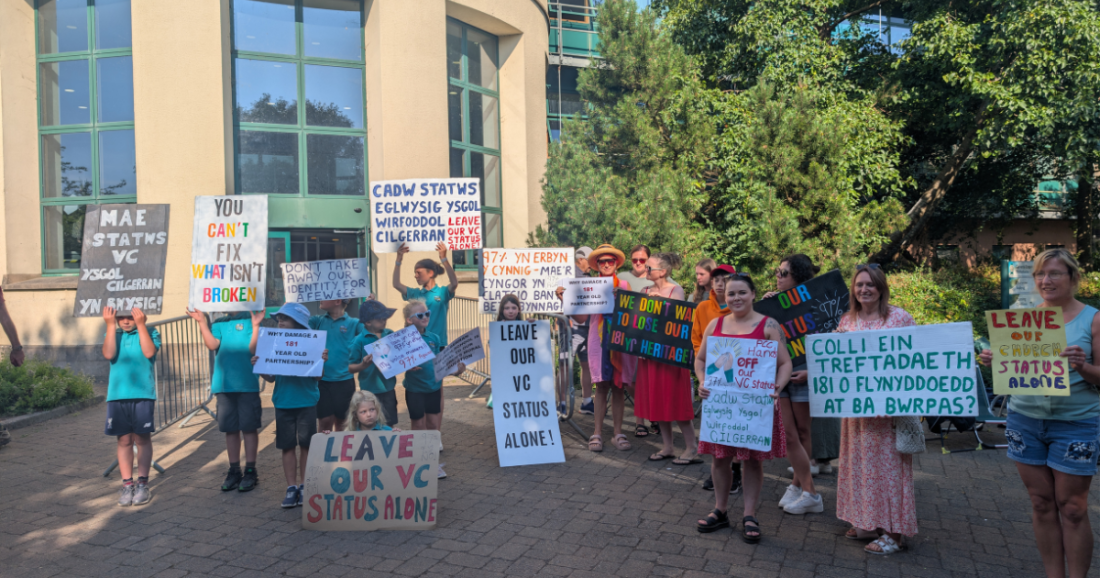
SUPPORTERS of Ysgol Cilgerran’s Church in Wales school have protested at a Pembrokeshire County Council meeting against council plans to remove church status from the school.
Back in May, Pembrokeshire County Council voted to remove Voluntary Controlled (VC) status from the Welsh-medium rural school despite 97 per cent of the responses to a consultation having opposed a change which the church describes as ‘entirely unnecessary’.
The Church in Wales has objected formally to the proposal and has warned it will take legal action on the grounds of “public misrepresentation and unqualified legal assertions made by Pembrokeshire County Council officers,” and “discrimination against faith schooling”.
During Pembrokeshire County Council’s full council meeting of July 16, parents, teachers, and students travelled to County Hall, Haverfordwest to protest.
Their colourful protest signs, made by students, carried messages such as “You can’t fix what isn’t broken”, “Leave our VC status alone”, and “Don’t take away our identity for a few £££”.
One of the protesters, an ex-pupil and governor, Sarah Moore, has said: “I’m here today because I’m horrified that the council are talking about taking the church status away from our school. The church gave that land for the school over 180 years ago.
“97 per cent have voted against this and yet they’re still trying to do it. If we want our children to stay in a church school, the nearest one is Letterston. So where will these children have that good education that they are getting now?”
Kelly Davies, parent and governor, said: “We feel really strongly as parents, the pupils and the community that we’re not happy about them taking VC status away.
“We have really strong links with the church and the school and the community. It just seems that they’re taking this away from us permanently for no reason.”
The Church has said it has deep concern about what it sees as a pattern of the council’s recent actions regarding Church Schools.
In June, councillors voted to close Manorbier Church in Wales Voluntary Controlled School, which was damaged by a fire in 2022.
The Church says it is taking formal action in this case.

It has also expressed concerns about VC status being lost for Tenby Church in Wales VC school after councillors backed a consultation on penitential education changes in the Tenby area.
A spokesperson for the Church in Wales said: “The entirely unnecessary threat to the status of this much-loved community school has had an impact on children, families, and the wider community. We are not prepared to allow another thriving rural school to lose its treasured character.
“Ysgol Cilgerran has our full support, and we hope that Pembrokeshire County Council listens to the voices of the community it serves, and chooses not to remove VC status.”
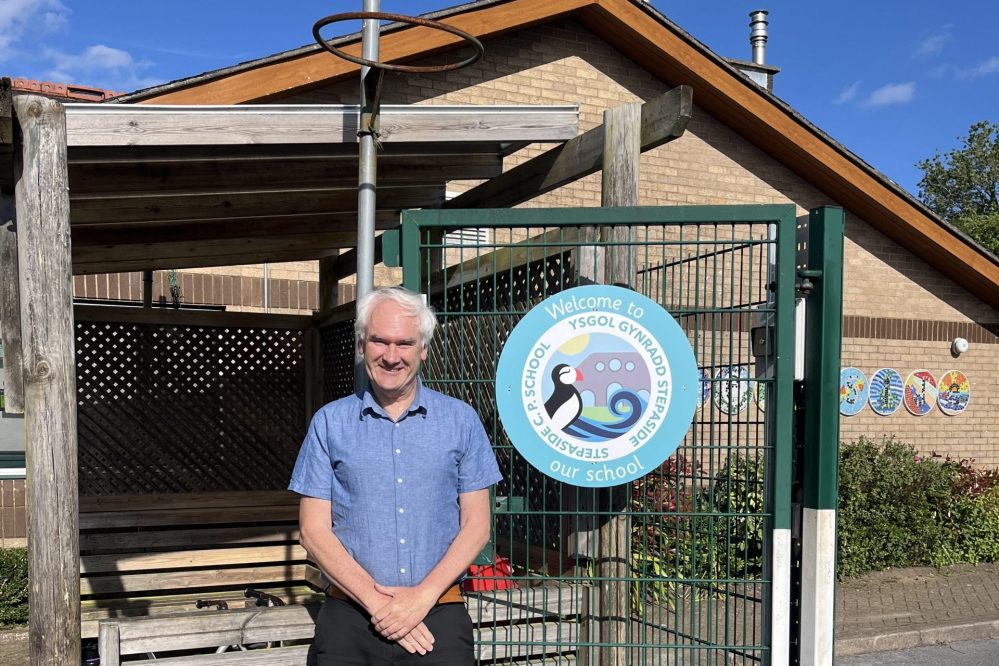
A CLOSURE-THREATENED Pembrokeshire school, which has now been saved, should “never have been considered for closure,” a local councillor who battled to keep it open has said.
Kilgetty’s Stepaside CP School was being earmarked for closure by Pembrokeshire County Council, as part of proposals to establish a new 3-11 primary school on the Saundersfoot School site, discontinuing both Saundersfoot school and Stepaside school.
The Stepaside proposal was based on surplus places for all the schools in the proposals, with Stepaside having a surplus capacity of over 50 per cent, councillors had previously heard; figures that have since been much debated.
In March, a vote at a full meeting of Pembrokeshire County Council reaffirmed a decision of last December, that the Director for Education be authorised to commence statutory consultation to discontinue Stepaside and Saundersfoot and establish the new three-11 primary school.
Since then, Pembrokeshire’s deputy leader Cllr Paul Miller, who has recently taken on Cabinet member responsibility for education, made a call for the school to instead remain open, rescinding the previous decision to discontinue Saundersfoot and Stepaside schools, which was unanimously backed at the July 16 meeting of Pembrokeshire County Council.
Local county councillors Alistair Cameron and Alec Cormack, who had both battled for the school to remain open, said they are delighted at the decision to rescind the previous backing of a public consultation on closing Stepaside School and merging it with Saundersfoot School on the existing Saundersfoot School Site.
Cllr Alistair Cameron said: “Stepaside School should never have been considered for closure. The number of pupils at the school have been stable since 2022 at between at between 110 and 115. We are looking at another good intake of pupils in September which shows just how popular this school is.
“This has been confirmed by the school inspectors, Estyn, who described it as a ‘Happy place where pupils feel safe and eager to learn’ and ‘a welcoming, calm and purposeful learning environment,’ where ‘pupils make good progress with their learning’.
“Thank you to Mr Jones, headteacher at Stepaside School, and all of his colleagues for their continued dedication and hard work for the children in their care.
“Thank you also to the Chair of Governors, Laura Burnett and all of the governors for their leadership as well as the parents and wider Kilgetty community for their support. The school staff can now concentrate on what they do best, which is to provide excellent education in a caring and nurturing environment.”
Cllr Alec Cormack welcomed the Cabinet decision saying adding “I am very pleased that the decision taken in council was unanimous.”
Speaking after the decision, Laura Burnett said: “The Governing Body of Stepaside Community Primary School are delighted to share the exciting news that the school will remain open for many years to come.

“This is a tremendous achievement for the community that is served by the school in Kilgetty.”



Community47 minutes ago
Household Cavalry drum horse returns home to Pembrokeshire for final farewell
Dyfed Willa Rose, who became Major Juno and the first mare to serve as a Household Cavalry Drum Horse, was...


News18 hours ago
Jo Stevens out as Welsh Secretary as Burnham reshapes government
Cardiff East MP repeatedly visited Pembrokeshire to champion clean energy jobs, but her successor inherits unresolved questions over Milford Haven’s...


Crime24 hours ago
Teen cleared of attempted murder but guilty of GBH after Milford teacher stabbed
Jury returns 11-1 majority verdict on charge of causing grievous bodily harm with intent, with sentencing set for September 3...


Community1 day ago
French troops march through Fishguard as Britain’s last invasion returns to life
Battle scenes, cavalry displays and a surrender procession brought one of Pembrokeshire’s most extraordinary stories back to the streets MUSKET...


News1 day ago
Andy Burnham promises new politics as he enters Downing Street
New Prime Minister admits politicians have “not been good enough” as he sets out a ten-year plan for Britain and...


Health2 days ago
Two new surgeons appointed as Hywel Dda admits orthopaedic waits remain too long
Health board says it is increasing capacity after figures revealed hip replacement patients waited an average of 64 weeks HYWEL...


Community3 days ago
84-year-old man rescued after falling overboard near Tenby
A MAYDAY call sparked a major nighttime rescue after an 84-year-old man fell from a tender and was swept towards...


Crime4 days ago
Jury hears final arguments in Milford Haven teacher stabbing trial
Defence says there was no motive or intention to kill as judge reviews competing accounts of classroom knife incident SPECIAL...


News4 days ago
Andy Burnham becomes Labour leader and prepares to enter No 10
Former Greater Manchester mayor promises an ‘unashamedly Labour’ government after completing extraordinary return to Westminster ANDY BURNHAM has been formally...


News4 days ago
Motorcyclist dies following collision near Narberth
Police appeal for witnesses and footage after fatal crash on B4313 at Redstone A MOTORCYCLIST has died following a collision...
-

 Health1 day ago
Welsh Ambulance Service invites public to AGM and Board meeting
-
News2 days ago
Andy Burnham set for No 10 as Wales awaits change
-
Crime24 hours ago
Teen cleared of attempted murder but guilty of GBH after Milford teacher stabbed
-

 Crime23 hours ago
What the Milford Haven School stabbing verdict really means
-

 Business1 day ago
Port appoints two new directors as energy and regeneration projects advance
-

 Community2 days ago
Tributes paid to long-serving Mansel Davies driver Gareth Griffiths
-
Community47 minutes ago
Household Cavalry drum horse returns home to Pembrokeshire for final farewell
-

 Entertainment2 days ago
Dinosaur adventure set to roar into the Torch Theatre