


News
Rules on political impartiality ‘need rethinking’, Cardiff University report finds


BROADCASTERS’ impartiality rules may be limiting proper scrutiny of political claims during election campaigns, according to a new Cardiff University report.
Academics from the university’s School of Journalism, Media and Culture spent 10 weeks analysing coverage of May’s elections in Wales, Scotland and England.
The study focused in particular on the Senedd election, which was the first held under Wales’ new voting system and following the expansion of the Senedd from 60 to 96 members.
Researchers found that scrutiny of policy and campaigning was limited in day-to-day coverage of the Welsh election.
Analysis of relevant television news items showed that 49% contained no scrutiny, 29% contained substantial scrutiny, and 22% included only brief scrutiny.

This means more than 70% of political claims on TV news received no scrutiny or only limited questioning.
The report found that scrutiny was stronger when coverage focused on one party at a time, or during one-to-one interviews. It was weaker in reports that attempted to include all six major parties in a single item.
Professor Stephen Cushion, who leads the project, said the findings raised serious questions about how the UK’s due impartiality rules are being applied during election campaigns.
He said: “Our new study suggests the UK’s current rules on broadcast impartiality limited the scrutiny of political parties across the English, Scottish and Welsh elections.

“In day-to-day reporting, the major broadcasters had to reflect a wide range of parties across three different contests – but the breadth of perspectives limited the depth of analysis, including the interrogation of specific policies and party political claims.
“This does not mean impartiality should be abandoned in a Fox News style way, but the rules need to be rethought to give broadcasters the flexibility to provide greater scrutiny in day-to-day news reporting.”
The report says broadcasters faced a significant challenge during the Senedd campaign, as they had to explain a new electoral system, the expansion of the institution, and how voters’ choices would translate into representation.

The Senedd election was also held at the same time as the Scottish election and English local elections, meaning Wales had to compete for attention in UK-wide bulletins.
Professor Cushion added: “Overall, the findings show that broadcasters played an important role in making the Senedd election visible and accessible to audiences.
“However, the analysis also identifies clear challenges. Future coverage needs to ensure that efforts to represent a broad range of parties, report public opinion and adapt election coverage for digital audiences are matched by clear explanation, consistent scrutiny and substantive engagement with policy debates in day-to-day reporting.”
The report, Reporting the 2026 UK Elections, with Wales in Focus: TV, Online and Social Media Coverage of the Senedd, has now been published by Cardiff University.


Coastguard teams and two RNLI lifeboats were called after the group was pushed south while attempting to pass through Jack Sound
THREE kayakers were rescued after getting into difficulty while returning from Skomer Island through Jack Sound.
Watchkeepers at NCI Wooltack Point had been monitoring the group as they attempted to make the crossing, but the kayakers were pushed south and eventually disappeared from view from the station.
One watchkeeper continued searching from the lookout while another went outside to try to locate them. The kayakers were eventually spotted from the cliff-top path in a nearby bay, where it was confirmed that they required assistance.
HM Coastguard was alerted and both Angle RNLI lifeboat and Little and Broad Haven RNLI lifeboat were tasked to the incident.
The rescue was successfully completed, with NCI Wooltack Point praising the teamwork between Pembrokeshire’s search and rescue agencies.
The kayakers later made a donation to the station in recognition of the assistance they had received.
Photo: NCI Wooltack Point watchkeeper Charles

Motorists are being advised to allow extra time as essential gas network upgrades begin on Bush Road
TEMPORARY traffic lights will be introduced in Pembroke while engineers carry out work to upgrade underground gas pipes.
Wales & West Utilities will begin work in the Bush Hill area on Monday, July 20, with the scheme expected to continue until Friday, August 21.
Temporary traffic lights will operate on Bush Road between the junctions with Buttermilk Lane and Whitehall Avenue. The lights will be manually controlled to help keep traffic moving and reduce congestion.
The utility company said the work had been agreed with Pembrokeshire County Council and scheduled during the school holidays to minimise disruption.
Motorists are being advised to allow additional time for their journeys while the restrictions are in place.
Adam Smith, who is managing the project for Wales & West Utilities, said: “We have planned this section of work to coincide with the school holidays to minimise disruption to motorists and the local community.
“We understand our work can cause disruption, but it is essential to maintain a resilient gas network that households and businesses can rely on every day.
“While much of the gas network is out of sight, it plays a vital role in daily life, from heating homes to cooking meals, and we know how important it is that gas is there when people need it.”
Wales & West Utilities transports gas to more than 7.5 million people across Wales and the south west of England through a network of more than 35,000 kilometres of underground pipes.
Anyone who smells gas or suspects carbon monoxide should call the National Gas Emergency Service immediately on 0800 111 999.
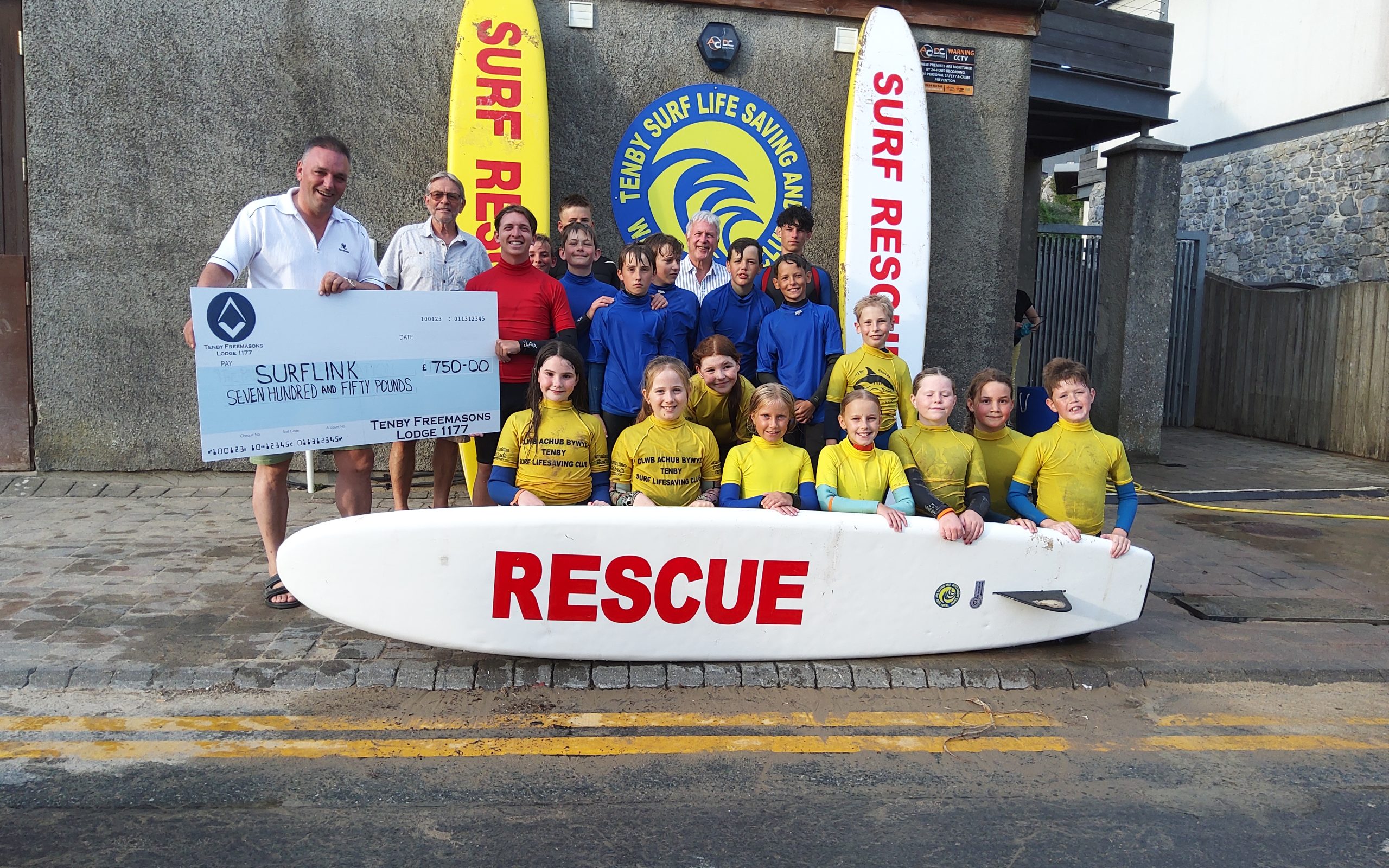
Funding will help volunteers purchase distinctive uniforms for patrols at Tenby South Beach
TENBY Freemasons have donated £750 to Tenby Surf Lifesaving Club to support its volunteer beach patrols and lifesaving work.
Members of Tenby Lodge presented the donation to the club, also known as Surflink, following a training session last week.
The club is introducing volunteer lifesaving patrols at Tenby South Beach on busy days when lifeguards are not on duty, helping to complement the work of the RNLI.
Volunteers require distinctive patrol uniforms so they can be easily recognised by members of the public on the beach.
Senior lodge member Tony Upham put forward a proposal to Tenby Lodge’s committee, which quickly agreed to provide the money needed to purchase the uniforms.
Surf club leader Tai Jackson said: “Lifeguard services have reduced in recent times, so we were keen to offer our skills.
“We are grateful once again for the assistance from the Freemasons in purchasing the essential kit required.”
Tenby Lodge charity steward Steve Thurgood said: “We are committed to supporting local good causes, so we are delighted to make these funds available to Surflink.
“The club provides an excellent voluntary service to the community, particularly to young people.”
Tenby Surf Lifesaving Club has taught the multi-disciplined sport of lifesaving since 1993, educating participants aged eight and above in surf safety, open-water skills and swimming confidence.
Weekly summer training sessions are held at the club’s facility at South Beach Car Park in Tenby. During the winter, the club runs weekly pool sessions at Tenby Leisure Centre, helping members develop the core swimming skills needed for beach training.
Through its links with the RNLI, the club also provides training and assessments for those hoping to become beach lifeguards, first aiders or sports coaches.

Its volunteers provide lifesaving cover for a number of major local events, including Ironman Wales, Long Course Weekend, the Saundersfoot New Year’s Day Swim and Tenby North Beach Boxing Day Swim.
The club’s stated aim is to save lives and prevent drowning through surf lifesaving education and training within the local community.
Anyone interested in joining Tenby Surf Lifesaving Club can email [email protected].
Pictured: Tenby Lodge Master Damian Brown presents the £750 donation to Tai Jackson. Also pictured at the rear are Steve Thurgood, left, and Tony Upham, right, with young members of Tenby Surf Lifesaving Club.



Crime7 hours ago
Jury hears final arguments in Milford Haven teacher stabbing trial
Defence says there was no motive or intention to kill as judge reviews competing accounts of classroom knife incident SPECIAL...


News10 hours ago
Andy Burnham becomes Labour leader and prepares to enter No 10
Former Greater Manchester mayor promises an ‘unashamedly Labour’ government after completing extraordinary return to Westminster ANDY BURNHAM has been formally...


News12 hours ago
Motorcyclist dies following collision near Narberth
Police appeal for witnesses and footage after fatal crash on B4313 at Redstone A MOTORCYCLIST has died following a collision...


Local Government1 day ago
Stepaside school saved as council abandons closure proposal
Governors welcome decision but maintain original plans were based on outdated information STEPASIDE Community Primary School will remain open after...

Crime1 day ago
Footballer given 200 hours’ unpaid work for eye-gouging assault during match
Magistrates heard Robert Hedley put an opposing player in a headlock before gouging at his eyes during a match in...


Community1 day ago
Tenby Summer Spectaculars brought to an end after harbour licence revoked
Round Table says it was willing to make major safety changes but could not secure the access controls needed to...

Local Government3 days ago
Catapult attacks suspected after wildlife deaths at Pembroke Mill Pond
Wildlife Crime Officers are investigating after the town council said around five animals showed signs of deliberate injury WILDLIFE found...


Crime3 days ago
Narberth retailer speaks of shoplifting toll after ‘collectable bear’ stolen
Independent shop owner said rising costs meant businesses could not afford to absorb losses caused by theft A NARBERTH retailer...


Crime3 days ago
Teen accused of attempting to murder teacher says she lied about stabbing
Defendant accepts teacher was terrified and that a knife wound to the head could kill, but denies deliberately attacking her...


Local Government5 days ago
Calls grow for independent investigation into Manorbier school closure
Councillor alleges misleading figures, inadequate insurance and poor treatment of staff CALLS for an independent investigation into the controversial closure...
-
Crime10 hours ago
Milford Haven teacher ‘fought for her life’ during alleged knife attack
-
Crime7 hours ago
Jury hears final arguments in Milford Haven teacher stabbing trial
-
Community1 day ago
Tenby Summer Spectaculars brought to an end after harbour licence revoked
-
Local Government1 day ago
Stepaside school saved as council abandons closure proposal
-
News10 hours ago
Andy Burnham becomes Labour leader and prepares to enter No 10
-
 Community1 day ago
Llangwm LitFest returns with tales of slow travel and inclusive writing
-

 Crime1 day ago
Police searching for driver who abandoned car after Haverfordwest pursuit
-

 News1 day ago
Welsh broadcasting authority plan sparks row over powers and cost