


Politics
First Minister to recommend counsel general to the King for appointment


THE COUNSEL general designate will be recommended to King Charles III by the First Minister following a Senedd agreement.
It comes following Rhun ap Iorwerth’s First Minister’s Questions debut on Tuesday, June 2.
Although the counsel general is appointed by the King on the recommendation of the First Minister, Senedd approval is required for the recommendation to be made.
Under the Government of Wales Act 2006, the First Minister may not recommend the appointment, or the removal, of the counsel general without the agreement of the Senedd.
The counsel general is the Welsh Government’s law officer, as well as the government’s chief legal advisor and representative in the courts.

The counsel general is not a minister, but is a member of the Welsh Government and can attend cabinet meetings at the invitation of the First Minister.
Notably, the role does not have to be held by a sitting Senedd Member.
As of 2026, the role of counsel general has twice been held by individuals who were not also sitting MSs – Theodore Huckle QC from 2011 to 2016, and Elisabeth Jones from August to September 2024.
Responsibilities of the role include the provision of legal advice to the government, oversight of prosecutions on behalf of the Welsh Government, and oversight of the Legal Services Department and Office of the Legislative Counsel.

The counsel general is also expected to take questions from MSs in the Siambr during plenary once every four weeks.
Former Plaid Cymru MP Elfyn Llwyd has been proposed as counsel general.
Addressing the Siambr on Tuesday, Mr ap Iorwerth said: “A barrister and an experienced parliamentarian, I know that Elfyn will step into the role with the same dignity, the same passion and the same pragmatic attitude that defined his career in Westminster and that drew respect from all parts of the House of Commons.

“He worked on a cross-party basis to create an offence of stalking. He campaigned for veterans and for a justice system for Wales.

“Elfyn foresaw this moment in an interview with Dewi Llwyd six years ago, sharing that one ambition remained, namely to become counsel general in the Senedd. He didn’t tell that to me, but he did say that, at that time, and I quote, ‘he would like to contribute as much as he could to developing the new Wales through that medium.’
“I have no doubt that that contribution will be a very valuable one, a thoughtful one and a principled one. I ask members to support this nomination today.”
Mr Llwyd was then called upon by Llywydd Huw Irranca-Davies to make a short contribution.
Speaking in the Siambr, Mr Llwyd pledged to “maintain the standards expected of me by the ministerial code, and to undertake my duties as required, looking at integrity independence, and respect for the rule of law”.
He continued: “I commit to provide clear, robust and unbiased advice to the Welsh Government, and to work to strengthen the quality and credibility of Welsh law as I take the next significant step in our devolved history.
“I therefore commit to work constructively with the government, and with you, the Senedd, recognising the crucial role that the Senedd has in scrutinising government, and ensuring transparency in the way legal decisions are made.”
He added: “I also pledge to carry out my duties fairly, working hard, with a clear focus on insisting on the best for Wales always, and, with the new energy steering the vision of this government, for the benefit of the people of Wales.”
The motion was agreed without amendment, meaning the First Minister may now recommend Mr Llwyd’s appointment


A CALL to apply discretionary powers to help properties that have moved from business rates to potentially facing second homes council tax charges in the tens of thousands is to be considered by senior Pembrokeshire councillors.
At the July 16 meeting of Pembrokeshire County Council, members considered a notice of motion by Cilgerran councillor John T Davies calling for the council to apply discretionary powers not to retrospectively charge the second homes council tax premium on residential properties that have moved from business rates to residential council tax.
His motion added: “This discretion is applied on municipal years, when the VOA have failed to inform Revenue Services of the change of status within the relevant municipal year.
“Over the last year I have received a number of representations from worried and concerned council tax-payers, who have moved from business rates status to full residential council tax category.
“In these instances, within my electoral area, both the council tax liability and second homes premium have been backdated up to three years by Revenue Services resulting in extortionate sums from £25,000 to £36,000 been charged against families and individuals.
“On all these occasions all have furnished their returns to the Valuation Office Agency (VOA) within the required time frame. The VOA subsequently sit on that information up to three years and eventually inform the council’s Revenue Services to revert the status of the property to full residential council tax category.
“This leads to automatically triggering the back dating of both the council tax liability and the second homes premium, which subsequently leads to extortionate sums being demanded of no fault of the council taxpayer.
“This current practice has led to individuals experiencing undue stress and mental health issues, leading to family breakdowns and in some extreme cases, concerns for the personal safety of individuals.
“By adopting this notice of motion, the council will be applying its powers to only backdate the standard council tax liability and waiver the second homes premium for the relevant period, reducing the personal anxiety and stress on individuals and families and demonstrating compassion over compliance.”
Members agreed the matter be referred to a future meeting of the council’s Cabinet for decision.

A CLOSURE-THREATENED Pembrokeshire school, which has now been saved, should “never have been considered for closure,” a local councillor who battled to keep it open has said.
Kilgetty’s Stepaside CP School was being earmarked for closure by Pembrokeshire County Council, as part of proposals to establish a new 3-11 primary school on the Saundersfoot School site, discontinuing both Saundersfoot school and Stepaside school.
The Stepaside proposal was based on surplus places for all the schools in the proposals, with Stepaside having a surplus capacity of over 50 per cent, councillors had previously heard; figures that have since been much debated.
In March, a vote at a full meeting of Pembrokeshire County Council reaffirmed a decision of last December, that the Director for Education be authorised to commence statutory consultation to discontinue Stepaside and Saundersfoot and establish the new three-11 primary school.
Since then, Pembrokeshire’s deputy leader Cllr Paul Miller, who has recently taken on Cabinet member responsibility for education, made a call for the school to instead remain open, rescinding the previous decision to discontinue Saundersfoot and Stepaside schools, which was unanimously backed at the July 16 meeting of Pembrokeshire County Council.
Local county councillors Alistair Cameron and Alec Cormack, who had both battled for the school to remain open, said they are delighted at the decision to rescind the previous backing of a public consultation on closing Stepaside School and merging it with Saundersfoot School on the existing Saundersfoot School Site.
Cllr Alistair Cameron said: “Stepaside School should never have been considered for closure. The number of pupils at the school have been stable since 2022 at between at between 110 and 115. We are looking at another good intake of pupils in September which shows just how popular this school is.
“This has been confirmed by the school inspectors, Estyn, who described it as a ‘Happy place where pupils feel safe and eager to learn’ and ‘a welcoming, calm and purposeful learning environment,’ where ‘pupils make good progress with their learning’.
“Thank you to Mr Jones, headteacher at Stepaside School, and all of his colleagues for their continued dedication and hard work for the children in their care.
“Thank you also to the Chair of Governors, Laura Burnett and all of the governors for their leadership as well as the parents and wider Kilgetty community for their support. The school staff can now concentrate on what they do best, which is to provide excellent education in a caring and nurturing environment.”
Cllr Alec Cormack welcomed the Cabinet decision saying adding “I am very pleased that the decision taken in council was unanimous.”
Speaking after the decision, Laura Burnett said: “The Governing Body of Stepaside Community Primary School are delighted to share the exciting news that the school will remain open for many years to come.

“This is a tremendous achievement for the community that is served by the school in Kilgetty.”

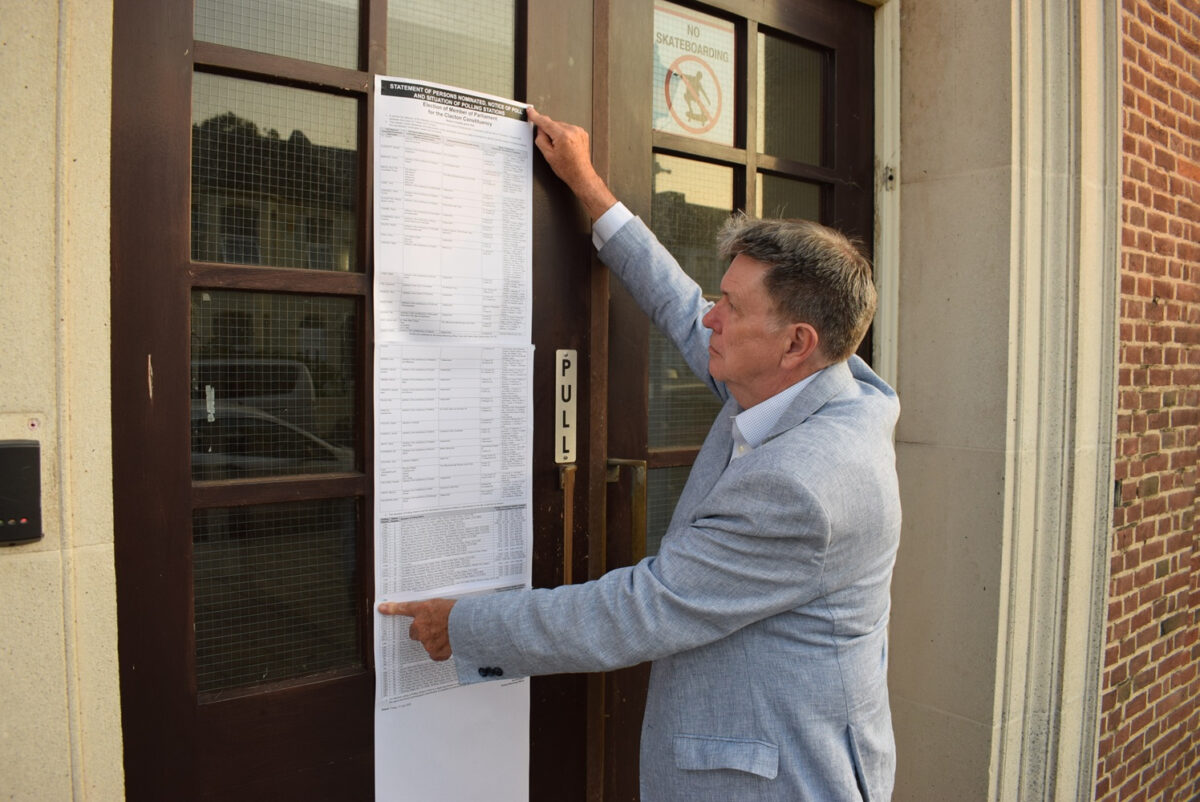
Nigel Farage will face an extraordinary field of 33 opponents when voters in Clacton return to the polls next month
A RECORD 34 candidates have been confirmed for the Clacton parliamentary by-election, which will take place on Thursday, August 13.
The contest was triggered after Mr Farage resigned as the constituency’s MP before announcing that he would stand again for Reform UK.
He said the election would allow local voters to judge his conduct following intense scrutiny of his financial backing and two inquiries by Parliament’s standards commissioner.
Mr Farage has denied wrongdoing and maintains that gifts and other support he received were personal and did not need to be registered under parliamentary rules. He has described the by-election as a contest between the public and the political establishment.
Labour, the Conservatives, the Liberal Democrats and the Green Party are among the larger parties that have declined to field candidates.
Their absence has left political satirist Count Binface and Reclaim Party leader Laurence Fox among the best-known names challenging Mr Farage.
The ballot paper will also feature three candidates from the Official Monster Raving Loony Party, several representatives of smaller political parties and a large number of independents.
Tendring District Council confirmed the final list after nominations closed on Friday.
The council said the field of 34 is believed to be the largest ever assembled for a UK parliamentary election.
The previous record is understood to have been 26 candidates at the Haltemprice and Howden by-election in July 2008. That election was called after Conservative MP David Davis resigned and stood again to campaign over civil liberties.
Full list of Clacton candidates
The candidates standing on August 13 are:
- Joseph 77, Independent
- Adham Alkhatip, The Forward Party
- Count Binface, Count Binface Party
- Nick The Incredible Flying Brick, Official Monster Raving Loony Party
- Tony Cane, Independent
- Woke Trump Carrzee, Independent
- William Stuart James Clouston, Social Democratic Party
- Rees Cowne, Independent
- Glenn Charles Cummings, Independent
- Martin Davies, Freedom Alliance – Real People, Real Alternative!
- Andy Erlam, Independent
- Nigel Farage, Reform UK
- Attieh Fard, Independent
- Laurence Fox, The Reclaim Party
- Tony Francis, Independent
- Robin Green, Independent
- Abi Hookway, Independent
- Howling Laud Hope, Official Monster Raving Loony Party
- Stephen Richard Ingram, Independent
- Amy Morris, Independent
- Derrick Norbert Morris, Independent
- Michael Noel O’Keeffe, Independent
- Martyn OBrien, Independent
- Nick Pelas, Independent
- Ketankumar Pipaliya, UK VOICE safer and stronger UK
- Daniel Pocock, Independent
- James Ransley, Consensus Party Candidate
- Gerry Smith, Independent
- Kai Stephens, British Democrats
- John Stevens, Rejoin EU
- Baron Von Thunderclap, Official Monster Raving Loony Party
- Pamela Walford, Independent
- Marcus White, Everyone is God Party
- Marc Wilkinson, Independent
Almost 80,000 people are eligible to vote across the constituency’s 51 polling stations.
Residents who are not already registered must apply by July 28. The deadline for postal vote applications is 5pm on July 29, while applications for proxy votes and free Voter Authority Certificates must be submitted by 5pm on August 5.
Mr Farage first won Clacton for Reform UK at the 2024 general election, receiving 21,225 votes and securing a majority of 8,405 over the Conservatives.
The seat has officially been vacant since July 8 following his resignation.



Crime15 hours ago
Jury hears final arguments in Milford Haven teacher stabbing trial
Defence says there was no motive or intention to kill as judge reviews competing accounts of classroom knife incident SPECIAL...


News19 hours ago
Andy Burnham becomes Labour leader and prepares to enter No 10
Former Greater Manchester mayor promises an ‘unashamedly Labour’ government after completing extraordinary return to Westminster ANDY BURNHAM has been formally...


News20 hours ago
Motorcyclist dies following collision near Narberth
Police appeal for witnesses and footage after fatal crash on B4313 at Redstone A MOTORCYCLIST has died following a collision...


Local Government2 days ago
Stepaside school saved as council abandons closure proposal
Governors welcome decision but maintain original plans were based on outdated information STEPASIDE Community Primary School will remain open after...

Crime2 days ago
Footballer given 200 hours’ unpaid work for eye-gouging assault during match
Magistrates heard Robert Hedley put an opposing player in a headlock before gouging at his eyes during a match in...


Community2 days ago
Tenby Summer Spectaculars brought to an end after harbour licence revoked
Round Table says it was willing to make major safety changes but could not secure the access controls needed to...
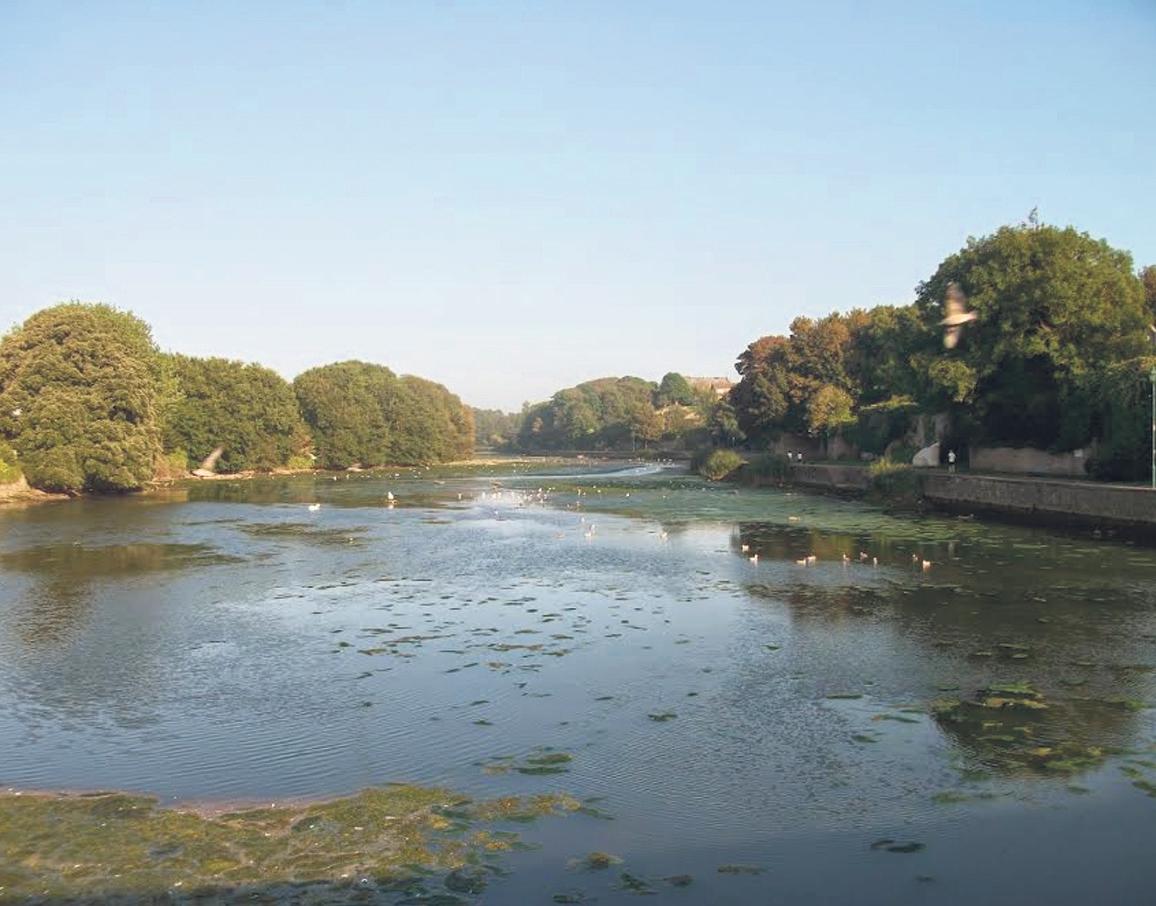
Local Government4 days ago
Catapult attacks suspected after wildlife deaths at Pembroke Mill Pond
Wildlife Crime Officers are investigating after the town council said around five animals showed signs of deliberate injury WILDLIFE found...


Crime4 days ago
Narberth retailer speaks of shoplifting toll after ‘collectable bear’ stolen
Independent shop owner said rising costs meant businesses could not afford to absorb losses caused by theft A NARBERTH retailer...


Crime4 days ago
Teen accused of attempting to murder teacher says she lied about stabbing
Defendant accepts teacher was terrified and that a knife wound to the head could kill, but denies deliberately attacking her...


Local Government5 days ago
Calls grow for independent investigation into Manorbier school closure
Councillor alleges misleading figures, inadequate insurance and poor treatment of staff CALLS for an independent investigation into the controversial closure...
-
Crime18 hours ago
Milford Haven teacher ‘fought for her life’ during alleged knife attack
-

 News2 days ago
Welsh broadcasting authority plan sparks row over powers and cost
-
Community2 days ago
Tenby Summer Spectaculars brought to an end after harbour licence revoked
-
Crime15 hours ago
Jury hears final arguments in Milford Haven teacher stabbing trial
-
Local Government2 days ago
Stepaside school saved as council abandons closure proposal
-

 Crime2 days ago
Police searching for driver who abandoned car after Haverfordwest pursuit
-

 Crime2 days ago
Fisherman admits safety offence after death of crewman off Pembs coast
-
 Community2 days ago
Llangwm LitFest returns with tales of slow travel and inclusive writing