


Community
Cyclist in 24 hour fundraising marathon

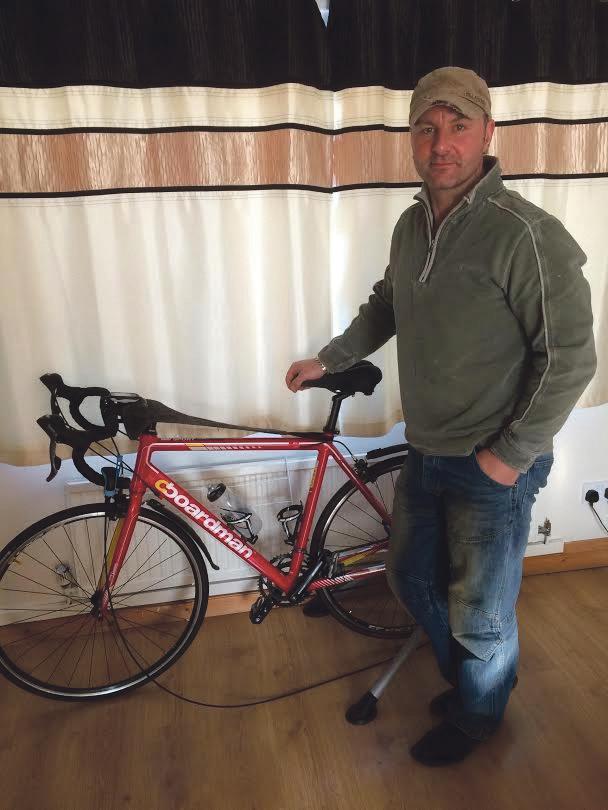
A LOCAL cyclist is to stage a 24 hour marathon static-bike ride on March 27 at Tesco in Haverfordwest to raise vital funds for Pembrokeshire’s Mind charity.

Local fundraiser: Lee Anson hopes to raises thousands for Mind.
Lee Anson suffered a family tragedy 3 years ago when his brother Mike Anson sadly took his own life as a result of severe depression. Lee spoke exclusively this week with The Herald and explained the reasoning behind what will be a gruelling 24 hours.
“In my mind after Mikey passed I wanted to do something to raise awareness for something that has a lot of stigma. Not enough people talk about mental health. We all suffer it at some point in our life but some of us don’t realise we are suffering with it. I myself have suffered and continue to – not to the extremes of my brother – fortunately, some of us come out of those dark places. There is always someone you can talk to. Michael was such a loud personality and really well liked – he hid his mental health problems so well – even on the day he passed he seemed normal, you wouldn’t have known. It’s very difficult to diagnose. I had been chatting with Mind since before Christmas. They are a Samaritan-style support network for people with mental health problems; you call them and they try and help you.”
The Herald wanted to know what sort of equipment was needed for such a feat and also what had inspired Lee to pick cycling for his fundraiser. He continued: “I’ve cycled for a lot of years and used to compete. I thought why not do something I enjoy and make it as difficult as I can for myself. I was going to do 12 hours but felt that wouldn’t be too much of a struggle. I have a normal road bike set up on a turbo trainer that applies magnetic resistance to the back wheel. I’m going to attempt to do 400 miles at about 85- 100 revs per minute, and an average speed of 15-17mph. I am sponsored by ‘Mike’s Bikes’ in Haverfordwest who will provide everything I need for the day; kit, wheels, sports drinks, etc.”
He went on to explain what preparations he has made, and the diet required for the ride. “I have taken a lot of advice – from Iron Man competitors. The key is avoiding salt loss and dehydration and keeping up calorie intake. I’ll burn between 600 to 800 calories an hour – so I need easily digestible food. I don’t think I’ll run out of food in Tescos! I still have to do some research on how much fluid I need, but as a rule about 750 ml per hour. Sweat is the biggest enemy and for the ‘sensitive areas’ there is a cream. I will change when my clothes are saturated, and pause for toilet breaks too. It’s about carb loading prior to the event so that I have a reserve tank. I’ll probably need about 150-200 calories per half hour.”

He then explained that he would need endurance to get through the full 24 hours and had support that would be invaluable for the event. Lee informed us that he would have another bike next to him where people can join him and offer support, but also could come along if they just wanted someone to have a chat with. On how much money he wanted to raise he finished by stating: “I chose that weekend as it’s the weekend before Easter; if you can spend a fiver on an egg I’m sure a pound would be OK so hopefully we will raise a lot and get some support – I’d love to say thousands – but it will be what it is and hopefully people will be generous.”
The Herald will be following the event and would encourage support and donations which can be made by going to the website www.justgiving. com or simply by turning up on the day and donating then, as well as offering some support for Lee. The award for innovative fundraising – for organisations that have run campaigns or events demonstrating creativity and innovation in fundraising.
WINNER
Merthyr Tydfil Housing Association Youth Group was set up to help Merthyr Housing reach its goal of raising the aspirations and life experiences of its young people through education and fundraising.

RUNNERS-UP
Inner Wheel District 15 is part of the largest women’s organisation in the world. The District has 31 clubs across West and South Wales, and in 2013 – 2014 raised more than £30,000 for charities.
Xcel Project– Towy Community Church in Johnstown, Carmarthen – the only charity-run bowling alley in the UK. Proceeds are invested back into the community through a foodbank and a recycled furniture project.

Award for the most admired organisation – for organisations most respected for their inspirational work and the causes they represent.
WINNER
Swansea-based Ethnic Youth Support Team (EYST), which was set up in 2005 by a group of ethnic minority young people to fill a gap in provision for young BME people aged 11 to 25 by providing a culturally sensitive and holistic support service to meet their needs.
RUNNERS-UP
Taking Flight Theatre Company was founded to promote complete inclusivity for disabled actors.
Time to Change Wales, the first national campaign to address the stigma and discrimination faced by people with mental health problems.



COMEDIAN Elis James will take to the Pavilion stage at the National Eisteddfod for the first time this year, performing on Wednesday, August 5 as part of the festival programme. Entry to the gig is included in the Maes day ticket, and with strong roots in the area, his return promises an evening of laughter and a warm homecoming atmosphere.
Famous for making quick connections with people from across Wales on his podcast ‘Elis & John’ on BBC Sounds, Elis will no doubt receive a warm welcome at the National Eisteddfod, arguably one of the best places in the world to connect with fellow Welsh people. With his observational comedy, often inspired by his upbringing in west Wales, this is expected to be an evening full of humour, marking the halfway point of the Eisteddfod week.
Elis said: “I’m very excited. I’ve never done stand-up in the Pavilion before. Mam will be there, I’m sure other members of the family will be there too, but don’t worry, I’m one of those people who is funny under pressure!”
Betsan Moses, the Eisteddfod’s Chief Executive, added: “It’s a pleasure to welcome Elis back home to the Garreg Las area.
“As a Welsh comedy giant, we’re looking forward to a night of humour in his company, reflecting the true spirit of the Eisteddfod.”
Elis was born in Haverfordwest and raised in Carmarthen. He’s a comedian, podcast presenter, actor and broadcaster. Since 2014, he’s presented a radio show with his friend and fellow comedian, John Robins, originally on Radio X before moving to BBC 5 Live in 2019.
Among the UK’s most popular comedians, Elis toured Wales with his show Derwydd in 2024, recording a performance at Carmarthen’s Lyric Theatre. He has since returned to English‑language stand‑up after a ten‑year break.
Day Maes tickets, which include admission to the gig, are available on the Eisteddfod website.
Eisteddfod Genedlaethol y Garreg Las will be held in Llantwd, north Pembrokeshire between August 1 and August 8.


A CALL for a storage container for a “well-established and valued” Pembrokeshire children’s nursery in a nearby cemetery has been refused by county planners.
In an application to Pembrokeshire County Council, Diane Evans of Meithrinfa Do Re Mi Nursery sought permission for the installation of a storage container, partially in retrospect, at Horeb Cemetery, Station Road, Letterston.
A supporting statement said: “The container is required to provide essential ancillary storage to support the lawful and established nursery use within the [nearby] chapel building.
“The site forms part of an active cemetery, owned and managed by a group of trustees. The applicant is one of the trustees and has obtained formal permission from the trustees for the container to be sited on this land.”
It added: “The container will be used solely for storage of nursery equipment and materials, including outdoor learning resources, maintenance equipment, and items required to manage both the nursery grounds and the cemetery land. No additional operational activity will take place within or around the container.”
It said the nursery, which provides childcare for approximately 83 children from the local community, “operates with a strong community focus and promotes sustainability and environmental awareness,” with plans to soften the container appearance through the planting of trees, shrubs and flowers.
An officer report recommending refusal said: “Whilst the container itself is modest in size and of a simple rectangular form, the proposal does introduce a rudimentary and visually incongruous structure. Its appearance is out of scale with its surroundings and detracts from the polite architectural character of Horeb Chapel.
“Consideration has been made with regards to alternative locations within the site, however, due to site constraints, the applicant has stated that there is no other feasible position for the container. Given the restrictive nature of the site, combined with its use as a cemetery, raises concerns as to whether a shipping container by its form and design can be considered an appropriate or complementary addition.
“Although the applicant has provided justification regarding the operational need for the additional storage, and while the local planning authority recognises and supports the functional requirements of the nursery, consideration must also be given to more sympathetic design solution.”
One letter of objection raised concerns including the container design, scale, inappropriate siting, visual impact and concerns about its deterioration, along with a potential impact on property values.
The application was refused on the grounds it would be “an overbearing and visually intrusive feature,” having “a detrimental impact on the character and appearance of the site and surrounding area,” and it “fails to identify the green infrastructure baseline of the site and follow a stepwise approach to provide sufficient and accurate mitigation and compensation measures”.

AHEAD of the Senedd elections in May, British Pest Control Association (BPCA) is calling on the next Welsh Government to do more to protect people in Wales from preventable pest problems in their homes.
In its new manifesto for public health pest management in Wales, the national trade body says no one should have to live with rats, cockroaches, flies or other pests because of poor housing conditions, slow repairs or inadequate waste management.
Housing, public health and environmental regulation are devolved to the Senedd.
BPCA is urging Welsh policymakers to make sure protections against pest problems apply to all renters, not just those in social housing.
The Association warned that pests in homes are not just a nuisance and can pose a risk to health.
Rodents can spread diseases, including leptospirosis, salmonella and listeria, while also causing damage by gnawing pipes and wiring. Cockroaches, flies, and other insects can spread pathogens, contaminate food and damage belongings.
Rosina Robson, Chief Exec of the British Pest Control Association (BPCA), said: “Too many people are still being left to deal with pest problems that could and should have been prevented.
“Where there are building defects, poor waste management or delays to repairs, infestations can quickly take hold. That has a real impact on people’s health, well-being, and quality of life.
“It should not matter whether someone lives in social housing, private rented housing or temporary accommodation. The risks posed by pests are the same, and the protections should be too.
“We want the next Welsh Government to recognise the danger pests pose in people’s homes and make sure everyone in Wales has the right to live in a decent home that is protected from avoidable infestations.”
BPCA’s manifesto calls on the next Welsh Government to:
- Recognise the danger that pests pose to the health and well-being of tenants
- Ensure protections for all renters, including people living in social rented, private rented and temporary accommodation
- Back a stronger public health approach to pest management in Wales.
The manifesto also highlights the wider role of professional pest management in protecting public health, food supply chains and the built environment across Wales.
BPCA says tackling pests properly means more than responding once an infestation has taken hold. Landlords and property managers also need to act on the advice of pest professionals, including improving communal waste disposal, repairing defects in buildings and addressing the conditions that allow pests to thrive.
Niall Gallagher, BPCA’s Technical Manager, added: “We wouldn’t accept pest activity in places such as factories or restaurants where food is prepared, and people should not be expected to put up with the same risks in their own homes.
“This is about prevention, public health and basic standards. Wales has an opportunity to lead the way and make sure fewer people are left living in misery because of pests.”
BPCA’s full manifesto, A manifesto for public health pest management in Wales, is available from the Association’s website.



News17 hours ago
Senedd election candidates confirmed as vote.wales goes live
Voters can now check who is standing in their constituency ahead of polling day on May 7 A TOTAL of...


Crime1 day ago
Police and partners launch summer crackdown after Tenby station stabbings
Extra patrols, more rail security and tougher action promised after violent disorder left four youths injured POLICE and partner agencies...


Crime2 days ago
Drug and weapon charges after Pembroke Dock arrest
Man remanded in custody following Diamond Street vehicle search A MAN has been remanded in custody after appearing at Swansea...

Crime2 days ago
Woman fights order taking four dogs from her
Swansea Crown Court hears appeal after long-running barking dispute in Trefin A PEMBROKESHIRE woman has told Swansea Crown Court that...


News2 days ago
Former county councillor Paul Dowson to stand in Ceredigion Penfro
Ex-Pembrokeshire member says he will offer voters a straight-talking independent alternative at the Senedd election FORMER Pembrokeshire county councillor Paul...


News2 days ago
Plaid Cymru sets out childcare, NHS and child poverty pledges in 2026 manifesto
Rhun ap Iorwerth’s party says plan is radical and fully costed as it bids to lead next Welsh government PLAID...


Community3 days ago
Police intervene after post raises fears of planned Pembroke Dock fight
Extra patrols launched after social media alert in aftermath of Tenby stabbings POLICE intervened after an online warning raised fears...

Crime3 days ago
Man arrested after alleged child sexual assault in Haverfordwest
Police enquiries ongoing after incident in Castle Square A MAN has been arrested after an alleged sexual assault of a...


Crime4 days ago
Four youths stabbed at Tenby railway station as two arrested
British Transport Police lead investigation after serious disorder involving group of youths FOUR youths suffered stab wounds during a major...


News4 days ago
Major emergency response in Tenby after incident near train station
Witnesses report injuries as police and ambulance crews remain at scene on Warren Street POLICE and ambulance crews remain at...
-
Crime4 days ago
Four youths stabbed at Tenby railway station as two arrested
-

 News7 days ago
Eluned Morgan targets Haverfordwest as Welsh Labour fights to hold its ground
-

 Community7 days ago
Johnston FC pays tribute after sudden death of Rhyan Nolan, 27
-

 Local Government5 days ago
Bridge works on Neyland-Burton road to continue into late April
-

 News5 days ago
Haverfordwest County AFC faces High Court winding-up threat from HMRC
-

 Entertainment4 days ago
Little Pigs at Home offers a peaceful sanctuary escape in Pembrokeshire
-

 News7 days ago
Trail hunting consultation opens as debate grows in Pembrokeshire
-

 Sport7 days ago
Haverfordwest County Under-13 girls shine at final FAW festival