


News
Bluestone ‘quarry’ findings questioned

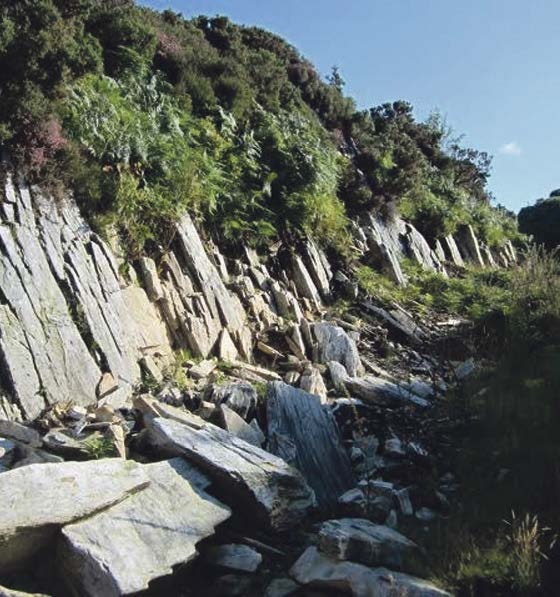

Disputed: T he ‘quarry’ site
FOLLOWING reports last week that archaeologists had located the ‘quarry’ where the Stonehenge bluestones originated, a paper had been published which casts significant doubt over their findings. Earth scientists who worked at a ‘ bluestone monolith quarry ‘ site at Craig Rhosyfelin in Pembrokeshire have suggested that the archaeologists have got it all wrong, and that the so-called ‘ engineering features ‘ on the flank of the crag are entirely natural. Furthermore, it is suggested that members of the digging team have unconsciously created the very features that they have cited in support of their quarrying hypothesis.
In a peer-reviewed paper published on Monday (Dec 14) in ‘ Archaeology in Wales ‘ journal Dr Brian John, Dr Dyfed Elis-Gruffydd and John Downes have described a set of Ice Age deposits and landforms at the site of an archaeological dig that was started in 2011, and have determined that there are no traces of human intervention in any of the features that have made the archaeologists so excited. These include features described by the diggers as a quarry face, a quarry spoil bank, a storage platform, props and pillars, stone rails, a ‘ proto-orthostat ‘ , a revetment, and an export pathway. Most of these are now dismissed as ‘ archaeological artifices ‘ unconsciously created by the archaeologists themselves during five years of highly selective sediment removal. In other words, the authors of the new article suggest that the archaeologists have created what they wanted to find, instead of describing what was there.
This site has been described by lead archaeologist Prof Mike Parker Pearson as ‘ the Pompeii of prehistoric stone quarries ‘ and has caused great excitement in archaeological circles. The selection of this rocky crag near the village of Brynberian for excavation in 2011- 2015 was triggered by the discovery by geologists Richard Bevins and Rob Ixer that some of the stone fragments in the soil at Stonehenge were quite precisely matched to an unusual type of foliated rhyolite found in the crag. This led the archaeologists to conclude that there must have been a Neolithic quarry here, worked for the specific purpose of cutting out monoliths for the bluestone settings at Stonehenge.
Commenting on the new research paper, Dr Brian John said: “The new geological work at Rhosyfelin and Stonehenge is an interesting piece of ‘rock provenencing’ – but it tells us nothing at all about how monoliths or smaller rock fragments from West Wales found their way to Stonehenge. We are sure that the archaeologists have convinced themselves that the glacial transport of erratics was impossible. We are not sure where they got that idea from. On the contrary, there is substantial evidence in favour of glacial transport and zero evidence in support of the human transport theory. We accept that there might have been a camp site at Rhosyfelin, used intermittently by hunters over several millennia.
But there is no quarry. We think the archaeologists have been so keen on telling a good story here that they have ignored or misinterpreted the evidence in front of them. That’s very careless. They now need to undertake a complete reassessment of the material they have collected.” The three authors of the new paper suggest that this fundamental error in interpretation might have been avoided if there had been greater cooperation in the Rhosyfelin dig between archaeologists and specialists from related disciplines.



Defendant admitted using Xbox without informing police as required under court order
ANTHONY COOMBES, aged 26, of Sand Banks, Broad Haven, appeared before Llanelli Magistrates’ Court on Thursday (Mar 20) charged with breaching a sexual harm prevention order.
The court heard that between February 26 and March 19, 2026, at Haverfordwest, Coombes repeatedly breached the order by using an Xbox device without informing police within three days, as required.
The offences relate to a sexual harm prevention order imposed at Swansea Crown Court on October 20, 2021.
Coombes indicated guilty pleas to the offences at the first hearing.
Magistrates committed the case to Swansea Crown Court for sentence.

He was remanded in custody ahead of the next hearing, which is due to take place at 9:00am on Friday, April 3, at Swansea Crown Court.
The court refused bail on the grounds that he was likely to offend, citing the nature and seriousness of the offences and his previous record and character.
A pre-sentence report was ordered.


Police say death not suspicious as 46-year-old arrested over alleged Class A drug supply
A MAN has died following a medical emergency at a property in Haverfordwest, police have confirmed.
Emergency services were called at 3:18pm on Wednesday (March 18) after a report of a medical incident.
A man was pronounced dead at the scene.
Dyfed-Powys Police said the man’s next of kin have been informed and are being supported by officers.
The death is not being treated as suspicious at this time.

However, police confirmed that a man, aged 46, was arrested on suspicion of being concerned in the supply of Class A drugs.
He has since been released under investigation while enquiries continue.
No further details about the deceased have been formally released.

FOUR people from Mynyddygarreg, Kidwelly, have been ordered to pay more than £129,000 following a successful prosecution for illegal dog breeding.
At Swansea Crown Court on Tuesday (Mar 10), before His Honour Judge Thomas KC, Stacey May June Edwards, Peter John Edwards, Sian Eleri Thomas and David Malcolm James Thomas, all of Sea Breeze, Mynyddygarreg, pleaded guilty to offences under the Breeding of Dogs (Wales) Regulations 2014.
The court imposed confiscation orders totalling £129,873.41 under the Proceeds of Crime Act across the four defendants. They were also ordered to pay £8,000 in costs, while each defendant received a £2,000 fine.
The investigation began in April 2021 after Carmarthenshire County Council’s Animal Health team received an enquiry from Peter Edwards about obtaining a dog breeding licence. Although licensing guidance was provided and a partial application was submitted in February 2022, this was later withdrawn.
In March 2024, the council received a complaint that puppies were being advertised for sale without the required licence. Officers subsequently contacted online advertising platforms and issued data requests to assess the scale of activity.
Analysis of records from Pets4Homes, Freeads and Gumtree revealed multiple litters being advertised by members of the same household.
Correspondence under the Police and Criminal Evidence Act confirmed that up to 25 dogs were kept at the property, including between 16 and 19 breeding females.
While some defendants claimed joint ownership of the dogs, others attempted to minimise their involvement.
The Herald understands that numerous puppy advertisements were posted between July 2020 and April 2025, demonstrating a sustained pattern of unlicensed breeding.

Carmarthenshire County Council’s Cabinet Member for Climate Change, Decarbonisation and Sustainability, Cllr Aled Vaughan Owen, said: “This case demonstrates the council’s firm stance against unlicensed and illegal dog breeding.
“These regulations are in place to protect animal welfare and ensure that breeding activities are subject to proper oversight. The scale of activity uncovered at this property was entirely unacceptable, and we welcome the court’s decision to issue significant confiscation orders under POCA.”
He added: “We urge anyone with concerns about illegal dog breeding to report it. Our Animal Health officers will continue to investigate thoroughly and take action against those who disregard the law.”

Residents are reminded that anyone breeding and selling dogs must comply with licensing regulations designed to protect both animal welfare and consumers.



Crime13 hours ago
Publican jailed for six years for supplying cocaine and cannabis
Milford Haven man sentenced at Swansea Crown Court following drug dealing operation A MILFORD HAVEN publican has been jailed for...


Local Government16 hours ago
Poverty summit highlights support efforts across Pembrokeshire
A SUMMIT bringing together key organisations from across Pembrokeshire has highlighted both the scale of local poverty and the work...


Education2 days ago
Milford Haven school plans unveiled but funding not yet secured
PLANS for a new £100 million school in Milford Haven have been unveiled, but the project has not yet secured...


News2 days ago
Council unveils plans for new state-of-the-art secondary school in Milford Haven
PEMBROKESHIRE COUNTY COUNCIL has revealed plans for a new state-of-the-art school in Milford Haven, promising modern, inspiring learning spaces for...


Health2 days ago
NHS waiting list falls — but cancer delays and diagnostic backlog worsen
Record progress claimed by Welsh Government as critics warn key targets are still being missed THE NHS in Wales has...


Crime3 days ago
Rapist jailed after ‘abhorrent’ attacks on woman and children
Haverfordwest man told police “women won’t have sex without force” A HAVERFORDWEST man who raped a woman and a young...


News3 days ago
Reform secures first Pembrokeshire councillor in Hakin by-election win
Late Reform candidate takes seat as independent surge and Labour withdrawal shape contest REFORM UK candidate Scott Thorley has won...


News3 days ago
Scott Thorley elected as Pembrokeshire’s first Reform councillor
REFORM UK candidate Scott Thorley has won the Hakin by-election after securing 179 votes. The full result is as follows:...


News3 days ago
Police confirm man has died after being recovered from River Cleddau
Major emergency response in town centre after concerns raised for man in water A MAN has died after being recovered...


Community3 days ago
Davies and Kurtz urge groups to seek employability funding
Community organisations in Pembrokeshire encouraged to apply for new grants supporting skills and job access LOCAL Senedd Members Samuel Kurtz...
-

 News7 days ago
Rayner and Lammy visit Wales to discuss justice and community safety
-

 News6 days ago
Fishguard linked to allegations in Many Tears Animal Rescue investigation
-

 News4 days ago
Emergency services flood Haverfordwest after reports of person in river
-

 Local Government7 days ago
Investigation confirmed after inspectors visit Many Tears Animal Rescue
-

 Crime3 days ago
Mother given community order after admitting child cruelty offence
-

 Business7 days ago
Legal action backed in case over development at Dinas Cross
-

 Business7 days ago
Oil firm praised for putting customers first during price surge
-

 Community7 days ago
Town hall takeover plan questioned as cost figures conflict