


News
Plaid launches commissioner manifestos



Critical of Christopher: Dafydd Llywelyn did not pull his punches
PLAID CYMRU candidates and members gathered in Carmarthen to launch the party’s national manifesto for the upcoming Police and Crime Commissioner election on May 5 – the same day as the Assembly election.
The Party of Wales ‘ candidates for the role of Police and Crime Commissioner (PCC) in the four policing forces are Arfon Jones (North Wales), Linet Purcell (South Wales), Darren Jones (Gwent) and Dafydd Llywelyn (Dyfed Powys).
The candidate for Dyfed Powys, Dafydd Llywelyn, who is the former Principal Crime and Intelligence Analyst for Dyfed Powys police force, said that the manifesto was designed to create ‘a strong, just and safe Wales’ and that this ambition would be fulfilled with three main priorities.
He added that Plaid Cymru Police and Crime Commissioners would focus on creating strong neighbourhood policing teams to cut crime in communities, protecting vulnerable groups and supporting victims, and breaking the cycle of crime to reduce future offending.
Speaking at the launch, Dafydd Llywelyn added: “Our manifesto for the Police and Crime Commissioner elections is designed to secure a strong, just and safe Wales. At the heart of our proposals lie a commitment to community safety, victim support and breaking the cycle of reoffending.”

The former police analyst went on to say: “If elected, Plaid Cymru Police and Crime Commissioners would work to ensure that all parts of Wales have strong neighbourhood policing teams that will cut crime in our communities, that vulnerable groups and victims are protected and supported so that they’re not just statistics, and that the cycle of crime is broken as often as possible.
“Plaid Cymru puts the best interests of Wales first – nationally and locally. Our PCCs would champion the needs of communities as well as continue to campaign against further Westminster cuts which have led to severely depleted frontline services.”
Looking at local policing priorities, Dafydd Llywelyn published his 10 personal pledges under the themes of Trust and Efficiency and Security and Safety as his platform to be elected as the new Police Commissioner for Dyfed Powys.
Following his address to the gathered audience and members of the press, he spoke to The Herald.

We began by asking the Plaid candidate why he had put himself forward for election.
He told us: “As many people will be aware I used to work for Dyfed Powys for thirteen and a half years. When Police and Crime Commissioners were put in post I did feel that there was a change in the way that the police were being run. I found frustrating working under that set up. As a result of that I thought perhaps I needed to be looking outside in terms of employment.
“I now lecture in criminology at Aberystwyth University. Plaid Cymru hadn’t put anyone forward the first time round, so I felt that I wasn’t represented on the ballot paper. It was a chance discussion last year when I heard the decision had changed and that Plaid Cymru were going to field candidates. I decided then to put my name forward. My background in the Police stands me in good stead.”

Dafydd Llewellyn was very direct in his criticism of the current Police and Crime Commissioner Christopher Salmon: “We have a police commissioner who has zero policing experience and that was very apparent in his first tenure.
“While I haven’t served as a police officer I did work as a support staff member in the Dyfed Powys force. Being a lecturer I am able to look at it in a critical way. I very often do research and I look at the issues of crime. I think my former colleagues appreciate that my experience does give me an insight into real policing issues.”
Given the financial difficulties facing local authorities and the Dyfed Powys- Police force we asked the Mr Llywelyn how he planned to tackle drug and alcohol related crime in the area.
He responded by identifying the range of stakeholders that a PCC needs to work with: “Drugs and alcohol-related crimes are issues you can only tackle in partnership with unitary authorities. The authority here in Carmarthenshire has called time after time for CCTV and he (Christopher Salmon) has not fulfilled that requirement. As far as social economic issues, which are often seen as the causes of crime, they are issues the Police Commissioners cannot deal with in isolation. They have to work with partner agencies, with charities and unitary authorities themselves.”
He added that it was time for Wales to be in control of its own policing policy and priorities: “We would like for recommendations in the Silk report two years for the devolving powers of policing to Cardiff to be followed through.”
The Herald asked Dafydd Llywelyn if there was a greater role to be played in crime prevention rather than crime busting.
He said: “Community work and work within the community is critical in terms of prevention and intervention. There are good examples of crime prevention undertaken by people like the youth service. I mentioned in my speech that there is a fragmentation of funding in terms of youth services. We can address that and give for the five and ten year period a strategy in terms funding for some of these agencies. It would give them a stronger footing in terms of some of the activities they want to carry out.”
With an implied criticism of a decision reached by Mr Salmon, Dafydd Llywelyn continued: “The prevention aspect is very important. I mentioned CCTV as preventing incidents from happening because they are spotted. CCTV doesn’t work as a deterrent if people understand that it isn’t being monitored. For town centre violence in particular alcohol related violent crime the deterrent is there: especially if you understand it is being monitored.”
He went on to announce further plans as Police and Crime Commissioner if elected saying that he would include investment in a modern CCTV infrastructure, road safety and ensuring victims are properly supported.
We suggested that some people might believe that the cost of employing Police and Crime Commissioners would be better spent on front line policing services.
Without hesitation the candidate explained: “If you tot the cost of their offices up it amounts to around £3m. I would agree with you that it would be better spent on front line policing. My first course of action would be to scrap the role of Deputy Police Commissioner – an unelected role which costs tens of thousands of pounds a year.”



HAVERFORDWEST town centre was a hive of activity today (Friday, Feb 27) as hundreds of children from schools across Pembrokeshire took part in a special St David’s Day celebration.
The popular parade, organised by the Pembrokeshire Language Forum, returned to the county town once again, with smiles all round from participants and spectators who lined the streets to watch.
Children paraded down High Street, through Bridge Street and along Quay Street, led by Samba Doc, before gathering at Picton Playing Fields for songs and dancing during an open-air jamboree with entertainer Tomos Tanllyd.
Pembrokeshire County Council Leader Cllr Jon Harvey said: “St David’s Day is always a special occasion in Pembrokeshire, and it was wonderful to see so many young people coming together to celebrate our language, culture and national identity.”
Cabinet Member for Education and the Welsh Language, Cllr Guy Woodham added: “The annual St David’s Day parade is a shining example of what schools in Pembrokeshire do to celebrate the Welsh language and culture, and they are certainly enthusiastic about it.”
Council Vice Chairman and Champion for the Welsh Language and Children and Young People, Cllr Delme Harries said: “It was fantastic to see such enthusiasm from pupils across the county, proudly celebrating St David’s Day.”
Local member Cllr Tom Tudor also praised the event, adding: “It really was a great celebration of St David’s Day and a highlight for Haverfordwest.”
Welsh Language Development Officer Catrin Phillips said the event continues to grow each year.
She said: “The St David’s Day parade, organised by the Pembrokeshire Language Forum, is always a highlight of the year and it’s wonderful to bring schools together to celebrate Welsh language and culture in such a joyful way.
“It has been especially encouraging to see new schools joining us this year, helping the event continue to grow.”

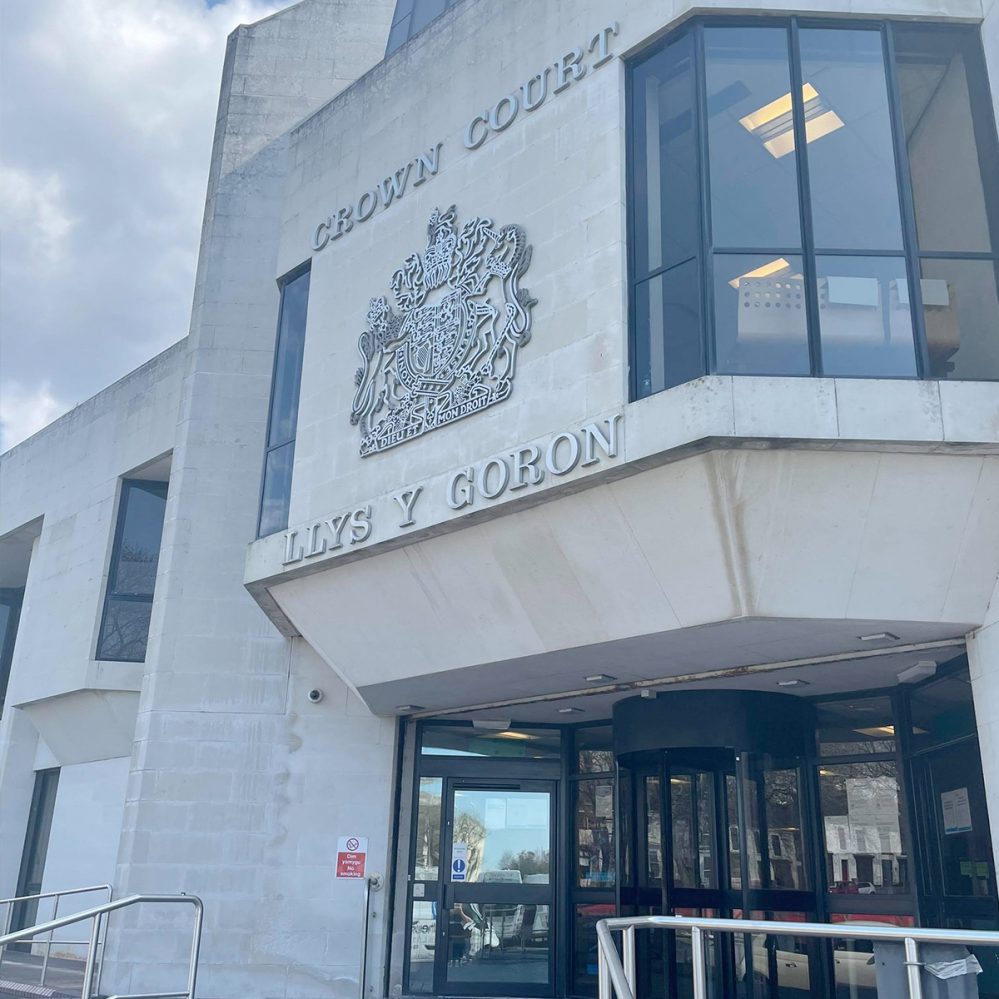
Five masked men smashed their way into property during terrifying late-night raid
A COUPLE feared they were about to be murdered when a masked gang armed with axes burst into their home, a jury at Swansea Crown Court has heard.
Five men dressed in dark clothing and balaclavas forced entry to the property shortly before 9:00pm on May 29, 2021, in what prosecutors say was a planned aggravated burglary. An emergency call was made at 8:51pm.
Prosecutor Mr Wright read to jurors a police statement from homeowner David Davies, who said he had been sitting with his partner, Carmen Bailey, when he heard loud banging at the front door.
“As I got to the entrance, the glass in the door was smashed and the men came through,” he said.
He described five intruders, all carrying axes. One of the men shouted: “Lay face down on the floor.”

Moments later, another voice yelled: “She’s on the phone,” after Ms Bailey contacted police. A further shout of “Let’s go boys” was then heard before the gang fled.
Mr Davies told officers that drawers throughout the property had been opened. Around £3,000 hidden in a spare room was not discovered, but two £50 notes were stolen along with a sanitary item and a Lloyds Bank paying-in book.
He attempted to follow the men as they left and saw the rear of a white SUV. Although his mobile phone had been smashed, it was still functioning.
In a later statement he described one suspect carrying a yellow-and-black rubber-handled axe, adding that another man “hopped out like a kangaroo” as he entered the property.
Ms Bailey said she was left utterly traumatised by the ordeal.
“I was absolutely petrified,” she said. “I felt like I was going to get murdered.”
She told police she could only see the men’s eyes through their balaclavas as she grabbed the house phone and called emergency services. A male voice shouted: “Where’s the money?”
The force of the attack shattered glass up to two metres into the hallway, the court heard.
A third witness, Doreen Jones, said she had phoned Mr Davies during the incident and heard male voices shouting: “Get down, get down.”
The investigation
Jurors were told that a white Nissan Juke — stolen in the Manchester area and fitted with cloned number plates — was later recovered near Paradise Nightclub in Pontardawe after the registration plates had been removed.
Several other men have already pleaded guilty to aggravated burglary, but Mohammed Mills and Michael Quinn deny involvement.
When Mills was arrested, officers recovered £235 in cash and a black iPhone. A vehicle linked to him was searched, leading to the discovery of a machete with an orange handle, black gloves and a balaclava.
Quinn was arrested in November 2021. Officers recovered a gold iPhone and a machete, while a large knife was found under his bed at home. A Nokia handset seized from him contained very little data, most of which had been deleted.
Automatic number plate recognition (ANPR) cameras placed vehicles linked to the defendants in the Bryncethin area at 6:40pm. Both vehicles were later seen at McDonald’s in Morriston at 7:35pm and at a Tesco service station at 8:32pm — around twenty minutes before the burglary.
There is no CCTV footage of the break-in itself.
The prosecution case
The prosecution allege the burglary was carefully planned, including what they describe as a “dry run” the previous day. They say the vehicles travelled together from Manchester and that the meeting in the area had been pre-arranged.
Jurors were told telecommunications evidence, including phone activity and satnav data, places devices linked to the defendants in relevant locations.
The defence
Mills claims he had recently started taxi work and was paid to drive men to Wales, saying he did not know their intentions. He denies wearing a balaclava and says the machete recovered was not his. His barrister told the court he cooperated fully with police and provided access to his phone.
Quinn maintains he travelled to Wales to sell his Vauxhall Insignia and denies any knowledge of the burglary. He says the knife found under his bed was used for dismantling furniture.
The judge reminded jurors that emotion must play no part in their deliberations and that the verdict is theirs alone.
The trial continues.

NATURAL RESOURCES WALES (NRW) is seeking public feedback after reaching a draft decision to approve changes to the environmental permit for the Withyhedge Landfill site in Pembrokeshire.
Following what it described as a detailed technical assessment, NRW said it is “minded to” grant a permit variation requested by the site operator, Resources Management UK Ltd. The variation would amend the environmental permit that controls how the site operates (permit number EPR/MP3330WP, application reference PAN-025929).
A four-week public consultation has now opened and will run until Thursday, March 26, 2026. NRW said all responses will be considered before any final decision is made.
The operator is proposing several changes, including alterations to the final shape of the land once the landfill is capped, updates to monitoring and management arrangements for groundwater, surface water and leachate, and the addition of up to 50,000 tonnes of waste soils for restoration purposes under a new waste recovery activity.
The application also includes consolidation and modernisation of the permit, including a review of existing improvement and pre-operational conditions.
NRW said it considers the proposed changes acceptable and believes they could help ensure the site operates without causing harm to the environment or nearby communities.
Residents are being encouraged to provide feedback on issues such as emissions, potential health impacts, environmental risks and how waste is managed at the site.
However, NRW stressed that certain matters fall outside its remit and cannot be considered as part of the consultation. These include planning issues handled by the local authority, such as the site’s location, traffic levels, visual impact, land use, access arrangements and operating hours.
Huwel Manley, Head of South West at Natural Resources Wales, said: “We know the community has a long-standing interest in what happens at Withyhedge Landfill, and we take that responsibility seriously.

“Given the history of the site and the concerns people have previously raised, we promised to take an approach that goes further than our usual consultation process for a permit variation.
“Being ‘minded to’ issue this variation means our specialists are satisfied the operator can meet the required standards, but before we make any final decision we want to hear from the people who live and work nearby. We encourage anyone with an interest in the site to take part in the consultation.”
Details of the draft decision and information on how to submit comments are available via NRW’s Consultation and Engagement Hub.




Community3 days ago
St David’s Day parade brings colour and celebration to Haverfordwest
HAVERFORDWEST town centre was a hive of activity today (Friday, Feb 27) as hundreds of children from schools across Pembrokeshire...


News4 days ago
Hoax 999 call sparks massive lifeboat and helicopter rescue — man arrested
Emergency services diverted from real incidents after false report off south Wales coast A MAJOR sea rescue operation involving three...


Crime4 days ago
St Dogmaels man jailed over hundreds of indecent images
Previous convictions for similar offences revealed to court A 57-YEAR-OLD man from St Dogmaels has been jailed for two-and-a-half years...


Health4 days ago
Petition against hospital service changes surges past 6,000 signatures
Public response now far exceeds health board consultation figures A PETITION calling for urgent Welsh Government intervention over services at...


Crime5 days ago
Milford Haven pensioner admits sexually assaulting two shop workers
76-year-old touched victims and kissed one on the neck, court hears A MILFORD HAVEN man has admitted sexually assaulting two...


News6 days ago
Senedd backs assisted dying legislation in historic vote
POLITICIANS in the Senedd have voted in favour of legislation that could allow assisted dying services to be provided through...
Crime6 days ago
Manchester men deny aggravated burglary after armed raid on dog breeder
Prosecution says machete-armed gang carried out “carefully planned” attack TWO men have gone on trial accused of involvement in an...


News6 days ago
Labour and Plaid criticised over £1.2m anti-racism ‘metaverse’ project
Figures revealed in Senedd questions as political row intensifies ahead of election THE WELSH GOVERNMENT has come under political pressure...


Business6 days ago
Local Senedd member hears retailer concerns ahead of election
INDEPENDENT shop owners in Pembrokeshire have warned that rising costs and increasing pressures could threaten the future of small high-street...

Charity7 days ago
Charity launches bid to save Foley House with new community cooperative
A PEMBROKESHIRE charity has launched an ambitious bid to restore Foley House, one of Haverfordwest’s most significant historic buildings, through...
-
News6 days ago
Labour and Plaid criticised over £1.2m anti-racism ‘metaverse’ project
-
Charity7 days ago
Charity launches bid to save Foley House with new community cooperative
-

 Crime7 days ago
Eleven-year jail term for rape after judge finds victim ‘particularly vulnerable’
-
 Health6 days ago
Health services row escalates as MSs demand action over Withybush and Bronglais
-
 Crime7 days ago
Haverfordwest man guilty of raping his own sister
-

 Crime7 days ago
Merlins Bridge man denies six child sex assault charges
-
Crime7 days ago
Man who threatened to kill Herald editor given suspended prison sentence
-

 Politics6 days ago
Farage vows to strip Cardiff’s ‘City of Sanctuary’ status ahead of manifesto launch