


News
Saint’s ‘potential contemporaries’ unearthed

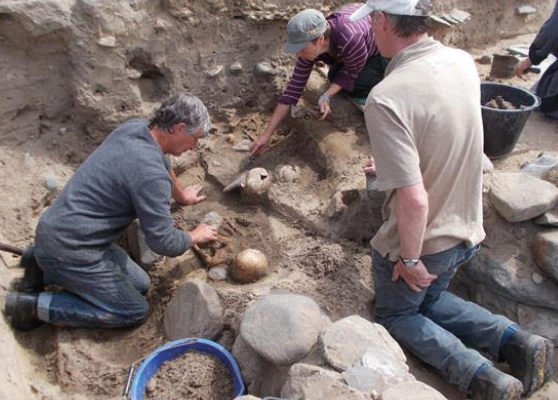
 DYFED ARCHAEOLOGICAL TRUST has revealed that skeletons buried at St Patrick’s Chapel in the Pembrokeshire Coast National Park may have belonged to contemporaries of St David.
The Trust carried out a three-week dig as part of their third and final year of excavation at the chapel in Whitesands Bay in May.
The dig unearthed signs that the medieval religious site was used before it was a chapel, and the remains discovered underneath may date back to a time before written records.
A number of the Christian burials found during the excavation are dated back to the early sixth century AD, a time when the now patron saint of Wales, St David, was a bishop.
Supporting the excavation was the Pembrokeshire Coast National Park Authority. Cultural Heritage Manager for the Authority, Phil Bennett, said: “Without doubt some of the people buried in St Patrick’s Chapel would have been contemporaries of St David – they might even have known him.

“They were not necessarily compatriots though. Research by the University of Sheffield on skeletons from similar sites in Pembrokeshire revealed that some of the people buried in them were not local but came from Ireland and continental Europe. Initial results from St Patrick’s Chapel suggest a similar pattern, making Whitesands Bay rather cosmopolitan.”
400 years ago, the chapel was in ruins, and nowadays there is no trace of it on the surface. However, harsh storms have regularly exposed graves containing human bones at the site for a number of decades.
In an attempt to make the erosion cease, over twelve years ago Pembrokeshire Coast National Park Authority placed boulders against the site. This proved a success until the boulders were washed away by massive storms in January 2014, leaving more burials exposed. An agreement was made that declared an excavation on the area of the site most vulnerable to erosion would be the best course of action; any further attempts to protect the site would simply prove futile.
In the relatively small area that has been excavated, nearly 100 skeletons have been unearthed. Some of these were laid in graves lined and capped with stone slabs, a traditional burial design in Western Britain between the sixth and 11th century AD. Christian tradition dictates that the head of a buried body should point to the west, and indeed the remains were found in this manner, aligned east to west.
The archaeologists made a particularly incredible discovery, as they found a stone cross fixed at the edge of one grave; a discovery that marks the first time in Britain that a stone-lined grave has been found in association with an upright cross.
A rather poignant discovery made by the archaeologists found that the majority of skeletons belonged to children.
Director of the Dyfed Archaeological Trust, Ken Murphy, said: “Many of the graves uncovered were those of children and were touchingly decorated with sea shells and shiny quartz pebbles. Two of the children’s grave stones had crosses scratched onto them. You can picture the tenderness felt by those involved with the burial.”

Acidic soil prevalent in most of Wales results in the quick decay of bone, but St Patrick’s Chapel is situated on top of wind-blown sand which has helped to preserve the bones.
Two skeletons were found buried face down, which raises the question if they were criminals or deviants of some sort. However, regardless of those questions, the remains were buried on sacred ground in a Christian cemetery.
Ken Murphy concluded: “This excavation has given us some really important information about the lives, beliefs and practices of people living in Wales over 1,000 years ago.”


ANYONE who hosts paying guests in Wales will soon be required by law to register their visitor accommodation with the Welsh Revenue Authority (WRA).
The new legal requirement will apply to all paid visitor accommodation across Wales, including spare rooms, holiday cottages, cabins, campsites and hotels. Registration will be required whether accommodation is let for a single night, occasionally, seasonally or all year round.
The register is being introduced to give a clearer picture of the visitor accommodation available in Wales and to support councils that decide to introduce the Visitor Levy. Registration will open in October 2026, and both informal hosts and professional accommodation providers will be required to comply or risk facing penalties.
Accommodation providers can prepare now by visiting gov.wales/registeryourplace to find out what information they will need and sign up for updates and reminders. Registration is free for providers and is expected to take less than 15 minutes to complete.
When registration opens, accommodation providers will be asked to provide information, including:
• contact details
• accommodation address
• type of accommodation
• how many people can stay
• when the accommodation is usually open for bookings
Who needs to register?
Any individual or business that takes bookings for overnight accommodation must register by law.
This includes:
• self-catering accommodation and homestays, including on Airbnb or similar
• hotels, guesthouses or bed and breakfasts
• campsites or camping pitches
• hostels or bunkhouses
• caravans, chalets, lodges, shepherd’s huts or glamping
• temporary accommodation for events, including festivals
Rebecca Godfrey, Welsh Revenue Authority Chief Executive, said: “If you take bookings for overnight stays in Wales, you’ll need to register with us. We want to make this process as straightforward as possible, and we’re here to support accommodation providers to register correctly and on time.

“We’ll be publishing further guidance before registration opens in October 2026. In the meantime, I’d encourage providers to visit gov.wales/registeryourplace to find out what to expect and sign up for updates.”



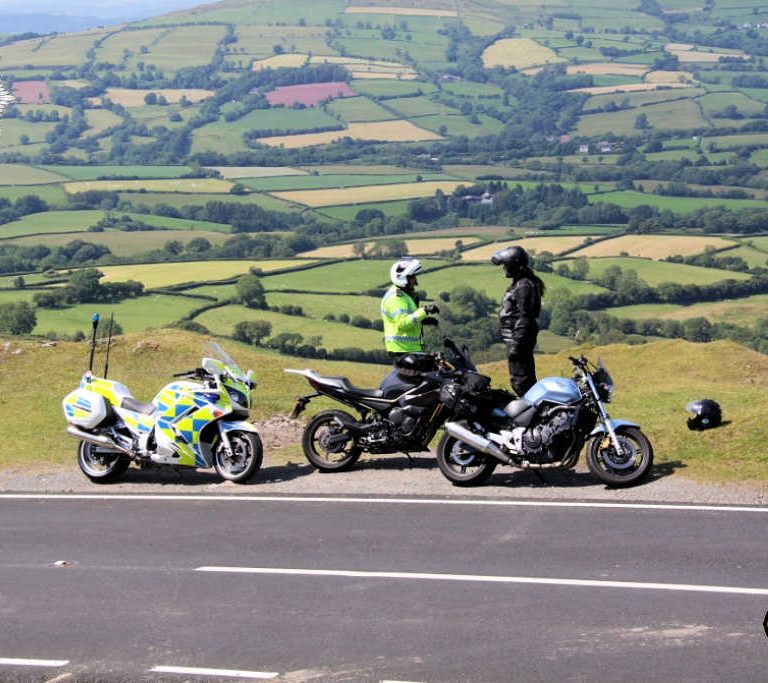
DYFED-POWYS POLICE has launched Operation Apex ahead of the Easter Bank Holiday, with officers stepping up efforts to keep motorcyclists safe on roads across the region.
The force says more riders are expected to take to the roads over the long weekend, prompting increased patrols, targeted enforcement on routes considered high-risk, and engagement with bikers at key locations.
Police are urging riders to take extra care by keeping their speed down on corners, watching carefully for other road users, and treating rural roads with caution, as conditions can change quickly and surfaces are often less predictable.
As part of the operation, motorcyclists are also being encouraged to sign up for a BikeSafe workshop. The police-led initiative offers expert advice as well as an observed ride aimed at helping bikers improve their skills and confidence on the road.
Officers are also reminding riders to carry out basic safety checks before setting off, particularly if their motorbike has not been used for some time. Tyres, brakes, lights, chain condition, oil and fuel levels should all be checked before any journey.
The warning comes as recent wet weather has left some road surfaces badly damaged, with potholes posing an extra hazard. Police also noted that while spring temperatures are improving, chilly mornings can still bring frost or icy patches in places, alongside the usual unpredictability of Welsh weather.
Dyfed-Powys Police said riders should enjoy the Easter weekend, but make safety and getting home safely their top priority.

A grassroots club brand that changed west Wales — and still echoes 25 years on
FOR many in west Wales, The Evolution Experience is more than just a name. It is a memory — of packed dancefloors, loud music, and the feeling that something different was happening locally.

Launched in 2000 by Tom Sinclair and his friend John Lee, Evolution began modestly but quickly grew into one of the most ambitious nightlife ventures Pembrokeshire had seen.
At a time when serious clubbing meant travelling to Swansea or Cardiff, a group of young people in Milford Haven decided to build something themselves.
What made The Evolution Experience different was not just the scale, but the people behind it. At a time when most 20-year-olds were either at university or in their first jobs, the team behind Evolution were organising large-scale events, managing budgets, dealing with authorities, and taking on responsibilities usually associated with far older operators.
According to the Evolution Experience website in June 2001, the main team members were: Tom Sinclair, John Lee, Denys Bassett-Jones, Gareth Jones, Linda Rouse, Declan Rouse, Dan Mills, Matthew Norman, Luke Sinclair and Mike Knight.

Filling a gap
In the early 2000s, Pembrokeshire’s nightlife was limited. There were pubs, small venues, and occasional events — but nothing on a scale to rival city clubs.
Evolution changed that.
Early nights at the Kings Function Centre in Milford Haven drew hundreds, then close to a thousand people. The venue — a cricket club hall — was transformed with lighting rigs, powerful sound systems, and multiple arenas.
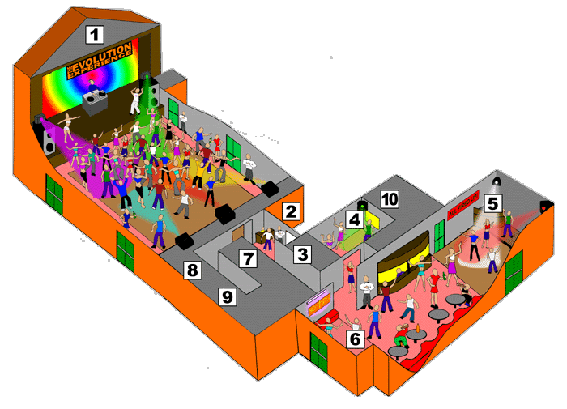
What emerged was not just a DJ night, but a full-scale experience.

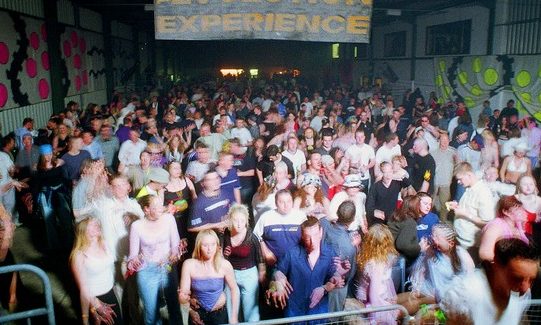
As the brand grew, larger venues followed, including the Park House Exhibition Centre in Haverfordwest, where crowds of up to 2,500 attended — an unprecedented scale for the county.
More than a club night
What set Evolution apart was not just its size, but how it was run.
Despite being organised by people in their late teens and early twenties, the operation was structured and professional. There were sponsorship deals, thousands of flyers distributed across the county, branded vehicles, trained security, and medical cover on site.

Promotion was hands-on, with mailing lists built manually and campaigns run across towns and villages.
The aim was clear: to deliver something that could stand alongside events in larger cities.
And it worked.
Big-name DJs and acts were brought to Pembrokeshire, while local talent was given a platform to perform in front of large crowds.
What made The Evolution Experience different was not just the scale, but the people behind it. At a time when most 20-year-olds were either at university or in their first jobs, the team behind Evolution were organising large-scale events, managing budgets, dealing with authorities, and taking on responsibilities usually associated with far older operators.

A platform for people
For many involved, Evolution was more than a night out.
It provided early experience in:
- event management
- sound and lighting
- marketing and promotion
- working under pressure
Participants went on to careers in a wide range of fields, including policing, design, IT, and the music industry.
For Sinclair, the experience would prove formative in a different way.

Expansion beyond west Wales
As Evolution grew, it began to move beyond its local roots.
Events were held in London, including a night at The Fridge in Brixton. The brand also reached overseas, with a tour in China and plans — later followed by smaller events — in Tokyo.
For a venture that began in a Milford Haven cricket club, the expansion was significant.
The Chequers turning point
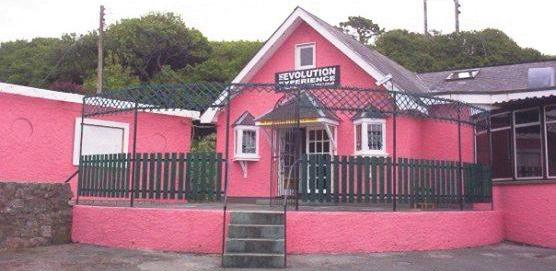
In 2002–2003, plans were put forward to establish a permanent home for Evolution at Chequers nightclub in Penally, near Tenby.
The move represented a major step — from one-off events to a fixed venue.
However, the application faced strong opposition from residents, authorities, and other stakeholders, particularly around concerns over noise and location.
Following a lengthy licensing hearing, the application was refused.
Sinclair disputed aspects of the decision, but the project did not proceed.
That pressure brought its own rewards. At just 22 years old, Sinclair found himself standing alone in a packed licensing hearing, representing his case for over six hours without legal support.
It was an experience that would shape everything that followed. “After that,” he has said, “nothing ever really felt that daunting again.”
A short-lived attempt to operate the venue as a private members’ club followed, but this also faced enforcement action and was ultimately discontinued.
Lessons learned
The refusal of the Chequers application marked more than just the loss of a venue. It was a moment where ambition collided with the limits of what was possible at the time — in terms of regulation, location, and local sensitivities.
For those involved, it was a harsh but valuable lesson. It exposed the realities of navigating systems that were still evolving themselves, and forced a deeper understanding of how decisions were made — and how they could be challenged.
The episode marked a turning point.
For those involved, it provided first-hand experience of the complexities of licensing, regulation, and public scrutiny.
Sinclair has since reflected that the experience influenced his decision to study law — and later to establish The Pembrokeshire Herald, where scrutiny of authority and public accountability became central themes.
That experience would have lasting consequences. For Sinclair, it sparked a deeper interest in law, leading him to study the subject and later apply that knowledge in a different arena — journalism.
The confidence built through Evolution, and the lessons learned during its most difficult moments, would go on to shape the approach behind The Pembrokeshire Herald.
A return — and a legacy
Although Evolution’s early peak passed, it did not disappear.
The brand returned in later years with events including:
- “No Place Like Home” nights in 2008
- smaller club events in 2009
- a full-house event in Tenby featuring SASH!
- sell-out shows at the De Valence Pavilion, including Judge Jules
Each time, the response showed that the name still carried weight.

A shared cultural moment
Today, The Evolution Experience occupies a rare place in local memory.
For those who were there in the early 2000s, it represents:
- first nights out
- a sense of something new
- proof that large-scale events could happen locally
For younger audiences, it remains a recognised and credible brand.
Few nightlife ventures bridge generations in this way.
Perhaps the most enduring impact of The Evolution Experience is not found in the events themselves, but in what came after.
Those involved did not simply move on — they carried the experience with them. Skills learned under pressure translated into careers across a range of professions, from public service to technology and the creative industries.
In that sense, Evolution was not just a series of nights, but a starting point.
Should it return?
With renewed interest and upcoming anniversary events, the question arises: should The Evolution Experience return in a larger way?
There is no simple answer.
The demand appears to be there, and the brand still resonates. However, the landscape has changed — with stricter regulation, different audience expectations, and a very different nightlife culture.
What is clear is that the original conditions that created Evolution cannot be replicated exactly.
More than nostalgia
Perhaps the question is not whether Evolution should return as it was, but whether the spirit behind it can be carried forward.
Because what Evolution demonstrated — 25 years ago — still matters:
That it is possible to build something significant from nothing, even in a rural area.
That young people, given the opportunity, can create, organise, and deliver at scale.
And that sometimes, what begins as a small idea can leave a lasting impact.
Today, the name still carries weight. For one generation, it represents a time when something genuinely new arrived in west Wales. For another, it is a brand associated with more recent events and headline DJs.
Few local ventures manage to bridge that gap — to be remembered by those who were there at the start, while still recognised by those discovering it for the first time.
A lasting impression
What started as a birthday party in Milford Haven became something far bigger — not just a club night, but a moment where a group of young people proved they could build something of scale, ambition and lasting impact.
Twenty-five years on, The Evolution Experience is no longer just about what happened on those nights. It is about what grew out of them — the confidence, the careers, and the belief that, even in a rural corner of west Wales, you didn’t have to wait for opportunity.
You could create it.



Crime24 hours ago
Driver spared jail after crash killed young couple
A PEMBROKE DOCK driver who caused the deaths of a young couple in a road crash has been given a...


Entertainment1 day ago
BBC unveils major new Welsh dramas with Tenby set for prime-time spotlight
New crime series Old Town Murders and supernatural thriller The Witch Farm will both be filmed and set in Wales...


Health1 day ago
No jobs for new paramedics in Wales as graduates told to apply for technician roles
Students trained at public expense urged to take lower-grade jobs as anger grows over NHS workforce planning NEWLY qualified paramedics...


News2 days ago
Health minister refuses to act on Withybush despite 15,000-signature petition
Senedd pressure grows as Welsh Government declines to intervene over surgery fears THE WELSH GOVERNMENT has refused to step in...


Business3 days ago
Fishguard to Wexford rail tunnel plan backed by Elon Musk firm
Six-hour London to Dublin service proposed in £32bn project ahead of Senedd election PLANS for a rail tunnel linking west...

Charity3 days ago
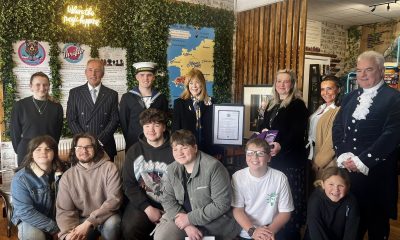
Milford Haven charity honoured with King’s Award for voluntary service
A PEMBROKESHIRE charity supporting vulnerable young people has received one of the highest honours in the UK for voluntary work....


News4 days ago
Plaid Cymru launches bid to lead next Welsh Government
Party positions itself as ‘government-in-waiting’ ahead of May election PLAID CYMRU has formally launched its campaign for the 2026 Senedd...


Crime4 days ago
Police appeal after attempted child abduction in Haverfordwest
DYFED-POWYS POLICE has launched an appeal for witnesses following a reported attempted abduction of a 12-year-old girl in Haverfordwest. The...


Crime5 days ago
Gunshot fired by police during incident in Milford Haven
A POLICE officer discharged a firearm during an incident in Milford Haven on Saturday evening (March 28), prompting an investigation...


Community6 days ago
Three Amigos Easter Run roars through Pembrokeshire
MOTORCYCLE enthusiasts turned out in force today (Saturday, March 28) as the popular Three Amigos Easter Run returned to the...
-

 News4 hours ago
Accommodation providers in Wales will be required to register under new law
-

 Charity4 days ago
RSPCA calls for stronger animal welfare measures as Welsh Labour launches manifesto
-

 Community6 days ago
Residents return home after major Carmarthenshire fire as probe continues
-
Business3 days ago
Fishguard to Wexford rail tunnel plan backed by Elon Musk firm
-

 Local Government6 days ago
Milford Haven Hakin Infants school site housing approved
-

 News6 days ago
West Wales man remanded in custody over serious sexual assault charge
-

 News7 days ago
Reform UK candidate quits days after Nazi salute row
-
 Tourism5 days ago
Moving to Australia from the UK: What you need to Kknow