


Farming
Welcome evidence of longer farm tenancies

THE TENANT FARMS ASSOCIATION has welcomed a report from the Central Association of Agricultural Valuers (CAAV) indicating that there has been a significant improvement in the average length of Farm Business Tenancies (FBTs) in England and Wales.
Since the introduction of FBTs in 1995 the TFA has been concerned that average lengths of term have ranged between only 3 to 4 years. As a result the TFA launched the FBT10+ campaign in 2015, the 20th anniversary of the introduction of the new legislation, to argue that farm tenancies had been too short for too long and that urgent change was necessary.
The short-term nature of agricultural tenancies has held back progression, investment, sustainable land use and productivity on farms. With much higher demand for land than supply, landlords can offer short-terms, for high rents at very little risk whilst at the same time pocketing generous and unconstrained tax benefits which the TFA argues must be addressed.
TFA Chief Executive George Dunn said: “It is encouraging to see from the CAAV report that the average length of all FBTs has increased to 4.5 years and that excluding lettings of less than a year, the average was six years. This is a step in the right direction towards the goal of seeing average lengths of term in excess of 10 years and clearly the TFA’s campaign has had an impact in encouraging more sustainable tenancy lengths being brought forward. However still more needs to be done to encourage the landlord sector to offer the longer terms that we need to see.”
“The new Government must grasp the nettle to introduce measures to change the fiscal environment within which rural landlords make decisions about letting land to encourage longer term FBTs. The tenanted sector cannot begin to consider issues of resilience and sustainability in the post Brexit environment with average lengths of term on new FBTs of under 10 years,” said Mr Dunn.

The TFA is arguing for the following measures to be in the new Government’s first Budget:
(a) Restricting the generous, 100% Agricultural Property Relief from Inheritance Tax (currently available to all agricultural landlords, regardless of the length of time for which they let land) only to those landlords prepared to let farmland for 10 years or more (excluding rotationally let land on short terms for vegetable and other high value crops).
(b) Clamping down on those land owners who, through schemes promoted by agents and accountants, are using share farming, contract farming, share partnerships and grazing licences as thin veneers of trading activity and as vehicles for aggressive tax avoidance where they take no risk in the business, have little, if any, entrepreneurial input and lack any management control.
(c) Offering landlords prepared to let farm land for 10 years or more the ability to declare their income as if it was trading income for taxation purposes.

(d) Reforming Stamp Duty Land Tax to end the discrimination against longer farm tenancies.
“The TFA is pleased to see that the Government has reconvened the Tenancy Reform Industry Group and this must be a key element for it to consider alongside other important measures to provide a sustainable framework for the tenanted sector of agriculture in the post Brexit era,” said Mr Dunn.



A CHARITY tractor road run across the Llŷn Peninsula will take place later this spring, raising money for two important health causes in north Wales.
The Welsh National Tractor Road Run (WNTRR) 2026 is scheduled for Sunday (May 31), starting at 10:00am from Crugarn Farm in Llanbedrog, near Pwllheli.
Organised by the Llŷn and Eifionydd Tractor Enthusiasts, the popular event will bring together tractor owners from across Wales and beyond for a scenic drive through the countryside while supporting charity.
This year’s run will raise funds for two beneficiaries: the Wales Air Ambulance and the Alaw Cancer Ward at Ysbyty Gwynedd in Bangor.
Support for vital services
The Wales Air Ambulance provides lifesaving emergency treatment across Wales, often reaching patients in remote rural areas where rapid response is critical. Meanwhile, Alaw Ward at Ysbyty Gwynedd supports cancer patients and their families across north Wales.

Organisers say the tractor run offers a chance for the farming and rural community to come together while raising money for causes that make a real difference.
The event has become a highlight in the calendar for vintage tractor enthusiasts, with tractors of all makes and sizes expected to take part.
Entry details for participants
Entries are open to tractor owners who wish to take part in the run. Entry costs £20 if submitted before the closing date of May 20. On-the-day entries will be accepted at £25.
Participants are asked to ensure their tractors are fully insured and road legal, and that drivers hold the appropriate licence.
All tractors are welcome, although larger machines will be grouped together at the rear of the convoy. Transport boxes and trailers with safe seating will be permitted, but standing passengers or bales are not allowed.
Caterers will be present at the start point and again during the lunch break, with toilet facilities available.
Late entries may be accepted, although organisers say drivers submitting forms after the closing date might not receive a souvenir or have their names included in the official programme.

How to enter
Drivers wishing to take part can request an entry form or further details from the event secretary, Anne Bates, by emailing [email protected] or calling 07721 910405.
Entry forms should be returned to Little Gigrin, Rhayader, Powys LD6 5NU.
Organisers say the run promises a relaxed day out for tractor enthusiasts and supporters alike, while helping to raise funds for two vital Welsh healthcare charities.

A PEMBROKESHIRE MP has said local farmers must be “at the heart” of upcoming UK–EU negotiations aimed at reducing trade barriers on agricultural products.
Henry Tufnell raised the issue with ministers this week, stressing that family farms play a crucial role in the county’s rural economy, culture, and food production.
Speaking about the negotiations, the Labour MP said new arrangements between the UK and the European Union could present a significant opportunity for Welsh agriculture if handled correctly.
Family farms central to talks
Mr Tufnell said he had asked the UK Government to confirm that the interests of farmers in counties like Pembrokeshire would be fully represented as discussions move forward.
“Family farms are the backbone of Pembrokeshire’s rural economy, culture, and food production,” he said.
“The UK’s upcoming negotiations with the EU will reduce trade barriers on agricultural products, presenting a significant opportunity for our local economy.”
He added that ensuring Welsh farmers benefit from improved market access must remain a priority.
“This week I asked the Minister to confirm that Pembrokeshire farmers are at the heart of these negotiations,” he said.
“I will keep working with both the UK and Welsh Labour Governments to ensure that Pembrokeshire farmers get the maximum benefit from our new relationship with the EU.”

Trade opportunities and concerns
Agriculture remains one of the sectors most affected by changes in the UK’s trading relationship with the EU following Brexit.
The European Union was historically the largest export market for British agricultural products, including Welsh lamb and beef, both of which are key industries in Pembrokeshire and across rural Wales.
Reducing regulatory barriers or simplifying export processes could make it easier for farmers to sell produce into European markets.

However, some farming organisations have previously raised concerns that future agreements could also lead to increased competition from imported food products if safeguards are not in place.
The National Farmers’ Union has repeatedly called for any new trade arrangements to protect high standards in animal welfare, environmental protection, and food safety.
Importance to Pembrokeshire economy
Farming remains a major part of Pembrokeshire’s economy, with family-run farms producing livestock, dairy, and arable crops across the county.
Many rural communities depend directly or indirectly on the agricultural sector through supply chains, food processing, tourism, and local employment.
Mr Tufnell’s comments come at a time when farmers are also facing rising costs for fuel, fertiliser, and feed, alongside ongoing uncertainty about agricultural support payments following the UK’s departure from the EU’s Common Agricultural Policy.
The MP said he intends to continue raising the issue in Westminster to ensure rural communities in West Wales benefit from any new trading opportunities.
“The priority must be making sure that farmers in Pembrokeshire are supported and able to thrive in the years ahead,” he said.
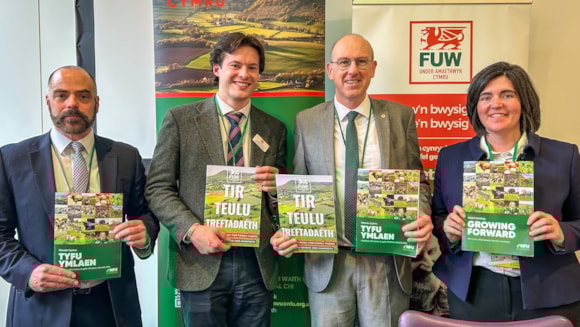
The Farmers’ Union of Wales (FUW) and NFU Cymru used their joint fringe event at Plaid Cymru’s recent Spring Conference, held at the ICC Newport, to reinforce their shared manifesto priorities and urge the next Welsh Government to deliver a fair, forward-looking budget that properly supports Welsh agriculture and the rural communities it sustains.
Chaired by Llyr Gruffydd MS, Plaid Cymru’s Agriculture and Rural Affairs spokesperson, the event provided a platform for both unions to set out the sustained financial pressures facing the sector.
They pointed to what they described as more than a decade of stagnation in the agricultural budget, warning that funding has failed to keep pace with rising costs and increasing regulatory and environmental expectations.
The unions argued that had overall funding kept pace with inflation over the past 13 years, the agricultural budget would now exceed £500 million – underscoring what they see as a substantial and growing gap between current allocations and the sector’s actual needs.
Speaking at the event, NFU Cymru President Abi Reader outlined the union’s key manifesto calls for a ring-fenced, multi-annual budget to support the sustainable growth of Welsh food and farming.
She said: “Welsh farmers must not be expected to do more for less. The next government must commit to providing a ring-fenced, multi-annual budget that matches our ambitions for the sustainable growth of the sector.
“This funding must underpin the financial resilience of our family farms and rural communities, while working in harmony with our environmental and climate obligations. We are calling for a budget in excess of £500 million per annum, with the majority of funding directed towards stability, productivity and efficiency gains on farm.
“We also call on the next Welsh Government to challenge the UK Government to ensure that future uplifts to agricultural support funding fairly reflect Wales’ needs, rather than being constrained by the limitations of the Barnett formula.”
The calls were echoed during the session by the FUW’s Senedd and Parliamentary Officer, George Lewes, who stressed that the next Welsh Government must also strengthen budgetary support for the forthcoming Sustainable Farming Scheme (SFS).
He argued that the transition to the new framework represents a significant structural shift for farm businesses and must be underpinned by adequate, long-term financial backing to ensure its success.
Commenting, he said:
“If we are to deliver on food security, climate and biodiversity goals, the scheme must be backed by a budget that matches those expectations.”
The fringe event also provided an opportunity for the unions to outline their wider shared ambitions for the sector ahead of the Senedd election. These included reducing on-farm bureaucracy, delivering a science-led and properly resourced strategy to eradicate bovine TB, and addressing ongoing concerns surrounding NVZ regulations and the unintended consequences they continue to create for family farms.
Concluding FUW President, Ian Rickman said: “Both unions have emphasised that alongside fair and sustained funding, meaningful regulatory reform and practical, evidence-based policies are essential to safeguarding the viability and long-term sustainability of Welsh agriculture.
Ahead of the Senedd election, we look forward to continuing constructive engagement with all parties to ensure these priorities are delivered for the benefit of our farmers, rural communities, and the wider Welsh economy.”



Crime10 hours ago
Man jailed after threatening to chop teen’s ears off in drunken phone call
17-year-old victim said she feared for her life after a series of threats A MAN who threatened a teenage girl...


Sport10 hours ago
Sean Bowen set for historic Welsh clash at Cheltenham Gold Cup
PEMBROKESHIRE jockey Sean Bowen could be part of a historic all-Welsh showdown when he lines up in the Cheltenham Gold...


Community11 hours ago
Tenby still waiting as Wales hits 50 rural mobile mast upgrades
Seaside town plagued by signal congestion again absent from latest government-backed coverage improvements A NEW milestone in the UK Government’s...


Crime1 day ago
Man raped 15-year-old girl in caravan while she was on family holiday in west Wales
Jury convicts Pendine man after court hears he raped intoxicated teenager in caravan during family holiday A MAN who raped...


Community1 day ago
Crash sparks fresh questions over future of former Haverfordwest library
CONCERNS have been raised about the future of a distinctive Haverfordwest building after a car crashed into it last week,...

Community2 days ago
Councillors vote to close Ysgol Clydau despite community concerns
Petition and protests fail to prevent closure of small rural school near Tegryn PEMBROKESHIRE COUNTY COUNCIL has voted to close...


News2 days ago
Rescue drama at Swanlake Bay as lifeboats race to aid hypothermic casualty
TENBY lifeboat crews were involved in a dramatic multi-agency rescue on Saturday morning (Mar 7) after a person suffering from...


Sport2 days ago
Wales show heart in Dublin but Ireland hold firm
Ireland 27 – 17 Wales – Aviva Stadium, Dublin – Guinness Six Nations, Round Four WALES produced their most encouraging...


Community3 days ago
Farm matriarch who built family poultry business dies aged 90
Tributes have been paid to the woman described as the “heart and soul” of a well-known Pembrokeshire family farm following...


Local Government3 days ago
Clean-up after yacht wrecked on rocks at Lower Town, Fishguard
A YACHT that ran aground on rocks at Lower Town in Fishguard is being cleared by Pembrokeshire County Council after...
-

 Community4 days ago
Whitland Post Office re-opens under new management
-

 Health1 day ago
Women’s health services ‘expanding’ across mid and west Wales says Health Board
-

 Health6 days ago
Davies and Kurtz attack ‘fantasy hospital’ pledge for west Wales
-
 Crime5 days ago
Man who threatened to kill police during Milford Haven standoff avoids jail
-

 Education6 days ago
NEU Cymru publishes manifesto to save education in Wales
-

 Ministry of Defence6 days ago
Welsh pride HMS Dragon to sail to shield UK’s Cyprus base
-

 Health7 days ago
Hywel Dda warns of ‘significant pressure’ as A&E departments remain packed
-

 Crime6 days ago
A teenage driver sentenced after pedestrian seriously injured on zebra crossing