


News
THE DEATH OF DEMOCRACY



Farcical scenes: The Council Chamber last Friday
THE EXTRAORDINARY meeting of Pembrokeshire County Council to decide if the Chief Executive, Bryn Parry Jones should be suspended has collapsed, amongst unprecedented scenes at County Hall last week.
On Friday, February 14, opposition Councillors were told by a top QC that they should withdraw from the meeting due to comments they had made in the press.
A stunned Cllr Bob Kilmister stood up and said “Can I just have a point of clarification please before other members go, I gave a response to the “Pembrokeshire Herald” and the question that they asked me was ‘Do you as an elected member support the growing calls for the chief executive to resign?’ Now I’m not aware that we have got that motion before us, I don’t believe that that is something that we can actually vote on as nobody is actually calling on him to resign.”
He added: “Now we have a notice of motion that is in that uses the word suspension. Suspension is a highly different thing to resignation. Resignation can only be done by the person concerned. I was asked my question about resignation and I said it in the chamber already that those people in that position should consider their position including that resignation.”
Cllr. Guy Woodham was next on his feet, saying: “I am one of the signatories on the notice of motion. When I gave the quote that appeared in the Pembrokeshire Herald, it said I believe it said the chief exec should be suspended pending an investigation. To me that doesn’t show pre-determination.”

Cllr. Reg Owens told the meeting: “Mr Chairman, are these names just the ones that came from the Pembrokeshire Herald? Because my name wasn’t read out and I gave my quote to the Western Telegraph. You have only been given the press cuttings from the Pembrokeshire Herald, You haven’t been given the press cutting from the Telegraph!”
Tim Kerr QC, the lawyer advising the Council on the ‘tax-dodge’ pension arrangements read out a list of Councillors who he felt could not participate in the meeting due to negative comments they had made about Bryn Parry Jones in the local press.
In light of this, most members of the opposition walked out of the council chamber and the one remaining signatory to the notice of motion that Bryn Parry-Jones be suspended, Cllr Phil Baker, withdrew the vote.Cllr. Phil Baker told the Herald after the meeting: “I knew something was afoot when the QC was allowed to remain after the Wales Audit Office report was discussed.”
He added: “I think that a lot of IPPG members as well as opposition Councillors are not happy about what has happened today. Very shabby indeed, it’s like the old East Germany.”


Labour leader: Cllr Paul Miller
Pembrokeshire Alliance
The Pembrokeshire Alliance Group have made a statement about the meeting:
A spokesperson said: “This meeting was an insult to democracy. The people of Pembrokeshire deserve openness, transparency and good governance and this meeting was an example of what happens when these principles are quite deliberately not followed.”

The Pembrokeshire Alliance Group says it is now in discussions with other opposition groups and non-affiliated Councillors as to what should happen next.
AM wants Bryn stripped of returning officer powers
Welsh Labour AM Rebecca Evans has called for embattled chief executive of Pembrokeshire Council Bryn Parry-Jones to be stripped of his role as Returning Officer for Wales in the European elections this May until local Councillors are allowed to debate the issue properly and the police investigation has concluded.
Rebecca Evans AM, Assembly Member for Mid and West Wales said: “After the embarrassing spectacle that was Friday’s ‘extraordinary meeting’ of Pembrokeshire council, it is clear that the Pembrokeshire council leadership is content to allow the debate to descend into farce rather than grapple openly and in public with the serious issues presented by the Wales Audit Office reports.
“It would now be utterly preposterous for Bryn Parry Jones to preside over the European Ballot as Returning Officer while his pension payments are still under police investigation. The public must have complete confidence in the election process, and in all of the people involved. Until the police investigation is concluded, alternative arrangements must be made – and that means relieving Bryn Parry Jones of his Returning Officer role.”
Paul Miller, leader of the Labour group in Pembrokeshire said: “Sometimes, particularly around planning issues, pre-determination rules help ensure fairness but last week it was worrying to see those rules used to stifle debate and silence critics in a totally unjust and undemocratic way. Many opposition Councillors felt cornered having a QC tell them that they had to leave. Having sought legal advice, I know that no Labour councillors pre-determined the debate. Pre-determination is a matter for individuals not lawyers. Enlisting a barrister in a crude attempt to undermine our roles as Councillors and prevent us from seeking to represent the views of our constituents on this hugely important issue is nothing short of Orwellian.
“The public deserve reassurance that this matter is being dealt with properly. I will not lie down and be silenced by the puppet administration running Pembrokeshire, and will continue to fight to ensure the full council are able to debate this.”
Angela Burns urges Bryn to step aside
AM Angela Burns has called for Pembrokeshire council’s chief executive to step aside.
She said: “I would say that he should stand aside. I’m perfectly happy for the status quo to be restored, providing the police investigation comes up saying that everything is as it should be.”
Mrs Burns said: “I would like to see an independent investigation being undertaken because I feel that the councillors involved here have acted with the most extraordinary behaviour.”
Plaid Cymru speaks out
Pembrokeshire Plaid Cymru leader Cllr Michael Williams has called on the Welsh Government to intervene in the running of Pembrokeshire County Council.
Cllr Williams told The Herald: “The recent events are yet more evidence of the gross incompetence of the Independent Group which presently masquerades as the controlling group of the Council. We say “masquerade” as it is patently obvious that the authority is run by a small cabal of out of control senior officers orchestrated by the Chief Executive, who are bringing the Council into disrepute.”
He added: “After their appalling performance in the Council meeting on Friday, is it any wonder that PCC is the laughing stock of Wales? Pembrokeshire tax payers deserve better. We deserve honesty and integrity, and they have consistently failed to deliver.”
“This Council staggers from crisis to crisis, from travel claims which were years late from the Leader to the misuse of Council computers by Councillor Rob Lewis to produce Independent group election literature. This together with failures to properly safeguard our children, a failed social care provision and recently dubious grant dealings in Pembroke Dock render them unfit.
“It was amazing to see on Friday their efforts to extricate themselves from their self-inflicted problems. Legal advice of forty five pages, which we, as elected Members, were not allowed to see, and the costs of at least one Q C, with another expert flown in from Edinburgh. This, plus the mysterious brown envelope left on the passenger seat of the Council vehicle which transported the Q C with information enclosed selectively identifying those Members who had stated that the CEO should go. “The rulers of North Korea would be proud.
“Mr Parry-Jones should step aside immediately, and take his poodle, Jamie Adams with him. The Welsh Government should immediately install Commissioners to take over the running of PCC” he concluded.
QC advice was ‘not the whole story’,says Herald
The Pembrokeshire Herald took independent legal advice before publishing comments made by County Councillors this month, in the days leading up to the vote over the suspension of chief executive of Pembrokeshire council, Bryn Parry Jones.
During the extraordinary meeting of Full Council, members were told to withdraw by a barrister appointed by senior officers and leaders of the authority.
Mr Tim Kerr QC told members that some of them had ‘crossed the line’ by showing predetermination over whether the chief executive should be suspended. Mr Kerr told members that this predetermination was demonstrated by comments made in the newspaper article.
Mr Kerr had been given photocopies of selected press cuttings from The Pembrokeshire Herald’s February 7 edition by the monitoring officer, Mr Laurence Harding. He told the meeting that the newspaper article had been ‘brought to his attention’ but refused to say by who. However, Deputy Leader, Cllr Rob Lewis told members that he also had copies of the same documents. He did not, however, admit to giving them to Mr Laurence Harding.
Pembrokeshire Herald editor Thomas Sinclair said: “There is legislation regarding the issue of predetermination that was not brought up at the meeting. Section 25(2) of the Localism Act 2011 provides that ‘a decision-maker is not to be taken to have had, or to have appeared to have had, a closed mind when making the decision just because the decision-maker had previously done anything that directly or indirectly indicated what view the decision-maker took’.”
Mr Sinclair added: “This legislation clearly applies to all County Councils in Wales & England, but a very restrictive interpretation of it was given to Councillors at Friday’s meeting.”
He concluded: “In the newspaper’s view if Lawrence Harding was acting in the best interests of all the members of the council, he would have advised members of any issue with what they had said before the meeting.”


Fire set in shared home left sleeping residents at risk and caused £130,000 damage
A TEENAGER who started a fire in his bedroom while other residents slept has been jailed for four years.
Jack Gornall, aged 18, of no fixed abode, was sentenced at Swansea Crown Court after admitting a series of offences including arson, threats with a knife, assault, and sending malicious communications.
The court heard that in the early hours of Sunday (Nov 17), Gornall deliberately started a fire inside his room at a shared property on Mansel Street, Carmarthen.
He then barricaded the door before climbing out of a first-floor window, leaving others inside the building at risk.
One resident was asleep at the time and had to be rescued by police. Two officers were later treated for smoke inhalation after tackling the incident before firefighters brought the blaze under control.
The fire caused extensive damage to the property, estimated at around £130,000.
Prosecutor Dean Pulling told the court that Gornall had earlier gone out to buy cigarettes and a lighter, and had carried out internet searches relating to accelerants in the days leading up to the fire.
The court also heard details of other offences.
In October 2024, Gornall repeatedly contacted his sister after being blocked, including calling her child’s phone. When she answered, he became abusive and threatened to report her to social services.

On another occasion in January 2025, he approached a car in Llandysul and produced a kitchen knife, waving it at occupants through an open window. The driver sped away and alerted police.
He also admitted stealing alcohol from a supermarket in Carmarthen, during which he became aggressive and assaulted a member of staff.
Gornall pleaded guilty to all offences at an early stage.

Judge Catherine Richards sentenced him to four years’ detention in a Young Offender Institution.
Climate
Port Talbot confirmed as ‘cornerstone’ of wind industry — questions remain for Milford Haven
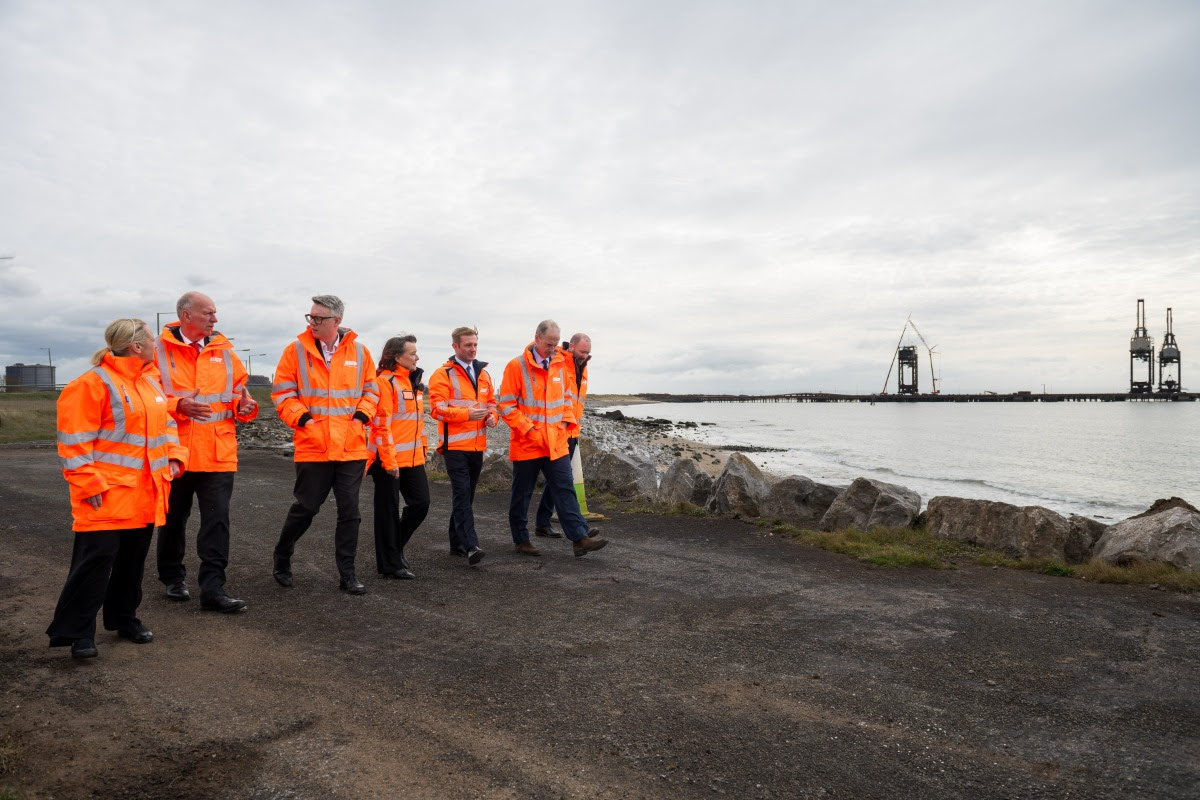
New government-backed deal with ABP reinforces Port Talbot’s central role in Celtic Sea wind plans
PORT TALBOT has been firmly established as the “cornerstone” of the UK’s floating offshore wind ambitions in the Celtic Sea, following a major agreement between the UK Government and Associated British Ports.
The deal confirms government support for the development of large-scale port infrastructure at Port Talbot, enabling manufacturing, assembly and deployment of floating wind turbines for gigawatt-scale projects.
The announcement strengthens Port Talbot’s position as the primary industrial hub for the emerging sector.
Henrik L. Pedersen, Chief Executive of Associated British Ports, said the development would “establish the port as a cornerstone of the Celtic Sea floating offshore wind industry.”
Clear role for Port Talbot
The agreement, subject to final regulatory approval, will support the delivery of major offshore wind projects awarded through the latest Celtic Sea leasing round.
Government ministers visiting the site described the development as a key step in building the UK’s clean energy future.
Energy Secretary Ed Miliband said the project would help Wales “storm ahead in floating offshore wind,” supporting thousands of jobs and driving economic growth.
Secretary of State for Wales Jo Stevens added that the investment would “further cement Port Talbot as a hub of the industries of the future.”
Milford Haven still waiting for detail
The latest announcement comes just days after questions were raised about Milford Haven’s role within the wider Celtic Freeport.

While Port Talbot’s position as a manufacturing and assembly hub is now clearly defined, there has still been no detailed breakdown of what activity will be based in Pembrokeshire.
Industry figures continue to point to Milford Haven’s strengths in operations, maintenance, logistics and servicing of offshore wind projects.
However, no formal commitments have yet been made.

Industry backing grows
Developers involved in Celtic Sea wind projects welcomed the progress at Port Talbot, describing it as essential infrastructure for delivering future schemes.
Ocean Winds said strengthening port infrastructure was “essential” to ensuring regional ports can support the rollout of offshore wind.
The Crown Estate also described the move as a key step towards unlocking the economic potential of the Celtic Sea, which could create thousands of jobs across Wales and beyond.
Growing pressure for answers
With Port Talbot now firmly positioned at the centre of construction and deployment, attention is likely to turn to how other ports—including Milford Haven—fit into the wider strategy.
For Pembrokeshire, the question remains unchanged:
As billions of pounds flow into the Celtic Sea over the coming decade, will Milford Haven secure a defined share of that investment—or continue to wait for clarity?
Pictured above:
From left to right: Cabinet Secretary for Economy, Energy and Planning, Rebecca Evans; David Rees MS for Aberavon; Minister for Energy Consumers, Martin McCluskey; Secretary of State Jo Stevens; Ashley Curnow, Divisional Port Manager (ABP); Julian Walker, Chief Commercial Officer and Regional Director (ABP), Mike Goddard, Head of Programme, Future Port Talbot (ABP)


Local athlete Mogsy Morgan breaks into world top ten in elite ocean discipline
TENBY waterman Gareth “Mogsy” Morgan is making a name for himself on the world stage after breaking into the top ten of one of the most demanding single-handed watersports disciplines.
Morgan has been ranked sixth in the world in the latest Hydrofoil Downwind leaderboard for 2026, based on performance over a 10km ocean swell navigation split—an elite benchmark in the sport.
Hydrofoil downwinding involves riding offshore ocean swells using a board, hydrofoil and paddle, often far from shore and exposed to challenging conditions. Athletes use GPS tracking to log their routes, which are then uploaded to global ranking systems for comparison.
Morgan said he is now competing alongside some of the sport’s biggest names, including Hawaiian world champions John Florence and Nathan Florence.
“I’m right up there in the world rankings,” he said. “I’ve trained hard to get into peak condition, and I’m continuing to improve my performance. The momentum is definitely on my side.”
He added that the sport offers a unique experience: “There’s a real flow state when you’re riding ocean swells—linking one wave to the next. It’s an incredible, almost meditative feeling, even though you’re exposed to real hazards offshore.”
Morgan has spent recent years travelling internationally to develop his skills, bringing that experience back to Wales as he pushes towards even higher rankings.
His recent success builds on a strong 2025, when he placed 69th in the world for the same 10km category and also ranked within the top 100 for shorter sprint distances.
“I’ve already improved on my 2025 results in the first few months of this year,” he said. “My goal now is to break into the top 50 worldwide.”

Morgan was an early pioneer of hydrofoiling in Wales, first adopting the technology during his time competing in the British Kite Racing Circuit, where he secured a third-place podium finish in his division.
He was also invited to take part in Olympic kite racing trials at the British Sailing Academy in Weymouth and has previously been crowned UK Kitesurfing Circuit Wavemaster Champion in his category.
Today, he continues to promote the sport locally by organising hydrofoil events across Pembrokeshire and South Wales, helping to grow interest and develop new talent.
With his sights firmly set on climbing the global rankings, Morgan added: “I’m still getting faster and pushing the limits. Watch this space—Cymru am byth.”



Crime4 hours ago
Teen jailed after starting fire while others slept
Fire set in shared home left sleeping residents at risk and caused £130,000 damage A TEENAGER who started a fire...


Health10 hours ago
GP crisis driving NHS pressure in Wales, Senedd report warns
Falling GP numbers and funding gaps blamed for worsening hospital delays THE NHS crisis highlighted earlier this week is being...


News1 day ago
Reform reveals west Wales candidates for Senedd battle
Monkton councillor tops Pembrokeshire list as party confirms Carmarthenshire names and includes Haverfordwest councillor in unwinnable Swansea spot REFORM UK...


Health1 day ago
Clash over Withybush Hospital services as Paul Davies challenges First Minister
A HEATED exchange in the Senedd has laid bare growing tensions over the future of hospital services in west Wales....


Crime2 days ago
Police stop car in Pennar as three arrested in drugs investigation
Suspected drug driver report leads to major police response and multiple arrests DRAMATIC scenes were reported in Pennar on Monday...


Business2 days ago
New pilot vessel Llanion arrives at Milford Haven
State-of-the-art 22-metre craft marks reset after £3.6m pilot boat controversy THE PORT OF MILFORD HAVEN has taken delivery of a...


Community3 days ago
Sycamore Gap legacy tree to take root in Pembrokeshire landscapes
A SAPLING grown from the famous Sycamore Gap tree is set to become part of Wales’ protected landscapes — with...


Business3 days ago
Could Primark be coming to Haverfordwest? Major retailer in talks for former Wilko site
Council confirms advanced discussions as speculation grows over high street boost HAVERFORDWEST could soon see a major high street revival,...


Business3 days ago
Rail investment ‘could unlock 40,000 jobs and £11bn for Wales’ says new report
RAILWAY stations across Wales could help unlock around 40,000 jobs and more than £11 billion for the economy by 2036,...


Local Government3 days ago
Milford Haven set for £200m investment with schools, leisure centre and rail upgrade
Council outlines major plans for town with backing from Welsh Government MILFORD HAVEN is set for a major transformation with...
-

 Crime6 days ago
Pembroke man remanded in custody over knife threat, assault and damage allegations
-

 Crime6 days ago
Broad Haven man remanded in custody over sexual harm prevention order breach
-

 Crime6 days ago
Publican jailed for six years for supplying cocaine and cannabis
-

 Business7 days ago
Plans to rebuild arson hit building at farm with one of largest sheep flocks in Wales
-
Business3 days ago
Could Primark be coming to Haverfordwest? Major retailer in talks for former Wilko site
-

 Business7 days ago
Rosemarket Dawn Till Dusk golf club 18-hole plans lodged
-

 Education6 days ago
4 Essential Cyber Security Tips to Protect Your Data
-

 News6 days ago
Pembrokeshire’s Muslims gather to celebrate Eid al-Fitr as Ramadan ends
Teifion
February 28, 2014 at 7:59 am
So let’s get this right, a London QC paid for by the Pembs. tax payer basically stops councilors who have expressed an opinion NOT favourable to Bryn Jones are told they cannot vote BUT those who support him through thick and thin and have told the press they will continue to do so and as I understand get special allowances from the Council ARE allowed to vote – No wonder the place is called the Kremlin on the Cleddau.
I can only hope the more decent and honest members of the IPPG have been disgusted by actions and acts conducted in their name will revolt against Mr Adams when the vote comes
rath_riviera
March 1, 2014 at 11:39 am
Seems there is a lack of understanding in Council between the technicality of the law and the spirit of the law. If speaking to the press provides rationale for stating pre-determination, then any pre-meeting conversation could be construed the same so that IPGG meetings would be an equivalent technical problem? The payment of a QC under these circumstances appears a questionable use of public funds: as a tax-payer, how am I gaining by paying for certain individuals being able to de-rail a Council meeting by show-boating a QC? Did full council have notice a QC would be present (and why)? It is reasonably foreseeable that the outcome would be a publically funded Council meeting being de-railed so that a vote the whole County wants cannot take place. Why not have him pop out of a cake? Whatever the technicalities, perception of foul-play is undermining integrity and trust. On top of the apparent shambles with pension funds, educational degradation, and current investigations into property, are we obtaining value for our money? Who sanctioned the QC payment? When was the last time the accounts were independently audited?