


News
Legal action threatened over ‘councillor’s’ status


THE COUNCIL’S Legal Department has failed to respond to two pre-action letters sent by solicitors acting on behalf of the local authority’s Labour Group as thedilemma over the future of David Boswell’s membership of the Council has taken yet another turn.
The Herald understands that the Council’s Legal Department now fears that if the Pembroke St Mary North ward was declared vacant, Mr Boswell might have a legal action against the local authority.
That potenital threat is two-fold: firstly, in relation to any change of position on the advice from Monitoring Officer Claire Jones he has relied upon; and, secondly, in respect of the potential prejudice formally removing him might cause to his scheduled trial at Swansea Crown Court.
Had Mr Boswell’s trial taken place as scheduled neither of the above issues could possibly have arisen.
Suspicion is growing among some council members that Council officers were counting on the trial being over to avoid embarrassment over the advice given to Mr Boswell by the officer upon whose advice they are entitled to rely upon as the last word.
However, the legal pressure has grown upon the authority. A letter before potential proceedings has been sent by a firm of solicitors acting for the Association of Labour Councillors.

With their initial letter unanswered, a second letter has now been sent from those solicitors which takes the Council to task both for their failure to respond to a letter marked ‘URGENT’, but also for statements made by the Monitoring Officer to the press and alleged comments made to councillors.
The Herald can confirm that despite receiving both letters, the Council has failed even to acknowledge their receipt at the time we went to press.
To quote the ALC Solicitor letter to the council: “We strongly disagree with your interpretation of this legislation and urge you to declare the vacancy as soon as possible. We do not consider that it is accurate or reasonable to describe a members’ seminar as a meeting of the local authority.”
The Council’s position turns on whether or not seminars for members are council meetings.
If they were Council meetings, the Council’s Legal Department would have been able to provide minutes of those meetings.
Council meetings, at law, are subject to rules in relation to publishing the agenda, setting out the the timetable, clear rules in regards to voting, and minute taking.
None of those apply to a seminar.

And the Council’s Legal Department refused to provide any of the information that define a Council meeting to this newspaper, claiming that it wanted to explain the legal situation to members first.
What that has to do with providing information that – if it exists – would prove the Monitoring Officer’s contention that seminars are meetings is unclear.
The Solicitors’ letter sent to the authority, sets out that position with a stinging rebuke to the Legal Department’s stated position, saying: ‘If it does not sound like a council meeting and it does not act like a council meeting, then it is more than likely not a council meeting’.
And ‘more likely than not’ is the key legal test. Not beyond a reasonable doubt, as in criminal proceedings.
Of course, the Council’s position would be stronger if it did not publish information likely to be of assistance to other potential parties to litigation.
At a meeting in 2011, a key Council committee considered a range of governance issues including member attendance at meetings.
The committee endorsed the position that members’ attendance should be published.
It even set out what meetings would be covered.
‘That the recording period cover each municipal year, and the record apply to attendances at formal Council body meetings (Council; Cabinet; Committees and Sub-Committees)’.
More fundamentally, it ‘suggested that training events/seminars be included in the attendance record’.
The distinction between what the Council then resolved were meetings on the one hand and members’ seminars and training on the other is crystal clear. If seminars were ‘meetings’ under the law, attendance would be recorded as a matter of course.
That is not the whole list of what is in the law covering council meetings. That also includes meetings which councillors attend as representatives of the authority.
However a list of what constitutes a council meeting cannot just be added to as and when a local authority finds convenient. A strong legal position would be that just because a statutory list of ‘meetings’ is not comprehensive (which is a fair reflection of the legal department’s position on the Local Government Act) that does not mean meetings which do not meet the criteria for council meetings can then be called council meetings.
The ridiculousness of the situation is best illustrated by the fact that on Wednesday (Feb 28), Mr Boswell attended a members’ seminar of an authority of which he is quite possibly no longer a member, while no press or public were admitted to the ‘council meeting’, no minutes were kept, and no agenda was published.
Why the Council’s legal department has been so reticent about replying to an urgent solicitors’ letter is a mystery, although no suggestion is made that it is either because council officers are hoping to ‘run down the clock’ in order to forestall taking any action at all or because they are paralysed by indecision.
In an email sent to all county councillors marked ‘CONFIDENTIAL’ in large red letters the Monitoriing Officer forcefully reminds members not to say anything that might jeopardise Mr Boswell’s trial. The Council’s monitoring officer appears also to suggest the Council has advice from ‘Leading Counsel’ (usually a QC) to support its position.
Advice from a barrister, even a leading one, is usually dependent on the content and quality of the instructions sent to one. There is a world of difference between a barrister being asked to advise a client and a barrister being asked to advise how a client might wriggle off a hook of their own making.
There is also a faint suggestion that legal advice obtained by the Council for the benefit of the authority might not be shared with all members. The way in which the email is set out makes it difficult to determine whether the Monitoring Officer would propose releasing advice on a limited basis. In addition, when quoting the Code of Conduct, Ms Jones states that members of a political party should consider whether or not they should declare ‘either a personal or prejudicial interest when speaking and voting’ on business of the authority.
That section of the email appears to be a remarkable attempt to prevent any debate by councillors of the cleft stick the council’s own officers have placed the authority in.
With dire warnings about ‘predetermination’ and ‘recent media stories’, Claire Jones seems to confuse discussing the potential that she might have got it wrong with expressing a view on whether or not Mr Boswell is guilty of the allegations – and that is all that they are – he faces.
The latter, it goes without saying is – quite properly strictly forbidden – the former is not the same thing at all.
Ms Jones’ email warns councillors of the dangers of expressing views as to whether or not she is wrong before an occasion upon which elected members can express a view. However, Ms Jones will know that pre-sentiment is not pre-determination, that councillors are permitted to make their minds up for themselves, and that the purpose of the rules about pre-determination and potential bias, as made clear by guidance given by the Public Services Ombudsman, is not to stifle either political or public discussion of contentious issues.
In addition, seeking advice on whether the Monitoring Officer is herself right or wrong is not predetermination by any means.










First Milk site secures four major trophies as co-operative celebrates 26 awards at International Cheese & Dairy Awards
FIRST MILK’S Haverfordwest Creamery has celebrated major success at this year’s International Cheese & Dairy Awards, after helping the farmer-owned co-operative secure 26 awards at the world’s largest cheese show.
First Milk won eight gold medals, 11 silver medals, one bronze medal and six major trophies at the prestigious awards, with cheese produced at Haverfordwest Creamery securing four of the competition’s top honours.
The Pembrokeshire creamery won the CHR Hansen Trophy for Champion Double Gloucester, the Tetra Pak Tebel Award for Best Extra Mature Creamery Block Cheddar, the ICDA Award for Best Medium Creamery Block Cheddar and the First Milk Past Masters Trophy.
The results underline the quality and consistency of the cheese produced at the Haverfordwest site, which continues to play a key role in First Milk’s award-winning cheesemaking operation.
Held annually, the International Cheese & Dairy Awards attracted its highest number of entries in several years, with many of the creamery cheddar classes receiving between 30 and 40 entries.
First Milk was recognised across a wide range of cheddar and regional cheese categories, including Double Gloucester, Red Leicester, Welsh cheese, vegetarian cheese and English creamery cheddar.
Jack Eade, Customer Quality Manager at First Milk, said the awards reflected the hard work of teams across the business.
He said: “These awards are incredibly hard won and reflect the dedication, expertise and passion of everyone involved in producing our cheese.
“To receive recognition across so many categories at one of the world’s most respected cheese competitions is something everyone at First Milk can be enormously proud of.
“While our grading team selects and prepares the entries, none of these achievements would be possible without the commitment of our farmer members producing exceptional quality milk, and the highly skilled teams at our creameries transforming it into consistently award-winning cheese.”
The latest success continues First Milk’s long-standing record at the International Cheese & Dairy Awards and reinforces Haverfordwest Creamery’s reputation as one of the leading producers of award-winning British cheese.
Photo caption:

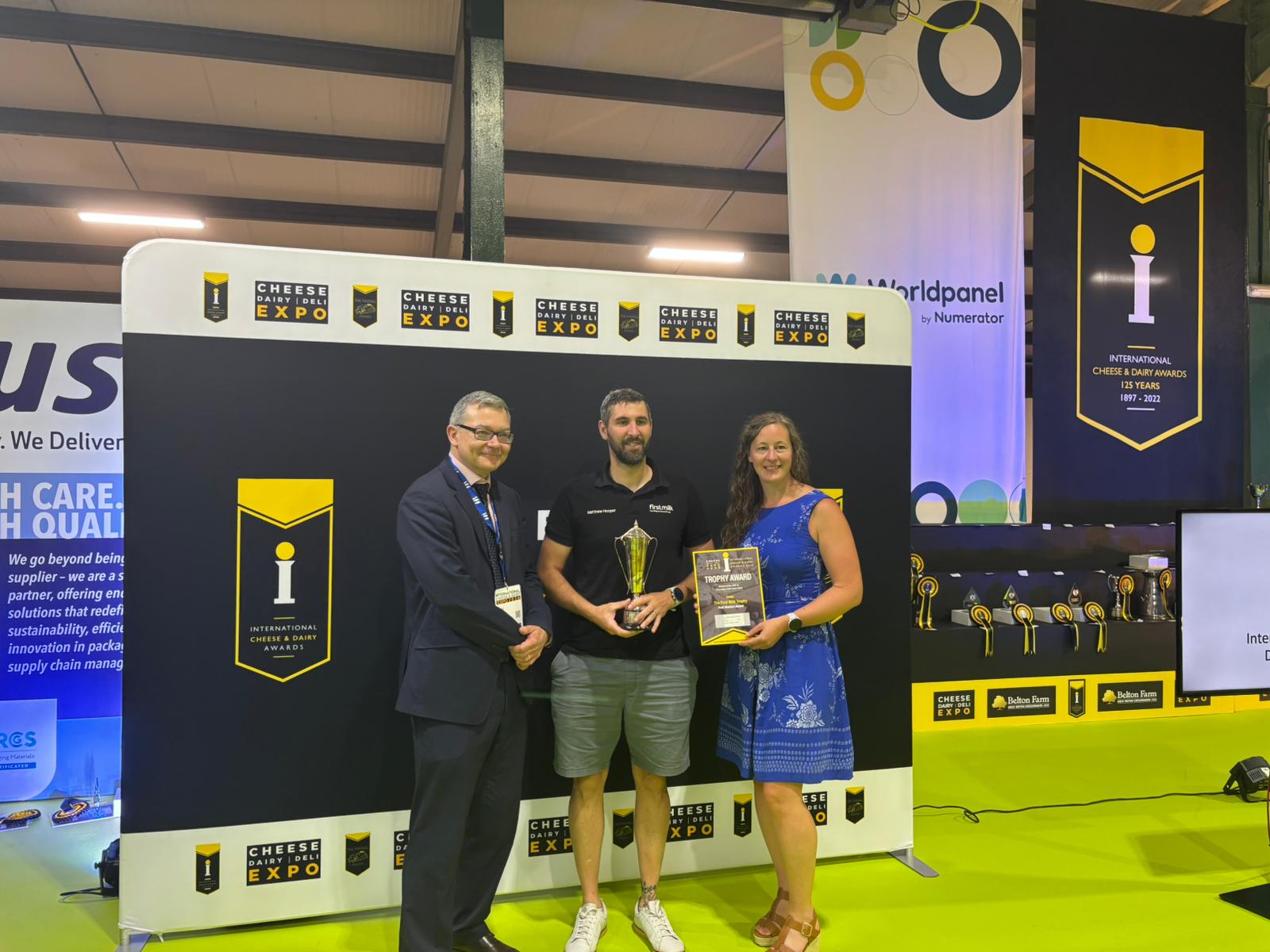
Rod Addy, Director General of the Provision Trade Federation, with First Milk’s Matthew Hooper and Dawn Mason at the International Cheese & Dairy Awards

FINAL preparations are underway for one of the biggest celebrations of transport heritage in Wales, as the Llangollen and Corwen Railway prepares to welcome thousands of visitors to its Classic Transport Weekend this Saturday and Sunday.
The event, taking place on July 4 and 5, will bring together close to 400 classic vehicles, three heritage train services, vintage shuttle buses, live music, family entertainment and a packed programme of attractions across the Dee Valley.
Glyndyfrdwy Station will once again form the centrepiece of the weekend, opening to visitors from 9.15am. Displays will include classic cars, motorcycles, vintage buses, military vehicles, tractors, commercial vehicles and rare fire engines, including the famous Green Goddess.
Visitors will also be able to enjoy unlimited travel on the railway throughout the weekend, with services operated by GWR Pannier Tank No. 7754, a Class 47 diesel locomotive and a classic four-car heritage DMU.

Trains will link all five stations on the line at Llangollen, Berwyn, Glyndyfrdwy, Carrog and Corwen, giving visitors the chance to explore the full railway.
Vintage shuttle buses will run approximately every 30 minutes between Corwen and Glyndyfrdwy, helping visitors move easily between different parts of the event.
New for this year is the exclusive Class 507 Driving Simulator, which will be based in the historic waiting room at Llangollen Station.
Created by the Class 507 Preservation Society using genuine controls rescued from withdrawn Merseyrail trains, the simulator gives visitors the chance to experience what it is like to drive one of Britain’s best-known electric trains.
Food and drink will also be available throughout the weekend. The Hungry Shunter will be serving freshly prepared food, while two fully licensed bars will offer Welsh ales from Hafod Brewery and Purple Moose Brewery, along with wines selected by Pip Gale of Blas Wine School.
Visitors can also relax at Glyndyfrdwy Station Tearoom and Porter’s Bar.
Saturday’s programme will continue into the evening with the popular Party in the Park, where the internationally acclaimed Froncysyllte Male Voice Choir will perform from 7.00pm in marquees beside the railway.
The concert is free for all Classic Transport Weekend ticket holders. Evening-only tickets are also available for £5.

Visitors will also be able to travel on the special Pavarotti Special heritage bus from Corwen before returning on a complimentary heritage railcar after the performance.
Classic Transport Weekend organiser Tim Hines said: “Everything is now in place and we’re ready to welcome visitors for what promises to be a fantastic weekend.
“Wherever you look there will be something happening, from steam trains and heritage diesels to vintage railcars, hundreds of classic vehicles, vintage buses, great food, live music and a wonderful atmosphere across the whole railway.
“One ticket gives visitors unlimited train travel and access to everything that’s happening at Glyndyfrdwy. Whether you’re a lifelong transport enthusiast or simply looking for a great family day out, there really is something for everyone.”
Co-organiser George Walker added: “The response from vehicle owners has been incredible.
“To have close to 400 exhibits travelling to Glyndyfrdwy is a wonderful achievement and we’re immensely grateful to everyone who has chosen to be part of this year’s event.
“You’ll see everything from beautifully restored classic cars and vintage buses to historic tractors, military vehicles, motorcycles, commercial vehicles and some wonderful surprises.
“There really is nowhere else where you’ll find this combination of road and rail heritage brought together in such a spectacular setting, and we’re incredibly proud to welcome everyone to Glyndyfrdwy this weekend.”
Free parking is available at Glyndyfrdwy, although spaces are limited.
Visitors are being encouraged to travel by train from Llangollen, Berwyn, Carrog or Corwen wherever possible, and make the journey part of the experience.
Classic Transport Weekend tickets include unlimited train travel, access to the vehicle displays, vintage shuttle buses and free admission to Saturday evening’s Party in the Park.
For more information and to book tickets, visit llangollen-railway.co.uk/classic-transport-weekend


A 24-YEAR-OLD man has been sent to Crown Court to face a series of alleged drug supply offences in Cardigan.
Harrison Casey, of Harebell Way, Brownsover, Rugby, appeared before Aberystwyth Magistrates’ Court on Wednesday (Jul 2).
He faces six charges relating to alleged offences at Bridge Street, Cardigan, between April 7 and April 24, 2023.
The charges include being concerned in the supply of cocaine, a Class A drug, and being concerned in the supply of cannabis, a Class B drug.
Casey is also accused of possessing cannabis with intent to supply, possessing tetrahydrocannabinol with intent to supply, being concerned in an offer to supply THC edibles, and possessing flualpazolam, a Class C drug.
There were no pleas to the charges at this stage.
Magistrates sent the case to Swansea Crown Court for trial under Section 51 of the Crime and Disorder Act 1998.
Casey was granted unconditional bail and is due to appear at Swansea Crown Court on August 3 for a plea and trial preparation hearing.



Community14 hours ago
Saundersfoot Harbour regeneration project wins national planning award
SAUNDERSFOOT HARBOUR’S redevelopment has been named Best Project at the RTPI Cymru Awards for Planning Excellence 2026. The award recognises...


Business20 hours ago
Pembrokeshire-based Ascona Group expands UK portfolio with Truckhaven acquisition
PEMBROKESHIRE-BASED Ascona Group has completed the acquisition of Truckhaven (Carnforth) Ltd, a major trunk road services area in Lancashire. The...


Health2 days ago
Wales begins early NHS winter planning after long waits and ambulance pressure
Ministers say health boards and councils must act now to ease pressure on hospitals, ambulances and social care before winter...

Crime3 days ago
Judge calls pensioner a ‘dirty old man’ as he avoids jail for exposing himself to women
Judge says 75-year-old Stewart Laugharne behaved ‘disgracefully’ as he avoids jail but is ordered to sign sex offenders register A...
Health3 days ago
Stroke services consultation reaches halfway point as public urged to have say
HYWEL DDA University Health Board is urging people to take part in its consultation on the future of stroke services,...


Business3 days ago
Welsh firms eye share of £5bn defence drone boom
WELSH defence and aerospace firms could be in line for a share of billions of pounds in new military spending...


Community5 days ago
Thousands line Cardigan streets for Lord Rhys homecoming parade
THOUSANDS of people lined the streets and quayside in Cardigan on Saturday as the town marked 850 years since Lord...


Crime6 days ago
Dyfed-Powys Police rated only ‘Adequate’ in organised crime inspection
A WATCHDOG has rated Dyfed-Powys Police only “Adequate” in its response to serious and organised crime, despite praise for the...


News6 days ago
Two taken to hospital after aircraft ditches in Cardigan Bay
Coastguard helicopter spotted two casualties after light aircraft came down off west Wales coast TWO people were taken to hospital...

Sport7 days ago
Long Course Weekend gets underway in Tenby as thousands head for county
Three days of swimming, cycling and running begin with The Wales Swim at North Beach THOUSANDS of athletes and supporters...
-
Crime6 days ago
Dyfed-Powys Police rated only ‘Adequate’ in organised crime inspection
-

 Entertainment7 days ago
Torch cuts children’s cinema tickets to £5.25 for summer
-

 News4 days ago
Biker dies and woman seriously injured in Black Mountain crash
-

 Climate7 days ago
Welsh waters, Westminster profits: Crown Estate row reignited in Wales
-

 Crime7 days ago
Former Swansea Prison inmate died 48 hours after release
-

 Community7 days ago
Working-class young people ‘shut out’ of marine conservation careers in Wales
-

 Crime6 days ago
Swansea man jailed for 16 years after attacking vulnerable woman
-
Community5 days ago
Thousands line Cardigan streets for Lord Rhys homecoming parade