


News
Pembroke Castle excavation completed


THE TWO WEEK archaeological excavation of Pembroke Castle has finished, with much information and material gathered to be analysed.
Dyfed Archaeological Trust, funded by the Castle Studies Trust, started the excavation on September 3, the first at the site for over 70 years. The excavations and topographic survey aimed to further advance the understanding of one of Wales’ and the UK’s most iconic castles.
The large outer ward has been an empty space since at least the eighteenth century, yet aerial photographs in 2013 revealed parch marks detailing the outline of a possible late medieval double-winged hall house. This was further confirmed by geophysical surveys carried out by Dyfed Archaeological Trust, funded by the Castle Studies Trust, in 2016. Such buildings are unusual in castles, particularly in the outer ward, generally associated with more lowly structures. This may suggest that the ward had been ‘gentrified’ matching historical accounts which place the birth of Henry Tudor in the outer ward: it may have occurred within this very building. It is thought more likely that he was born in what was a modern residence for the time, than in a guard tower on the castle walls.
Under the guidance of well-known castle expert Neil Ludlow, Dyfed Archaeological Trust excavated two trenches to understand more about the form, date, context and function of the remains. Additionally, they carried out a topographic survey to make a detailed record of the layout of the castle.
Neil Ludlow said prior to the excavation: “The geophysical survey carried out in Pembroke Castle, in 2016, funded by the Castle Studies Trust, showed a large, winged building that resembles, in plan, a late-medieval manor house. This is an unusual find within a castle, and has additional significance at Pembroke as the possible birthplace of King Henry VII.

“But this is still guesswork, as nothing else about the building is known. All we really know is that it was excavated in the 1930s without records. Thanks to the support of the Castle Studies Trust, some of these questions will be answered as well as learning more about later medieval high status living.”
Pembroke Castle stands on a site that has been occupied since at least the Roman period. Norman lords founded the first traditional castle there in the 11th century. Henry Tudor was born at Pembroke Castle on January 28 1457. On August 22 1485, Henry seized the English crown, defeating King Richard III at the Battle of Bosworth Field, in the culmination of the Wars of the Roses. He was the last king of England to win his throne on the field of battle, and was crowned Henry VII, first monarch of the House of Tudor.
On the first day of the excavation, a possible wall was quickly made visible in trench one, and trench two revealed a former path surface through the castle grounds and the suggestion of an outer wall. Bone, pottery, brick and tile were found, most from the early 20th century but with some late medieval and post medieval material as well.
The second day saw a second wall revealed close to the east, yet the walls appeared too close together to be associated with the walls seen on the parch marks. Large areas of mortared stone patches were revealed to the west, suggesting walls, and the outer wall of the building in trench two started to become exposed as well. A large amount of oyster shell was collected from the site as well as more pottery and bone.

On the third day, the full width of the wall in trench two was made visible at its western end, at roughly one metre wide, suggesting a substantial structure. In trench one the two walls located close together were thought to represent the cess pit.
The fourth day brought wind and rain, but did not deter progress, with more backfill being removed from both trenches to reveal the surviving walls of the structure. Day five saw good progress, removing almost all of the remaining backfill from trench one to reveal a rubble collapse layer – pre-dating the 1930s excavations. The large mass of masonry is thought to be a possible curving stair, whilst the top of the large wall in trench two was fully exposed.
The sixth day saw further poor weather, and so the focus was on washing and sorting the cleaned finds for bagging up. By the afternoon the weather improved somewhat and the team were able to start the removal of layers of building collapse within the trenches.

Members of the Castle Studies Trust who are funding the investigation visited the site on day seven to check on progress. Work continued in trench one revealing an area of potential bedrock within the possible small room at its eastern end. Collapse material has been removed from trench two to reveal a spread of mortar and slate, potentially a collapsed roof within the structure.
The eighth day saw a sample excavation of the small room in trench one completed, exposing more of a large outcrop of limestone bedrock in its base. Cadw gave permission to slightly extend the trenches and this was started in the afternoon.
The ninth day saw trench two extended to expose the return of the large wall in the northwestern corner of the building, which again appears to be a substantial wall, suggesting a tall building. The extension in trench one was also continued, but no continuation of any walls were seen, although a deposit of rubbish was revealed containing large quantities of roofing slate, oyster shell, bone and quite a few pieces of glazed tile.
The tenth day saw the return of the wall in the second trench fully exposed, the cobbled surface on the outside of the wall cleaned and a rough stone slab floor adjacent to the steps was exposed. They finished taking the eastern extension of the trench down to the correct level, and commenced excavation of the possible cess pit, which is being sampled for environmental analysis.
Day 11 saw the recording and site survey start, as they finished excavation of a small test pit in trench one, onto a second possible stone slab floor. The east end of the trench was found to contain a mix of material, with pottery dating throughout the medieval and later medieval period, as well as three shards of Roman pottery too.
Day 12 was spent undertaking further recording and drawing in the two trenches as the work drew to a close.
The recording was finished on the thirteenth day, as they started backfilling in the afternoon.
In between the volunteers stopped to watch the 1st Battalion Royal Welsh being given the freedom of Pembroke. The last day saw both trenches were backfilled and re-turfed by the end.











Campaigners demand landscape protection and underground cables while environmentalists warn Wales cannot slow the clean energy transition
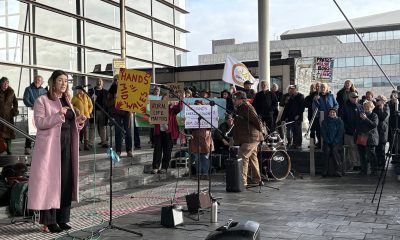
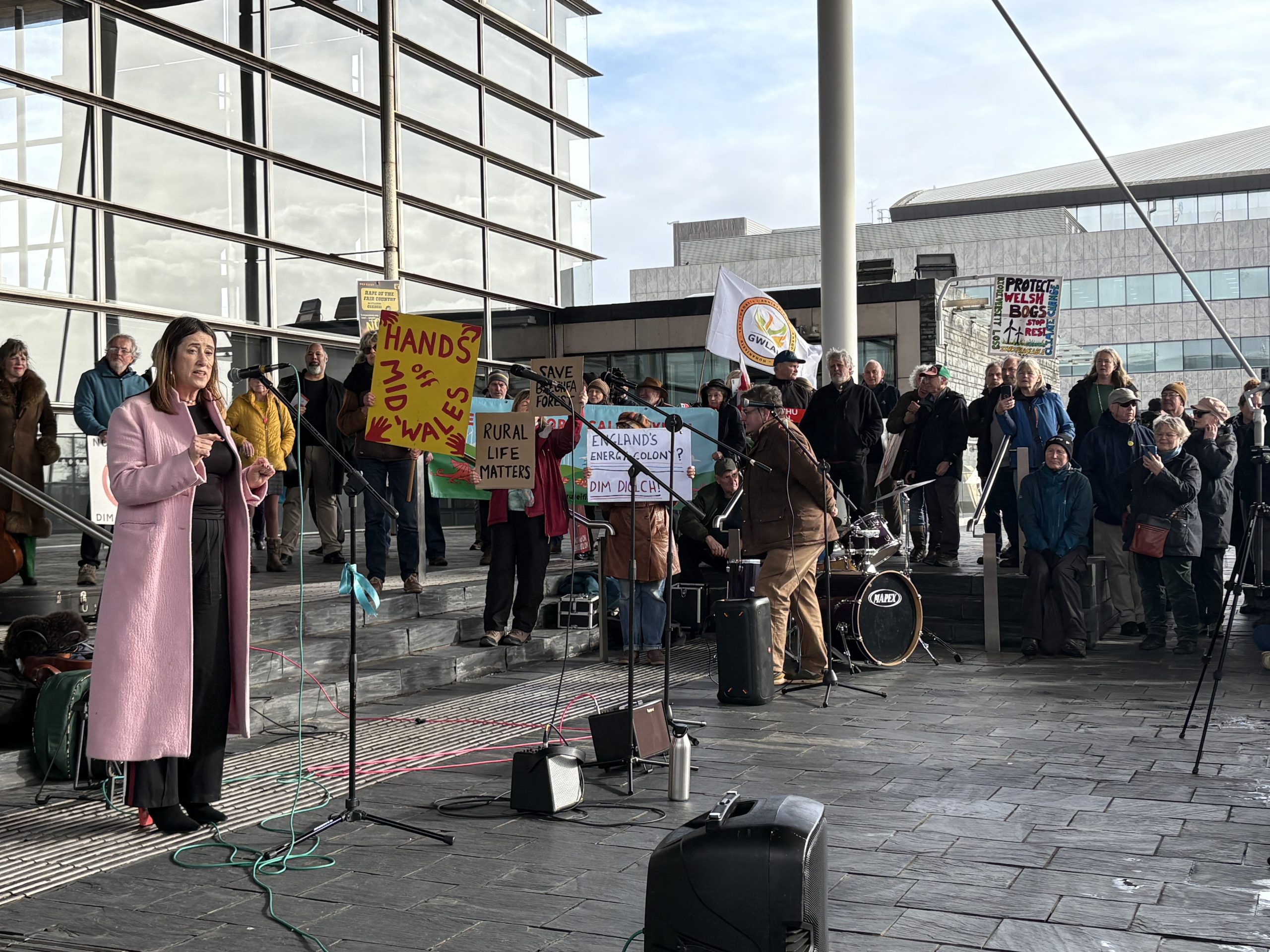
A PROTEST took place outside Senedd Cymru on Wednesday (Feb 11) as campaigners gathered to oppose large-scale wind farms, energy parks and new overhead pylons across rural Wales.
Residents from mid and west Wales, including farming families, countryside groups and community activists, assembled on the steps of the Welsh Parliament holding banners reading “Hands off Mid Wales”, “Rural life matters” and “Protect Welsh bogs”.
Many said they support renewable energy in principle but fear that current proposals would industrialise rural landscapes while delivering little benefit to local people.
Among those addressing the crowd was Jane Dodds, leader of the Welsh Liberal Democrats, who renewed calls for ministers to require electricity cables to be placed underground rather than carried on new lines of pylons.
Calls for underground cables
Dodds said Wales must not lose its countryside in the rush to decarbonise.
“We cannot afford to lose our countryside,” she told protesters. “Once these wind turbines and pylons are in place, the impact on our landscapes will be long lasting and, in many cases, irreversible.
“Local people feel their concerns are being overlooked while large developers push ahead with major projects. That is not how the transition to green energy should work.”
She pointed to a recent budget agreement which secured £1 million for a Visual Impact Innovation Fund to trial undergrounding technologies and explore alternatives to overhead infrastructure in sensitive areas.
“We need a balanced approach,” she said. “We must move away from fossil fuels, but we must also protect the beauty and character of rural Wales.”

Why people are protesting
Speakers and attendees raised concerns about:
• visual impact of turbines and pylons on open countryside
• effects on peatland, wildlife and habitats
• loss of productive farmland
• heavy construction traffic through small villages
• profits flowing to distant shareholders rather than host communities
Several campaigners argued that decisions feel “done to” communities rather than shaped with them, with limited consultation and little long-term return.

Some called for smaller-scale, locally owned schemes instead of what they described as “mega-projects”.
Climate groups defend renewables
In response to the protest, Climate Cymru said Wales must not step back from wind power and other renewables, warning that continued reliance on fossil fuels would worsen both the climate and cost-of-living crises.
Stan Townsend, spokesperson for the group, said: “Rising energy bills and energy insecurity are already affecting families, farmers and businesses across the country.
“Turning away from renewables would mean deeper dependence on volatile, expensive, polluting fossil fuels. We need clean, home-grown energy to protect people and the planet.”
He said Wales has some of the best wind resources in Europe and a major opportunity to cut bills, create skilled jobs and strengthen energy security.
Community ownership ‘key to support’
Community Energy Wales said many objections could be eased if local people had ownership or a financial stake in developments.
Leanne Wood, co-executive director, said: “If communities can part own developments, many of the objections to new wind turbines can be overcome. Ownership brings control.
“This would lock the profits into those communities and potentially reduce bills.”
The organisation is working to enable locally generated renewable electricity to be sold directly to local consumers so that wealth stays within towns and villages.
A wider debate
The demonstration highlights a growing divide over how Wales meets its net zero targets.
While environmental groups stress the urgent need to expand renewable energy quickly, rural campaigners say the Wales-wide push must not come at the expense of landscapes, farming and community consent.
Dodds urged the Welsh Government to strengthen planning, consultation and benefit schemes so that communities see clear advantages.
For many at the Senedd, the message was clear: renewable energy is necessary — but only if local people share the control, the profits and the decisions.

A NEW alliance bringing together community groups, trade unions, faith leaders and campaigners from across west Wales is set to launch in Haverfordwest next month.
The West Wales branch of the Together Alliance will officially begin with a public meeting at 7:00pm on Wednesday (Mar 18) at Haverfordwest Mosque, Cherry Grove.
Organisers say the event will unite local politicians, farmers, artists, anti-racist organisations and faith groups in response to what they describe as growing “voices of division” in national and local politics.
In a statement, the alliance said: “Those who preach division are becoming more confident. Their false promises seize on very real economic problems and scapegoat migrants, Muslims and refugees.
“But we can change things together. The voices of unity can grow stronger. Strength lies in solidarity and working together for hope, not despair.”
The group aims to build cooperation between communities and challenge racism and extremism through grassroots organising. It says hundreds of organisations and individuals nationwide have already signed up.
The Haverfordwest launch forms part of a wider mobilisation ahead of a major national demonstration planned for London on March 28.
Several high-profile supporters have also backed the campaign, including comedian and campaigner Lenny Henry, who said: “We stand for love over hate, hope over fear and unity over division. We’re coming together against racism.”
Singer Paloma Faith added: “There is no world that I want to live in where discrimination is acceptable for anything.”
Organisers say anyone interested in promoting inclusion, equality and community solidarity is welcome to attend.

Davies attacks ‘Nation of Sanctuary’ policy after asylum seeker jailed for child rape
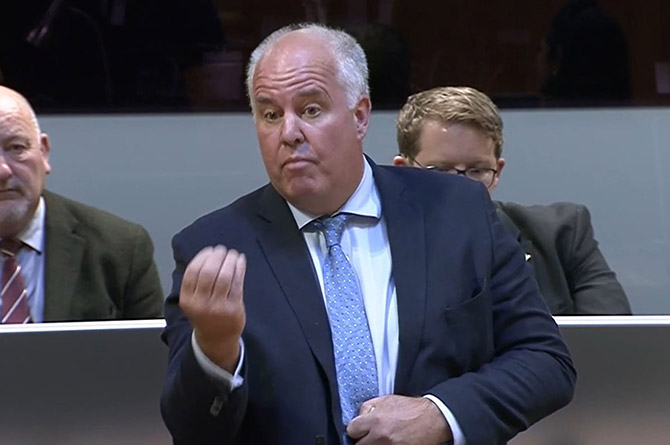
A SENIOR Welsh Conservative has called for the Welsh Government’s “Nation of Sanctuary” policy to be scrapped after an Afghan asylum seeker was convicted of abducting and raping a 12-year-old girl.
Andrew RT Davies, leader of the Welsh Conservatives in the Senedd, said the case highlighted what he described as the “dangers” of the current approach to asylum and migration in Wales.
Ahmad Mulakhil, who arrived in the UK by small boat from France in March 2025, was convicted of the attack just four months later.
The case, reported nationally this week, has prompted renewed political debate over the Welsh Government’s stance on supporting asylum seekers and refugees.
Mr Davies said: “This appalling case demonstrates the dangers of importing violent criminals into Britain.

“Plaid Cymru and Labour’s decision to make Wales a Nation of Sanctuary for asylum seekers is a pull factor, encouraging more people to enter our country illegally.
“I reiterate my calls for this dangerous policy to be scrapped.”
The comments directly target the Welsh Government’s “Nation of Sanctuary” plan, launched in 2019, which aims to make Wales a welcoming place for refugees and people seeking asylum, with support for housing, education and integration.
The Welsh Government has previously defended the policy, saying it reflects “Welsh values of compassion and fairness,” and stressing that responsibility for border security lies with the UK Government.
Meanwhile, the UK Government has introduced tougher measures aimed at reducing small-boat crossings and speeding up removals of those with no right to remain.
The latest case is likely to intensify scrutiny of how asylum accommodation and safeguarding are managed across Wales.
For many residents, the debate now centres on how to balance humanitarian support with public safety and confidence in the system.

As Mr Davies’ intervention shows, the political argument over Wales’s role as a “Nation of Sanctuary” is far from over.
Meanwhile the official figures show that asylum seekers commit less crime than the general population.



Crime10 hours ago
Publican admits supplying cocaine and cannabis at Crown Court
Admits cocaine and cannabis supply but denies intent and cash allegations A MILFORD HAVEN pub landlord has admitted supplying cocaine...


Local Government11 hours ago
Plaid win in Fishguard North East by-election
PLAID CYMRU has taken the Fishguard North East seat on Pembrokeshire County Council following this week’s by-election. Billy Shaw was...


News1 day ago
Man to return to court over alleged harbour collision
Three charges relate to navigation of vessel in Milford Haven A NEWPORT man is due to return to court later...


Business2 days ago
Computer Solutions Wales under fire from customers
Claims of unreturned devices, unpaid refunds and small claims court cases as company blames landlord dispute CUSTOMERS across west Wales...


News2 days ago
Starmer under fire as aides quit and Scottish Labour leader calls on him to resign
Two senior Downing Street exits in 24 hours as Anas Sarwar breaks ranks, but ministers insist the Prime Minister is...


News2 days ago
Fresh concerns over £60m A40 scheme after resurfacing works just months after opening
QUESTIONS are being asked about the condition of the newly-opened A40 Llanddewi Velfrey to Redstone Cross carriageway after sections of...

Charity3 days ago
RSPCA looks back at the Sea Empress oil tanker disaster 30 years on
Charity reflects on one of the biggest environmental disasters to hit UK IN just a few days time it will...


Crime4 days ago
Pembroke Dock man admits threatening to hack woman’s head off with sword
Court imposes strict bail conditions and bans contact with named individuals ahead of sentencing A PEMBROKE DOCK man has admitted...


Crime4 days ago
Teenager remanded after teacher injured in knife incident at Milford Haven school
Fifteen-year-old charged with Section 18 grievous bodily harm and possession of a bladed article appears before Swansea magistrates A FIFTEEN-YEAR-OLD...

Crime4 days ago
Police confirm teacher was stabbed at school as teenager appears in court
15-year-old charged with Section 18 GBH with intent and possession of a bladed article on education premises POLICE have confirmed...
-
 Health6 days ago
Health board targets rise in steroid and gym drug use across west Wales
-
 Crime6 days ago
Teacher injured and teenager arrested for attempted murder at Milford Haven School
-
Business2 days ago
Computer Solutions Wales under fire from customers
-

 Business5 days ago
Six-figure negligence victory leaves retired builder trapped in divorce limbo
-

 Sport6 days ago
Wales name squad for Six Nations opener against England
-

 News6 days ago
Reform appoints Dan Thomas to lead party in Wales
-

 News6 days ago
Another Senedd member defects to Reform as Lib Dem MP hits out
-

 Health6 hours ago
Health Board to decide future of nine key services at two-day meeting