


News
Milford Haven: Pensioner to face three charges of sexual assault on a minor


A PENSIONER, 76-years-old, from Milford Haven will appear in court on Tuesday (Dec 10) to face three charges of sexual assault on a minor.
Graham John, of Nelson Avenue, is alleged to have intentionally touched a girl under 13 years of age in a sexual way.
The charges are being brought under Section 7 of the Sexual Offences Act 2003.
The alleged offenses took place between April 2017 and November 2018.












COMMUNITY pharmacies across Wales are being forced to sell some medicines at a loss because of an outdated NHS funding system that no longer reflects real-world costs, owners have warned.
Under current rules, pharmacists must dispense prescriptions at prices set nationally, even when those prices are lower than what they paid wholesalers — leaving them out of pocket on everyday items such as aspirin.
The situation has led to mounting debts, emergency loans and, in some cases, owners remortgaging their homes simply to keep their doors open.
Figures from the National Pharmacy Association suggest four in ten Welsh pharmacies were not profitable last year, with many described as “clinging on by their fingertips”.
Selling at a loss
Unlike normal retailers, pharmacies cannot set their own prices or refuse to stock products.

They are contracted to the NHS through the Welsh Government’s Community Pharmacy Contractual Framework, which fixes reimbursement rates for prescription medicines.
But wholesalers’ prices have risen sharply due to inflation, supply shortages and higher manufacturing costs.
That means the maths often no longer adds up.
In one example shared by pharmacists, a packet of 75mg aspirin costs £3.75 to buy but is reimbursed at just £3.05 — a loss of 70p each time it is dispensed.

Multiply that across hundreds of packs a month and dozens of other medicines, and small losses quickly turn into thousands of pounds.
One west Wales pharmacy owner told The Herald: “You wouldn’t run a corner shop selling bread for less than you paid for it. But that’s effectively what we’re told to do every day.”
‘Averaging out’ no longer works
The government’s model assumes that losses on some drugs will be balanced by profits on others.

But pharmacists say that system — once workable — has broken down.
Generic medicines that previously provided modest margins are now also rising in price, while reimbursement rates lag weeks or months behind market costs.
At the same time, running costs have surged.
Energy bills, staff wages, National Insurance contributions, fuel for deliveries and regulatory costs have all increased, while core NHS funding has remained largely flat in real terms for nearly a decade.
Owners say they are now busier than ever too, as GP surgeries redirect patients to pharmacies for minor ailments, vaccinations and clinical advice — work that takes time and staff but often brings little additional income.
Debt and closures
The result is growing financial pressure.
Some pharmacists report taking out short-term loans just to cover monthly payroll, while others have dipped into pensions or personal savings.
Across the UK, hundreds of community pharmacies have closed in recent years, with rural and small-town chemists particularly vulnerable.
Health campaigners warn that if closures continue, patients could lose easy access to prescriptions, advice and walk-in care — pushing more pressure back onto already stretched GP practices and hospitals.
Government response
The Welsh Government says it recognises pharmacies are an essential part of primary care and points to increased investment, including additional stability payments and grants for premises improvements.
A spokesperson said reimbursement prices are set using supplier data and that “while some medicines may be reimbursed below cost on occasions, this is offset by the profits pharmacies make on most of the medicines they dispense”.
But pharmacists argue that assumption no longer reflects reality.
A simple question
At the heart of the row is a basic principle.
If the NHS commissions a service, pharmacists say, it should at least cover the cost of providing it.
As one owner put it: “No business can survive by selling stock at a loss and hoping it balances out. Eventually the numbers catch up with you.”
Unless the funding formula changes, many fear more local chemists could disappear from Welsh high streets — and with them one of the most accessible parts of the health service.
Photo caption: Community pharmacies say fixed NHS prices are forcing them to dispense some medicines below cost (Pic: stock).

A WEST WALES charity that delivers blood, medication and urgent medical supplies for the NHS has received a welcome funding boost thanks to the generosity of local driving examiners and instructors.
Blood Bikes Wales has thanked the West Wales Driving Examiners for raising money through a festive Christmas Jumper Day, with additional contributions from Approved Driving Instructors and staff from the Driver and Vehicle Standards Agency.
The fundraising effort has resulted in a sizeable donation that the charity says will go directly towards keeping its volunteer-run service on the road.
Blood Bikes Wales provides a free out-of-hours courier service for the NHS, transporting blood, samples, donor breast milk, medication and other urgent items between hospitals and healthcare sites. The service helps reduce costs for the health service while ensuring patients receive time-critical treatment as quickly as possible.
Mark, the charity’s West Area Representative, accepted the cheque on behalf of the organisation at a small presentation outside the local driving test centre.
A spokesperson for Blood Bikes Wales said the support would “go a long way in helping us continue supporting NHS services and patients across the region”.
They added: “We’re truly grateful for the generosity and community spirit shown by the West Wales Driving Examiners, local ADIs and DVSA staff. Every donation helps keep our bikes fuelled, maintained and ready to respond when the NHS calls.”
The group added a light-hearted note about the day, joking that while there may not have been an official “pass mark” for festive knitwear, the examiners would certainly have earned top marks.
Blood Bikes Wales is powered entirely by volunteers, who give up their time to carry out thousands of deliveries each year, often late at night and in poor weather conditions.
Anyone interested in supporting the charity, either through donations or volunteering, can find more information on the Blood Bikes Wales website.
Campaigners demand landscape protection and underground cables while environmentalists warn Wales cannot slow the clean energy transition
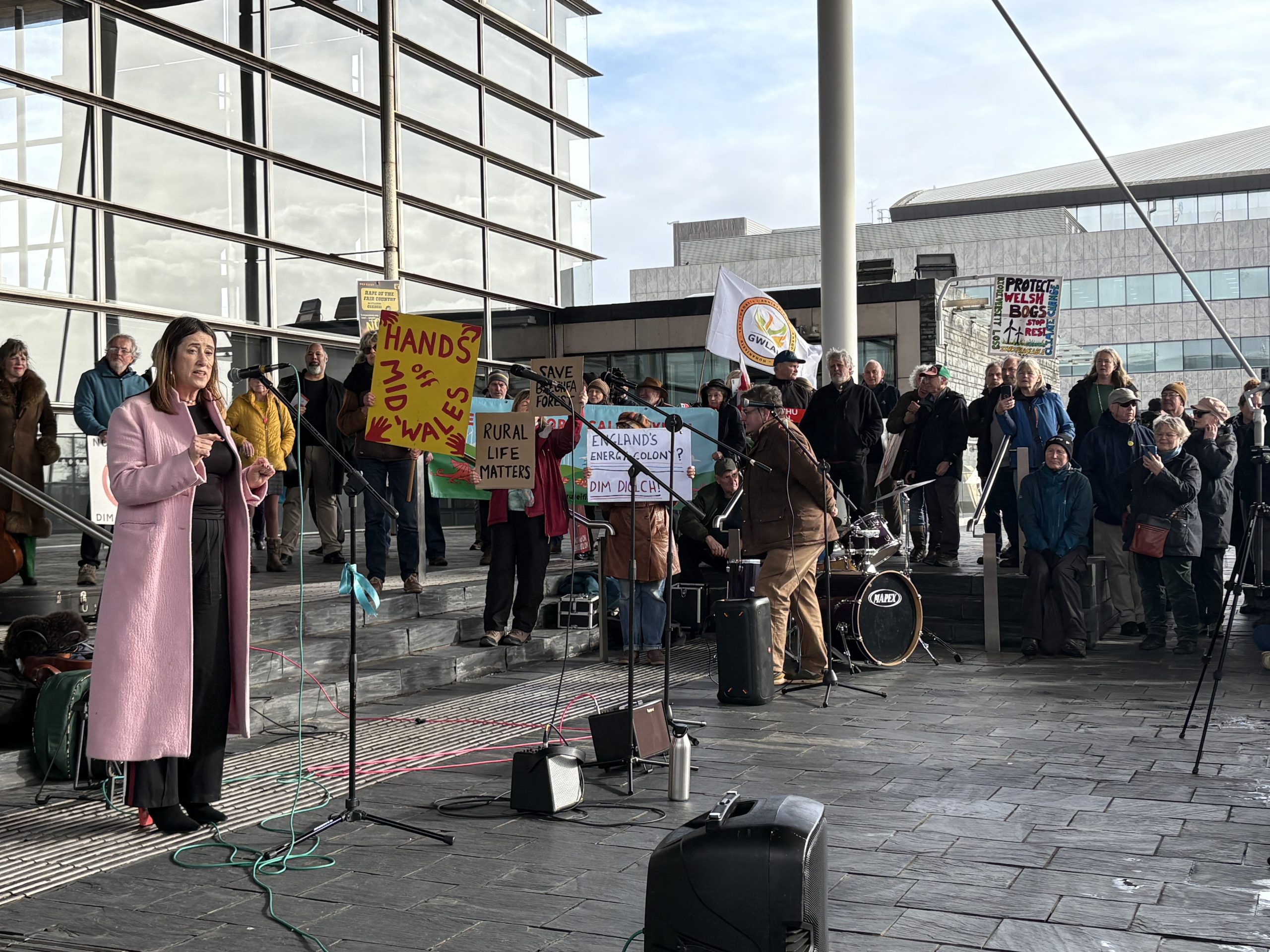
A PROTEST took place outside Senedd Cymru on Wednesday (Feb 11) as campaigners gathered to oppose large-scale wind farms, energy parks and new overhead pylons across rural Wales.
Residents from mid and west Wales, including farming families, countryside groups and community activists, assembled on the steps of the Welsh Parliament holding banners reading “Hands off Mid Wales”, “Rural life matters” and “Protect Welsh bogs”.
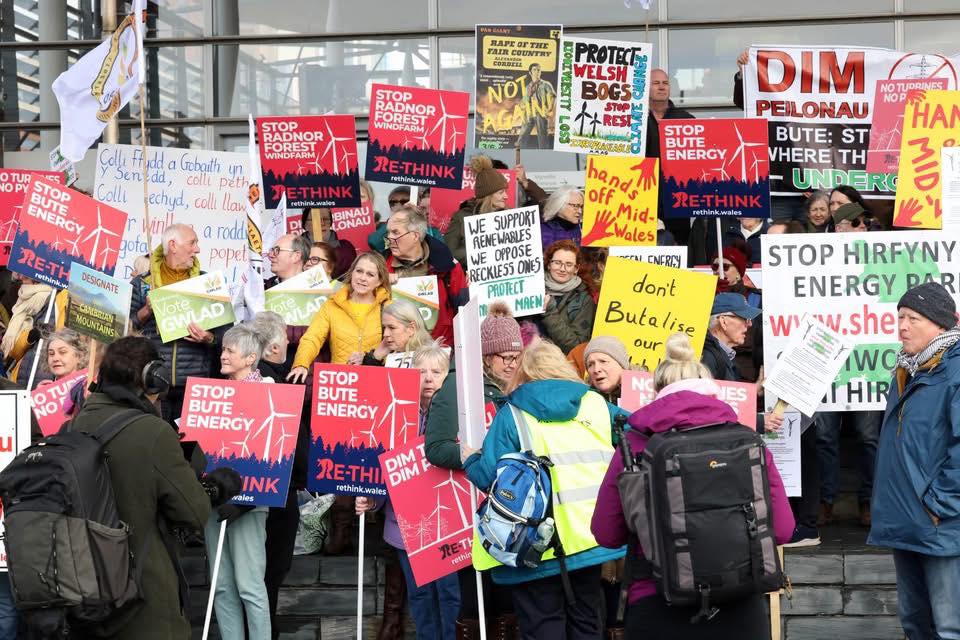
Many said they support renewable energy in principle but fear that current proposals would industrialise rural landscapes while delivering little benefit to local people.
Among those addressing the crowd was Jane Dodds, leader of the Welsh Liberal Democrats, who renewed calls for ministers to require electricity cables to be placed underground rather than carried on new lines of pylons.

Calls for underground cables
Dodds said Wales must not lose its countryside in the rush to decarbonise.
“We cannot afford to lose our countryside,” she told protesters. “Once these wind turbines and pylons are in place, the impact on our landscapes will be long lasting and, in many cases, irreversible.
“Local people feel their concerns are being overlooked while large developers push ahead with major projects. That is not how the transition to green energy should work.”
She pointed to a recent budget agreement which secured £1 million for a Visual Impact Innovation Fund to trial undergrounding technologies and explore alternatives to overhead infrastructure in sensitive areas.
“We need a balanced approach,” she said. “We must move away from fossil fuels, but we must also protect the beauty and character of rural Wales.”
Why people are protesting
Speakers and attendees raised concerns about:
• visual impact of turbines and pylons on open countryside
• effects on peatland, wildlife and habitats
• loss of productive farmland
• heavy construction traffic through small villages
• profits flowing to distant shareholders rather than host communities
Several campaigners argued that decisions feel “done to” communities rather than shaped with them, with limited consultation and little long-term return.

Some called for smaller-scale, locally owned schemes instead of what they described as “mega-projects”.
Climate groups defend renewables
In response to the protest, Climate Cymru said Wales must not step back from wind power and other renewables, warning that continued reliance on fossil fuels would worsen both the climate and cost-of-living crises.
Stan Townsend, spokesperson for the group, said: “Rising energy bills and energy insecurity are already affecting families, farmers and businesses across the country.
“Turning away from renewables would mean deeper dependence on volatile, expensive, polluting fossil fuels. We need clean, home-grown energy to protect people and the planet.”
He said Wales has some of the best wind resources in Europe and a major opportunity to cut bills, create skilled jobs and strengthen energy security.
Community ownership ‘key to support’
Community Energy Wales said many objections could be eased if local people had ownership or a financial stake in developments.
Leanne Wood, co-executive director, said: “If communities can part own developments, many of the objections to new wind turbines can be overcome. Ownership brings control.
“This would lock the profits into those communities and potentially reduce bills.”
The organisation is working to enable locally generated renewable electricity to be sold directly to local consumers so that wealth stays within towns and villages.
A wider debate
The demonstration highlights a growing divide over how Wales meets its net zero targets.
While environmental groups stress the urgent need to expand renewable energy quickly, rural campaigners say the Wales-wide push must not come at the expense of landscapes, farming and community consent.
Dodds urged the Welsh Government to strengthen planning, consultation and benefit schemes so that communities see clear advantages.
For many at the Senedd, the message was clear: renewable energy is necessary — but only if local people share the control, the profits and the decisions.



Crime1 day ago
Publican admits supplying cocaine and cannabis at Crown Court
Admits cocaine and cannabis supply but denies intent and cash allegations A MILFORD HAVEN pub landlord has admitted supplying cocaine...


Local Government1 day ago
Plaid win in Fishguard North East by-election
PLAID CYMRU has taken the Fishguard North East seat on Pembrokeshire County Council following this week’s by-election. Billy Shaw was...


News2 days ago
Man to return to court over alleged harbour collision
Three charges relate to navigation of vessel in Milford Haven A NEWPORT man is due to return to court later...


Business3 days ago
Computer Solutions Wales under fire from customers
Claims of unreturned devices, unpaid refunds and small claims court cases as company blames landlord dispute CUSTOMERS across west Wales...


News3 days ago
Starmer under fire as aides quit and Scottish Labour leader calls on him to resign
Two senior Downing Street exits in 24 hours as Anas Sarwar breaks ranks, but ministers insist the Prime Minister is...


News3 days ago
Fresh concerns over £60m A40 scheme after resurfacing works just months after opening
QUESTIONS are being asked about the condition of the newly-opened A40 Llanddewi Velfrey to Redstone Cross carriageway after sections of...


Charity3 days ago
RSPCA looks back at the Sea Empress oil tanker disaster 30 years on
Charity reflects on one of the biggest environmental disasters to hit UK IN just a few days time it will...


Crime4 days ago
Pembroke Dock man admits threatening to hack woman’s head off with sword
Court imposes strict bail conditions and bans contact with named individuals ahead of sentencing A PEMBROKE DOCK man has admitted...


Crime5 days ago
Teenager remanded after teacher injured in knife incident at Milford Haven school
Fifteen-year-old charged with Section 18 grievous bodily harm and possession of a bladed article appears before Swansea magistrates A FIFTEEN-YEAR-OLD...


Crime5 days ago
Police confirm teacher was stabbed at school as teenager appears in court
15-year-old charged with Section 18 GBH with intent and possession of a bladed article on education premises POLICE have confirmed...
-

 Health7 days ago
Health board targets rise in steroid and gym drug use across west Wales
-

 Health21 hours ago
Health Board to decide future of nine key services at two-day meeting
-

 Crime7 days ago
Teacher injured and teenager arrested for attempted murder at Milford Haven School
-
Business3 days ago
Computer Solutions Wales under fire from customers
-

 Business6 days ago
Six-figure negligence victory leaves retired builder trapped in divorce limbo
-

 News7 days ago
Reform appoints Dan Thomas to lead party in Wales
-

 Sport7 days ago
Wales name squad for Six Nations opener against England
-

 Business5 days ago
Minimum alcohol price to rise by 30 per cent as retailers warn of border impact