


News
How special forces who train in and protect Pembrokeshire saved ‘hijacked’ oil tanker and 22 crew

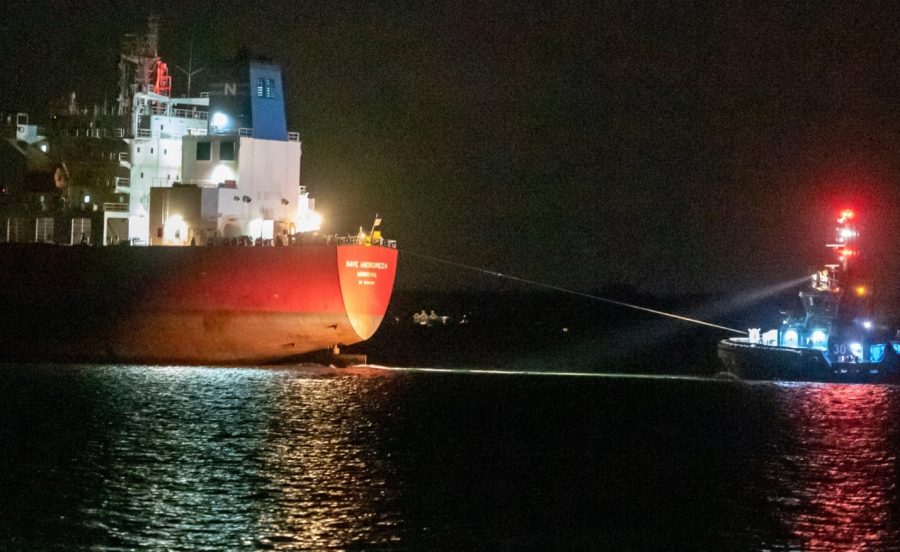
A ROYAL NAVY special forces strike group, who are regularly seen training in and around Milford Haven, was scrambled this week to assist the skipper of an oil tanker which had been stormed by stowaways off the Isle of Wight.
In a dramatic series of events, which raises potential security issues for all UK ports including The Port of Milford Haven, the vessel, the Nave Andromeda, made radio distress calls on Sunday morning (Oct 25) after failing to dock as expected in Southampton on the south coast of England at 10:30 HRS.
By evening, the boat was stormed by commandos from service, who detained seven individuals after they were met with “overwhelming force”.
Luckily for the crew of the Nave Andromedea the Special Boat Service (SBS), who are based at Poole were only a few minutes helicopter flying time away from the stricken vessel. It’s rare that Britain’s special forces are deployed on home territory, which makes the raid all the more remarkable.
Thanks to the skill of the men, many of whom trained in Pembrokeshire, the 22 crew were declared uninjured.

Four choppers flew the Special Boat Service out from their headquarters in Poole, Dorset.
They performed the rescue and the all clear was given just after 7.30pm.
A spokesperson for Hampshire police said Monday that seven men were arrested “on suspicion of seizing or exercising control of a ship by use of threats or force.”
“They all remain in custody at police stations across Hampshire,” the statement added. “Investigators are speaking to the crew members to establish the exact circumstances of what happened.”

During the altercation several stowaways made verbal threats to the crew on board the tanker, Hampshire police said in an official statement to press.
The 750-foot (228-metre) vessel is registered in Liberia, according to the Press Association.
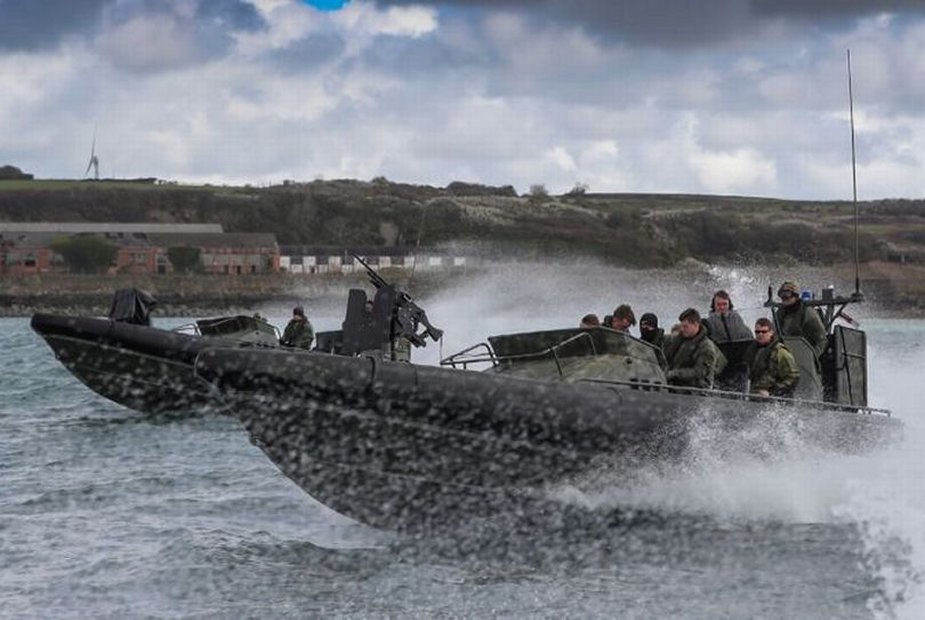
Royal Navy special forces training in Milford Haven
The tanker was south east of Wight when the incident occurred.

Two coast guard helicopters were sighted circling around the vessel on Sunday, and a three-mile exclusion zone was placed around the area south of Sandown on the island’s east coast.
The tanker is currently docked in Southampton while the police inquiry continues, The Heald understands.
The Ministry of Defence confirmed in a statement to The Pembrokeshire Herald: “In response to a police request, the Defence Secretary and Home Secretary authorised Armed Forces personnel to board a ship in the English Channel to safeguard life and secure a ship that was subject to suspected hijacking.
“Armed forces have gained control of the ship and seven individuals have been detained. Police investigations will now continue. Initial reports confirm the crew are safe and well.”
Bob Sanguinetti, chief executive of the UK Chamber of Shipping said that the zig-zagging “could well have been a way of alerting the authorities.” The vessel would also have been in touch with authorities via radio, though, he added.
He said “the uncertainty here is over the motives of the stowaways and, like I said, it could be nothing more sinister than seeking political asylum.”
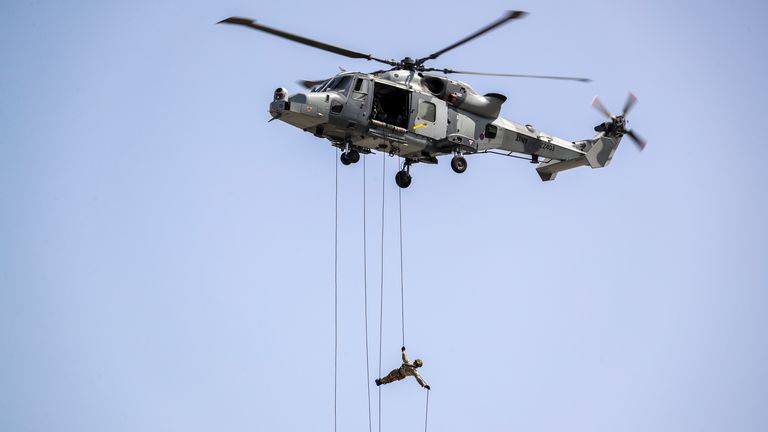
To rescue tanker crew SBS members descended from four helicopters
DISTRESS CALLS ON TAPE
A recording reveals the dramatic moment the captain of the oil tanker that was stormed by stowaways’ maydays for help.
During the call on an open radio channel, the captain says he is trying to ‘keep them calm’ but some of the intruders were outside the ship’s bridge.
He said: “The stowaways go outside, I see four-person port side, midship, near to the manifold, and I have two of them starboard side on the bridge but cannot coming inside.
“I try to keep them calm but I need immediately, immediately agency assistance.”
In other radio messages, the captain is said to have claimed he ‘feared for his life’ as the drama unfolded off the coast of the Isle of Wight on Sunday morning.
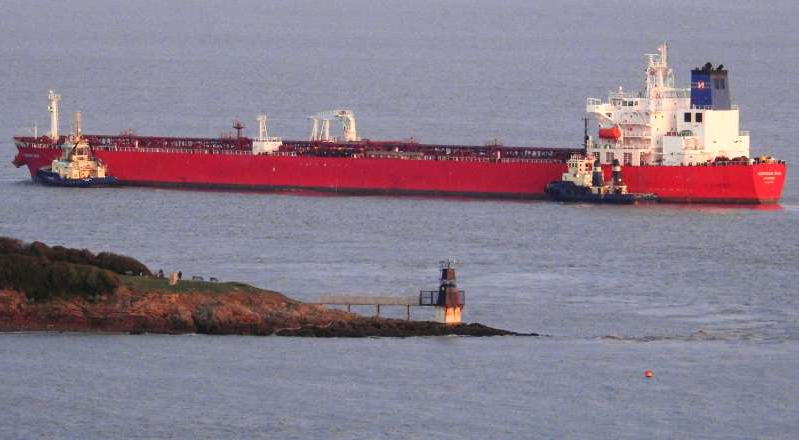
The tanker is now docked in Southampton as the investigation continues
IN OUR BACK YARD
Naval insiders were relieved to have concluded the incident relatively quickly once the police asked for help. “This was happening pretty much in the Royal Navy’s backyard. I think they were keen to show they could put a stop to it,” a naval source said.
The defence secretary, Ben Wallace, and the home secretary, Priti Patel, authorised armed forces personnel to board the ship in the Channel in response to a police request, the MoD said.
Wallace said: “I commend the hard work of the armed forces and police to protect lives and secure the ship. In dark skies, and worsening weather, we should all be grateful for our brave personnel. People are safe tonight thanks to their efforts.”
A GOOD OUTCOME
Tobias Ellwood, the chairman of the Commons defence committee, said the boarding of the tanker by British armed forces was a “good outcome”. “Seven stowaways onboard taking over a ship or causing the ship not to be in full command would have triggered a multi-agency alarm and then well-rehearsed classified protocols were put into action,” he told the BBC.
“Initially, it didn’t look like this was terrorist-related nor involving WMD, but the erratic behaviour [of the ship] was concerning. The safety of the crew was important, as is indeed any unauthorised movement towards the coast. I am pleased to see that swift action has been taken.”
SHIPS OWNER GRATEFUL
The ship’s operator, Navios Tankers Management, said the stowaways “illegally boarded” the Liberian-flagged tanker in Lagos.
A statement from the company said the master of the ship had become “concerned for the safety of the crew due to the increasingly hostile behaviour of the stowaways”.
The company thanked the UK authorities in the operation “for their timely and professional response”.
“Navios would also like to pay tribute to the master of the Nave Andromeda for his exemplary response and calmness and to all the crew for their fortitude in a difficult situation.”
The vessel left Lagos on 6 October. Lloyd’s List, the shipping newspaper, said it believed seven stowaways had boarded in Nigeria. Their presence had been discovered but they became violent when the crew attempted to lock them in a cabin.
PROTECTING MILFORD HAVEN
The SBS has been protecting shipping in Milford Haven for some time. The nature of the cargo of oil and LNG gas means that tankers inevitably depart from the middle east.
Last year the special forces joined the US carrier strike group currently deployed in the Persian Gulf, near Iran, in order to counter potential Iranian attacks on UK ships heading for Milford Haven and other ports.
In 2017, UK intelligence reports indicated jihadis from ISIS could have got their hands-on limpet mines, which can be attached to the hulls of ships.
It is thought they could be attached to the hulls of tankers carrying millions of gallons of oil with the resulting explosion strong enough to destroy an entire port.
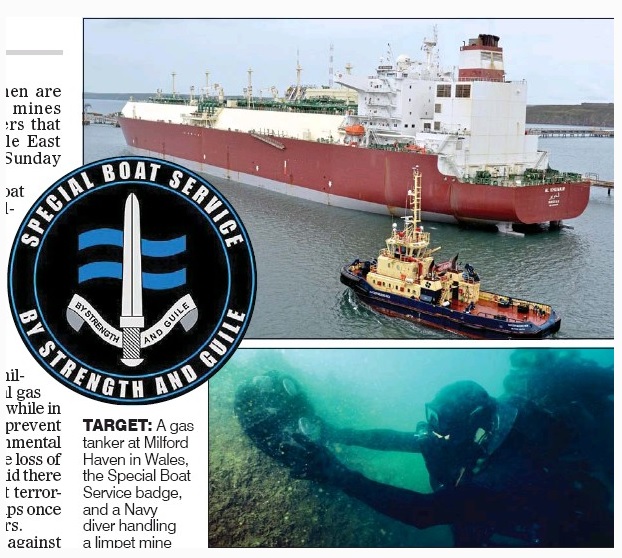
Protecting Milford Haven: A clipping from the Scotland on Sunday
And frogmen from the Special Boat Service (SBS) and Royal Navy divers have been given the task of preventing it, with training taking place locally.
As well as SBS training, Milford Haven has hosted other major naval exercises. One such example was in 2013 with an exercise called Cambrian Trader. The four-day mission was designed to train the Navy’s Maritime Trade Operations specialists and prepare them for deployment in support of the Royal Navy anywhere in the world.
Together with Dyfed Powys Police, the Port of Milford Haven and members of the Army Reserve, the exercise involved well over a hundred people, yet it was almost unseen by the public because so much of the activity is waterborne, or at the Port’s Headquarters.
Bill Hirst, the then Harbourmaster said at the time: “As the third largest Port in the UK safely handling 29% of Britain’s seaborne trade in oil and gas, Milford Haven provides a great base for those wanting to understand how a busy commercial port operates.
Opportunities to exercise with the Royal Navy are rare and therefore we are pleased that they have chosen Milford Haven and are keen to support them.”








Defendant admitted using Xbox without informing police as required under court order
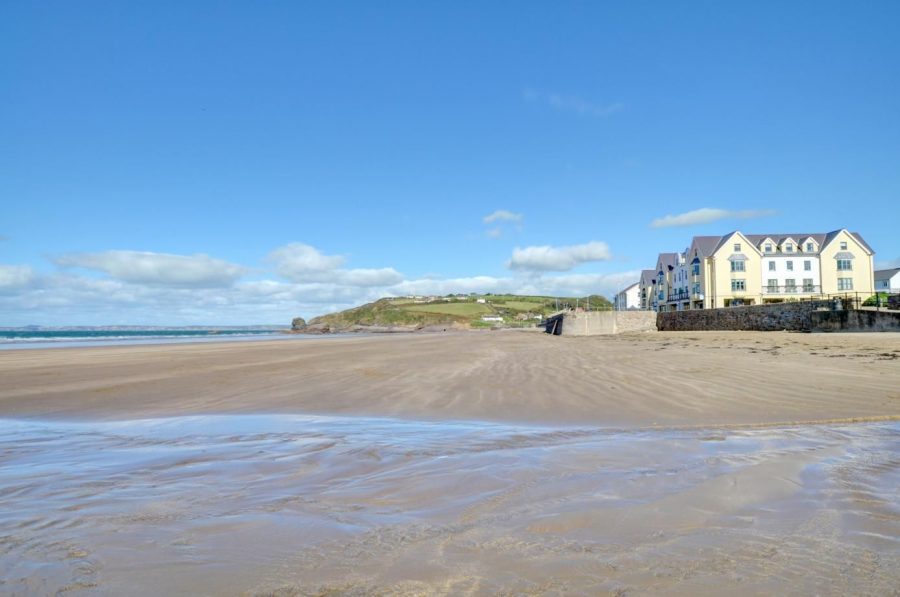
ANTHONY COOMBES, aged 26, of Sand Banks, Broad Haven, appeared before Llanelli Magistrates’ Court on Thursday (Mar 20) charged with breaching a sexual harm prevention order.
The court heard that between February 26 and March 19, 2026, at Haverfordwest, Coombes repeatedly breached the order by using an Xbox device without informing police within three days, as required.
The offences relate to a sexual harm prevention order imposed at Swansea Crown Court on October 20, 2021.
Coombes indicated guilty pleas to the offences at the first hearing.
Magistrates committed the case to Swansea Crown Court for sentence.
He was remanded in custody ahead of the next hearing, which is due to take place at 9:00am on Friday, April 3, at Swansea Crown Court.
The court refused bail on the grounds that he was likely to offend, citing the nature and seriousness of the offences and his previous record and character.
A pre-sentence report was ordered.
Police say death not suspicious as 46-year-old arrested over alleged Class A drug supply
A MAN has died following a medical emergency at a property in Haverfordwest, police have confirmed.
Emergency services were called at 3:18pm on Wednesday (March 18) after a report of a medical incident.
A man was pronounced dead at the scene.
Dyfed-Powys Police said the man’s next of kin have been informed and are being supported by officers.
The death is not being treated as suspicious at this time.
However, police confirmed that a man, aged 46, was arrested on suspicion of being concerned in the supply of Class A drugs.
He has since been released under investigation while enquiries continue.
No further details about the deceased have been formally released.

FOUR people from Mynyddygarreg, Kidwelly, have been ordered to pay more than £129,000 following a successful prosecution for illegal dog breeding.
At Swansea Crown Court on Tuesday (Mar 10), before His Honour Judge Thomas KC, Stacey May June Edwards, Peter John Edwards, Sian Eleri Thomas and David Malcolm James Thomas, all of Sea Breeze, Mynyddygarreg, pleaded guilty to offences under the Breeding of Dogs (Wales) Regulations 2014.
The court imposed confiscation orders totalling £129,873.41 under the Proceeds of Crime Act across the four defendants. They were also ordered to pay £8,000 in costs, while each defendant received a £2,000 fine.
The investigation began in April 2021 after Carmarthenshire County Council’s Animal Health team received an enquiry from Peter Edwards about obtaining a dog breeding licence. Although licensing guidance was provided and a partial application was submitted in February 2022, this was later withdrawn.
In March 2024, the council received a complaint that puppies were being advertised for sale without the required licence. Officers subsequently contacted online advertising platforms and issued data requests to assess the scale of activity.

Analysis of records from Pets4Homes, Freeads and Gumtree revealed multiple litters being advertised by members of the same household.
Correspondence under the Police and Criminal Evidence Act confirmed that up to 25 dogs were kept at the property, including between 16 and 19 breeding females.
While some defendants claimed joint ownership of the dogs, others attempted to minimise their involvement.
The Herald understands that numerous puppy advertisements were posted between July 2020 and April 2025, demonstrating a sustained pattern of unlicensed breeding.
Carmarthenshire County Council’s Cabinet Member for Climate Change, Decarbonisation and Sustainability, Cllr Aled Vaughan Owen, said: “This case demonstrates the council’s firm stance against unlicensed and illegal dog breeding.
“These regulations are in place to protect animal welfare and ensure that breeding activities are subject to proper oversight. The scale of activity uncovered at this property was entirely unacceptable, and we welcome the court’s decision to issue significant confiscation orders under POCA.”
He added: “We urge anyone with concerns about illegal dog breeding to report it. Our Animal Health officers will continue to investigate thoroughly and take action against those who disregard the law.”

Residents are reminded that anyone breeding and selling dogs must comply with licensing regulations designed to protect both animal welfare and consumers.


Crime20 hours ago
Publican jailed for six years for supplying cocaine and cannabis
Milford Haven man sentenced at Swansea Crown Court following drug dealing operation A MILFORD HAVEN publican has been jailed for...


Local Government22 hours ago
Poverty summit highlights support efforts across Pembrokeshire
A SUMMIT bringing together key organisations from across Pembrokeshire has highlighted both the scale of local poverty and the work...


Education2 days ago
Milford Haven school plans unveiled but funding not yet secured
PLANS for a new £100 million school in Milford Haven have been unveiled, but the project has not yet secured...


News2 days ago
Council unveils plans for new state-of-the-art secondary school in Milford Haven
PEMBROKESHIRE COUNTY COUNCIL has revealed plans for a new state-of-the-art school in Milford Haven, promising modern, inspiring learning spaces for...

Health2 days ago
NHS waiting list falls — but cancer delays and diagnostic backlog worsen
Record progress claimed by Welsh Government as critics warn key targets are still being missed THE NHS in Wales has...


Crime3 days ago
Rapist jailed after ‘abhorrent’ attacks on woman and children
Haverfordwest man told police “women won’t have sex without force” A HAVERFORDWEST man who raped a woman and a young...


News3 days ago
Reform secures first Pembrokeshire councillor in Hakin by-election win
Late Reform candidate takes seat as independent surge and Labour withdrawal shape contest REFORM UK candidate Scott Thorley has won...

News3 days ago
Scott Thorley elected as Pembrokeshire’s first Reform councillor
REFORM UK candidate Scott Thorley has won the Hakin by-election after securing 179 votes. The full result is as follows:...

News4 days ago
Police confirm man has died after being recovered from River Cleddau
Major emergency response in town centre after concerns raised for man in water A MAN has died after being recovered...


Community4 days ago
Davies and Kurtz urge groups to seek employability funding
Community organisations in Pembrokeshire encouraged to apply for new grants supporting skills and job access LOCAL Senedd Members Samuel Kurtz...
-

 News7 days ago
Rayner and Lammy visit Wales to discuss justice and community safety
-
 News6 days ago
Fishguard linked to allegations in Many Tears Animal Rescue investigation
-
 News4 days ago
Emergency services flood Haverfordwest after reports of person in river
-
 Local Government7 days ago
Investigation confirmed after inspectors visit Many Tears Animal Rescue
-

 Crime3 days ago
Mother given community order after admitting child cruelty offence
-
 Community7 days ago
Town hall takeover plan questioned as cost figures conflict
-

 News4 days ago
Senedd vote to ban greyhound racing hailed as ‘landmark moment’ by charities
-
 Business7 days ago
Oil firm praised for putting customers first during price surge