


Politics
Last-minute council tax lowering to come under spotlight


A CLAIM at last-minute use of reserves was used to lower Pembrokeshire’s council tax increase to avoid senior councillors being defeated during the setting of the council’s annual budget is to come under the spotlight later week.
Pembrokeshire County Council was facing a 16.3 per cent council tax increase when setting the council budget for 2024-’25 in March; that figure dropping to 12.5 per cent after an 11th-hour alternative budget proposal by deputy leader Cllr Paul Miller was narrowly backed.
That drop in the council tax rise was made by using additional reserves of £1.5m, as well as £1m target for council efficiency savings.
Members of the council’s Governance & Audit Committee are, at its April 18 meeting, to consider concerns raised by Councillor Huw Murphy about the budget process following that meeting, along with assurances provided responding to his concerns.
A report for members states: “On March 25 Councillor Murphy raised concerns to the Chair of the Governance & Audit Committee regarding the council’s budget setting process for the 2024-25 budget, and associated issues, which council considered and set at their meeting on March 7.

“The Chair of the Governance & Audit Committee asked the Chief Executive to review those concerns and report to the Committee to provide assurance that there were no procedural failures in the budget setting process.”
Cllr Murphy has written: “An email was sent out on behalf of the Director of Resources on Feb 1 making it clear that no alternative/amendment budget could be presented after Feb 14. However, on March 7 at full council this is exactly what occurred.”
He has raised concerns about why an alternative budget proposal was allowed after February 14, and has asked whether there was sufficient time for the accepted alternative budget to be analysed.
He says his political group advanced a potential budget alternative to use £750,000 in reserve, which was refused, with a maximum of £375,000 offered, along with a later proposal refused, claiming Cllr Miller’s £1.5m proposal may have been submitted just 18 hours before the budget D-day.

In his lengthy document raising his concerns he states: “I am also aware that some ruling group councillors arrived at County Hall very early on March 7 to possibly refine the amendment that was then put before council.
“I form my opinion on becoming aware of a councillor having been contacted repeatedly in an effort to ‘persuade’ him in the weeks before full council to support a council tax of 16.31 per cent who was contacted on two to three occasions on the morning of March 6 and bravely refused to relent and made it clear he could not support a CT of higher than around 12 per cent.
“This councillor is in the ruling group and, in my opinion, his refusal and the refusal of others on the ruling group to buckle to a CT rise of 16.31 per cent caused panic in a Cabinet now facing imminent defeat at full council the next day and as a result they drafted a last-minute alternative/amended budget to appease ruling group councillors who had rebelled.”

The report for members concludes: “There is no evidence of procedural failings in the budget setting process and the legal budget setting procedures have been adhered to. There was sufficient time for officers to properly assess the alternative budget proposed and for the S151 Officer to make a properly informed statement at Council on March 7.”
It is recommended members consider the concerns raised by Cllr Murphy and notes the assurance provided in response to those concerns, and the committee notes that there were no procedural failures in the council’s budget setting process.

Climate
Port Talbot confirmed as ‘cornerstone’ of wind industry — questions remain for Milford Haven

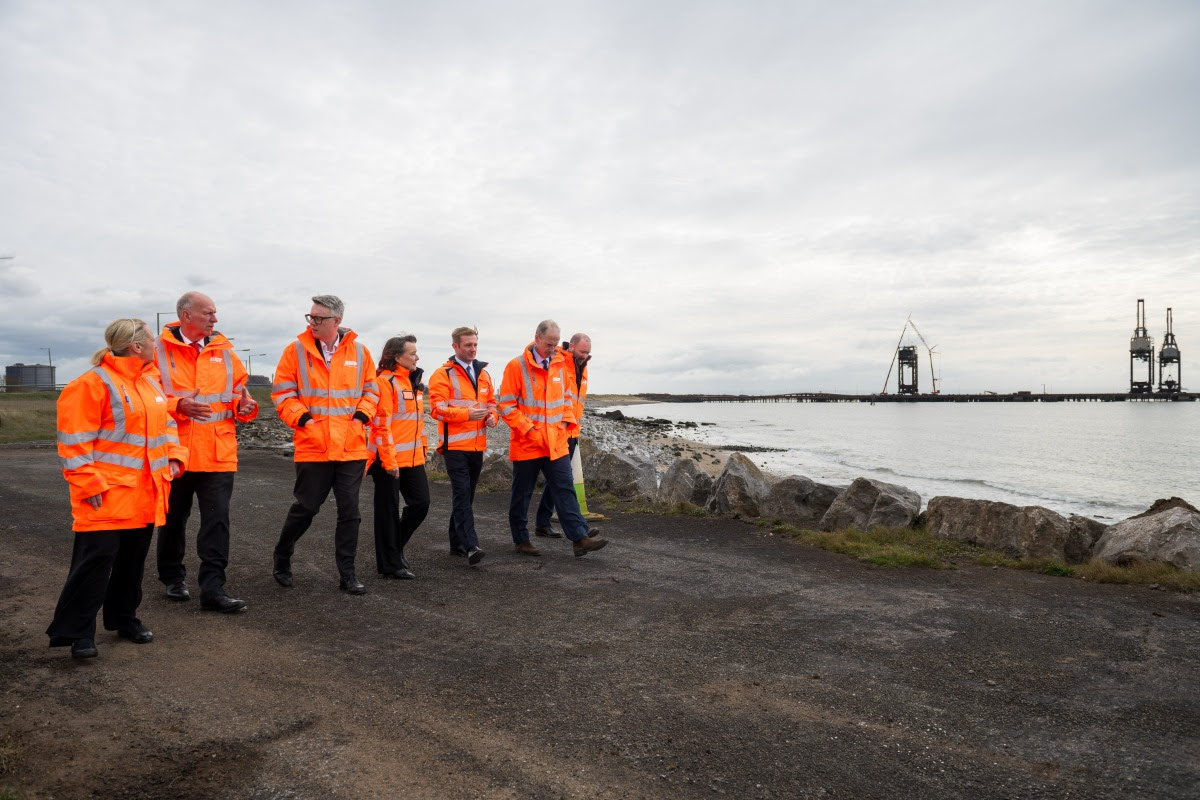
New government-backed deal with ABP reinforces Port Talbot’s central role in Celtic Sea wind plans
PORT TALBOT has been firmly established as the “cornerstone” of the UK’s floating offshore wind ambitions in the Celtic Sea, following a major agreement between the UK Government and Associated British Ports.
The deal confirms government support for the development of large-scale port infrastructure at Port Talbot, enabling manufacturing, assembly and deployment of floating wind turbines for gigawatt-scale projects.
The announcement strengthens Port Talbot’s position as the primary industrial hub for the emerging sector.
Henrik L. Pedersen, Chief Executive of Associated British Ports, said the development would “establish the port as a cornerstone of the Celtic Sea floating offshore wind industry.”
Clear role for Port Talbot
The agreement, subject to final regulatory approval, will support the delivery of major offshore wind projects awarded through the latest Celtic Sea leasing round.

Government ministers visiting the site described the development as a key step in building the UK’s clean energy future.
Energy Secretary Ed Miliband said the project would help Wales “storm ahead in floating offshore wind,” supporting thousands of jobs and driving economic growth.
Secretary of State for Wales Jo Stevens added that the investment would “further cement Port Talbot as a hub of the industries of the future.”
Milford Haven still waiting for detail
The latest announcement comes just days after questions were raised about Milford Haven’s role within the wider Celtic Freeport.
While Port Talbot’s position as a manufacturing and assembly hub is now clearly defined, there has still been no detailed breakdown of what activity will be based in Pembrokeshire.
Industry figures continue to point to Milford Haven’s strengths in operations, maintenance, logistics and servicing of offshore wind projects.
However, no formal commitments have yet been made.

Industry backing grows
Developers involved in Celtic Sea wind projects welcomed the progress at Port Talbot, describing it as essential infrastructure for delivering future schemes.
Ocean Winds said strengthening port infrastructure was “essential” to ensuring regional ports can support the rollout of offshore wind.
The Crown Estate also described the move as a key step towards unlocking the economic potential of the Celtic Sea, which could create thousands of jobs across Wales and beyond.
Growing pressure for answers
With Port Talbot now firmly positioned at the centre of construction and deployment, attention is likely to turn to how other ports—including Milford Haven—fit into the wider strategy.
For Pembrokeshire, the question remains unchanged:
As billions of pounds flow into the Celtic Sea over the coming decade, will Milford Haven secure a defined share of that investment—or continue to wait for clarity?
Pictured above:
From left to right: Cabinet Secretary for Economy, Energy and Planning, Rebecca Evans; David Rees MS for Aberavon; Minister for Energy Consumers, Martin McCluskey; Secretary of State Jo Stevens; Ashley Curnow, Divisional Port Manager (ABP); Julian Walker, Chief Commercial Officer and Regional Director (ABP), Mike Goddard, Head of Programme, Future Port Talbot (ABP)

Port Talbot secures £64m backing as questions grow over Pembrokeshire’s share of offshore wind boom
MILFORD HAVEN’S role in Wales’ clean energy future is under intense scrutiny after a major government-backed wind project placed Port Talbot firmly at the centre of the Celtic Sea boom.
The UK Government has confirmed up to £64 million in funding to transform Port Talbot into the UK’s first dedicated floating offshore wind hub—unlocking up to 4.5GW of capacity and thousands of jobs.
But as the scale of the investment becomes clear, a critical question is now being asked across Pembrokeshire: what does Milford Haven actually get?
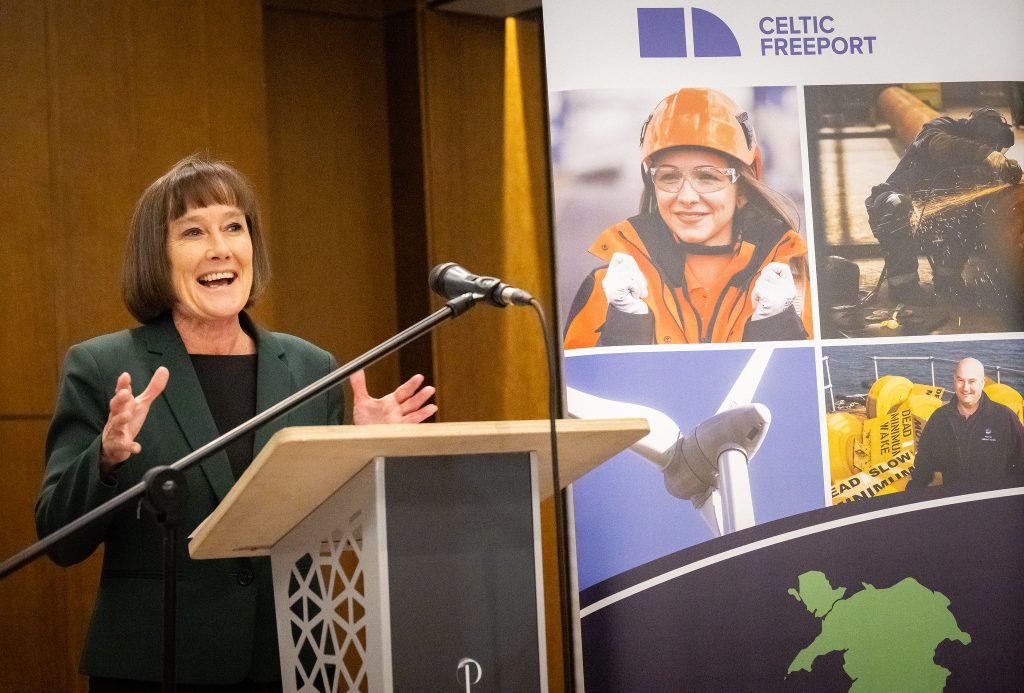
Freeport partnership — but unequal detail
The UK Government has made clear the scale of its backing for Port Talbot, describing it as central to its “clean power mission.” The £64 million grant will fund design and engineering work to develop a specialist floating wind port, expected to unlock at least 4.5GW of projects in the Celtic Sea—enough to power around 6.5 million homes. Officials say the scheme could support up to 5,000 jobs and attract more than £500 million in private investment.
Energy Secretary Ed Miliband said: “With its deep waters and strong winds, we are supporting Wales to storm ahead in floating offshore wind – a pioneering industry that will support thousands of good jobs, drive growth across the country and unlock the next generation of clean, homegrown power.”
Both Port Talbot and Milford Haven form part of the Celtic Freeport, a flagship project intended to drive growth across South West Wales.
Yet while Port Talbot has secured clear backing as the main construction and assembly hub, there has been no detailed explanation of Milford Haven’s role.
That lack of clarity is raising concern locally.
Milford Haven is one of the UK’s most strategically important energy ports, handling a significant share of the nation’s gas imports and boasting deep-water access ideal for large-scale offshore operations.

For many, it appeared an obvious candidate to play a central role in floating wind.
WHY THIS MATTERS
- Floating wind in the Celtic Sea could power millions of homes
- More than £500 million in private investment expected
- Up to 5,000 jobs linked to port and supply chain activity
- Wales could attract tens of billions in long-term renewable investment
- Early decisions will determine where those jobs are based
‘Value will go elsewhere’
The announcement has also triggered political criticism over how much economic benefit Wales will actually retain.
The Welsh Liberal Democrats have warned that key components for the turbines are likely to be manufactured abroad, with only assembly taking place in Port Talbot.

Welsh Liberal Democrat MP David Chadwick said: “Any job creation is a positive step for Port Talbot, but Labour need to be honest about what this actually contains.
“These turbines are set to be built using imported steel and only assembled locally, not manufactured. This means much of the real economic value will still go elsewhere.”

Major projects already linked to Milford Haven
Despite the uncertainty, significant clean energy investment is already being directed into Milford Haven itself.
A £50 million green hydrogen project within the Freeport tax site is set to begin construction this year, producing low-carbon hydrogen using renewable electricity—much of it expected to come from offshore wind.
UK Energy Minister Michael Shanks said the investment was “crucial in de-carbonising industry, driving investment, boosting our energy security and creating hundreds of jobs in our industrial heartlands.”
Welsh Secretary Jo Stevens added: “This is a huge milestone… which will create jobs and help grow the Welsh economy.”
Meanwhile, a major 1.5GW floating wind project in the Celtic Sea has already secured an Agreement for Lease, with Welsh Government backing.
Economy Secretary Rebecca Evans said: “These projects will create thousands of skilled jobs and help secure our energy independence for generations to come.”

Labour promises jobs — but few specifics
On Friday (Mar 27), Eluned Morgan is set to visit the Port of Milford Haven, where she will pledge to bring more jobs to West Wales through clean energy investment.
She is expected to say the region has “a wealth of opportunity” in the sector and promise that rural communities will benefit from the transition.
However, no specific commitments have yet been made about what proportion of offshore wind activity will be based in Pembrokeshire.
What could Milford Haven secure?
Industry expectations suggest Milford Haven could play a key role in:
- Servicing and maintenance vessels
- Crew transfer operations
- Storage and logistics for turbine components
- Long-term operations bases for offshore wind farms
The Herald understands that discussions around Milford Haven’s role in operations and maintenance have been ongoing for several years, but no formal allocation of work has yet been confirmed.
In contrast, Port Talbot has already secured early-stage government backing and a clearly defined role in construction and assembly.
Opportunity — but no guarantees
Floating offshore wind development in the Celtic Sea is expected to accelerate later this decade, with the first large-scale projects likely to come online in the early 2030s.
Supporters argue the expansion of offshore wind is key to reducing long-term energy bills and protecting the UK from volatile global fossil fuel markets.
Milford Haven’s location, infrastructure, and experience in handling large-scale energy logistics place it in a strong position.
But without firm agreements, there is no certainty over how much work will ultimately come to the area.
With billions of pounds expected to flow into the Celtic Sea over the next decade, early decisions could shape the economic balance of the region for a generation.
A defining moment for the Haven
For Milford Haven, the stakes could hardly be higher.
The port has long been central to the UK’s fossil fuel economy.
Floating offshore wind represents the next chapter—but whether Pembrokeshire becomes a key player or a supporting act remains unresolved.
As political parties set out competing visions ahead of the next Senedd election, local leaders are now under pressure to secure clear commitments.
The opportunity is real.
The investment is coming.
The only question now is whether Pembrokeshire secures its share—or watches it land elsewhere.

Public consultation launched as ministers move to tighten animal welfare laws
TRAIL hunting could soon be banned across Wales and England under new UK Government plans, with a public consultation launched this week (Mar 26).
The move would deliver on a key manifesto pledge and marks the latest step in efforts to strengthen animal welfare protections across the UK.
Trail hunting involves hounds following a pre-laid scent, often animal-based, across the countryside to replicate traditional fox hunting. The practice became widespread after the Hunting Act 2004 outlawed hunting wild mammals with dogs.
However, ministers say trail hunting can still result in harm to wildlife. Concerns have been raised that hounds may pick up the scent of live animals, leading to foxes, hares, and in some cases pets being injured or killed.
There are also ongoing allegations that the activity is sometimes used as a cover for illegal hunting.
Assistant Chief Constable Matt Longman, who leads on hunting for the National Police Chiefs’ Council, has previously warned that trail hunting can act as a “smokescreen”, giving individuals the opportunity to continue traditional hunting practices.
Ministers have stressed that alternative countryside activities—such as drag hunting and clean-boot hunting, which use artificial scents—would still be permitted.
The government acknowledged the role that hunts can play in supporting rural jobs and communities, but said future activity must not put wildlife at risk.
Animal Welfare Minister Baroness Sue Hayman said: “We pledged to ban trail hunting in our manifesto and that is exactly what we intend to do.

“The nature of trail hunting makes it difficult to ensure wild and domestic animals are not put at risk of being killed or injured – that is clearly unacceptable.
“We understand that this is a complex issue and are seeking views from everyone with an interest to help shape how we bring this forward.”
Secretary of State for Wales Jo Stevens added: “It is right that the UK Government is going to ban trail hunting in Wales. In 2004 traditional fox hunting was banned and this is the latest step to ensure we have the highest standards for animal welfare.”

The proposals follow the publication of the government’s wider animal welfare strategy, described as one of the most ambitious reform programmes in a generation.
The public consultation on the ban will run until June 18.



Crime13 hours ago
Teen jailed after starting fire while others slept
Fire set in shared home left sleeping residents at risk and caused £130,000 damage A TEENAGER who started a fire...


Health19 hours ago
GP crisis driving NHS pressure in Wales, Senedd report warns
Falling GP numbers and funding gaps blamed for worsening hospital delays THE NHS crisis highlighted earlier this week is being...


News2 days ago
Reform reveals west Wales candidates for Senedd battle
Monkton councillor tops Pembrokeshire list as party confirms Carmarthenshire names and includes Haverfordwest councillor in unwinnable Swansea spot REFORM UK...


Health2 days ago
Clash over Withybush Hospital services as Paul Davies challenges First Minister
A HEATED exchange in the Senedd has laid bare growing tensions over the future of hospital services in west Wales....


Crime3 days ago
Police stop car in Pennar as three arrested in drugs investigation
Suspected drug driver report leads to major police response and multiple arrests DRAMATIC scenes were reported in Pennar on Monday...


Business3 days ago
New pilot vessel Llanion arrives at Milford Haven
State-of-the-art 22-metre craft marks reset after £3.6m pilot boat controversy THE PORT OF MILFORD HAVEN has taken delivery of a...


Community3 days ago
Sycamore Gap legacy tree to take root in Pembrokeshire landscapes
A SAPLING grown from the famous Sycamore Gap tree is set to become part of Wales’ protected landscapes — with...


Business4 days ago
Could Primark be coming to Haverfordwest? Major retailer in talks for former Wilko site
Council confirms advanced discussions as speculation grows over high street boost HAVERFORDWEST could soon see a major high street revival,...


Business4 days ago
Rail investment ‘could unlock 40,000 jobs and £11bn for Wales’ says new report
RAILWAY stations across Wales could help unlock around 40,000 jobs and more than £11 billion for the economy by 2036,...


Local Government4 days ago
Milford Haven set for £200m investment with schools, leisure centre and rail upgrade
Council outlines major plans for town with backing from Welsh Government MILFORD HAVEN is set for a major transformation with...
-

 Crime7 days ago
Pembroke man remanded in custody over knife threat, assault and damage allegations
-

 Crime7 days ago
Broad Haven man remanded in custody over sexual harm prevention order breach
-

 Crime7 days ago
Publican jailed for six years for supplying cocaine and cannabis
-

 Business3 days ago
Taxi fare shock in Milford Haven as drivers switch to meters
-

 Crime7 days ago
Carmarthen man denies coercive control allegations
-
Business4 days ago
Could Primark be coming to Haverfordwest? Major retailer in talks for former Wilko site
-

 News7 days ago
Pembrokeshire’s Muslims gather to celebrate Eid al-Fitr as Ramadan ends
-

 Education7 days ago
Prendergast School achieves gold award for Armed Forces support