


Politics
Sacked Welsh Government minister Hannah Blythyn gives her side of story

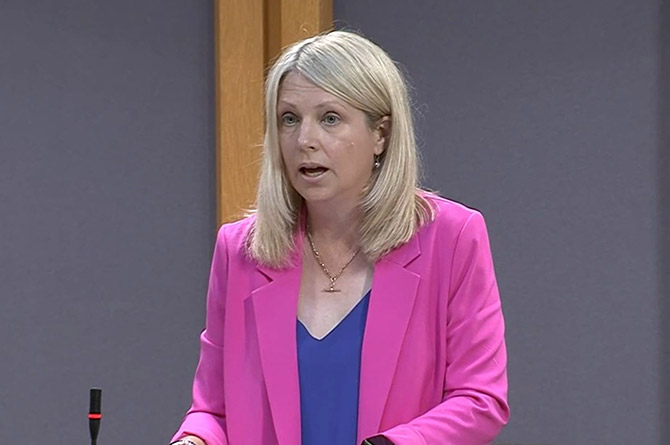
A MINISTER sacked by Wales’ First Minister amid claims she leaked information to the press has broken her silence, telling the Senedd her side of the story.
Hannah Blythyn, the Labour MS who has represented Delyn since 2016, reiterated her vehement denial of the allegations made by Vaughan Gething.
She was accused of leaking messages between ministers which revealed the First Minister deleted Covid-era texts to swerve freedom of information legislation.
Ms Blythyn has been on leave and her personal statement was the first time she has spoken in the chamber, or Siambr, since her sacking in May.
Describing it as a privilege to serve in government – “particularly under Mark Drakeford” – she said: “This is not a statement that is easy for me to make, nor one that I take lightly.

“Indeed, there were times in the not-too-distant past when I’m not sure I would or could stand and speak in this Siambr again.
“I do so today because I know my removal from government has been a focus of discussion in this place while I have not been here.
“I also feel a responsibility to those closest to me and my many constituents who have demonstrated great patience, understanding and confidence in me….
“I know I can look all my colleagues who sit on these benches in the eye and say I have never leaked or briefed the media about any of you.

“In fact, I can say to everyone in this Siambr.
“Whilst I will not share the detail, I will wish to share that I have formally raised concerns about the process by which I was removed from government.”
Ms Blythyn said she was not being shown any alleged evidence before being sacked, made aware she was under investigation nor advised she had broken the ministerial code.

She told the Senedd: “I absolutely recognise and respect that it is within the gift of any First Minister to appoint and remove members of their government.
“I understand the nature of politics, I completely accept that. I raise concerns not out of self-interest but because I fundamentally believe in devolution and public service.”
In closing, she said: “In spite of the challenges and difficulties – perhaps because of them – I feel a renewed sense of commitment to the politics of public service and a real determination to continue to contribute to devolved democracy, my community and our country.”
She added: “I have very real concerns that lessons have not been learned from the past.
“Proper process not only needs to be in place and followed to ensure the dignity and respect of individuals but also to uphold the integrity of the civil service and the office of First Minister.
“I want to take a moment to reflect on something that is very personal and somewhat difficult for me but I feel it’s important to say for the sake of how we do politics.
“I know there has been speculation about my circumstances and whether I have been well enough to work.
“This has ranged from tantamount to misinformation and what can be put down to misunderstanding.”
Ms Blythyn told the chamber the past few months have taken a toll on her mental health as she called for a kinder politics.
She said: “It should not be surprising that what happened has been hugely detrimental to me on a personal level and led to acute anxiety and stress.
“I have never been signed off work before …. there was a point when the thought of putting my camera on to vote and seeing you all literally took my breath away.
“I share this now not in search of sympathy, I don’t want people’s sympathy, but because my recent experience has brought home to me that while we all ‘talk the talk’ on mental health, there is still more to do to improve our understanding and the impact that it has on individuals and their ability to do things we would ordinarily take for granted.
“Sadly, I think sometimes we get so caught up in the politics that we don’t always think about the person.”
Immediately following her sacking, Ms Blythyn wrote on social media: “I am deeply shocked and saddened by what has happened.
“I am clear and have been clear that I did not, nor have I ever leaked anything.
“Integrity is all in politics and I retain mine.”
In a statement at the time, the First Minister said: “It is of vital importance we are able to maintain confidence among government colleagues, so we work as one to focus on improving the lives of the people in Wales.”
Mr Gething kept the door open for his Labour colleague to return to government in future, praising her work on fire services and Wales’ LGBTQ+ action plan.
Martin Shipton, associate editor of Nation Cymru, penned an article in early May, accusing the First Minister of misleading the UK Covid inquiry by not admitting to deleting records.
In a ministerial group chat in August 2020, Mr Gething, the then-health minister, wrote in the leaked iMessage: “I’m deleting the messages in this group.
“They can be captured in an FoI [freedom of information] and I think we are all in the right place on the choice being made.
Ms Blythyn, a trade unionist from Connah’s Quay, supported Mr Gething’s opponent Jeremy Miles in the Labour leadership race after Mark Drakeford stood down.
The left-winger, who has been tipped as a potential future Welsh Labour leader, served as deputy minister for housing, local government and the environment under the former First Minister.



PEMBROKESHIRE COUNTY COUNCIL has revealed plans for a new state-of-the-art school in Milford Haven, promising modern, inspiring learning spaces for children and young people across the community.
A newly released video accompanying the announcement features the First Minister, the local authority’s Deputy Leader, the Cabinet Member for Education and the headteacher, outlining what the development will deliver. The plans include specialist teaching areas, improved accessibility, and high-quality outdoor learning and play spaces.
The project places a strong emphasis on sustainability, incorporating energy-efficient features and modern building standards designed to reduce environmental impact while delivering long-term value.
The scheme forms part of a Strategic Outline Case approval. Any final funding commitment will depend on the project successfully progressing through the full business case process.
Cllr Guy Woodham, Cabinet Member for Education, said: “This project represents a major investment in our children’s future. The new school will offer a safe, modern and inclusive environment where pupils can thrive, and we are delighted to share this vision with the community as we move towards the next stage of this exciting process.”

First Minister Eluned Morgan added: “This is fantastic news for pupils, parents, teachers and the whole community. Modern learning environments can make a real difference to pupils and staff alike. The Welsh Government has shown its commitment to new schools in Pembrokeshire as part of our wider programme of improving schools and colleges across Wales.”
Speaking on behalf of staff, pupils and governors, Deputy Headteacher Daryl John said the school community was excited by the plans.
He said: “Milford Haven School recently welcomed a visit from the First Minister, along with the Deputy Leader and Cabinet Member for Education, to mark initial progress on proposals for a new, aspirational school building.
“The development will provide inspirational learning and teaching spaces, offering high-quality, ambitious and equitable opportunities for all pupils. It aims to support our young people to thrive, develop their talents and grow into confident, successful individuals, supported by dedicated staff and the wider school community.”

Stephen Thomas, Headteacher at Milford Haven Primary School, said the project had been long awaited.
He said: “This new school building has been long awaited, and I know how much it will mean to our children, staff and the community as a whole in Milford Haven.
“For many years, our community has hoped for facilities that truly reflect the potential, pride and ambition of our children, and now that vision is becoming a reality.

“This is more than just a new building. It is a statement of belief in our young people and in the future of Milford Haven. It will provide modern, high-quality learning environments, improved spaces for wellbeing and inclusion, and facilities that will open up wider opportunities for our pupils and families.
“As Headteacher, I feel incredibly proud and grateful to see this investment in our community. Our children deserve the very best, and this new school will help us continue raising aspirations, strengthening community links and ensuring every child can thrive.”
The council will now begin a period of consultation and engagement with pupils, staff, parents and local residents to ensure the new school reflects the needs and ambitions of the whole community.

Port Talbot jobs and future of UK steel industry in focus despite government move to curb cheap imports
WELSH steelworkers could be among the biggest beneficiaries of new UK tariffs on imported steel — but unions have warned that without a long-term plan, the industry will continue to face uncertainty.
The UK Government has confirmed it will strengthen its tariff regime from June to prevent the dumping of cheap foreign steel on the domestic market, a move welcomed by trade union Unite.
However, the union says the decision highlights a wider problem — a reactive approach that has left critical industries like steel “lurching from crisis to crisis.”
The issue is particularly significant for Wales, where the steel industry remains a cornerstone of the economy, with communities such as Port Talbot heavily reliant on the sector for jobs and investment.
Unite general secretary Sharon Graham said: “Unite welcomes the strengthening of the UK’s tariff regime to prevent the dumping of cheap foreign steel onto the domestic market from June.
“But this last minute situation is just another reminder that the reactive approach to UK steel that sees it lurch from crisis to crisis needs to be overhauled.”
She added: “Ministers must introduce a long-term strategy that secures the future of the industry, which is vital to the UK’s economy and national security, without delay.”
The Herald understands that concerns remain across the Welsh steel sector about the pace and direction of change, particularly following the transition away from traditional blast furnace steelmaking at Port Talbot.
Unions and industry figures have repeatedly warned that the shift towards electric arc furnaces, while more environmentally sustainable, could reduce the UK’s ability to produce so-called “virgin steel” — a key material for major infrastructure and defence projects.
Unite has called on the government to go further by legislating to ensure that all major UK infrastructure developments use domestically produced steel.
The proposal would have clear implications for Wales, potentially boosting demand for steel produced at Welsh sites and helping to safeguard jobs.
Unite regional secretary Peter Hughes said: “The steel strategy must be a first step in backing the UK steel industry and steelworkers.

“Steel is a foundation industry and is critical to the success of our economy. The government must also back the production of virgin green steel as we can’t simply rely on electric arc furnaces to produce all the steel we need.”
The debate comes at a crucial time for Welsh steelmaking, with significant public investment already committed to supporting the industry’s transition to greener production methods.
While ministers have framed the tariffs as a necessary step to protect domestic producers, critics argue that without a comprehensive industrial strategy, the measures risk being a short-term fix.
For communities in south Wales, the stakes remain high. Steel is not only a major employer but a defining part of the region’s identity — and decisions made in Westminster will have lasting consequences on the ground.
As global competition intensifies and energy costs remain volatile, pressure is mounting on the UK Government to move beyond emergency interventions and set out a clear, long-term vision for the future of steel — one that secures both jobs and production capacity in Wales.


PARKING charge increases in Pembrokeshire, which include part of Tenby’s multi-storey and the new Haverfordwest interchange moving to a 24-hour charging model, have been backed by senior councillors.
At the March meeting of Pembrokeshire County Council’s Cabinet, members were asked to back a number of amendments to the current Pembrokeshire County Council parking charges.
For parking permits the changes proposed, to take effect from April 1, were: Y Penfro, parking across any long stay car park all year, from £240 a year to £300; The Puffin, which allows non-vehicle specific parking in a specific named car park all year round, from £180 to £240; Coastal, a transferable permit to allow a vehicle to park in specific seasonal car parks, up from £120 season to £160; Parking Permit Passport, a weekly permit transferable across all long stay car parks, from £35 to £40 a week.
These changes are expected to net an extra £25,000 a year.
At the Haverfordwest Interchange, changes, moving from a 9am-7pm charging to 24 hours, include the first hour now being free, with additional charges to the current rates of 10 hrs at £3.50 and 24 hrs at £4.50, along with a new dedicated motorcycle bay charge of £1 per 24 hours.

At Tenby multi-storey, to take effect from May 1, the proposal is to introduce 24 hours charging on floors 1–3. The ground floor would remain as charging between 9am and 7pm, this floor is short stay only, maximum stay two hours.
The main additional summer charges are: 10 hours £6, 24 hours £10, and weekly £50, up from the current £30; winter rates see 10 hours £3, 24 hours £5, and weekly £25, the latter up from £15.
From March 2027, Tenby Harbour Resident Permits see no cost changes, but a maximum of two vehicle registrations allowed, but a Tenby Harbour visitors permit will be introduced at a cost of £60 per vehicle.
These would be via a Variation Order which involves consultation. It is proposed to bring back any comments to Cabinet prior to implementing.

In Haverfordwest, a new four-hour charge, at £3, for Perrots Road is proposed alongside the current one and two-hour stay charges.
The town’s Hole in the Wall Car park is proposed to be revoked.
Two sites at Gelliswick Seafront currently have no enforceable parking restrictions. Due to recurring issues including overnight camping, it is proposed to introduce: Gelliswick Seafront – free parking, and Gelliswick – free parking.
Many of these changes will be require variation orders.
Other general cincreases proposed included: on street resident permit, £46 a year (to £48); on street visitor permit £52.50 (£60); compound £200 a week (£250); charity £50 (£65) free if all funds to charity; events, on a sliding scale dependent on the percentage capacity of the car park used from less than 50 per cent £100 (£150), 50-75 per cent £175 (£225) and over 75 per cent £225 (£275).
Members backed the changes, also agreeing to undertake a full review of parking services operations to include parking charges, charging periods, seasonal charges, license opportunities, in line with full cost recovery, with a report back to Cabinet in June 2027 – any changes to be implemented from September 2027.



Education6 hours ago
Milford Haven school plans unveiled but funding not yet secured
PLANS for a new £100 million school in Milford Haven have been unveiled, but the project has not yet secured...


News7 hours ago
Council unveils plans for new state-of-the-art secondary school in Milford Haven
PEMBROKESHIRE COUNTY COUNCIL has revealed plans for a new state-of-the-art school in Milford Haven, promising modern, inspiring learning spaces for...


Health10 hours ago
NHS waiting list falls — but cancer delays and diagnostic backlog worsen
Record progress claimed by Welsh Government as critics warn key targets are still being missed THE NHS in Wales has...


Crime1 day ago
Rapist jailed after ‘abhorrent’ attacks on woman and children
Haverfordwest man told police “women won’t have sex without force” A HAVERFORDWEST man who raped a woman and a young...


News1 day ago
Reform secures first Pembrokeshire councillor in Hakin by-election win
Late Reform candidate takes seat as independent surge and Labour withdrawal shape contest REFORM UK candidate Scott Thorley has won...


News2 days ago
Scott Thorley elected as Pembrokeshire’s first Reform councillor
REFORM UK candidate Scott Thorley has won the Hakin by-election after securing 179 votes. The full result is as follows:...


News2 days ago
Police confirm man has died after being recovered from River Cleddau
Major emergency response in town centre after concerns raised for man in water A MAN has died after being recovered...


Community2 days ago
Davies and Kurtz urge groups to seek employability funding
Community organisations in Pembrokeshire encouraged to apply for new grants supporting skills and job access LOCAL Senedd Members Samuel Kurtz...


News2 days ago
Emergency services flood Haverfordwest after reports of person in river
Town centre sealed off as multi-agency response continues A MAJOR emergency response is underway in the centre of Haverfordwest after...


News2 days ago
Detectives receive surge of new information in bid to identify man found at Powys reservoir
Public response follows release of facial image as officers pursue fresh lines of enquiry DETECTIVES investigating the identity of a...
-

 Health6 days ago
Welsh Ambulance Service to host bi-monthly Board meeting
-

 News5 days ago
Rayner and Lammy visit Wales to discuss justice and community safety
-

 News4 days ago
Fishguard linked to allegations in Many Tears Animal Rescue investigation
-
News2 days ago
Emergency services flood Haverfordwest after reports of person in river
-

 Charity7 days ago
Many Tears Animal Rescue visited by inspectors as police attend in support role
-

 Local Government5 days ago
Investigation confirmed after inspectors visit Many Tears Animal Rescue
-

 Community6 days ago
Local charity hosts cancer awareness event in Cardigan
-

 Farming7 days ago
Plea to remove decades old ‘unviable’ planning conditions from property