


Community
Wales hurtling towards 10,000 care home bed deficit over next decade

EXPERTS have warned there will be desperate shortage of 10,000 care home beds in Wales over the next decade.
The alert has been raised specialist business property adviser Christie & Co who say there is a growing need for new, “future proof” care homes to meet the need.
Their prediction comes at a time when demand is spiralling upwards, with the over 85 population set to double over the next 20 years.
According to sector champions Care Forum Wales (CFW) the “alarming figures” illustrated the need for social care to be funded properly for existing homes to survive and encourage the development of new ones.
CFW warned that Wales was “sleepwalking into disaster” because the growing shortage of care home beds would pile pressure on the beleaguered NHS when hospitals were already virtually at breaking point.

Building new care homes is a costly business as Gwynedd and Flintshire county councils have shown recently.
They have plans to build two new facilities with a total of around 100 beds between them at an estimated cost of more than £250,000 per bed.
If their figures are correct that would mean it would mean it would cost £400 million for the extra beds needed in North Wales and £2.5 billion for the whole of Wales over the next 10 years.
Worryingly, Christie & Co also revealed in the report that 40 elderly care homes in Wales closed and only four opened between 2020 and 2023 – with no new ones in North Wales.

Among the closures in North Wales were Trewythen Hall in Gresford, Bay Court in Kinmel Bay, Gwastad Hall in Cefn y Bedd and Morfa Newydd in Greenfield with the loss of more than 160 beds.
CFW Chair Mario Kreft MBE said: “The report from Christie & Co paints a bleak picture an illustrates how the existing crisis is going to get even worse, creating a double whammy for our overstretched hospitals which have rows of ambulances queuing outside and patients on trolleys in corridors.
“Instead of being able to build more care homes to meet growing demand, we are seeing more and more care home closures.

“The cost of building new care homes and replacing the beds we are losing now is absolutely eye-watering.
“Our public finances in Wales are already under pressure so where is this money coming from?
“The way care homes are funded in Wales is a total postcode lottery with 29 variations on a theme, with most of social care being commissioned by the 22 local authorities and seven health boards.
“Within that there is a gaping North-South divide with five of the six county councils in North Wales paying the lowest fees, arrived at by a fee-fixing cartel known as the North Wales Regional Fees Group.
“The one shining exception is Conwy Council where earlier this year announced inflation-busting plans to increase fees by up to 20% after warnings that care homes were at risk of financial meltdown and closure.
“Following a long-running campaign by Care Forum Wales they have introduced fairer fees which reflect the actual cost of providing care for vulnerable people in privately run homes, including those with dementia.
“That came about because Conwy broke away from the North Wales Regional Fees Group and took our advice by commissioning leading healthcare economists Laing & Buisson to analyse the true costs of care providers for the current year.
“It’s and internationally recognised tool to ensure that and those living and working in care homes can receive the best care, while at the same time, ensuring that the
“This is something we have been calling for over many years. All we want is fairness in line with the Welsh Government’s ‘Let’s agree to agree’ guidance.
“The fundamental issue threatening the viability of care homes is the unrealistically low fees that the vast majority of councils and health boards pay, fees that come nowhere near covering the true cost of providing care.
“Economically, it would make a lot more sense to ensure the financial security of our existing care homes instead of just relying on the forlorn hope that somebody is going to magically build enough new ones to meet current needs and the increasing demands for social care.
“We’ve had a generation of injustice and it’s a generation where the institutional prejudice and discrimination against the private care sector in Wales has meant that those living and working in these fantastic community assets have not been valued.
“The problems we have in social care lead to the pressures in the NHS which lead of course then to extra costs being placed on the NHS which would largely be alleviated if local authorities had a more enlightened approach to social care.
“If Conwy can do it, the other five local authorities in North Wales can and should do it and of course, the money has always been there. It’s how you politically choose to spend it.
“Across the famous Foryd Bridge, which links Kinmel Bay and Rhyl, Denbighshire County Council is budgeting announced much smaller increases of around 8% on rock bottom fees which have been immediately wiped out by inflation and the cost of living crisis.
“The vastly differing rates mean that Denbighshire will be paying £9,224 a year less per person than Conwy towards the cost of giving exactly the same level of nursing care to residents.
“It is simply an outrage. It’s an affront to the families that that bridge spanning the mouth of the River Clwyd can mean such a massive difference for vulnerable people, including those with dementia.
“The families of those people, who will often be expected to make up the difference, need to ask why and quite frankly, it is a bridge too far.
“This is undoubtedly a stealth tax on families and quite frankly, the people making these decisions in those authorities should be utterly ashamed of themselves in the way they are betraying vulnerable people including those with profound dementia and their families.
“What this demonstrates is that there is an urgent need for us to look again at the way social care is funded.
“We need a national approach to eliminate this iniquitous postcode lottery so that the people for whom we provide care and our staff are treated fairly.
”This is too important to be left to local authorities and health boards alone – it has to be driven by the Welsh Government.”
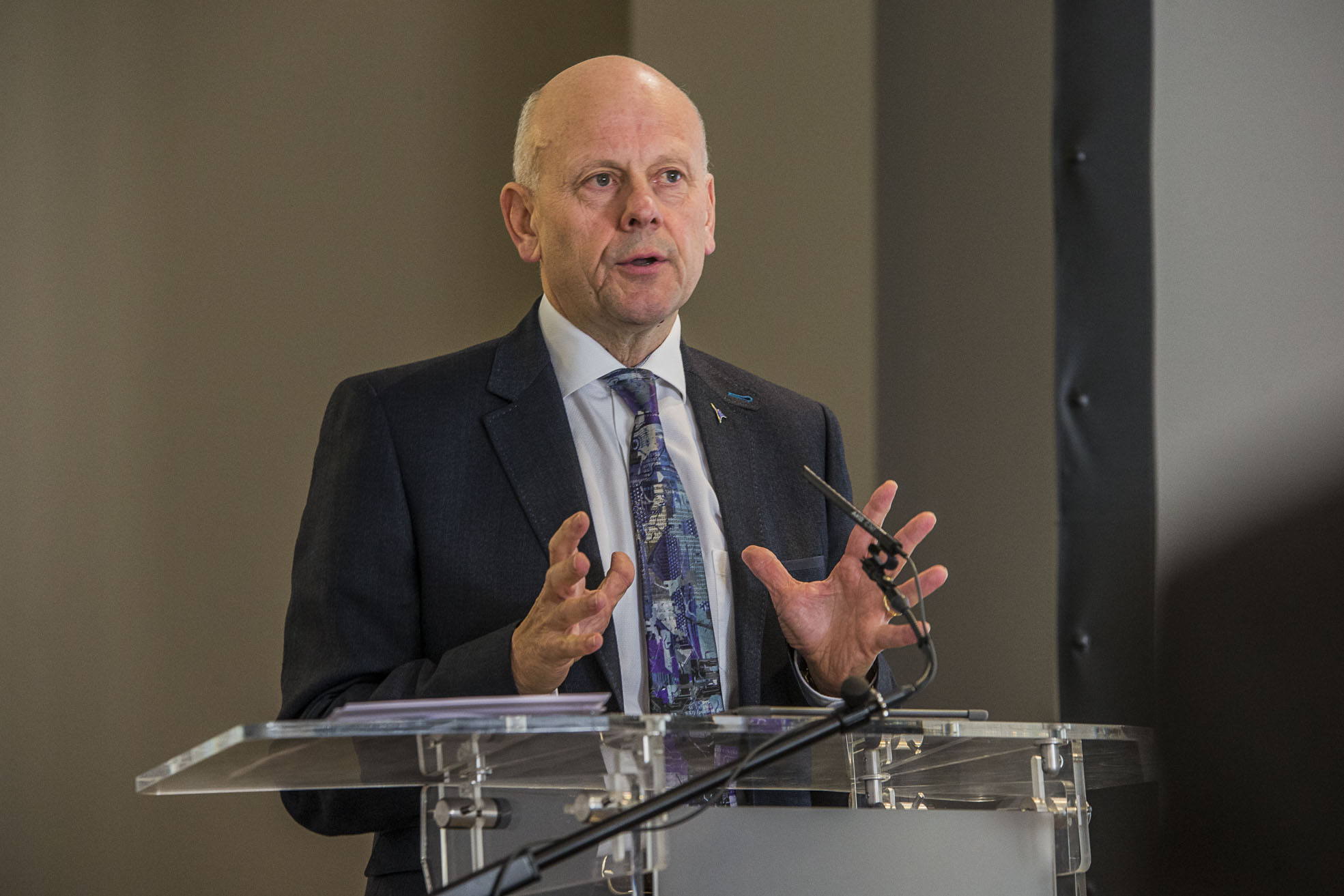
Pictured: Mario Kreft MBE, Chair of Care Forum Wales



A CALL to extend a former Pembrokeshire school used as a community hub has been given the go-ahead.
In an application to Pembrokeshire Coast National Park, Brendan Patchall, through agent Kinver Kreations Ltd, sought permission for an extension of Yr Hen Ysgol, Dinas Cross.
The application said of Yr Hen Ysgol: “The Old School (Yr Hen Ysgol) at Dinas Cross Pembrokeshire is the community hub. The venue hosts many events including arts, sports, education, music and hobbies and serves as a warm, safe haven. They are a registered charity, acting as a non-profit-making organisation, run by unpaid volunteers.”
An officer report recommending approval said: “The Old School has significant historical and community value. The site was originally gifted to the people of Dinas Cross by the Barony of Kemaes (Cemaes) during the 19th Century for the construction of a village school.
“The building is representative of a typical Victorian school structure, constructed of locally sourced rubble stone, much of which has been rendered, beneath pitched slate roofs. Its simple, functional form and modest detailing reflect the vernacular architectural traditions of rural Pembrokeshire during that period.

“The building has been subject to a series of extensions and alterations over time, resulting in an irregular plan form. Notwithstanding these changes, the property retains its historic character and continues to serve the community, now functioning as a community hall.”
It went on to say: “The scale of the extension is considered subservient to the existing building, representing a logical and proportionate addition that does not dominate the host structure. The siting to the rear ensures that the more sensitive public-facing elevations of the building remain largely unaffected.”
It concluded: “The proposed development seeks to extend and enhance an existing community facility at Yr Hen Ysgol, Dinas Cross. The scheme represents a proportionate and well considered addition to the building, which will improve its functionality, accessibility and long-term viability as an important local community asset.”
The application was conditionally approved by park planners.


Historic Haverfordwest building set for transformation after years of neglect
A HISTORIC Haverfordwest building is set to be transformed into a major cancer support centre, breathing new life into one of Pembrokeshire’s most significant architectural landmarks.
Foley House, which has stood neglected for nearly 20 years, will become the new home of Adam’s Bucketful of Hope Cancer Support Centre—an ambitious project inspired by the life and legacy of Adam Evans-Thomas.

The plans were discussed at a recent meeting held at The Merlin Theatre, Pembrokeshire College, attended by local councillors, campaigners, and community supporters.
Speaking after the meeting, County Councillor for the Castle Ward and Chairman of the charity, Thomas Tudor, said it had been “lovely” to hear more about the building’s history and future potential.
He thanked guest speaker Mark Muller for outlining the history of Foley House, and Cris Tomos of PLANED for offering guidance on how the project could move forward. Tribute was also paid to The Bucket Music Makers and Chris Evans-Thomas for their continued support.
New purpose for historic building
Designed in 1791 by renowned architect John Nash—best known for his work on Regent Street, Regent’s Park and parts of Buckingham Palace—Foley House is regarded as one of Haverfordwest’s architectural gems.
Now, after years of decline, the building is set to be carefully restored and adapted to provide a modern, accessible centre for cancer support services.
The Herald understands the vision is to create a welcoming environment combining heritage with healthcare, including lifts, treatment rooms, and calm spaces designed for patients and their families.
Inspired by Adam’s legacy
The project builds on the legacy of Adam Evans-Thomas, who was diagnosed with Chronic Myeloid Leukaemia in his early twenties.

Despite years of treatment, Adam became known for his courage, humour, and compassion—qualities that inspired those around him. He died at the age of 35, but his story continues to shape cancer support services in Pembrokeshire and beyond.
Over the past 30 years, initiatives linked to his legacy have helped establish the PHODU ward at Withybush Hospital and a double ICU room at the University Hospital of Wales in Cardiff.
Friends and family are now aiming to take that legacy further by creating a dedicated centre of excellence in Haverfordwest.

Expanding support services
The new centre will not only continue existing support services but expand them, including therapies and treatments not always available through the NHS.
Plans also include a significant expansion of lymphoedema services, helping patients recovering from cancer surgery.
Alongside clinical support, Foley House will offer a wide range of wellbeing activities, including singing, gentle exercise, meditation, yoga, and arts and crafts.
Community at its heart
Organisers say the centre will be firmly rooted in the community, with volunteers and patients playing a central role.
A group known as the “Buckateers”—patients and volunteers aged 70 and over—will help bring energy and character to the project, including themed events celebrating the building’s Georgian heritage.
There are also plans to host performances by young musicians, creating a welcoming and uplifting atmosphere for visitors.
Call for support
With restoration work ahead, the charity is now seeking funding partners, grants, and corporate sponsors to help bring the project to completion.
Supporters say every contribution will help transform Foley House into a vital community resource—offering hope, care, and comfort to families across Pembrokeshire.
For more information, or to get involved, contact Adam’s Bucketful of Hope Cancer Support Centre at [email protected] or call 01437 779400.

Coastguard, police, fire and ambulance crews take part in large-scale training operation
A MAJOR multi-agency search and rescue exercise is taking place off the Pembrokeshire coast today (Friday, March 27), involving coastguard teams alongside police, fire and ambulance crews.
The operation is centred on the waterway between Neyland and Mill Bay, including Neyland Marina.
Milford Haven Coastguard confirmed the exercise is designed to test emergency response capabilities, with multiple agencies working together on a simulated rescue scenario.
As part of the drill, several “man overboard” (MOB) training mannequins are being deployed into the water, while vessels and drones are also being used.
The exercise is being coordinated by Milford Haven Maritime Rescue Coordination Centre.
A Notice to Mariners has been issued, warning those using the waterway to proceed with caution.
Vessels are being asked to maintain a safe speed and give the exercise area a wide berth to avoid disruption to operations.
Anyone requiring further information can contact Milford Haven VTS on VHF Channel 12 or via email at [email protected]
The notice remains in force until 11:59pm today.




Education20 hours ago
Ysgol Henry Tudor reassures parents over Sikh ceremonial kirpan
School says religious item worn by pupil is secured, symbolic and non-functional YSGOL HENRY TUDOR has moved to reassure parents...


Crime2 days ago
Teen jailed after starting fire while others slept
Fire set in shared home left sleeping residents at risk and caused £130,000 damage A TEENAGER who started a fire...


Health2 days ago
GP crisis driving NHS pressure in Wales, Senedd report warns
Falling GP numbers and funding gaps blamed for worsening hospital delays THE NHS crisis highlighted earlier this week is being...


News3 days ago
Reform reveals west Wales candidates for Senedd battle
Monkton councillor tops Pembrokeshire list as party confirms Carmarthenshire names and includes Haverfordwest councillor in unwinnable Swansea spot REFORM UK...


Health3 days ago
Clash over Withybush Hospital services as Paul Davies challenges First Minister
A HEATED exchange in the Senedd has laid bare growing tensions over the future of hospital services in west Wales....


Crime4 days ago
Police stop car in Pennar as three arrested in drugs investigation
Suspected drug driver report leads to major police response and multiple arrests DRAMATIC scenes were reported in Pennar on Monday...


Business4 days ago
New pilot vessel Llanion arrives at Milford Haven
State-of-the-art 22-metre craft marks reset after £3.6m pilot boat controversy THE PORT OF MILFORD HAVEN has taken delivery of a...


Community4 days ago
Sycamore Gap legacy tree to take root in Pembrokeshire landscapes
A SAPLING grown from the famous Sycamore Gap tree is set to become part of Wales’ protected landscapes — with...


Business5 days ago
Could Primark be coming to Haverfordwest? Major retailer in talks for former Wilko site
Council confirms advanced discussions as speculation grows over high street boost HAVERFORDWEST could soon see a major high street revival,...


Business5 days ago
Rail investment ‘could unlock 40,000 jobs and £11bn for Wales’ says new report
RAILWAY stations across Wales could help unlock around 40,000 jobs and more than £11 billion for the economy by 2036,...
-

 Business4 days ago
Taxi fare shock in Milford Haven as drivers switch to meters
-
Business5 days ago
Could Primark be coming to Haverfordwest? Major retailer in talks for former Wilko site
-

 Crime6 days ago
Child rapist found with abuse images after moving to west Wales
-

 Community7 days ago
Charlie the ventriloquist doll returns to Pembroke Dock after 100 years
-

 Crime6 days ago
Milford Haven drug dealing pub boss who boasted of ‘best coke around’ jailed
-

 Community5 days ago
Broad Haven volunteers secure ‘national asset’ status for nature reserve
-

 Health4 days ago
Average of 18 deaths a week in Wales linked to A&E delays, figures reveal
-

 Sport5 days ago
Haverfordwest secure bonus-point win over title-chasing Tumble