


Crime
Kyle Bevan: What we know so far about the death of Pembrokeshire child killer


Police launch investigation at HMP Wakefield – the same prison where Ian Watkins was killed last month
CHILD killer Kyle Bevan, who was serving a life sentence for murdering his two-year-old stepdaughter Lola James in Haverfordwest, has been found dead inside HMP Wakefield – one of Britain’s highest-security prisons.
Police were called to the West Yorkshire jail at around 8:25 am on Wednesday (Nov 5) following reports that a man had been found dead in his cell. Bevan’s death was confirmed shortly afterwards by the Prison Service, which said that police are investigating and declined to give further details.
A Prison Service spokesperson said: “HMP Wakefield prisoner Kyle Bevan’s death was confirmed on 5 November. We are unable to comment further while the police investigate.”

Police and prison investigations under way
West Yorkshire Police are leading inquiries into the circumstances of Bevan’s death. As is routine following any death in custody, the Prisons and Probation Ombudsman will also open an independent investigation in due course.
Bevan, aged 31, had been serving a life sentence with a minimum term of 28 years for the murder of his stepdaughter in 2020.

The cause of death has not yet been released, and officials have not stated whether it is being treated as suspicious. Bevan was found dead just weeks after Lostprophets singer Ian Watkins, a convicted paedophile, was murdered by other inmates inside the same facility on October 11.

“Prison under strain”
HMP Wakefield, a Category A men’s prison housing more than 600 of the UK’s most dangerous offenders, has recently been described by inspectors as “a prison under strain.”
A report published earlier this year found increasing levels of violence, overcrowding, and poor perceptions of safety among prisoners—particularly older men sharing wings with a growing number of younger inmates.
The back-to-back deaths of Watkins and Bevan have prompted renewed questions about safety, staffing, and conditions inside the high-security jail, known informally as “Monster Mansion.”

The murder of Lola James
Bevan’s original conviction was one of the most harrowing cases to emerge from west Wales in recent years.
On 17 July 2020, two-year-old Lola James suffered catastrophic head injuries after what the judge later described as a “frenzied and extremely violent attack.” She died in hospital four days later.
At Swansea Crown Court in April 2023, Bevan was found guilty of murder after jurors heard that Lola had sustained 101 separate injuries to her body. He claimed the family dog had pushed her down the stairs, but medical evidence showed she had been assaulted repeatedly over several months.

Bevan, described in court as a “self-confessed spice head” who also used amphetamines, Xanax and cannabis, had moved into the family home in Haverfordwest only months before the killing.
Judge Mr Justice Griffiths said Bevan had shown “no remorse at all” for his actions, adding that the murder was the culmination of months of cruelty.

Mother jailed for failing to protect her daughter
Lola’s mother, Sinead James, was sentenced to six years in prison for causing or allowing the death of a child. The court heard that she had ignored warnings from friends, family and social services, continuing to leave Lola in Bevan’s care despite signs of previous injuries.
A Child Practice Review into the tragedy was commissioned by Pembrokeshire County Council, examining whether agencies could have done more to protect the little girl.

A council spokesperson said at the time: “Whilst Pembrokeshire County Council has had some historical involvement with Lola and her family, the local authority was not involved at the time of her death or during the relationship between Kyle Bevan and Sinead James.
The council continues to offer its sincerest condolences to Lola’s family for their loss.”
Reaction and next steps
The announcement of Bevan’s death has prompted strong reactions on social media, with many expressing the view that “justice has finally been served,” while others have questioned conditions inside the prison.
The cause of death and findings of the police inquiry are expected to be released in due course. An inquest will follow once the post-mortem examination has been completed.
The Herald will continue to monitor official updates from West Yorkshire Police, the Prison Service and the Ombudsman’s investigation.


MID WALES peace activist Angie Zelter was arrested outside the Royal Courts of Justice in London after holding a placard in support of Palestine Action.
The 75-year-old campaigner, from Knucklas, Powys, was detained at around 12:20pm on the steps of the court, according to Radnor Palestine Links.
The group said Ms Zelter was arrested under Section 13 of the Terrorism Act 2000 after holding a sign which read: “Saving lives is not terrorism. I support Palestine Action.”
She was taken to Charing Cross Police Station and released around two hours later, the group said.
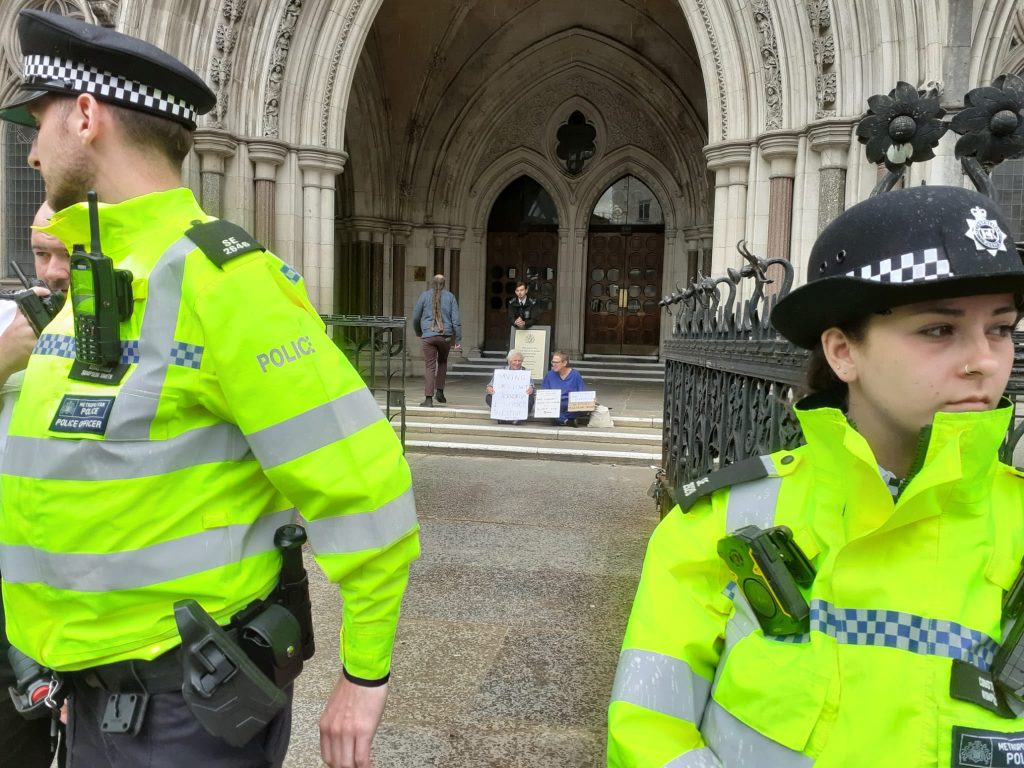
The arrest came as the Court of Appeal ruled in favour of the UK Government over its decision to proscribe Palestine Action under terrorism legislation.
The ruling overturned an earlier High Court decision which had found the ban unlawful. The Court of Appeal held that the Government’s decision was lawful and proportionate.
Palestine Action was banned after the Home Secretary moved to proscribe the group under the Terrorism Act 2000. Supporting or inviting support for a proscribed organisation can be a criminal offence.
Radnor Palestine Links said the protest formed part of an ongoing campaign against the use of counter-terrorism laws against peaceful demonstrators.
Ms Zelter, a long-standing peace and human rights campaigner, has been arrested more than 100 times worldwide during decades of non-violent direct action. She is also known as a founder of Trident Ploughshares.
Speaking after her arrest, Ms Zelter said: “I think it’s a terrible indictment of the criminal justice system that you are charging me with terrorism for holding a peaceful sign.
“We have to uphold the most important international laws. Peaceful, disruptive protest is absolutely essential to protect democracy.”
The Metropolitan Police has been asked to confirm the circumstances of the arrest, whether Ms Zelter was formally charged, and the conditions of her release.
Photo caption: Court protest: Angie Zelter outside the Royal Courts of Justice in London holding a sign in support of Palestine Action (Pic: Radnor Palestine Links).


Court hears defendant contacted protected person despite ban
A LLANGADOG man has been fined £1,375 after twice breaching a restraining order by contacting a protected person he had been banned from approaching.
Adam Thomas Davies, 34, of Llangadog, appeared before Llanelli Magistrates’ Court on Monday (Jun 15) for proceedings linked to an existing community order.
The court heard Davies had breached a restraining order on two separate occasions in June last year by contacting a person he had been prohibited from approaching under an order imposed by Llanelli Magistrates’ Court in November 2019.
Magistrates were told the original community order, imposed in August 2025, had become unworkable due to long-term physical health issues alongside Davies’ employment.
The court revoked the existing order and resentenced him for the original offences.
Davies was made subject to a new community order running until June 14, 2027. He must comply with a Rehabilitation Activity Requirement and attend appointments or activities as directed by probation services, for up to 15 days.
As a punitive element of the order, magistrates imposed a fine of £1,375.
The court heard the breaches related to unlawful contact made in Carmarthenshire despite the restrictions remaining in force.
Davies was ordered to pay the fine at a rate of £120 per month, starting from July 13.


COMMUNITY groups, charities and local organisations across the Dyfed-Powys area are being invited to apply for funding for projects aimed at improving road safety.
Police and Crime Commissioner Dafydd Llywelyn has launched a new Road Safety Community Grant Fund to support local initiatives designed to reduce risks on the roads, raise awareness and encourage safer behaviour among drivers, cyclists and pedestrians.
The fund will support preventative projects led by communities, including education and awareness programmes, behaviour-change campaigns, road safety events, training and skills development, and evidence-led pilot schemes.
Applications will be assessed on their potential to improve road safety, provide value for money and deliver clear community benefits.
Mr Llywelyn said: “Keeping our communities safe on our roads is a fundamental part of our wider mission to protect the public and reduce harm.
“By investing in community-led initiatives, we are empowering local organisations to deliver practical, innovative solutions that improve road safety, change behaviours, and ultimately save lives.”
The fund forms part of the commissioner’s Police and Crime Plan for 2025-2029, which includes commitments to preventing harm, supporting safer communities and working in partnership on issues affecting local people.
Further details, including eligibility criteria and how to apply, are available on the Dyfed-Powys Police and Crime Commissioner’s website.
The fund closes at 10:00pm on Sunday, July 19.



Business1 day ago
Celtic Freeport five-year plan puts Milford Haven at centre of green energy future
Strategy promises investment, skilled jobs and new supply chains, but major barriers remain over grid connections, planning and delivery THE...


Education1 day ago
Closure of Ysgol Clydau approved after emotional council debate
COUNCILLORS WARNED RURAL COMMUNITIES WILL REMEMBER DECISION PEMBROKESHIRE councillors have voted to close Ysgol Clydau following an emotional debate over...


Education1 day ago
Manorbier school closure process to continue after narrow council vote
Questions remain over insurance, rebuilding costs and possible legal action by Diocese PEMBROKESHIRE councillors have voted to press ahead with...


Community1 day ago
The father, son and daughter lifeguard trio saving lives in Pembrokeshire
A FATHER, son and daughter are preparing to help keep beachgoers safe on the Pembrokeshire coast this summer as part...


Community2 days ago
Beating of the Bounds brings music, boats and tradition to Haverfordwest
CENTURIES-OLD CEREMONY DRAWS FAMILIES TO THE RIVERSIDE HAVERFORDWEST’S historic Beating of the Bounds returned on Sunday (Jun 14), with boats,...


Community2 days ago
Milford Haven School pupil praised after stepping in during real-life emergency
A YEAR 11 pupil at Milford Haven School has been praised after putting his first aid training into action to...


Community2 days ago
River festival brings crowds to Haverfordwest
A CELEBRATION of the River Cleddau brought crowds into Haverfordwest on Saturday (June 13) as the town’s River Festival returned...


Charity2 days ago
Voices at the Castle hailed as unforgettable night after weather setback
Russell Watson headlines spectacular charity concert at Pembroke Castle A SPECTACULAR evening of live music at Pembroke Castle has been...


Local Government3 days ago
Council admits 74 rights of way complaints remain unresolved
Key post vacant since February as walker raises safety concerns over paths near Llanteg and Amroth PEMBROKESHIRE COUNTY COUNCIL has...


Education4 days ago
Diocese threatens legal action as Manorbier school closure battle intensifies
Church says council could face judicial review over fire-hit school A BITTER row over the future of Manorbier Church in...
-

 Community2 days ago
Pembrokeshire Chess Club crowned Welsh champions
-
Education4 days ago
Diocese threatens legal action as Manorbier school closure battle intensifies
-

 Crime5 days ago
Pembroke Dock teenager sentenced over train strangulation attack
-

 Crime5 days ago
Man accused of six rapes including alleged Haverfordwest offence
-

 Local Government4 days ago
Taxi suspended after county-wide licensing checks
-

 Crime5 days ago
Brothers found guilty of causing death of Welsh dad in ‘reckless’ race
-

 Crime4 days ago
Currys worker denies stealing £2,500 of store stock
-

 Local Government6 days ago
Ombudsman clears Woodham over Imperial Hall complaint