


News
OBR leak, tax freeze and political chaos as Reeves prepares for ‘tight’ Budget

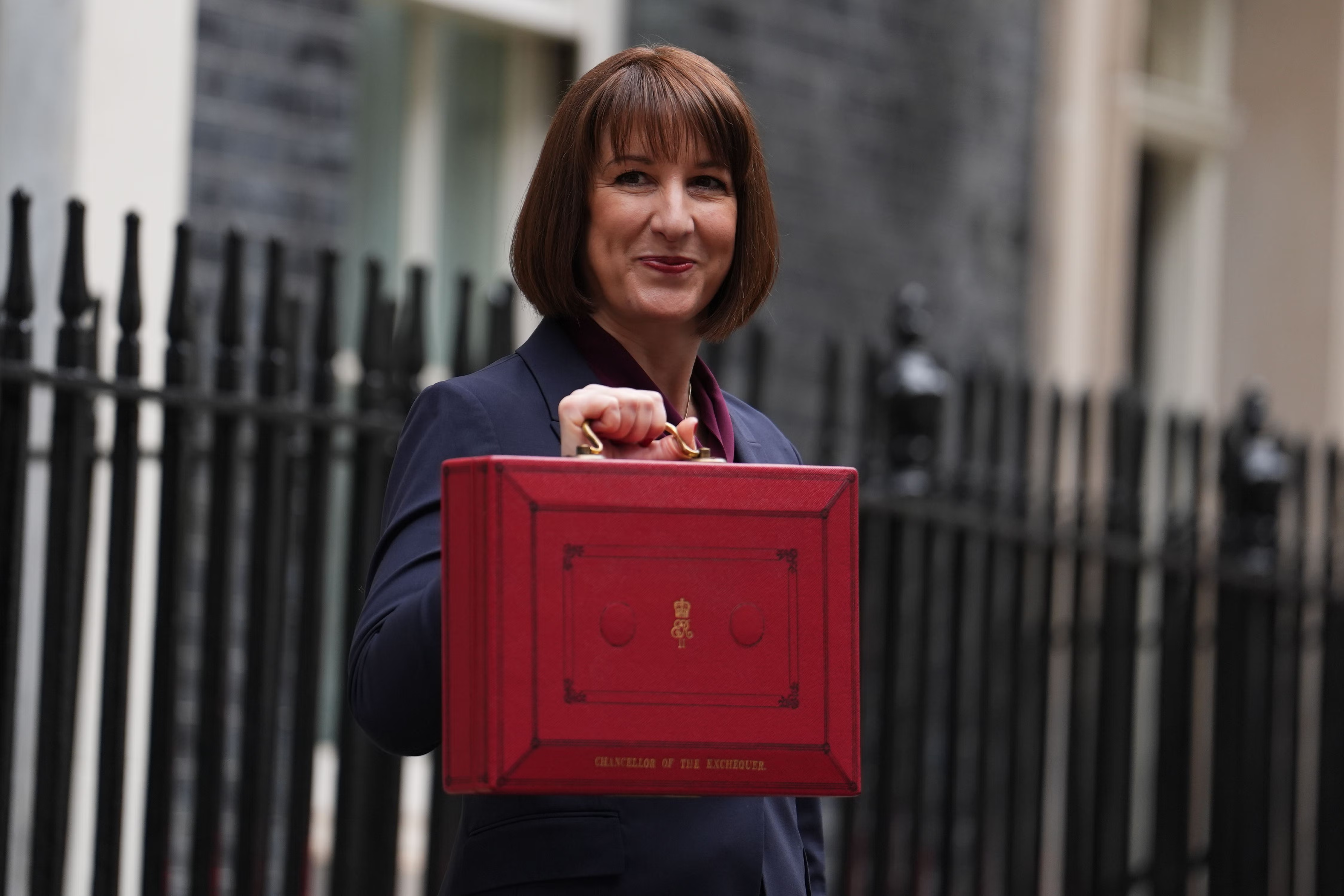
The Herald looks at what’s in the Budget for Wales
LIFE in Wales could be shaped for years by today’s UK Budget after the Office for Budget Responsibility (OBR) accidentally published its full economic forecasts online, confirming a prolonged income tax freeze, weak growth and rising debt before the Chancellor, Rachel Reeves, even reached the despatch box.
The leak — the most serious fiscal breach in recent memory — appeared briefly on the OBR website early this morning. It was removed within minutes, but not before journalists downloaded the full 100-page outlook.
The fallout has stretched deep into Westminster, with senior ministers now confirming that the “riot act” has been read to those suspected of leaking details of the Budget to the media.
Income tax thresholds frozen until 2030–31
The OBR documents confirm that all income tax thresholds will remain frozen for another three years, extending the freeze to 2030–31.
This long-term fiscal drag means more people paying higher taxes without any formal rise in tax rates.

For Wales — where wages lag behind the UK average — the impact will be felt quickly:
- More Welsh workers pushed into basic and higher-rate bands
- Inflation-linked pay rises partially wiped out
- Household budgets squeezed at a time of rising rents, food prices and energy bills
The OBR estimates the policy will raise £8.3bn in 2029–30 alone.
Income tax rate rise scrapped after internal backlash
One of the most dramatic overnight developments was confirmation that a proposal to raise income tax rates for the first time in 50 years has been dropped.
The Financial Times reported that the measure was under consideration until late in the process but abandoned after strong internal resistance and fears of breaking Labour’s manifesto commitments.
This followed a highly unusual press conference from Rachel Reeves yesterday, in which she warned that sticking to Labour’s spending promises would be impossible without either tax rises or “deep cuts” to investment.
Westminster row: ‘Riot act’ read to MPs and Government insiders
The Budget has been engulfed by political turmoil.
Chief Secretary to the Prime Minister, Darren Jones, confirmed this morning that ministers and parliamentarians have been reprimanded over leaks, telling LBC:

“There have been some leaks which are unacceptable… We’ve had to read the riot act to people in Government.”
Pressed on whether MPs were involved, he replied:
“I think so.”
The comments underline the scale of internal frustration as revelations continue to emerge ahead of the Chancellor’s speech.
Record-high tax burden confirmed
The leaked OBR forecasts verify that the overall UK tax burden will reach a post-war high by the end of the decade.
Ed Davey, the Liberal Democrat leader, accused the Government of “raising taxes by stealth”.
For Welsh businesses — particularly hospitality firms already battling rising wage bills, energy costs and weaker footfall — the measures will intensify pressure. Some small breweries and pubs have already warned they are “on the edge”.
Weak growth and rising debt: tight years ahead for Wales
According to the leak, UK GDP will average just 1.5% growth over the forecast period, while public debt rises from 95% to 96% of GDP by 2030.
Because Welsh Government funding is tied to UK spending through the Barnett formula, this means:
No major uplift for NHS Wales
Council budgets in Pembrokeshire, Ceredigion and Carmarthenshire remain under strain
School funding pressures continue
Delays expected for transport and road upgrades
Rural support programmes remain uncertain
Public services already struggling with inflation and backlogs face further tightening.
Borrowing reduction relies on stealth taxes
The leak shows borrowing falling from 4.5% of GDP in 2025–26 to 1.9% by 2030–31, but the improvement is almost entirely due to the extended tax threshold freeze, not stronger economic growth.
What Reeves is expected to announce today
Although full details will not be confirmed until this afternoon, the Chancellor and Prime Minister have signalled several measures:
- A UK-wide rail fare freeze
- Minimum wage increases from April
- Support for childcare expansion
- Progress toward free school breakfasts
But Welsh hospitality operators warned this morning that wage hikes could push some businesses into closure, with more than 100 breweries shutting down in the past year.
What it all means for Wales
Based on the OBR leak and overnight political briefing, Wales should prepare for:
- Higher effective taxes for millions of workers
- No major improvement in Welsh Government spending power
- Slow growth and weak job creation
- Tough choices on public services
- Ongoing pressure on councils, the NHS, rural communities and small businesses
Rachel Reeves will deliver her Budget in the Commons later today — but the leaks, warnings and political chaos already paint a clear picture: a tight Budget, rising taxes by default, and little immediate relief for Wales.












Pembrokeshire security worker Josh Davies praised for professionalism, kindness and proving first impressions can be wrong
JOSH Davies is hard to miss.
With tattoos across his head, face, neck and hands, he is the kind of man people notice before they know anything about him.
But those who know him, work with him, or have simply crossed paths with him after a long night on duty, tell a very different story.
They describe him as a gentleman. A grafter. A man with a big heart. Someone who would do anything to help another person.

Now Josh, who completed his Door Supervisor course with RM Training and Security Solutions last year, is being praised for the way he has built a career in the security industry and become a valued member of the team.
The Pembrokeshire-based company said Josh had gone “from strength to strength” since gaining his licence, working across licensed venues, events, customer-facing roles, response duties and other security work.
A spokesperson for RM Training and Security Solutions said: “From day one, Josh showed a natural ability for the security industry.
“Since gaining his licence, he has thrown himself into every opportunity presented to him, working across a variety of roles including licensed venues, events, customer-facing positions, response duties, and much more.

“There genuinely seems to be nothing Josh cannot turn his hand to. His willingness to learn, adaptability, reliability, and positive attitude have made him a valued member of the RM team.”
But it is not only his employers who have noticed.
After RM Training shared Josh’s success story online, dozens of people came forward to praise him, with many saying his appearance should never be mistaken for the man underneath.
One woman said she had met Josh on a Sunday morning after he had finished a night shift.

She said: “He was an absolute gentleman. Someone you would say from first impression of meeting, nice guy, good guy.”
Another person, who said she had known Josh since he was young and treated him like a son, said: “I can’t thank him enough for what he has done for me in my life. He is one in a million.
“People look at him like a big boy, but he has got a heart and he will do anything to help anyone.”
Others described him as a “great bloke”, “absolute gentleman”, “sound bloke”, and someone who was “built to be a doorman”.
In an industry where first impressions, calm judgement and public confidence matter, RM Training said Josh’s professionalism had become one of his strongest qualities.
The company added: “What stands out most is his professionalism. Whether dealing with members of the public, clients, colleagues, or challenging situations, Josh consistently demonstrates the highest standards expected within our industry.
“He represents both himself and RM Training & Security Solutions exceptionally well at all times.
“We are incredibly proud to have Josh as part of the team and look forward to watching his continued growth and success within the security industry.”
Security staff are often seen only when something goes wrong, but much of the work involves preventing problems before they happen, reassuring the public, supporting event organisers, and knowing how to deal with difficult situations calmly.
Josh’s story has struck a chord because it challenges the quick assumptions people can make.
To some, the tattoos may be the first thing they see.
To those who know him, they are simply part of a man who has worked hard, taken his chance, and earned respect through his attitude and actions.
One supporter summed it up simply: “Life loves a grafter.”
Photo caption:
Josh Davies has been praised by RM Training and Security Solutions and members of the public for his professionalism and kindness (Pics: DarthMartyMedia).

A SPECIAL service has been held at St Davids Cathedral to celebrate 150 years of the Mothers’ Union.
Members and officials gathered for the anniversary celebration on Sunday (Jun 21), where Bishop Dorrien welcomed those attending and spent time speaking with the Provincial Chaplain.
The occasion had particular significance for Bishop Dorrien, who is the third generation of his family to be a member of the Mothers’ Union.
The organisation, founded in 1876, continues to support families, communities and church life across Wales and around the world.
Those attending said the celebration was a fitting tribute to the work of generations of members, with hopes expressed for the next 150 years.
Caption:
Celebration: Members and officials gathered at St Davids Cathedral to mark 150 years of the Mothers’ Union (Pic: Diocese of St Davids).

Free family festival will celebrate Milford Haven’s seafaring history and coastal community
MILFORD WATERFRONT will burst into life on Saturday, June 27, as the first Harbour Fest sails into town for a day of music, food, family fun and maritime celebration.
The free event will run from 10:00am to 6:00pm at Mackerel Quay and across the waterfront, bringing together local traders, live entertainment, coastal organisations and independent businesses for a packed day beside the water.
Organisers say the festival will celebrate everything that makes Milford Haven special, from its seafaring history and working harbour to its growing reputation as a destination for food, shopping, culture and family days out.
Visitors will be able to browse stalls from local makers and producers, enjoy street food and live performances, and explore a Marine Zone featuring organisations involved in sea safety, marine conservation and coastal life.
The Marine Zone will include Seagrass Network Cymru / Project Seagrass, Pembrokeshire Coastal Forum, Mid and West Wales Fire and Rescue Service, Dyfed-Powys Police, NCI Wooltack Point, Rudders Marine Training, RNLI Milford Haven and RNLI Angle Lifeboat.
RNLI Angle Lifeboat is expected to be based on the Mackerel Stage, while the Sea Cadets will be giving rope-tying displays at Milford Haven Museum, where craft activities will also be taking place.
Live entertainment will run throughout the day, with performances from Tom & Abz, Will Scott, Ryan Bristow, Milford Haven Town Band, Kyle Kirkhouse and ShantyJacs Sea Shanties.
Businesses across the waterfront are also joining in. All Pets Vet Care will hold a family-friendly open day with a bouncy castle, treasure hunts, quizzes, craft activities and behind-the-scenes tours. Aurora Artisan Crafts will host vocal performances, Biffy’s Bar & Restaurant will feature solo acoustic music from Laurence Lewis, and Martha’s Vineyard will offer seafood street food with live music from Ryan Bristow and Steve Bartram.
At Tŷ Milford Waterfront’s outdoor plaza there will be face painting, children’s activities, pop-up artists and an afternoon DJ set, while Phoenix Bowl and Pirate Pete’s Adventure Play will have inflatables and glitter tattoos outside.
The Waterfront Gallery will host introduction to felt-making workshops with textile artist Carole Fletcher, giving participants the chance to create a woollen felt flower pin brooch or phone/glasses case. The workshops start at 10:30am, 1:00pm and 3:30pm and cost £5 per person.
A wide range of traders will also be attending, including 5th Flock Spirits Co, Cinnamon Grove Distillery, Cwm Deri Wines & Liqueurs, Ferncraft, Get Loaded, J.J. Pottery, Major Nuts, Orange Garden Design, Pembrokeshire Chilli Farm, Pembrokeshire Gold, Pembrokeshire Lottery, Plumstone Welshcakes and SlateArtSJ.
With music drifting across the marina, food stalls lining the waterfront and lifeboats, sea safety teams and coastal groups adding a strong maritime flavour, Harbour Fest is expected to bring a lively summer atmosphere to one of Pembrokeshire’s best-known waterside destinations.

Organisers say the event is suitable for families, friends and visitors of all ages, with plenty to see and do throughout the day.
Photo caption: Harbour Fest will take place at Milford Waterfront on Saturday, June 27 (Pic: Milford Waterfront).



Community9 minutes ago
The gentle giant behind the tattoos
Pembrokeshire security worker Josh Davies praised for professionalism, kindness and proving first impressions can be wrong JOSH Davies is hard...


Charity24 hours ago
Toy Story fans fill charity toy box at Haverfordwest cinema
Donations pour in for SNAP Specialist Play as families embrace Toy Story 5 launch A TOY STORY-themed charity appeal at...


Community1 day ago
Lord Rhys emerges from the mist in St Davids
Giant puppet begins historic journey marking 850 years since the first Eisteddfod MIST swirled around St Davids Cathedral on Friday...


News2 days ago
Tragic tribute paid to Haverfordwest man after A4075 collision
FAMILY REMEMBERS “KIND AND LOVING” CALLUM HANSON THE FAMILY of a 22-year-old man from Haverfordwest who died following a road...

News3 days ago
Motorcyclist, 22, dies in A4075 crash in Pembrokeshire
A 22-year-old woman remains in hospital after two-vehicle collision A MOTORCYCLIST has died following a serious two-vehicle crash on the...

Community3 days ago
Why police will be visiting every home in Pembrokeshire
New operation aims to knock on more than 257,000 doors across Dyfed-Powys over the next three years DYFED-POWYS POLICE has...


Crime3 days ago
Prisons at breaking point: MPs warn Wales is paying the price of a failing system
Frozen healthcare budgets, overcrowded jails, homelessness on release and mounting pressure on staff are undermining rehabilitation across Wales, according to...


News4 days ago
Brexit at 10: How Britain was sold a dream that cost us dearly
A decade after the referendum, the promised benefits remain hard to find while the economic costs are increasingly difficult to...


Crime4 days ago
Worcestershire man jailed after violent attack on woman in Tenby
Defendant was already serving a suspended sentence when serious assault took place A WORCESTERSHIRE man has been jailed for more...


Climate4 days ago
Offshore wind ‘could bring new generation of jobs to Milford Haven’
Pembrokeshire ports and Celtic Sea projects placed at centre of Wales’ green energy ambitions MILFORD HAVEN and Pembroke Dock could...
-

 Community7 days ago
Pembrokeshire Chess Club crowned Welsh champions
-

 Crime3 days ago
Milford Haven man jailed for breaching domestic violence protection order
-

 Local Government5 days ago
Security privately arranged by Mayor at Beating of the Bounds
-

 News3 days ago
Crash on Freeman’s Way causes school-run chaos across Haverfordwest
-

 Crime5 days ago
Man wanted by court after failing to attend hearing over alleged shop thefts
-
 Crime5 days ago
Man banned from roads after drink-driving offence
-

 Crime5 days ago
Man jailed after admitting strangulation and assaults
-

 Crime5 days ago
Man sentenced over stalking campaign and lock knife offence