

News
Flooding fuels rise in rail delays across Wales

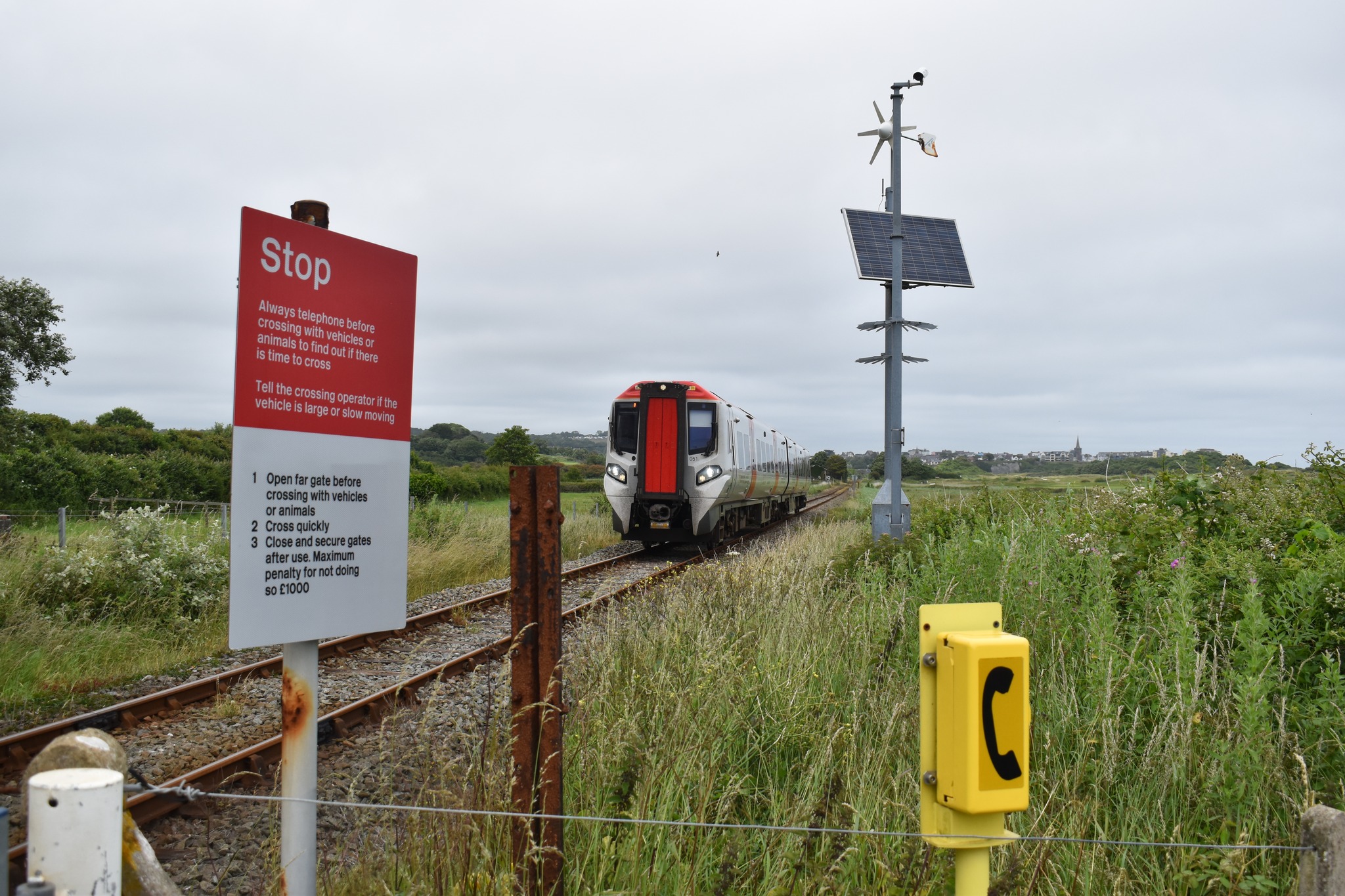
New analysis links worsening disruption to heavier rainfall and repeated trouble spots on the network
RAIL passengers in Wales are facing growing delays and cancellations as flooding increasingly hits the network, according to new analysis based on Network Rail data.
Figures obtained through the Freedom of Information Act suggest flood-related disruption affecting services in Wales has risen by around 256 per cent compared with the mid-2010s.
Between 2022 and 23 December 2025, services affecting passengers in Wales generated an average of around 2,366 passenger delay minutes a year due to flooding. That compares with an average of 664 a year between 2014 and 2017.
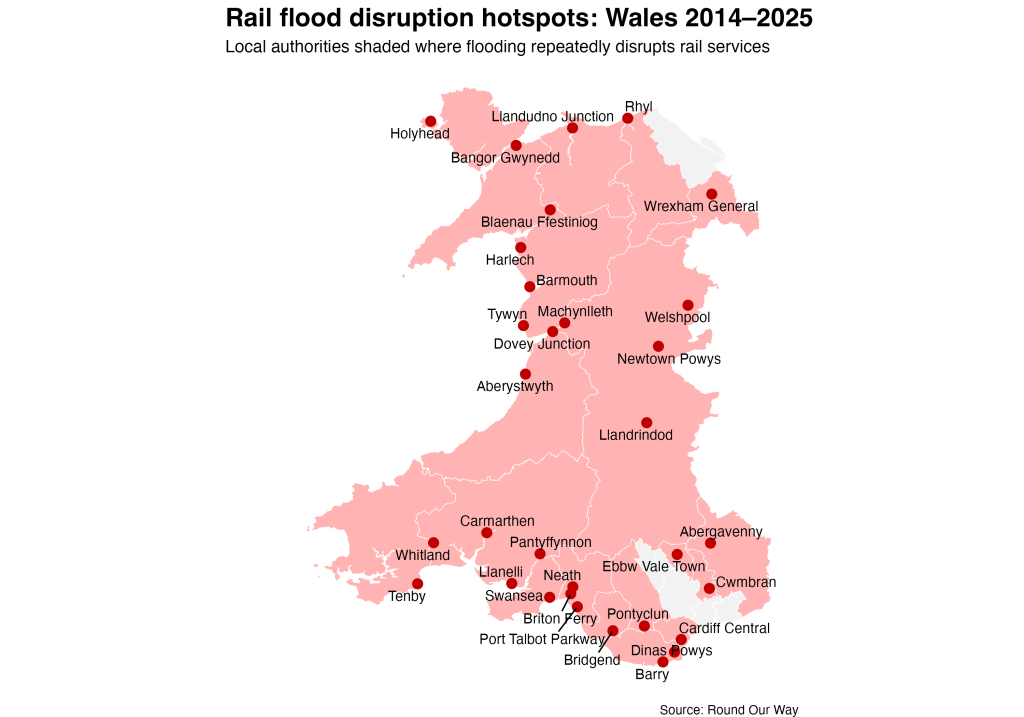
The analysis, carried out by climate not-for-profit Round Our Way, says train operators serving towns and cities across Wales, including Great Western Railway, CrossCountry, Transport for Wales and Avanti West Coast, have all been affected.
The worst disruption has been concentrated around a number of repeat trouble spots on the rail network, including Machynlleth, Cardiff Central, Bridgend, Bangor and Pontyclun, where flooding has repeatedly interrupted services.

Round Our Way said its analysis of Network Rail cancellation data suggests flood-related disruption is placing increasing strain on the rail network as periods of extreme rainfall become more common.
The group said the figures show not only more major disruption events, but also a worsening day-to-day baseline, with even quieter periods now causing more passenger delay than in previous years.
Gemma Plumb, a meteorologist at Weather Change, said: “It’s clear that train users are seeing more and more disruption to their journeys as a result of heavy rain and flooding, which is hugely frustrating for people who rely on the train network to get around.
“We know that climate change is leading to more extreme weather, including more intense rainfall. This is because a warmer atmosphere can hold more moisture, so when it rains, it rains more.”
Sofie Jenkinson, co-director at Round Our Way, said the rail network appeared to be under “persistent weather stress” as climate change began to have more regular effects.
She said: “This causes significantly more delays to train passengers. But it is also a problem for rail operators, particularly the large inter-city train operators running services into regions of the country that are worst hit by flooding, like the South West, Scotland and Wales.
“The significant rise in delays shows the increased impact of extreme weather caused by climate change, raising concerns about safety beneath the surface of our creaking rail infrastructure for passengers and operators alike.”

Round Our Way said Britain was not adequately prepared for the effects of climate change on everyday infrastructure and called for long-term investment to make the rail network more resilient.
The group pointed to wider warnings from climate experts that rising global temperatures are likely to increase the intensity of rainfall, putting more pressure on ageing transport systems.
Network Rail data used in the study covers the period from 1 April 2014 to 23 December 2025 and relates to incidents classed as flood-related disruption.
A train is recorded as cancelled if it fails to stop at one or more planned stations. Full cancellations are classed as trains that completed less than half of their intended journey, while part cancellations are those that ran at least half, but not the full route, or missed one or more planned stops.


Owner says she has done nothing wrong, but RSPCA says it cannot comment on ongoing enquiries
GREENACRES Rescue has confirmed that two dogs removed from a Milford Haven property earlier this year remain safe in its care while an investigation continues.
The Herald first reported in April that police had attended a property in the Precelly Place area following welfare concerns raised by neighbours.
At the time, Greenacres confirmed that two dogs had been admitted into its care and said it would be working with the local authority, police and RSPCA while enquiries were carried out.
The rescue has now issued a further update after renewed speculation on social media prompted a number of enquiries from concerned members of the public.
Greenacres said it had deliberately remained largely silent since the dogs first arrived in order to protect the integrity of the ongoing investigation and any potential legal proceedings.
With the permission of the RSPCA, the rescue said it was now able to provide a brief update to reassure those who had been worried about the animals’ welfare.
Greenacres confirmed that both dogs have remained safely in its care since the day after they were removed. During that time, they have received veterinary treatment, appropriate nutrition, rehabilitation and ongoing support from the rescue’s experienced team.
The charity said it understood public frustration that more information had not been shared sooner, but stressed that investigations involving alleged animal cruelty can be complex and may take considerable time to conclude.
Greenacres said: “As an independent, self-funded rescue, Greenacres Rescue has no greater legal powers than any other member of the public.
“Throughout every stage, the police and the RSPCA are required to act within the powers and procedures set out in the Animal Welfare Act.
“Whilst this can be frustrating for everyone involved, these legal processes are there for good reason and must be followed.”
The owner of the dogs has contacted The Herald and has asked us to report that she denies any wrongdoing. She says she has been told there will be no further action against her.

However, the RSPCA has said it is unable to discuss ongoing enquiries about specific individuals or what action may be taken.
A spokesperson said: “We’re grateful to people who report their concerns to us but we cannot comment any further as we are unable to discuss ongoing enquiries about specific individuals and what action may be taken.
“We understand how frustrating that is for animal lovers but releasing information could prejudice a future investigation or could lead to us being fined.”
Greenacres has confirmed that the Belgian Malinois has now been legally surrendered into its care. The rescue is currently assessing the most appropriate long-term plan for her future.
However, she is not available for direct rehoming and will continue to undergo further behavioural assessment and rehabilitation. Greenacres said it is working with experienced specialists to ensure the best possible outcome for the dog.
The smaller crossbreed dog remains under seizure by the RSPCA and police and continues to form part of the ongoing investigation. Ownership has not yet been transferred, and Greenacres said that position is likely to remain unchanged until the investigation and any related legal process has concluded.
The rescue has also clarified that it has not been involved in the rescue or care of any cats or kittens believed to be connected to the property. Questions about those animals should be directed to the RSPCA.
Greenacres added that a lack of public updates should not be mistaken for a lack of action.
The rescue said: “Much of this work happens behind the scenes and, by its very nature, cannot be shared publicly whilst investigations remain active.
“Our priority will always be the welfare of the animals and ensuring that ongoing legal proceedings are not compromised.
“Please be assured that both dogs are safe, are receiving the care they need, and remain a priority for everyone involved.”
Greenacres thanked the public for their support, patience and understanding while the relevant authorities complete their investigation.
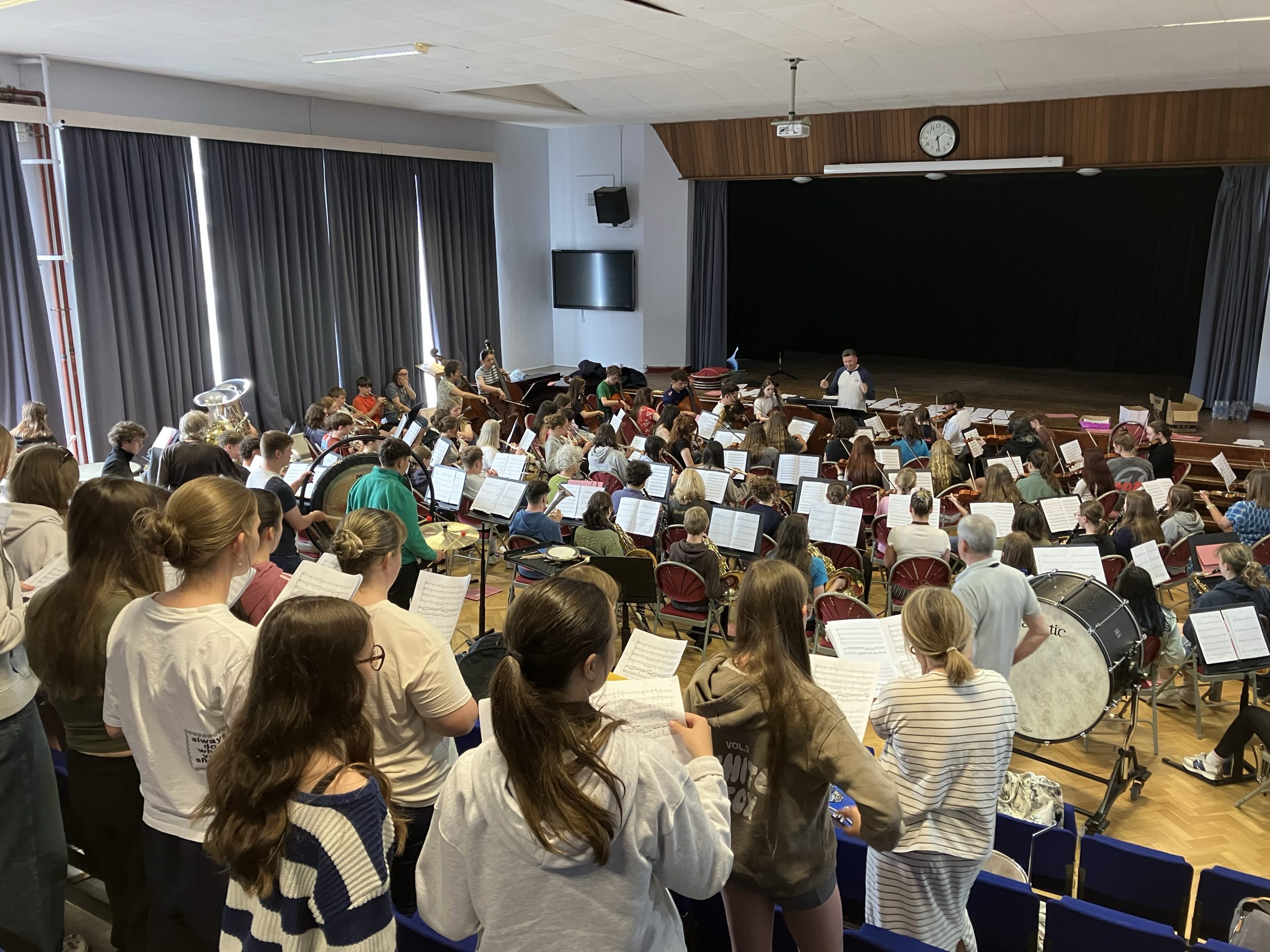
NEW Paul Mealor work, with words by Menna Elfyn, will be performed by 150 young people from Carmarthenshire, Ceredigion and Pembrokeshire
A new composition by internationally acclaimed Welsh composer Paul Mealor will bring this year’s National Eisteddfod to a spectacular close, as 150 young musicians from across west Wales take to the Pafiliwn stage.
Côr a Cherddorfa’r Tair Sir, the Three Counties Choir and Orchestra, will perform Angerdd a gerdd, a new work specially commissioned from Professor Mealor, with words by celebrated poet Menna Elfyn.
The concert will close the Pafiliwn programme on the final Saturday evening of the festival, bringing together young performers from Carmarthenshire, Ceredigion and Pembrokeshire for what organisers say will be one of the highlights of the week.
Côr y Tair Sir was originally formed following the creation of Dyfed in the 1974 local government reorganisation, becoming well known across the region and beyond. It has now been revived especially for this year’s National Eisteddfod, with support from the National Music Service of Wales and sponsorship from the Gwendoline and Margaret Davies Charity, Gregynog.
Rehearsals began in the spring, with pupils meeting regularly to prepare for the performance.
Professor Mealor said he had been delighted by the response from the young musicians.
“One hundred and fifty young people came together to rehearse my new work, to Menna Elfyn’s powerful words, and it sounded wonderful from the very first rehearsal,” he said.
“It’s a challenging piece for young voices, but I’ve been hugely impressed by their commitment, and I’m certain it will be a thrilling experience for the audience on the night.”
Mealor, who was born in St Asaph and raised in Connah’s Quay, has long-standing links with Wales’ musical tradition. He studied composition with Professor William Mathias at the University of York and has credited Mathias as the inspiration behind his musical career, particularly his passion for choral music.
The new work will also showcase the words of Menna Elfyn, one of Wales’ leading poets. Since the publication of her first poetry collection, Mwyara, 50 years ago, she has produced numerous volumes of poetry, children’s books and anthologies, while also writing for stage, radio and television. Her work has received widespread critical acclaim and many awards.
As well as marking the end of the festival week, the concert will celebrate the National Eisteddfod’s rich musical heritage and give a new generation of performers the chance to present a major choral work on one of Wales’ most prestigious stages.

Classical music will feature prominently across the Maes this year, with events taking place at Y Stiwdio and Encore.
Among the highlights is a performance of Atgof o’r Sêr, Memory of the Stars, composed by Robat Arwyn with words written especially for Bryn Terfel. First performed at the 2001 Denbigh National Eisteddfod, this year marks the 25th anniversary of its premiere.
The eight-song cycle will be performed by recent winners of the Osborne Roberts Memorial Prize, including Steffan Lloyd Owen, Meinir Wyn Roberts, John Ieuan Jones, Llinos Haf Jones, Dafydd Jones, Siriol Elin, Joshua Mills and Lisa Dafydd.
Another highlight will be a rare opportunity to hear two songs by composer Meirion Williams, marking the 50th anniversary of his death.
On behalf of the Eisteddfod, musician Sioned Webb and Steffan Prys explored the archive of the late soprano Ceinwen Rowlands, with the assistance of Maredudd ap Huw at the National Library of Wales.
Sioned spent time in London during the 1980s researching and completing an MA dissertation on the life and work of Meirion Williams, but she was unaware of the Ceinwen Rowlands collection at the time.
This year she discovered two previously unperformed pieces in strict Welsh metres, cywyddau by Siôn Cent and Huw Morys, also known as Eos Ceiriog. She edited them for performance with the assistance of Eurig Salisbury.
It will be the first time the two songs have been heard in more than 80 years. Nerys Williams, the composer’s daughter, has been invited to attend the Eisteddfod and present the scores to Tŷ Cerdd.
Betsan Moses, Chief Executive of the National Eisteddfod, said: “There’s a strong programme of classical music across the Maes this year. We’re delighted to welcome so many former competition winners back to perform, celebrating the connection between competing at the Eisteddfod and their career in music.
“We’re also using Rhosygilwen, near the Maes, as the venue for our music prelims during the week, and everyone is welcome to come along and enjoy the performances.
“The Pafiliwn event on the final Saturday evening promises to be one of the highlights of the festival. It is wonderful to give classical music such a prominent place at its heart, while offering talented young local musicians the chance to be part of a unique experience, working alongside one of Wales’ best-known composers and bringing the words of one of our leading poets to life through music.
“It will provide a memorable finale to a week of music and creativity.”
Eisteddfod Genedlaethol y Garreg Las will be held in Llantwd, north Pembrokeshire, from August 1 to 8. Further information and tickets are available at eisteddfod.cymru.


A TENBY woman has been fined after magistrates found she permitted an uninsured driver to use a car in Pembroke Dock.
Christy May Brown, aged 38, of Bush Terrace, Jameston, Tenby, was not present when her case was dealt with at Llanelli Magistrates’ Court on Wednesday (Jul 8).
The court heard that on November 1, 2025, Brown permitted Robert Christopher to use a Vauxhall Astra, registration KW08 KRD, on Ferry Lane, Pembroke Dock, when there was no insurance in force covering third-party risks.
The offence was proved in her absence.
Brown was fined £120 and ordered to pay a £48 victim services surcharge and £120 costs. Her driving record was endorsed with six penalty points.
Magistrates also dealt with a second matter, relating to Brown permitting Christopher to drive the same vehicle otherwise than in accordance with a driving licence. The court heard that he was a provisional licence holder, driving unaccompanied by a qualified passenger, and that no L-plates were displayed on the vehicle.
That offence was also proved in absence, but no separate penalty was imposed.
The court made a collection order and Brown was ordered to pay the £288 balance at £24 per month from August 5.
The case had earlier been reopened under section 142 of the Magistrates’ Courts Act 1980, with a sentence imposed on May 20, 2026 set aside and a previous licence endorsement removed.



Crime13 hours ago
Teacher stabbing trial: The first week of evidence
Jury hears accounts of alleged planned classroom attack, teacher’s fear she was dying, and boy’s words after leaving school A...


Community15 hours ago
Haverfordwest Castle refurbishment reaches new heights as roof goes on
Major milestone reached in project to transform historic gaol building into flagship visitor attraction A MAJOR milestone has been reached...


Business2 days ago
Pembrokeshire lands £98m share of Wales marine energy boom
New industry report says county has received the second highest level of marine energy investment in Wales, supporting more than...
Crime2 days ago
First aider tells jury teacher was “crying, shaking” after classroom stabbing
A SCHOOL first aider has told a jury that teacher Vicki Williams was “crying, shaking” and in “complete shock” after...


Crime3 days ago
Teacher feared she was dying after Milford Haven classroom stabbing
A TEACHER allegedly stabbed in the head at Milford Haven Comprehensive School told a jury she feared she was dying...


News3 days ago
Farage to resign as MP and fight Clacton by-election amid finance row
NIGEL FARAGE has announced he will resign as MP for Clacton and stand again in the by-election he intends to...
Crime3 days ago
Teacher tells jury there were ‘no issues’ with accused pupil hours before ‘stabbing’
Milford Haven teacher gives evidence as trial of 15-year-old continues at Swansea Crown Court A TEACHER allegedly stabbed at Milford...


News3 days ago
Major incident stood down after fire at Impala Terminal in Milford Haven
Fire involved decommissioned oil tank containing residual crude oil and around 60 cylinders A MAJOR incident declared during a fire...


News3 days ago
Large fire breaks out at Impala Terminal in Milford Haven
Black smoke seen for miles as emergency services respond to incident at former Puma Energy site A LARGE fire has...
Crime4 days ago
Prosecution outlines ‘planned attack’ as Milford Haven teacher stabbing trial opens
Jury hears teenager allegedly brought kitchen knife into school before teacher was stabbed in the head THE JURY in the...
-

 Education7 days ago
Education secretary vows to tackle ‘root causes’ of antisocial behaviour in schools
-

 Education6 days ago
Ysgol Glannau Gwaun celebrates prestigious Gold Active Travel award
-

 Community7 days ago
Closure-threatened Stepaside school expected to remain open
-

 Education7 days ago
First Minister pressed on biological sex, additional learning needs, and NHS jobs
-

 Farming3 days ago
Pembrokeshire slaughterhouse given urgent improvement rating after audit failure
-
News3 days ago
Large fire breaks out at Impala Terminal in Milford Haven
-

 Education4 days ago
Council failed Welsh language standards over school closure
-

 Entertainment2 days ago
Swing and big band classics heading to Torch Theatre