


Community
AM visits historic Llangwm church



Paul Davies AM: with church officials and parishioners outside St
Jerome’s Church, Llangwm
ASSEMBLY MEMBER Paul Davies recently visited the historic St Jerome’s Church in Llangwm to hear of exciting plans to renovate and conserve the church as well as providing comfortable facilities that could benefit the whole community and visitors alike.
Research carried out strongly suggests that the Church was originally built in around 1100. There is also strong evidence that a church stood on the site before the present one was built. Reminders of the early heritage remain, and these include two stones standing out from the wall above the pulpit that are understood to be all that remains of the medieval staircase that led to a minstrel’s gallery. In addition several other features remain.
Extensive research has been carried out by members of the community into the history of the 12th century Flemish settlement. It is planned to use this research to create a tapestry, and use 21st century technology so visitors can use their smart phones and tablets to learn of the village’s rich history whilst looking at the tapestry. It is planned to call this ‘The Talking Tapestry of Llangwm’.
Commenting on his visit, local AM Paul Davies said “I was delighted to visit St Jerome’s Church in Llangwm and meet with church officials to discuss their very exciting plans. Having passed by the church on many occasions, it was very interesting to hear the church’s history which dates back approximately one thousand years. To see heritage that goes back many hundreds of years is truly thought provoking and inspiring.”
Mr Davies added “I believe that ‘The Talking Tapestry of Llangwm’ will be an excellent feature which will utilise modern technology to tell a story of many hundreds of years ago. It gives me great pleasure to support St Jerome’s in their continuing bid to attract funding, and I look forward to visiting the church again once the work is complete.”



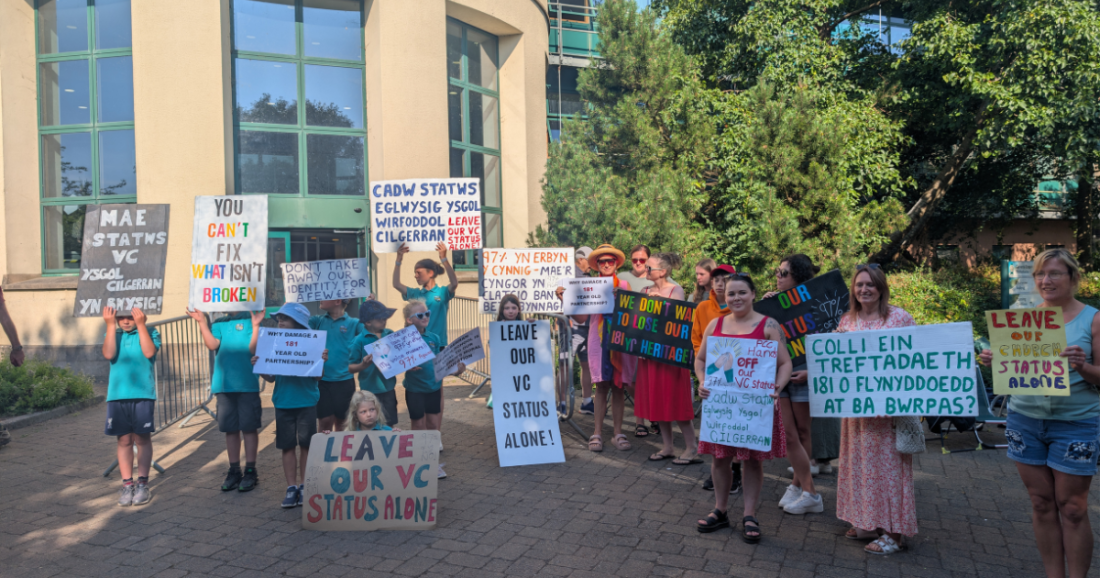
A FURTHER secular group has backed Pembrokeshire County Council’s plan to redesignate a north county faith primary school as a nonreligious community school.
Back in May, Pembrokeshire County Council voted to remove Voluntary Controlled (VC) status from Welsh-medium Ysgol Cilgerran’s Church in Wales school despite 97 per cent of the responses to a consultation having opposed a change which the church describes as ‘entirely unnecessary’.
That consultation followed a review which “considered the extent of surplus school places in the area, set against a significant decline in the pupil population,” the council has previously said.
Hundreds opposed the proposed changes, with a petition on the council’s own website gaining 391 signatures.
The Church in Wales has objected formally to the proposal and has warned it will take legal action on the grounds of “public misrepresentation and unqualified legal assertions made by Pembrokeshire County Council officers,” and “discrimination against faith schooling”.

At the council’s July meeting, Cilgerran parents, teachers, and students travelled to County Hall, Haverfordwest to protest.
Their colourful protest signs, made by students, carried messages such as “You can’t fix what isn’t broken”, “Leave our VC status alone”, and “Don’t take away our identity for a few £££”.
One of the protesters, an ex-pupil and governor, Sarah Moore, has said: “I’m here today because I’m horrified that the council are talking about taking the church status away from our school. The church gave that land for the school over 180 years ago.
“97 per cent have voted against this and yet they’re still trying to do it. If we want our children to stay in a church school, the nearest one is Letterston. So where will these children have that good education that they are getting now?”

The Church has said it has deep concern about what it sees as a pattern of the council’s recent actions regarding Church Schools.
In June, councillors voted to close Manorbier Church in Wales Voluntary Controlled School, which was damaged by a fire in 2022.
It has also expressed concerns about VC status being lost for Tenby Church in Wales VC school after councillors backed a consultation on penitential education changes in the Tenby area.

Wales Humanists recently supported the council plans, writing to Pembrokeshire County Council expressing its support for the proposal “on behalf of the area’s substantial non-religious community”.
It says, according to the 2021 Census, almost half of people in Pembrokeshire identified as having no religion.
Since then, another secular group, The National Secular Society (NSS), has expressed its support for the council.
The NSS campaigns for publicly funded faith schools to be phased out, and for religiously selective admissions to be abolished.
Welcoming the move, the NSS praised the council’s “secular approach to education” as the “best means of ensuring publicly funded schools are equally welcoming to all children, regardless of their backgrounds”.
The NSS added: “Inclusive schools which educate pupils together are one of our best means of promoting community cohesion, whilst faith schools which divide children on the basis of religion and are entirely out of step with the irreligious and religiously diverse Wales of today.
“Schools we all pay for should be managed in the best interests of everyone, not used as a vehicle for the agenda of religious institutions.”

PEMBROKESHIRE is continuing to operate a “warn and inform” approach to tackling to dog owners bringing their pets to beaches where they are restricted, councillors heard.
Bylaws connected to restrictions on dogs on Pembrokeshire beaches are to come under the spotlight later this week in a series of questions to be heard at full council.
Traditionally running from May 1 to September 30, there are total bans on dogs at Tenby’s North Beach and Whitesands in St Davids.
Partial bans are in operation on parts of Lydstep, Newgale, Saundersfoot, Tenby Castle and South Beach, Amroth beach, Poppit Sands, Broad Haven North, and Dale.
There is also a voluntary dog restriction on the beach at Coppet Hall between 10am and 6pm.
Guide dogs are welcome on Pembrokeshire’s beaches all year round.
In a three-pronged series of submitted questions heard at the July meeting of Pembrokeshire County Council, Councillor Rhys Jordan asked for details surrounding dogs on beaches bylaws.
“Can the relevant Cabinet Member confirm where the operative beach dog bylaws, schedules, amendments and deposited plans are currently published, and whether all public-facing maps, signs and webpages accurately reflect the legal restrictions in force?
“Can the relevant Cabinet Member confirm who formally approved the council’s 2026 approach to beach dog restrictions, including any warning-led or ‘warn and inform’ approach, and who is currently authorised to enforce the byelaws following the end of WISE’s ([Waste Investigations Support & Enforcement)] involvement in enforcement for Pembrokeshire County Council?
“Given the lack of substantive response to requests for this information, the apparent difficulty in producing relevant and legal governance documents, and the need for residents and visitors to understand any legal restrictions with certainty, will the relevant Cabinet Member agree to suspend enforcement and active promotion of the 2026 beach dog restrictions until the byelaws, deposited plans, decision records and enforcement arrangements have been verified and published in one accessible location?”
Cllr Jordan has previously said he felt that “blanket bans” on some of the county’s beaches were “overly punitive on dog owners”.
Responding to the submitted question Cabinet Member for Residents Services Cllr Rhys Sinnett said the authority “remains satisfied the current restrictions continue to operate lawfully and doesn’t consider there to be grounds to suspend enforcement relating to these restrictions”.

He said, however, the council is reviewing enforcement implementation and wider authorisations as part of ongoing work relating to antisocial behaviour and public protection matters, adding the information was available on the council’s website.
In a series of supplementary questions, Cllr Jordan asked: “If a member of the public ignores dog beach restrictions today, what statutory enforcement will Pembrokeshire County Council take?”
Cllr Sinnett said the council was continuing a “warn and inform” approach as it had since the cessation of the WISE contract, adding: “Officers provide advice, guidance and warnings as a primary approach; for known or persistent offenders the authority retains the ability to utilise statutory measures such as community protection warnings or community protection notices.
“While breaches of a bylaw may result in a financial penalty it’s important to note this is not automatic and any decision will be proportionate and evidence-based; no Fixed Penalty Notices are being issued this season.”

WOMEN across the Dyfed-Powys area are set to benefit from improved access to specialist support following the opening of a new Women’s Centre Hub at Parc Dewi Sant.
Operated by The Nelson Trust, the hub forms part of the continued development of trauma-informed services for women experiencing multiple disadvantage.
It provides a safe and supportive environment where women can access practical advice, guidance and specialist help to address the challenges they face.
The Office of the Police and Crime Commissioner has worked alongside The Nelson Trust and partners from the Local Criminal Justice Board to support the development of the facility.
The project forms part of the board’s wider commitment to improving outcomes for women throughout the Dyfed-Powys area.
The hub was officially opened on Friday, July 3, bringing together organisations involved in delivering support and recognising the partnership work that helped establish the new service.
Peer support will also play an important role, with volunteers drawing on their own lived experiences to help women facing similar circumstances.
Referrals to the Dyfed-Powys service are currently made through the Community Rehabilitation Service via probation. The hub is not presently accepting self-referrals.
Police and Crime Commissioner Dafydd Llywelyn said: “Women experiencing multiple disadvantage deserve access to the right support at the right time.
“By working closely with our partners, we can help ensure that women across our communities are able to access the specialist services they need to address the challenges they face and build safer, more positive futures.
“This partnership demonstrates what can be achieved when organisations come together with a shared commitment to supporting vulnerable members of our communities.”



News3 hours ago
Princess Royal celebrates Pembrokeshire craftsmanship at family-run weaving mill
A Pembrokeshire business that began after a mother grew tired of waiting three weeks for her children’s name tapes has...


Local Government4 hours ago
Burger King could be coming to Haverfordwest as plans submitted
Plans have been lodged for a Burger King outlet at the Morrisons petrol station on Bridge Meadow Lane BURGER KING...


Crime23 hours ago
Murder investigation launched into death of Pembrokeshire man in 1991
A 67-YEAR-OLD man has been arrested on suspicion of murder after new potential evidence emerged in connection with a death...


Community1 day ago
‘Paying £29 to reach a cashpoint is absurd’: Narberth’s urgent ATM appeal
Residents, businesses and visitors are being urged to provide evidence after two High Street cash machines were removed, leaving the...


Crime2 days ago
Haverfordwest man jailed for seven years for historic rape and sexual assault of girl
A HAVERFORDWEST man has been jailed for seven years after being convicted of raping and indecently assaulting a girl during...


News2 days ago
Burnham more willing to listen on Welsh devolution, says First Minister
Rhun ap Iorwerth says he will press the new Prime Minister for powers over policing, railways and Wales’ natural resources...


Crime2 days ago
Women jailed after man chased through Milford home and attacked with knives
Kelly Rees receives further 27-month sentence while already serving prison term for notorious taxi robbery TWO women have been jailed...


Crime2 days ago
Mother headbutted and clawed police officers after threatening social worker
Court shown body-worn footage of violent confrontation at Goodwick property A COURT has been shown police body-worn footage capturing the...


Crime3 days ago
Man, 37, found dead following major police response in Pembroke Dock
Death not being treated as suspicious as police make statutory referral to IOPC following active investigation A 37-YEAR-OLD man has...


Community3 days ago
Household Cavalry drum horse returns home to Pembrokeshire for final farewell
Dyfed Willa Rose, who became Major Juno and the first mare to serve as a Household Cavalry Drum Horse, was...
-
Crime2 days ago
Haverfordwest man jailed for seven years for historic rape and sexual assault of girl
-

 Community2 days ago
Goodwick Sea Scouts spruce up headquarters ahead of Wales in Bloom judging
-

 Sport2 days ago
More than 160 runners take on inaugural Llys-y-Frân 10km
-
Crime23 hours ago
Murder investigation launched into death of Pembrokeshire man in 1991
-

 News1 hour ago
Burnham’s first week – what it means for Wales
-
Community1 day ago
‘Paying £29 to reach a cashpoint is absurd’: Narberth’s urgent ATM appeal
-

 Health1 day ago
Record summer waits expose deepening crisis in Wales’ A&E departments
-

 Community1 day ago
Green Flag flies at Manorbier Community Garden for first time