


News
£1.3m payout slashed


 “COWSHED CINDERELLA”, Eirian Davies, who won £1.3 million against her aging parents last year, has had the payout slashed to just £500,000 by the Court of Appeal.
The 47-year-old sued her mum and dad, claiming they promised her she would ultimately step into their shoes and take over the family’s thriving dairy farm.
Miss Davies spent a large part of 25 years milking the cows on Henllan Farm, Whitland, Dyfed, and tending its herd of pedigree Holstein cows.
She said she missed out on going to Young Farmers’ Club dances with her two sisters as a teenager because she had to “stay at home with a muck fork”.
Her parents, Tegwyn and Mary Davies, now in their 70s, denied they had treated her unfairly but were ordered to pay her £1.3 million by a judge.

Today, however, three senior judges in London ruled that was far too generous – and slashed Miss Davies’ award to £500,000. And Lords Justice Lewison, sitting with Lords Justice Patten and Underhill, gave her 12 months to leave the farm where she grew up.
After the court heard the farm had been “in lockdown” due to a TB outbreak, her parents were given time to come up with the cash they now owe their daughter.
A judge ruled two years ago that Miss Davies was due a stake in the 182-acre farm as fair recompense for the the years of lowpaid toil she put in.
She had told the court: “They always told me that the farm would be left to me.
“Even on my birthday, when the other girls were having things, they would say – ‘you will have the damn lot one day, it will all be yours’,” she said.
Her father would regularly warn her “not to kill the goose that lays the golden egg” if she complained about her meagre wages, she added.
She claimed she could have ‘made a better life elsewhere’, but her parents insisted that she earned a fair income, also receiving free ‘bed and board’ and other benefits.

Describing her as ‘a self-employed herdswoman’, they argued she would have done no better financially had she worked away from the farm. In 2009, Miss Davies, who had a passionate interest in pedigree milking cows, was shown her parents’ draft will, which left the lion’s share of the farm to her. However, the couple later made changes to their bequests and proposed placing the farm in trust for the benefit of all three of their daughters equally.
The family feud finally hit court after an “altercation” in the milking parlour in 2012 and Mr and Mrs Davies tried, but failed, to evict their daughter from Henllan Farmhouse.
The Court of Appeal upheld her right to a stake in the farm and, in February last year, Judge Milwyn Jarman QC awarded her £1.3 million.
Attacking the decision, her parents’ QC, Simon Fancourt, said the payout was “hugely disproportionate”.
It was, argued the barrister, wrongly based on an assumption that Miss Davies legitimately expected to “inherit the whole lot” on her parents’ death.
Describing the dispute as “bitter” today, Lord Justice Lewison agreed that the award was over the top and cut it to £500,000.
The legal costs of the case are bound to come to a high, six-figure, sum, further depleting the family fortune.
Mr and Mrs Davies will have to pay the costs of earlier hearings, but their daughter must cover those run up in her parents’ successful appeal.


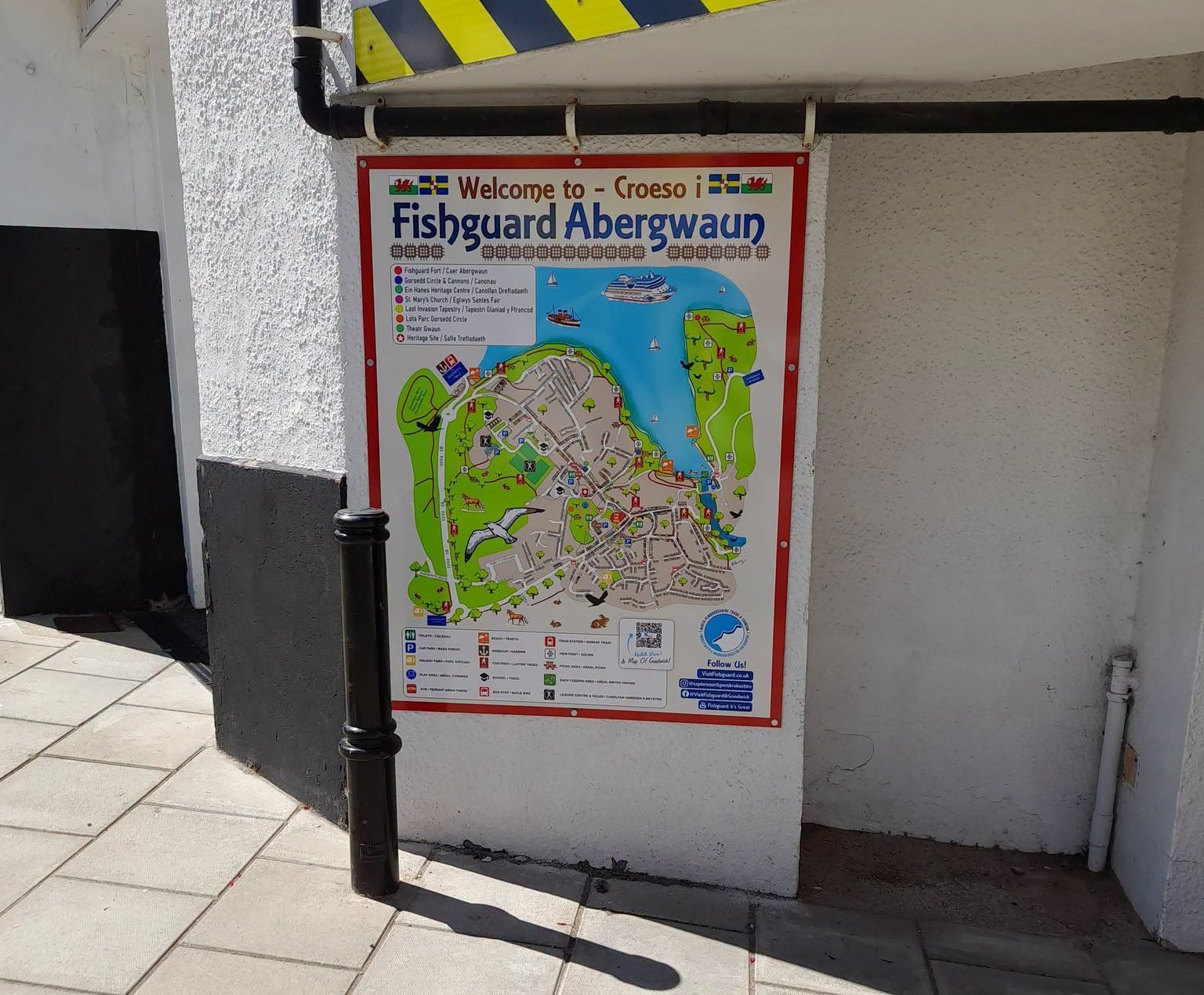
A NEW town map has been installed in the heart of Fishguard to help residents and visitors discover more of what the area has to offer.
The map, created by Visit Fishguard & Goodwick’s in-house graphic designer, has been placed on the Abergwaun Hotel tunnel, near Offshore Surfwear’s new shop.
The group said it was “incredibly proud” of the finished result and thanked the building owner for allowing the map to be installed on the premises.
Visit Fishguard & Goodwick is now hoping to create a similar map for Goodwick and is asking for help from a centrally located building owner who may be willing to host it.
Anyone who can help, or knows of a suitable location, is being asked to get in touch with Visit Fishguard & Goodwick.

Organisers say popular charity events cannot safely go ahead without clear powers to control crowds
TENBY ROUND TABLE has announced that this summer’s Tenby Summer Spectacular events have been cancelled until further notice amid a dispute with Pembrokeshire County Council over crowd control at the harbour.
The events, which were due to take place on Sunday, August 16 and Sunday, August 30, have been a major feature of Tenby’s summer calendar for decades, drawing large crowds to the harbour for entertainment, food, drink and fireworks.
In a statement, Tenby Round Table said the decision had been made “with enormous sadness” and claimed it had been forced on organisers because of unresolved issues over the safe management of pedestrian access.
The organisation said it needed the council’s Public Realm department to use statutory powers to temporarily restrict pedestrian access through the event area when capacity is reached.
Organisers said the matter had first been raised with the council in September 2025 and again formally in writing in May 2026.
They said volunteers had attended meetings, commissioned professional health and safety consultants and worked on Event Management Plans, but claimed the council had still not provided a clear answer.
Tenby Round Table said: “PCC’s Public Realm department has had nine months to answer one question on safe and controlled access to the harbour. It has not done so.”
The group also alleged that recent written responses from the council contained factual inaccuracies and misleading statements about the relevant legislation.
It added that the council’s legal advice was understood to be provisional and still under internal review.
The cancellation is currently described as provisional, with organisers giving the council a final deadline of June 25 to provide what they describe as a clear, accurate and legally grounded answer.
Tenby Round Table said that if this is provided, it will do everything possible to reinstate the events.
The group said the Summer Spectacular had raised hundreds of thousands of pounds for local charities, sports teams, community groups and worthy individuals since it began.

It said the cancellation would be a devastating blow to those who benefit from the funds raised.
The statement added that organisers are still working with Dyfed-Powys Police and other relevant authorities ahead of a council licensing committee meeting in July, which is expected to consider whether the event licence should be renewed, amended or withdrawn.
The Herald has asked Pembrokeshire County Council for comment.


SUNSHINE, sea shanties and street food helped draw hundreds of visitors to Cardigan RNLI Lifeboat Station on Saturday (Jun 20).
The station’s Sea Shanty and Street Food Festival brought together families, supporters and visitors from across the region for a day of maritime music, food and community spirit.
Traditional sea shanty groups performed throughout the event, with songs echoing around the lifeboat station, while street food vendors served a range of refreshments.
The event also gave visitors the chance to learn more about the lifesaving work carried out by the RNLI and its volunteer crews.
Cardigan RNLI thanked the performers, food vendors, volunteers, sponsors and supporters who helped make the day a success.
Bruce Harris, Launch Authority and event organiser, said: “It was wonderful to see so many people come together to support the station, enjoy the entertainment, and celebrate our maritime heritage.
“The atmosphere throughout the day was fantastic, and we are incredibly grateful to everyone who attended, performed, volunteered, and contributed to such a memorable event.”
The RNLI is the charity that saves lives at sea. Its volunteers provide a 24-hour search and rescue service around the United Kingdom and Republic of Ireland coasts.
The charity operates 238 lifeboat stations in the UK and Ireland and more than 240 lifeguard units on beaches around the UK and Channel Islands.
Since the RNLI was founded in 1824, its lifeboat crews and lifeguards have saved more than 146,700 lives.



Community10 hours ago
Tenby Summer Spectacular cancelled amid council row over harbour access
Organisers say popular charity events cannot safely go ahead without clear powers to control crowds TENBY ROUND TABLE has announced...


News15 hours ago
Motorcyclist dies after four-vehicle crash on A40 in Carmarthenshire
A MOTORCYCLIST has died following a four-vehicle collision on the A40 between St Clears and Whitland. Dyfed-Powys Police said the...


News15 hours ago
Rhun ap Iorwerth urges new deal for Wales after Starmer quits
First Minister says next Prime Minister must focus on greater powers, fair funding and respect for Wales’ democratic mandate FIRST...


News16 hours ago
How Labour’s landslide victory unravelled in just two years
Prime Minister announces resignation after losing support within his own party as Andy Burnham emerges as overwhelming favourite to take...


News1 day ago
Long Course Weekend set to bring thousands to Pembrokeshire
Three days of swimming, cycling and running will once again transform Tenby into one of the UK’s biggest endurance sporting...


Community1 day ago
The gentle giant behind the tattoos
Pembrokeshire security worker Josh Davies praised for professionalism, kindness and proving first impressions can be wrong JOSH Davies is hard...


Charity2 days ago
Toy Story fans fill charity toy box at Haverfordwest cinema
Donations pour in for SNAP Specialist Play as families embrace Toy Story 5 launch A TOY STORY-themed charity appeal at...


Community3 days ago
Lord Rhys emerges from the mist in St Davids
Giant puppet begins historic journey marking 850 years since the first Eisteddfod MIST swirled around St Davids Cathedral on Friday...


News4 days ago
Tragic tribute paid to Haverfordwest man after A4075 collision
FAMILY REMEMBERS “KIND AND LOVING” CALLUM HANSON THE FAMILY of a 22-year-old man from Haverfordwest who died following a road...

News5 days ago
Motorcyclist, 22, dies in A4075 crash in Pembrokeshire
A 22-year-old woman remains in hospital after two-vehicle collision A MOTORCYCLIST has died following a serious two-vehicle crash on the...
-

 Crime5 days ago
Milford Haven man jailed for breaching domestic violence protection order
-

 Local Government7 days ago
Security privately arranged by Mayor at Beating of the Bounds
-

 News5 days ago
Crash on Freeman’s Way causes school-run chaos across Haverfordwest
-

 Crime6 days ago
Man wanted by court after failing to attend hearing over alleged shop thefts
-
 Crime6 days ago
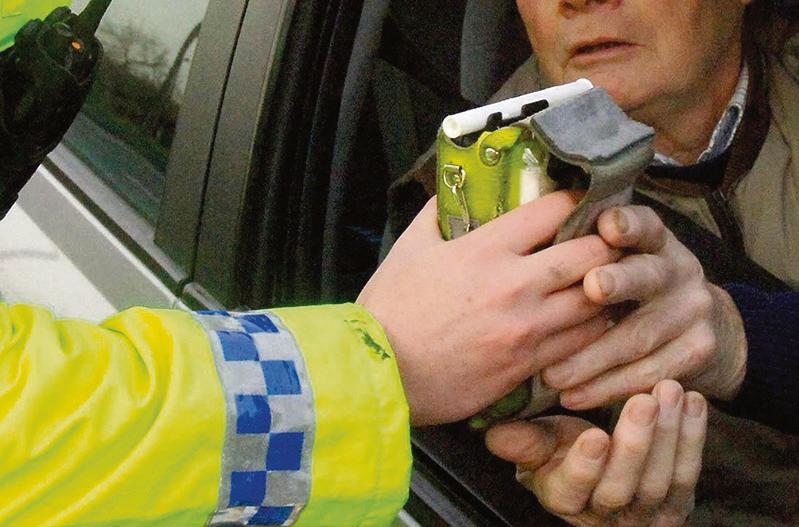
Man banned from roads after drink-driving offence
-

 Crime6 days ago
Man jailed after admitting strangulation and assaults
-

 Crime6 days ago
Drug trafficker must repay £33,000 after court rules he made nearly £500,000
-

 Crime6 days ago
Man sentenced over stalking campaign and lock knife offence