


Cymraeg
Llyfr newydd gan Vaughan Roderick

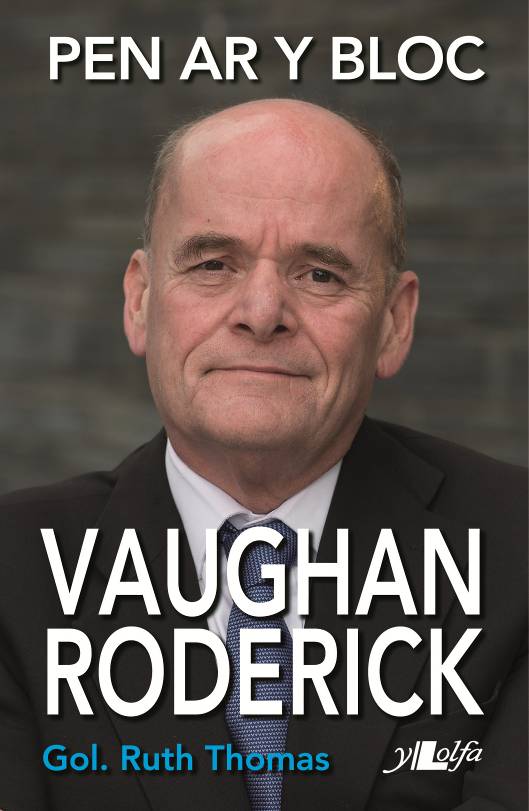
FE fydd y degawd nesaf gyda’r mwyaf arwyddocaol erioed i wleidyddiaeth Cymru, yn ôl Golygydd Materion Cymreig y BBC, Vaughan Roderick, ar achlysur cyhoeddi cyfrol o’i waith i nodi ugain mlynedd wedi i Gymru bleidleisio dros gael Cynulliad Cenedlaethol.
Yn y gyfrol, Pen ar y Bloc, a gyhoeddir yr wythnos hon, dywed Vaughan fod ‘y platiau tectonig yn symud ac mae cwestiynau a fyddai wedi ymddangos yn hurt ddeng mlynedd yn ôl bellach yn rhai rhesymol’.
Mae’r symudiadau hyn, meddai, yn golygu bod cwestiynau’n codi ynghylch bodolaeth ambell un o’r pleidiau mawrion yn eu ffurfiau presennol gan broffwydo hefyd y gall dyddiau gwleidyddiaeth dosbarth fod yn tynnu at eu terfyn. Mae hefyd yn darogan y posibilrwydd o’r Deyrnas Unedig a’r Undeb Ewropeaidd yn chwalu.
‘A fydd y Deyrnas Unedig, yr Undeb Ewropeaidd, neu’r ddau, yn debyg o gwympo’n ddarnau neu a fydd modd iddynt lwyddo i ail-greu eu hunain? Fe gawn weld.’
Mae’r gyfrol, a luniwyd ar y cyd rhwng Vaughan a’i gyd-newyddiadurwr, Ruth Thomas, yn atgynhyrchu y gorau o flog llwyddiannus Vaughan gan sicrhau na fydd ei ysgrifau bachog yn diflannu mewn unrhyw ‘Oes Dywyll Ddigidol’.

Bydd cyhoeddi’r gyfrol, sydd yn cynnwys deunydd newydd sydd yn cloriannu rhai o’r datblygiadau gwleidyddol pwysicaf ers 1997, yn golygu bod cofnod cwbl anhepgor o hanes Cymru wedi ei greu.
Mae’r gyfrol hefyd yn cynnwys teyrnged i gyn-Brif Weinidog Cymru, Rhodri Morgan, a fu farw ar yr 17eg o Fai, yr ysgrifennodd Vaughan yn arbennig ar gyfer y gyfrol.
Meddai’r Athro Richard Wyn Jones, pennaeth Canolfan Llywodraethiant Cymru ym Mhrifysgol Caerdydd, ‘Dyma sylwebaeth wleidyddol o’r radd flaenaf: praff, eang ei orwelion ac eangfrydig ei ysbryd. Prawf pellach ein bod wedi bod yn eithriadol o ffodus fel cenedl i gael Vaughan Roderick i’n tywys trwy holl droeon dau ddegawd cyntaf datganoli.’
Ers diwedd y 1970au, mae Vaughan wedi tystio i nifer o’r digwyddiadau sydd wedi newid Cymru – o brotestiadau Cymdeithas yr Iaith, streic y glowyr, y frwydr dros ddatganoli hyd at y bleidlais Brexit.
Fe wnaeth hynny ar radio a theledu, ac o 2004 ymlaen fe ysgrifennodd ar gyfer gwasanaeth newyddion ar-lein y BBC, trwy’r golofn O Vaughan i Fynwy i ddechrau, a’i flog o 2007 ymlaen.
Dywed ei olygydd Ruth Thomas, fod llais unigryw Vaughan wedi ‘diffinio cenhedlaeth’.
Meddai Vaughan wrth adlewyrchu ar ei waith, ‘Y cyfan y gall newyddiadurwr ei wneud yw adrodd a mesur pwysigrwydd stori fel y mae’n ymddangos ar y pryd, trwy sbectol ein hoes ni.’

O ganlyniad i ddadansoddiad Vaughan dros y degawdau mae Pen ar y Bloc yn gronicl cynhwysfawr, hanfodol a ffraeth y bydd unrhyw un sydd â diddordeb yn hanes a gwleidyddiaeth Cymru yn ei fwynhau.
Bydd Pen ar y Bloc yn cael ei lansio yn Y Senedd am 6 o’r gloch, nos Fawrth 19 Medi yng nghwmni Vaughan Roderick, Ruth Thomas, Betsan Powys a’r Athro Richard Wyn Jones. Bydd yn cynnwys trafodaeth banel gyda Jane Hutt AC, David Melding AC, Helen Mary Jones a Kirsty Williams AC.
Trefnir y noson ar y cyd rhwng gwasg Y Lolfa a Chynulliad Cenedlaethol Cymru.
Mae Pen ar y Bloc gan Vaughan Roderick (£14.99, Y Lolfa) ar gael nawr.

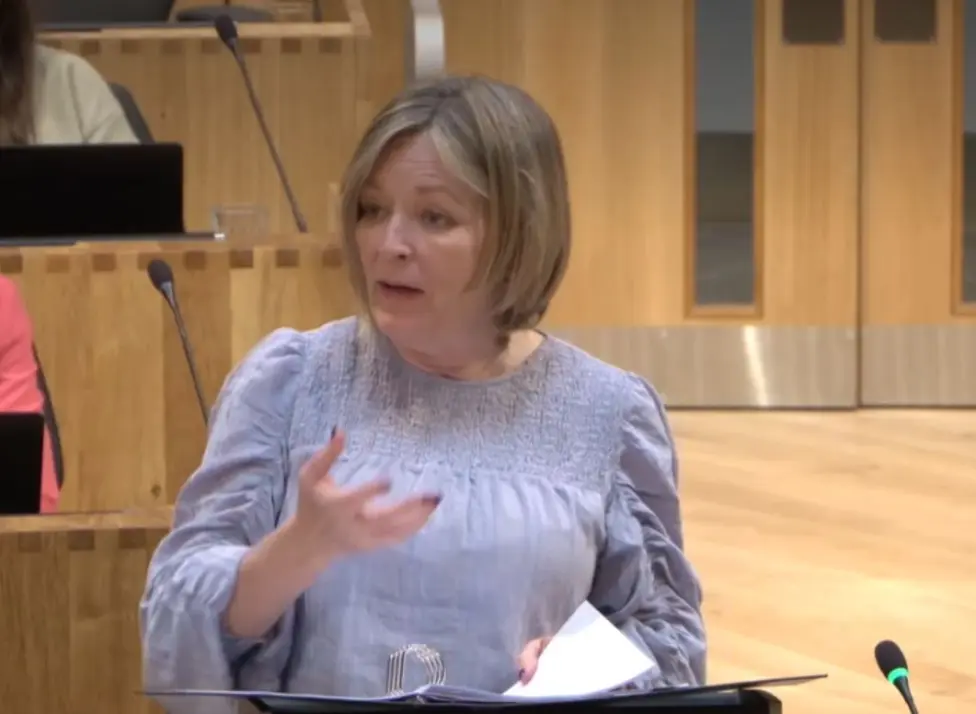
EDUCATION is “the key to unlocking our nation’s potential”, according to the new minister responsible for Wales’ schools.
Anna Brychan, who was appointed education and Welsh language minister last month, now has responsibility for school standards, improvement and attainment, Welsh medium education, early childhood education, and curriculum and assessment arrangements.
She also has responsibility over policies to protect and promote the Welsh language.
Setting out her priorities for the seventh Senedd term, the Caerdydd Penarth MS highlighted raising educational standards, workforce support, and strengthening skills.
She said: “This government has made education a national priority, to raise standards in our schools and ensure the best conditions for learning and teaching. The education system is currently failing too many of our children and young people.
“A lack of talent is not the problem, neither is a lack of commitment. We have children and young people who are full of potential, and we have an able and dedicated workforce.
“The problem is that the whole system hasn’t always worked together to support and unlock the potential of our learners, nor do we share data and understanding of what is needed to ensure progress in every school, in every area, consistently and powerfully.”
“We want the education system to function as one connected system: to support our children from early years right up to the point where they start working.”
Concluding her speech, Ms Brychan pledged the Welsh Government will build “an education system that works for all learners, in Welsh and English – in our two national languages – and above all else, for Wales.”
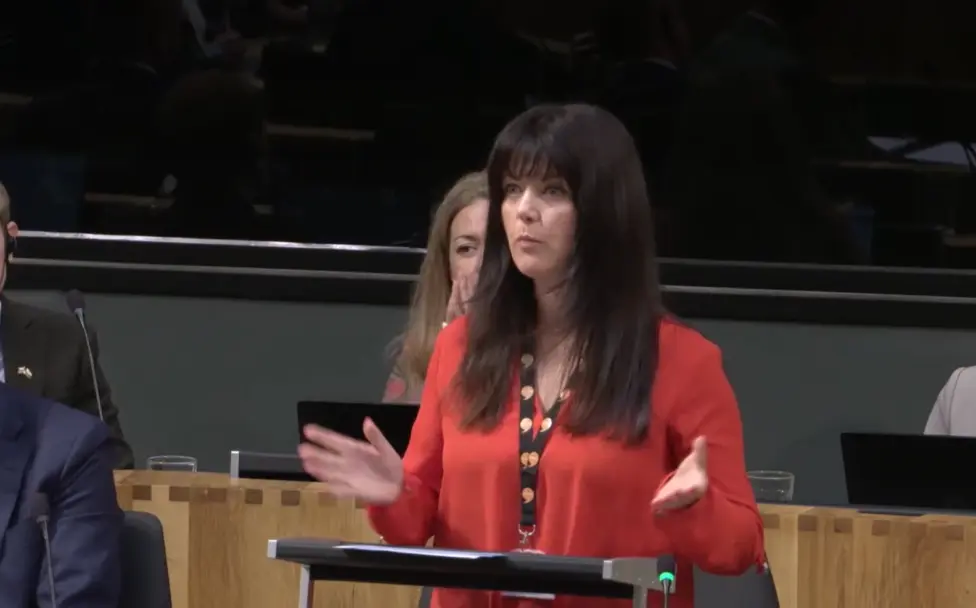
Helen Jenner, who is Reform’s deputy leader and shadow minister for education, voiced “concerns” about the minister’s statement and the lack of detail regarding teacher retention.
Ms Jenner, who was a teacher herself in London, told the Siambr that she can “understand” why so many are leaving the profession.
She said: “We’re losing experienced teachers faster than we can replace them. That concern is only amplified by our shared ambitions for bilingual and Welsh-medium education.

“The challenge is not simply finding teachers; it’s finding teachers with the language skills needed to deliver those ambitions. Every experienced bilingual teacher who leaves the profession is not easily replaced.
“If we’re already struggling to retain the workforce we have today, how can the government realistically hope to deliver the workforce it will need tomorrow?”
Concluding her statement Ms Jenner said: “Every one of us here can remember a teacher who changed our lives. The problem is that experience takes years to build, but only a moment to lose.
“If this government fails to address workload and behaviour in detail, Wales will continue to lose our best teachers, and when teachers leave, it is not the ministers who pay the price, it is our children.”
Ms Brychan responded: “I’ve said often that I’m of the opinion that this is the most important professional role in our society – and I’m sure that some people here will disagree, but that is my view – and that we then need to retain that experience within the classroom.
“I can also assure [Ms Jenner] that we will be working with teachers and local authorities, and with unions in the social partnership that we have, to look at how we can proceed with the detailed work on reducing the workload, and tackling, to all intents and purposes, the conditions that teachers are working in.”
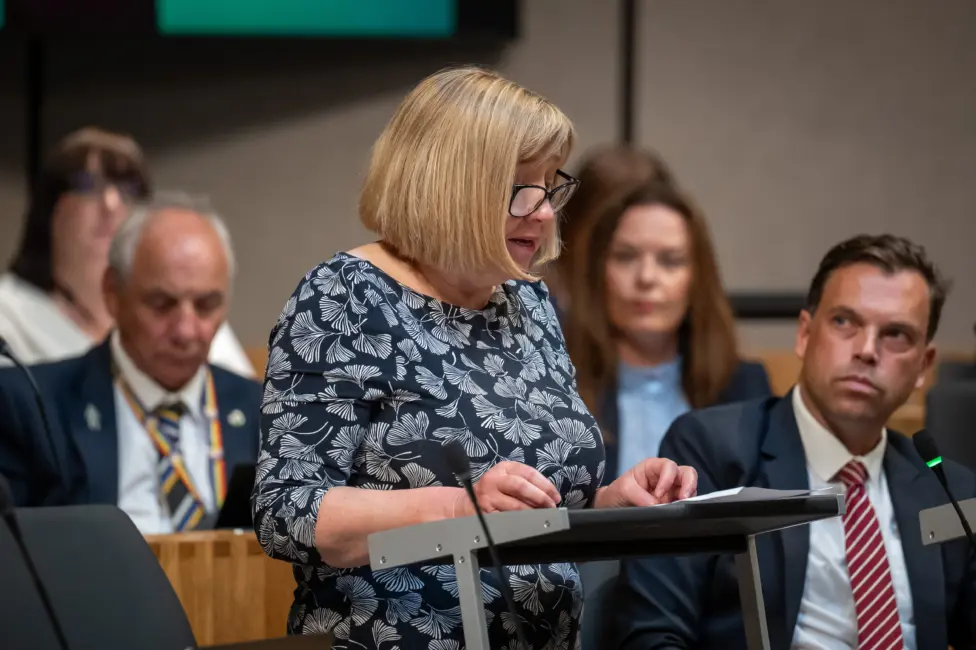
Labour’s Lynne Neagle, a former education minister, congratulated Ms Brychan on her appointment and said the role is “without any shadow of a doubt, the very best job in government.”
Questioning the minister on why the Plaid government has chosen to delay the response to the independent Welsh pay review body report on teachers’ pay, Ms Neagle noted the previous Labour administration had “made a commitment” to consult before the school holidays to “protect time for our teaching staff.”
She said the delayed response “will likely lead to teachers not being paid in September”.
Ms Brychan confirmed she had received the report but told Ms Neagle it is “sensible” to “take time to consider the recommendations”.
She added: “Previous governments have also found that they would need to take proper time over the summer, before coming to a firm conclusion about that.”
Ms Neagle also quizzed Ms Brychan on mental health in schools, saying she is “very proud” of the previous Welsh Government’s record on the issue.
She told the Siambr: “It is essential to ensure that young people have consistent, high-quality access to school counselling.
“And if I might say, politics can never ever come before the mental health of children and young people.”
In response, Ms Brychan said: “Mental health will be a priority for us in schools as well.
“We know it is a significant factor, and any factors that influence or hinder learners from making the progress we want them to make, we want to see them making, we will make sure that the support is there to support them.”

Sam Rowlands, the Conservative spokesperson for education and families, asked Ms Brychan where she would like to see Wales in the PISA rankings come the end of this Senedd term.
He said: “The reality is that we continue to see Wales at or near the bottom of UK education rankings, and consistently doing poorly on international PISA rankings, with too many young people still leaving school without secure literacy and numeracy skills.
“That’s a longstanding issue and one that requires urgent attention and clear accountability.”
The minister responded: “Our education system isn’t where we would like it to be. I think there is agreement on that among the workforce and broader society, and that is why we are focused on these fundamentals and are deliberately setting targets whereby we can hold ourselves to account”.
With PISA results due to be published again in September, Ms Brychan committed to take the “most meaningful information” she can from the report, adding: “It’s about more than just numbers. There’s a lot of data that we can use there, and we can use that meaningfully in order to inform our numeracy and literacy plans.”
Mr Rowlands went on to question his opposite number on the Welsh Government’s position on mobile phones in schools.
Referencing a survey published on Tuesday 16 June by the Welsh Conservatives, he shared findings which suggested mobile phone restrictions have positive impacts on “reducing distraction, improving behaviour, tackling bullying and supporting learner wellbeing.”
Mr Rowlands pushed Ms Brychan to confirm whether the Welsh Government intends to “take a more consistent, national approach to mobile phone use in schools” or if it will leave the decisions to the discretion of individual schools.
Noting there currently is no national directive or guidance, Ms Brychan told Mr Rowlands that the intention is to move to statutory guidance from September.

FINANCIAL backing of this year’s Eisteddfod in Pembrokeshire, to the tune of £73,000, with a potential budget of up to £200,000, has been approved by senior councillors.
The 2026 Eisteddfod, running from August 1-8 at Llantwd, north Pembrokeshire, holds particular historical significance as it marks the 850th anniversary of the first recorded Eisteddfod, held in 1176 at Castell Aberteifi.
With this year’s Maes located close to the original site, the event is expected to be a landmark occasion for the region and for Wales as a whole.
The National Eisteddfod is the largest cultural festival in Europe and one of the most prominent events in the Welsh cultural calendar, attracting approximately 175,000 visitors annually.
The festival celebrates Welsh language, literature, music, and the arts, with a diverse programme of competitions, performances, exhibitions, and community activities.
The Eisteddfod proclamation took place in Narberth last May, with hundreds attending.
At the June meeting of Pembrokeshire County Council’s Cabinet, members were asked to approve Pembrokeshire County Council to lead and deliver Pentre’r Garreg Las at the National Eisteddfod 2026.
Cabinet was also asked to approve the current financial commitment of approximately £73,751 (+ VAT), noting that further costs will be finalised as the programme develops, and endorse collaborative arrangements with Ceredigion and Carmarthenshire County Councils.
A budget for up to £200,000 for the promotion of the event is also being pencilled in; members hearing it was hoped this figure would be a ceiling of potential costs, with hopes the council’s part could be lowered by external funding.
A report for members, presented by Cabinet Member for Adult Social Care, Safeguarding and the Welsh Language Cllr Alistair Cameron, said: “The National Eisteddfod is Europe’s largest travelling cultural festival, attracting up to 170,000 visitors annually and providing a nationally significant platform for the celebration of Welsh language, culture and identity.
“As lead authority, Pembrokeshire is responsible for the overall coordination, planning and funding of the Pentre. This includes the development of the overarching concept, the curation of a coherent thematic programme, and the management of key relationships with partner authorities, stakeholders and delivery partners.”
It went on to say: “While initial site, infrastructure and concept costs have been identified at approximately £73,751 (+ VAT), it is recognised that the full delivery of Pentre’r Garreg Las, as a flagship offer led by Pembrokeshire, will necessitate a broader major events budget estimated in the region of £200,000. The funding for this is coming from the current major events budget with additional funding coming from the initiative fund reserve.”
The report said efforts will be made to maximise external funding opportunities in order to mitigate the net cost to the council.
Cabinet Member for Residents’ Services Cllr Rhys Sinnett said: “This is a fantastic opportunity for Pembrokeshire to showcase the best of this county,” adding: “The last time it was here was 2004, we get to see this opportunity maybe every 20 years, it’s down to us to make the best of the opportunity, overall it’s a fantastic story for us as a county.”
A full budget breakdown is expected at the July Cabinet meeting, members agreeing to back the recommendations.

AS THE NATIONAL Centre for Learning Welsh celebrates its highest ever number of learners – over 20,000 in 2024–2025 – it has announced a new ambassadors scheme with the aim of inspiring even more people to learn, use and enjoy the Welsh language.
The Learn Welsh Ambassadors Scheme will be launched today (May 23) at the Urdd Eisteddfod on Anglesey, as part of the Eisteddfod’s ‘Learners’ Day’ celebrations.
Four high-profile ambassadors have been appointed to the new scheme:
- Aleighcia Scott – singer and DJ, and one of the mentors on S4C’s talent show Y Llais, who will also be honoured with the Green robe at Eisteddfod Genedlaethol y Garreg Las in August.
- Tori James – adventurer and the first Welsh woman to climb Mount Everest.
- Katie Owen – DJ and social media influencer.
- Ian Gwyn Hughes – Head of Public Relations at the Football Association of Wales.
The four ambassadors will represent the Centre, sharing their personal experiences of the Welsh language, and promoting the work of the Learn Welsh sector. They will also support recruitment campaigns, encouraging people from all backgrounds to begin learning Welsh, or to continue their language journey.
The scheme reflects the Centre’s vision to attract and support a wide range of audiences to learn and use Welsh, including workforces, communities, key sectors such as Health and Social Care, the Education Workforce and Sport, young people and families.
The Centre is launching the scheme at the Urdd Eisteddfod. It works in partnership with the Urdd to provide a range of opportunities for the organisation’s staff, and the young people using its services, to strengthen their Welsh language skills or to begin learning the language.
The Centre is also pleased to support the Urdd’s medals for young Welsh learners, the Bobi Jones Medal for learners aged 19 years’ old and above, and the Learners’ Medal for learners aged under 19 years.
Dona Lewis, Chief Executive of the National Centre for Learning Welsh, said: “Creating new Welsh speakers is the Centre’s main aim, supporting them to use and enjoy the language with confidence in their everyday lives.
“I’m pleased to say the Learn Welsh sector is going from strength to strength, with more people than ever completing our courses.
“We’re delighted to welcome a group of passionate ambassadors who will share their experiences of the Welsh language and help promote and celebrate our work. We’re proud to launch this new scheme at the Urdd Eisteddfod, one of our partners.
“The Centre works creatively and in partnership across different sectors, providing one, single learning pathway to becoming a Welsh speaker. We are all here to welcome and support our learners and new speakers at every stage of their language journey.”
Aleighcia Scott said: “I’m delighted to take part in this scheme. Learning Welsh has been an important personal journey for me, and it has opened new doors – both creatively and socially.”
Tori James said: “Learning a new skill can be a bit like climbing a mountain – it can be a challenge, but every small step is a success!
“I’m very pleased to have the opportunity to support people to take their first step into learning Welsh, and to keep going – it’s a journey well worth taking.”
Katie Owen said: “I’d always wanted to learn Welsh, and it has been the best thing I’ve done. The Welsh-speaking community is so welcoming, and the National Centre for Learning Welsh offers so many opportunities to learn and use the language.”
Ian Gwyn Hughes said: “Welsh belongs to all of us, and it has been fantastic to see the positive response to our use of the language at the Football Association of Wales. I look forward to supporting the Centre’s work to extend the use of Welsh in all kinds of contexts.”



News2 minutes ago
Rhun ap Iorwerth urges new deal for Wales after Starmer quits
First Minister says next Prime Minister must focus on greater powers, fair funding and respect for Wales’ democratic mandate FIRST...


News34 minutes ago
How Labour’s landslide victory unravelled in just two years
Prime Minister announces resignation after losing support within his own party as Andy Burnham emerges as overwhelming favourite to take...


News13 hours ago
Long Course Weekend set to bring thousands to Pembrokeshire
Three days of swimming, cycling and running will once again transform Tenby into one of the UK’s biggest endurance sporting...


Community20 hours ago
The gentle giant behind the tattoos
Pembrokeshire security worker Josh Davies praised for professionalism, kindness and proving first impressions can be wrong JOSH Davies is hard...


Charity2 days ago
Toy Story fans fill charity toy box at Haverfordwest cinema
Donations pour in for SNAP Specialist Play as families embrace Toy Story 5 launch A TOY STORY-themed charity appeal at...


Community2 days ago
Lord Rhys emerges from the mist in St Davids
Giant puppet begins historic journey marking 850 years since the first Eisteddfod MIST swirled around St Davids Cathedral on Friday...


News3 days ago
Tragic tribute paid to Haverfordwest man after A4075 collision
FAMILY REMEMBERS “KIND AND LOVING” CALLUM HANSON THE FAMILY of a 22-year-old man from Haverfordwest who died following a road...


News4 days ago
Motorcyclist, 22, dies in A4075 crash in Pembrokeshire
A 22-year-old woman remains in hospital after two-vehicle collision A MOTORCYCLIST has died following a serious two-vehicle crash on the...


Community4 days ago
Why police will be visiting every home in Pembrokeshire
New operation aims to knock on more than 257,000 doors across Dyfed-Powys over the next three years DYFED-POWYS POLICE has...


Crime4 days ago
Prisons at breaking point: MPs warn Wales is paying the price of a failing system
Frozen healthcare budgets, overcrowded jails, homelessness on release and mounting pressure on staff are undermining rehabilitation across Wales, according to...
-

 Crime4 days ago
Milford Haven man jailed for breaching domestic violence protection order
-

 Local Government6 days ago
Security privately arranged by Mayor at Beating of the Bounds
-

 News4 days ago
Crash on Freeman’s Way causes school-run chaos across Haverfordwest
-

 Crime6 days ago
Man wanted by court after failing to attend hearing over alleged shop thefts
-
 Crime6 days ago
Man banned from roads after drink-driving offence
-

 Crime6 days ago
Man jailed after admitting strangulation and assaults
-

 Crime6 days ago
Drug trafficker must repay £33,000 after court rules he made nearly £500,000
-
 Crime6 days ago
Man sentenced over stalking campaign and lock knife offence