


News
Claim a free McDonalds cheeseburger this week


TO REMEDY ‘Blue Monday’, McDonalds is giving away a free cheeseburger to everyone this week.
Starting today (Jan 21), the fast food chain is asking customers to install the McDonalds app on their phone and then take it to their nearest restaurant for a free burger.
Blue Monday is said to be the ‘most miserable day’ in the year.
The app is available on both the Google Play store for Android devices, and the App Store for iOS devices.
Once downloaded, register a new account, or log in to your existing account, and go to ‘My Deals’ to claim your free burger.

The offer runs until Friday (Jan 25) and can be claimed any time after 10:30am, when the breakfast menu finishes.


THE ARMED FORCES flag is flying proudly at County Hall this week ahead of Armed Forces Day on Saturday, June 27.
Leader of Pembrokeshire County Council, Cllr Tessa Hodgson, and the Council’s Armed Forces Champion, Cllr Simon Hancock were among those who marked the flag raising on Monday morning (June 22).
Also present were the Chairman of Council, Cllr Delme Harries, the Chief Executive, Will Bramble and the Regional Armed Forces Covenant Liaison Officer, Hayley Edwards.
Cllr Hancock said: “It is always a very proud moment to see the Armed Forces Flag flying over County Hall.
“Armed Forces Day is a chance to show our deep appreciation for the men and women who serve, as well as the families and communities who support them.
“Our county has a rich history of connection with the Armed Forces, and we are proud to uphold and strengthen that bond.
“As a Council we are committed to ensuring that members of the Armed Forces community in Pembrokeshire receive the recognition and support they truly deserve and we are proud to be a Defence Employer Recognition Scheme Gold Award holder.”


A MILFORD HAVEN man has appeared before magistrates accused of rape and sexual assault.
James Kershaw, 46, is charged with raping a woman in Milford Haven between February 1, 2013, and March 31, 2014.
He also faces a charge of sexually assaulting a female over the age of 13 by penetration with his finger between December 1 and December 30, 2012.
Kershaw appeared before Haverfordwest Magistrates’ Court on Tuesday (Jun 23) by video link and denied both charges.
Due to the seriousness of the allegations, magistrates declined jurisdiction and sent the case to Swansea Crown Court, where Kershaw is due to appear for a pre-trial hearing on July 24.
He was released on conditional bail, with the sole condition that he must not contact the complainant.

All passengers rescued as emergency services remain at scene
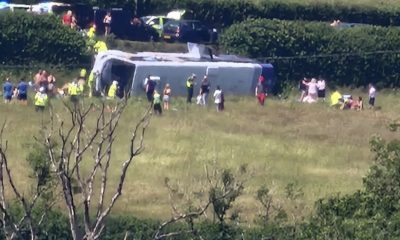
A BUS overturned on the A484 between Kidwelly and Ferryside on Tuesday (Jun 23), prompting a major emergency response and lengthy road closures.
The incident happened shortly after 12:20pm near the Kidwelly roundabout at Parc y Bocs.
Emergency services, including firefighters from Kidwelly, Carmarthen and Tumble, were sent to the scene following reports of a serious collision involving the bus.
Mid and West Wales Fire and Rescue Service confirmed that all passengers were safely removed from the vehicle.
A spokesperson said: “All passengers have been safely removed from the bus and are receiving appropriate care.”
A rest centre has been established at the John Burns Centre in Kidwelly, where welfare arrangements are being made for those involved.

The scale of the incident led Dyfed-Powys Police to declare a major incident earlier in the day, with officers urging members of the public to avoid the area.
The A484 remains closed between the Kidwelly roundabout at Parc y Bocs and Llandyfaelog while emergency services continue their response and carry out investigations into the cause of the crash.
Police, ambulance and fire crews remain at the scene.
Motorists are being advised to find alternative routes and are warned that the road is expected to remain closed for a considerable time.
Emergency services have also issued advice for drivers caught in congestion during the hot weather, urging people to stay hydrated, keep vehicles ventilated and never leave children, vulnerable adults or pets inside parked vehicles.
The cause of the incident has not yet been confirmed.

The Herald will provide further updates as more information becomes available.


News6 hours ago
Bus overturns in major incident near Kidwelly
All passengers rescued as emergency services remain at scene A BUS overturned on the A484 between Kidwelly and Ferryside on...


Community1 day ago
Tenby Summer Spectacular cancelled amid council row over harbour access
Organisers say popular charity events cannot safely go ahead without clear powers to control crowds TENBY ROUND TABLE has announced...


News1 day ago
Motorcyclist dies after four-vehicle crash on A40 in Carmarthenshire
A MOTORCYCLIST has died following a four-vehicle collision on the A40 between St Clears and Whitland. Dyfed-Powys Police said the...


News1 day ago
Rhun ap Iorwerth urges new deal for Wales after Starmer quits
First Minister says next Prime Minister must focus on greater powers, fair funding and respect for Wales’ democratic mandate FIRST...


News1 day ago
How Labour’s landslide victory unravelled in just two years
Prime Minister announces resignation after losing support within his own party as Andy Burnham emerges as overwhelming favourite to take...


News2 days ago
Long Course Weekend set to bring thousands to Pembrokeshire
Three days of swimming, cycling and running will once again transform Tenby into one of the UK’s biggest endurance sporting...


Community2 days ago
The gentle giant behind the tattoos
Pembrokeshire security worker Josh Davies praised for professionalism, kindness and proving first impressions can be wrong JOSH Davies is hard...


Charity3 days ago
Toy Story fans fill charity toy box at Haverfordwest cinema
Donations pour in for SNAP Specialist Play as families embrace Toy Story 5 launch A TOY STORY-themed charity appeal at...


Community3 days ago
Lord Rhys emerges from the mist in St Davids
Giant puppet begins historic journey marking 850 years since the first Eisteddfod MIST swirled around St Davids Cathedral on Friday...


News4 days ago
Tragic tribute paid to Haverfordwest man after A4075 collision
FAMILY REMEMBERS “KIND AND LOVING” CALLUM HANSON THE FAMILY of a 22-year-old man from Haverfordwest who died following a road...
-

 Crime5 days ago
Milford Haven man jailed for breaching domestic violence protection order
-
 News5 days ago
Crash on Freeman’s Way causes school-run chaos across Haverfordwest
-

 Crime7 days ago
Man wanted by court after failing to attend hearing over alleged shop thefts
-
 Crime7 days ago
Man banned from roads after drink-driving offence
-

 Crime7 days ago
Man jailed after admitting strangulation and assaults
-

 Crime7 days ago
Drug trafficker must repay £33,000 after court rules he made nearly £500,000
-
 Crime7 days ago
Man sentenced over stalking campaign and lock knife offence
-

 Health3 days ago
Woman jailed assaults on police, harassment and XL Bully possession