

News
Refinery could be out of action for weeks, costing Valero millions


THE FALLOUT from Friday’s disruption to the national electricity supply across many parts of the UK will be serious for Pembrokeshire’s oil refinery.
Pembroke Refinery – owned by Valero – can refine up to 220,000 barrels of oil per day.
Along with 900,000 other electricity users in the UK, it suffered a complete power failure on August 9.
A source close to the plant told The Herald that screens in the control room went blank and refinery operators were forced to shut down manually.
During the incident there were large flare offs at the site and black smoke could be seen from the stacks.

There was a strong smell of oil in the air reported by nearby residents.
Despite Valero’s official spokesperson saying on Friday that the company did not comment on operational matters, another source told this newspaper that the power outage had knocked the fluid catalytic cracker offline, and that it would likely take a number of weeks for the refinery to get back to normal operations.
Our source said: “This is going to cost Valero millions of pounds. Everyone is very tight lipped at the present time, but I expect that there will be a big meeting on Monday – I understand that there are colleagues flying in from Texas.
“With the refinery out of action some ships may be forced to leave Milford Haven without any cargo.”
Our source told us: “I know that there is at least one ship waiting, on berth three I think, to load up with alkylate, but with the cracker down this won’t be happening.”
In 2017 a power outage and resulting smoke at a Valero Energy Corp refinery forced residents to remain indoors for several hours in Benicia, California. According to local news media reports at the time, black smoke from the refinery, also caused traffic to back up on Interstate 680 and forced evacuations from the industrial park where the plant is located. Orders to remain indoors and evacuate the industrial park had been lifted by noon. Two people were treated for respiratory distress.
Electrical disruptions and power failures at refineries often cause immense damage in terms of lost production, excessive repair costs, environmental impact and safety concerns. Electrical power is the lifeblood of the refinery and plant operation. An individual incident can run losses into millions of dollars a day. In 2012, the Phillips 66 refinery in New Jersey was down for 23 days. They estimated the lost revenue was over $650 million US Dollars.
The Government says it plans to launch an investigation into the major power cut. The blackout also brought travel chaos to the rail network and affected the power supply to Newcastle Airport and Ipswich Hospital.

Power had to be restored to more than 900,000 customers after what National Grid Electricity System Operator said was the almost simultaneous loss of two large generators.
Andrea Leadsom, Secretary of State for Business, Energy and Industrial Strategy, said Friday’s power outage had caused “enormous disruption”.
She added: “National Grid must urgently review and report to Ofgem.
“I will also be commissioning the Government’s Energy Emergencies Executive Committee to consider the incident.”
The committee will look at whether National Grid, which manages the electricity supply system, stuck to its processes and procedures and if these were fit-for-purpose.
It will also examine if there were technical performance issues in the country’s power system, the efficiency of communications around the incident and how power demand was restored.
National Grid said it would seek to “understand the lessons learned” from the incident, while energy regulator Ofgem called for an “urgent detailed report” on what went wrong.
Duncan Burt, operations director at National Grid, said the power cut was an “incredibly rare event”, but back-up systems had “worked well” in response.
He explained that automatic processes triggered by the loss of the two generators had temporarily disconnected electrical demand across the country to “help keep the rest of the system safe”.
Valero have been contacted for a further comment.











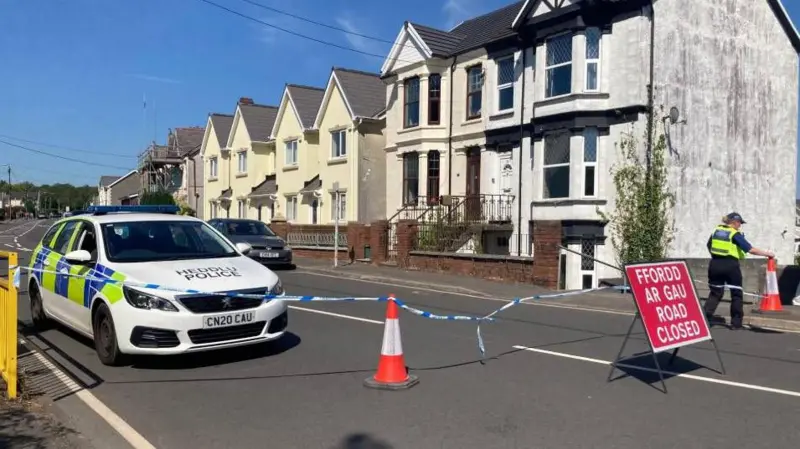
Five people are now in custody following a collision involving a car and an off-road motorcycle
THREE more men have been arrested after an 18-year-old died following a collision between a car and an off-road motorcycle in Gorseinon.
South Wales Police were called to Pen Cae Crwn Road at around 12:58pm on Thursday, where the teenager, who is believed to have been from Swansea, was pronounced dead at the scene.
A second man, aged 19, was taken to hospital with injuries.
Two 18-year-old men were arrested on suspicion of murder on Thursday.
Police confirmed on Friday that a further three arrests had been made.
A 33-year-old man from Gorseinon was arrested on suspicion of murder.
A 38-year-old man from Gowerton and a 38-year-old man from Mount Pleasant were arrested on suspicion of assisting an offender.
The latest arrests bring the total number of people detained in connection with the investigation to five.
Several roads in the area remained closed on Friday morning while officers continued their investigation.
Cordons had been removed from some streets, although traffic cones, road signs and police tape remained at the roadside.
Gorseinon Rugby Club chairman Ian Murphy said the local community had been left in “deep shock”.
He said: “For youngsters to get involved in a tragedy like this is shocking and disturbing, very disturbing for us all.

“Everybody was talking about it. All the roads were closed by police and ambulances, so it took a while for it to sink in what was going on.
“We were aware that there might have been a chase involving a car and a motorbike, and the full tragedy unfolded from there.”
South Wales Police has not confirmed the circumstances leading up to the collision, and enquiries remain ongoing.

Freedom of Information figures show more than 1,600 patients remained on the health board’s hip replacement waiting list in May
PATIENTS awaiting elective hip replacement surgery under Hywel Dda University Health Board waited an average of 450 days during the 2025/26 financial year, according to newly released figures.
The average wait was equivalent to just over 64 weeks, significantly longer than the treatment times set out under Welsh NHS targets.
The figures were obtained through a Freedom of Information request submitted to the health board by private healthcare marketplace My Medical Gateway.
In Wales, the stated aim is for 95% of patients to begin treatment within 26 weeks of referral, with no patient waiting longer than 36 weeks.
Hywel Dda confirmed that 1,608 patients were on its waiting list for hip replacement surgery as of May 28, 2026.
The health board also said 16 patients had been removed from the waiting list during the 2025/26 financial year after choosing to undergo treatment privately.
Hip replacement surgery is most commonly offered to people experiencing severe pain, stiffness and reduced mobility, often after other treatments such as physiotherapy, pain relief, injections and lifestyle changes have failed to provide sufficient relief.
Sara Gezdari, Head of Investor Relations at My Medical Gateway, said prolonged waits could have a serious effect on patients’ physical and emotional wellbeing.
She said: “Many people join NHS waiting lists after already spending months or years attempting to manage their condition through physiotherapy, pain relief medication, injections and lifestyle modifications.
“By the time surgery is recommended, they are often already struggling. The true impact of waiting is measured not in weeks but in declining quality of life.”
She said patients waiting for surgery could experience increasing pain, disrupted sleep, reduced mobility, loss of independence, social isolation and worsening mental health.
Long waits could also have financial consequences, particularly for people whose employment relies on physical mobility.

Ms Gezdari added: “Many patients continue working despite severe symptoms. As pain worsens, productivity often falls. Some reduce their hours. Others leave work entirely.
“The consequences can be particularly significant for self-employed individuals who depend upon physical mobility to earn a living.”
My Medical Gateway said private hip replacement surgery in the UK typically costs between £12,549 and £14,950.
The company, which connects UK patients with private hospitals in the European Union, said the average price offered by many European providers was approximately £9,088.
However, travelling abroad for medical treatment can involve additional considerations, including travel costs, insurance, post-operative care and arrangements if complications arise.
The Freedom of Information response was returned by Hywel Dda University Health Board on June 8, 2026.

Local school placements helped Millie Brace gain the experience and connections needed to begin her career at Templeton Primary School
A SAUNDERSFOOT student is celebrating after graduating from the University of Wales Trinity Saint David and securing a teaching job in Pembrokeshire before completing her degree.
Millie Brace graduated this week with a BA in Primary Education with Qualified Teacher Status from UWTSD’s Carmarthen campus.
She will begin her first teaching post at Templeton Primary School in September.
Millie said the opportunity to remain close to home and complete placements in Pembrokeshire schools had been a major factor in her decision to study at UWTSD.
“I chose UWTSD because it allowed me to stay close to my family and continue living at home while studying, which was important to me,” she said.
“Another key reason was the opportunity to complete local teaching placements.
“I knew how competitive teaching jobs can be in Pembrokeshire, so gaining experience in local schools was a great way to build professional connections and develop an understanding of the schools and communities I want to work in.”
Her placements allowed her to gain experience in a range of classrooms and helped her develop the confidence needed to apply for teaching roles.
“Before graduating, I was delighted to secure a teaching position at an amazing primary school in my local area,” she said.
Millie praised the support she received from university staff, school mentors and teachers during her final placement at Lamphey Primary School.
“Although I had not previously taught that particular year group, I received fantastic support from my class mentors and staff at Lamphey Primary School,” she said.
“Their knowledge and experience, combined with the research and understanding I developed through my course and assignments, greatly increased my confidence.”

Millie said the flexibility of the degree allowed her to explore subjects linked directly to her classroom experience and professional development.
“My favourite thing about the course was the flexibility of the assignments,” she said.
“They allowed me to explore topics that genuinely interested me and focus on areas that reflected my personal development targets from placements.
“This made the work feel relevant to my experiences in the classroom and helped me connect theory with practice.”
She also valued the sense of community at the Carmarthen campus and the friendships she formed with other student teachers.
“One of the biggest challenges during my studies was adapting to different placement schools and managing the increasing expectations placed on me as I progressed,” she said.
“Each school had its own routines, approaches and learning environments.
“What helped me most was the support of other student teachers. We shared resources, exchanged ideas and helped each other with lesson planning and preparation.”
Outside her studies, Millie continued to enjoy the Pembrokeshire coastline, spending her spare time paddleboarding, walking her dog and learning to surf.
She said she would recommend UWTSD to anyone considering a career in teaching.
“The course provided excellent placement opportunities, allowing me to gain valuable experience in local schools and build professional connections that helped me secure a teaching job before graduating,” she said.
“I have also made friends for life, and the relationships I built have been one of the most rewarding parts of my university experience.”
Millie will now take the next step in her career when she joins Templeton Primary School at the beginning of the new academic year.



Crime11 hours ago
Ann Widdecombe: Welsh politicians pay tribute as murder probe launched
Prime Minister Sir Keir Starmer has praised the former minister’s “conviction and dedication”, while political figures in Wales remembered her...


News15 hours ago
Solardo pulls out of Haverfordwest show as organisers offer full refunds
Headline act confirms non-appearance as Park House Series announces major event changes DANCE music duo Solardo will no longer perform...


Local Government16 hours ago
Conservatives win Pembroke Dock seat as Reform stalls and Dowson polls just 11
Jamie Street takes Market ward with a 43-vote majority as Reform finishes fourth despite its major Senedd breakthrough two months...

Health17 hours ago
Hospital ward closed after highly contagious scabies outbreak
Hywel Dda confirms wider rise in cases across Carmarthenshire, Pembrokeshire and Ceredigion as patients and staff are offered treatment A...


Crime2 days ago
Teacher stabbing trial: The first week of evidence
Jury hears accounts of alleged planned classroom attack, teacher’s fear she was dying, and boy’s words after leaving school A...


Community2 days ago
Haverfordwest Castle refurbishment reaches new heights as roof goes on
Major milestone reached in project to transform historic gaol building into flagship visitor attraction A MAJOR milestone has been reached...


Business3 days ago
Pembrokeshire lands £98m share of Wales marine energy boom
New industry report says county has received the second highest level of marine energy investment in Wales, supporting more than...
Crime3 days ago
First aider tells jury teacher was “crying, shaking” after classroom stabbing
A SCHOOL first aider has told a jury that teacher Vicki Williams was “crying, shaking” and in “complete shock” after...

Crime4 days ago
Teacher feared she was dying after Milford Haven classroom stabbing
A TEACHER allegedly stabbed in the head at Milford Haven Comprehensive School told a jury she feared she was dying...


News4 days ago
Farage to resign as MP and fight Clacton by-election amid finance row
NIGEL FARAGE has announced he will resign as MP for Clacton and stand again in the by-election he intends to...
-
 Farming4 days ago
Pembrokeshire slaughterhouse given urgent improvement rating after audit failure
-

 Entertainment3 days ago
Swing and big band classics heading to Torch Theatre
-
 Education5 days ago
Council failed Welsh language standards over school closure
-

 News4 days ago
From boccia to boxing: ALN multisport events give youngsters chance to try activities
-
 News4 days ago
Large fire breaks out at Impala Terminal in Milford Haven
-

 Community6 days ago
Milford Haven Carnival brings colour, music and crowds to the town
-

 News3 days ago
Questions raised over Hamilton Accies finances after club’s Haverfordwest friendly
-

 Farming1 day ago
Working Carmarthenshire farm opens gates to visitors with new holiday cottages