


News
There are no illegal immigrants in Penally, Home Office confirms

THE HOME OFFICE has been in touch with The Pembrokeshire Herald to clarify some of the queries that locals have regarding the Penally Army Camp, now being used to house asylum seekers.
The Management Team at the asylum seeker holding unit have refused to engage with the local County Councillor, John Preston, but the information now received could go some way to answer some of the questions which have, until now, remained unanswered on social media, and by the local member himself.
Firstly, there has been speculation about the immigration status of those people held in Penally. The government has now confirmed that those being housed in MoD sites are people “currently awaiting asylum decisions”.
This means that all of the people in the camp have applied for asylum officially, and that they are currently in the United Kingdom legally. This is because a refugee, who has presented himself to the UK authorities without delay, showed good cause for his entry or presence and has made a claim for asylum as soon as was reasonably practicable, is afforded protection in law from offences connected with that entry. It is legal for people to enter the country in a manner which would normally be illegal, as long as it was for the purposes of seeking asylum.
The people who are staying at Penally Camp are new to the UK, having arrived in boats or in the back of lorries – but they have already been quarantined and screened for Covid-19.

A Home Office spokesperson said: “In line with guidelines about arrivals into the United Kingdom, asylum seekers will have first spent a 14-day quarantine period in other temporary accommodation before, providing they do not display any symptoms of Covid-19, being moved to the MoD sites [including Penally].”
The Home Office also said that whenever using contingency accommodation, they “ensure that detailed assessment is carried out to ensure asylum seekers have the support services they need. If there are any issues that need to be addressed, we will work with our contractor and other partners to find solutions.
Suggesting that the decision to use Penally Camp was made in a rush the Home Office said: “There are times where contingency accommodation must be procured and mobilised at speed to ensure we meet our legal obligations.”
The spokesman added: “The Home Office is committed to working collaboratively with communities and stakeholders to ensure that destitute asylum seekers are provided with safe, secure and suitable accommodation while their asylum claims are considered. This includes working in partnership with local authorities, Clinical Commissioning Groups in England and Local Health Boards in Wales, Public Health England and Wales, the Welsh Government and local police forces. We have specifically set up an Asylum Accommodation Strategic Working Group to support collaborative working.
“Our ambition is to house asylum seekers within the asylum estate without the need for contingency accommodation. We are working to address the issues putting pressure on our asylum accommodation. This includes resuming support cessations, to get people moving out of accommodation when their cases are concluded, and also to continue to take steps to address illegal migration and the exploitation and organised criminality that goes with it, including the dangerous Channel crossings we have seen in recent times”.
THREAT OF ARREST
In regards to the protests in Penally, the Home Office spokesperson said: “We will not tolerate any attempts to fuel resentment towards asylum seekers and we will take all the necessary steps to protect people in our care.

“We continually review the security at asylum accommodation sites with providers, who work closely with local police to ensure action is taken if someone tries to access a site.”
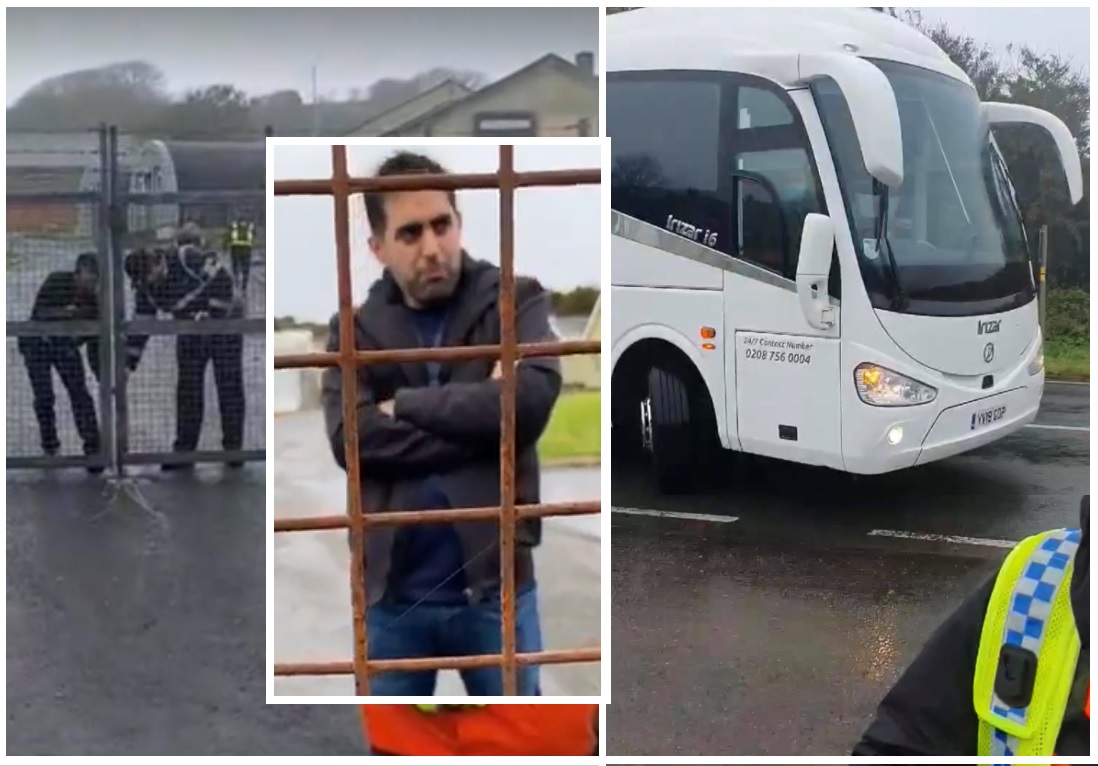
The information sent from the Home Office came on the day that more asylum seekers were bussed into the camp, under the escort of unmarked police vehicles (Sept 28).
One solitary protestor was on hand to attempt to block the bus, but under the threat of arrest he was moved out of the way by a police officer.
On Monday evening, some of the asylum seekers from the camp came to the gates to speak to protestors. One of those protestors, James Gould, a member of the Facebook group ‘Penally Against Illegal Migrant Camp’ live streamed an ad-hoc interview with one of the camp residents, which has now been seen by over 20,000 people.
COUNCILLOR WANTS HIS VOICE HEARD
Meanwhile, Cllr Preston is pushing forward with his plan to spread national awareness about what is happening in Penally. He told the press over the weekend: “I spoke with a Home Office official last week and stated that I am deeply uncomfortable with the possibility that our human rights obligations may not be possible to uphold in such a facility”
“It is my understanding that the asylum seekers have been removed from support networks established within the UK who have the infrastructure to provide them with their essential medical, spiritual, emotional, and domestic needs.
“They have then been transported during the night to Penally where they have witnessed mass protests and media attention.
“Due to the highly prominent location of the camp it has now become a point of public curiosity creating an environment of anxiety and fear for those on both sides of the fence.
“I have met with residents and business owners over the weekend, and it is still not clear why such a facility has been established in the heart of one of Europe’s premier holiday destinations.
“I am in contact with the BBC with a view to raising national awareness of the situation at Penally Camp and how it has been implemented by the Home Office as I consider this to be of national importance.
“It will not benefit anyone to have a government enquiry in five years’ time to tell us lessons have been learnt’. The injustice is happening now in real time and this decision must be re-called as a matter of urgency”
In other comments to the press the councillor said: “No consideration has been afforded to the elderly population in the area or to the needs of a large group of vulnerable adults. The autocratic manner in which this decision has been made should be a concern to us all. We will continue to demand that it is reconsidered”








A NEW exhibition exploring memory, belonging and the changing face of rural life is opening in Cardigan.
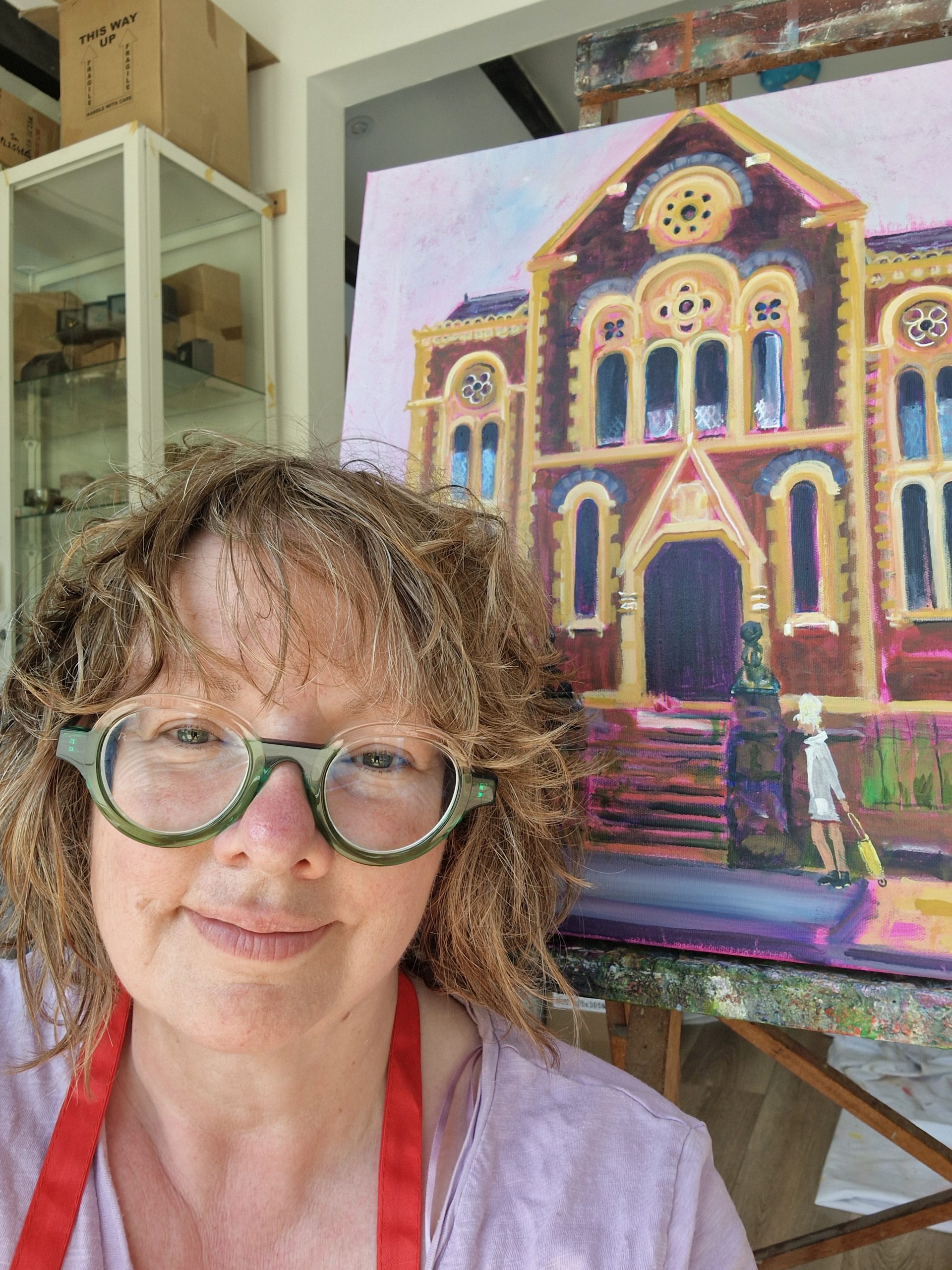
West Wales artist Sue Dewhurst will present From the Outside Looking In at Oriel Cardi Bach, with the exhibition running from June 27 to July 30.
The collection brings together several new series of work reflecting on the people, places and traditions that shaped Dewhurst’s childhood in the 1970s.
At the heart of the exhibition are the Chapel Girls, a group of paintings focusing on women who might once have filled the chapels that dominated Welsh village life. In Dewhurst’s work, they are now seen finding new forms of belonging through shopping trips, bingo halls, dating apps, bottomless brunches and everyday rituals, while redundant chapels stand silent around them.
The exhibition also includes A Bit of a Do, a series inspired by weddings, family parties and village hall celebrations.
Among the familiar characters are the mysterious woman in her best hat who appears at every gathering, the accountant calculating buffet logistics, the retired nurse dancing barefoot long after everyone else has gone home, and Harry, a grumpy gent with a mysteriously missing fingertip that nobody dares ask about.
Dewhurst’s Ghost Town series will also feature, exploring the changing landscapes of northern mill towns and communities transformed beyond recognition. These works sit alongside expressive coastal paintings inspired by New Quay and the Ceredigion coast.
A further installation of miniature “party paintings” will be presented like treasured relics rescued from a forgotten village hall or working men’s club. Wrapped with handwritten stories and nostalgic memorabilia, the pieces invite visitors to remember people and moments that might otherwise disappear.
Sue said music also plays an important role in the exhibition.
She said: “Music is so evocative for me and can instantly transport me back to a certain point in time.
“I’ve always been fascinated by the lives we don’t usually celebrate – the women who held communities together, the odd characters who turned up at every family occasion, the places that shaped us and the memories that linger long after buildings and traditions have changed.
“This exhibition is really about looking back with affection and humour, while recognising that we are all, in one way or another, trying to find where we belong.”

Originally from Lancashire and now based near Llandysul, Dewhurst has spent more than thirty years working in the arts. She previously ran Oriel Haywire in Llandysul before its closure around eighteen months ago.
From the Outside Looking In opens at Oriel Cardi Bach, Cardigan, on June 27 and runs until July 30.
Visitors are invited to rediscover familiar faces, forgotten stories and the beauty found in ordinary lives.
.

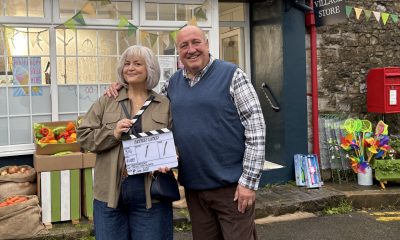
A HEARTWARMING new Welsh BBC comedy co-written by Ruth Jones and Steve Speirs has started filming in South Wales.
Better Later, a six-part series for BBC iPlayer, BBC One and BBC One Wales, will explore the unexpected joys of an unlikely friendship.
The comedy stars Jones and Speirs as two people who meet at a knee trauma clinic. Retired teacher Clive, played by Speirs, is 60, widowed and facing a new chapter in life. Shelley Anne, played by Jones, is a 55-year-old environmental health officer going through a bitter divorce.
The series is being filmed in and around South Wales, including the Brecon Beacons, and is set in the fictional village of Brynfach.
Ruth Jones said: “In a funny way this show has been 35 years in the making, which is when I first met Steve. It’s not that we’re slow writers, it’s just that we’ve been up to other things. It’s fantastic to be back in front of the camera with him again.”
Steve Speirs said: “Our first time acting together for quite a long time. Ruth makes me laugh more than anyone and I’m a terrible giggler. This could be a long shoot.”
Better Later has been commissioned by BBC Cymru Wales and BBC Comedy and is being made by Tidy Productions in association with BBC Studios Comedy, with support from Creative Wales.
The series was commissioned by Nick Andrews, Head of Commissioning at BBC Cymru Wales, and Jon Petrie, Director of Comedy at the BBC. The commissioning editors are Emma Lawson and Paul Forde.
Executive producers are Sarah Fraser for Tidy Productions and Josh Cole for BBC Studios Comedy. The producer is Owen Bell and the director is Simon Massey.
Transmission details will be announced in due course.
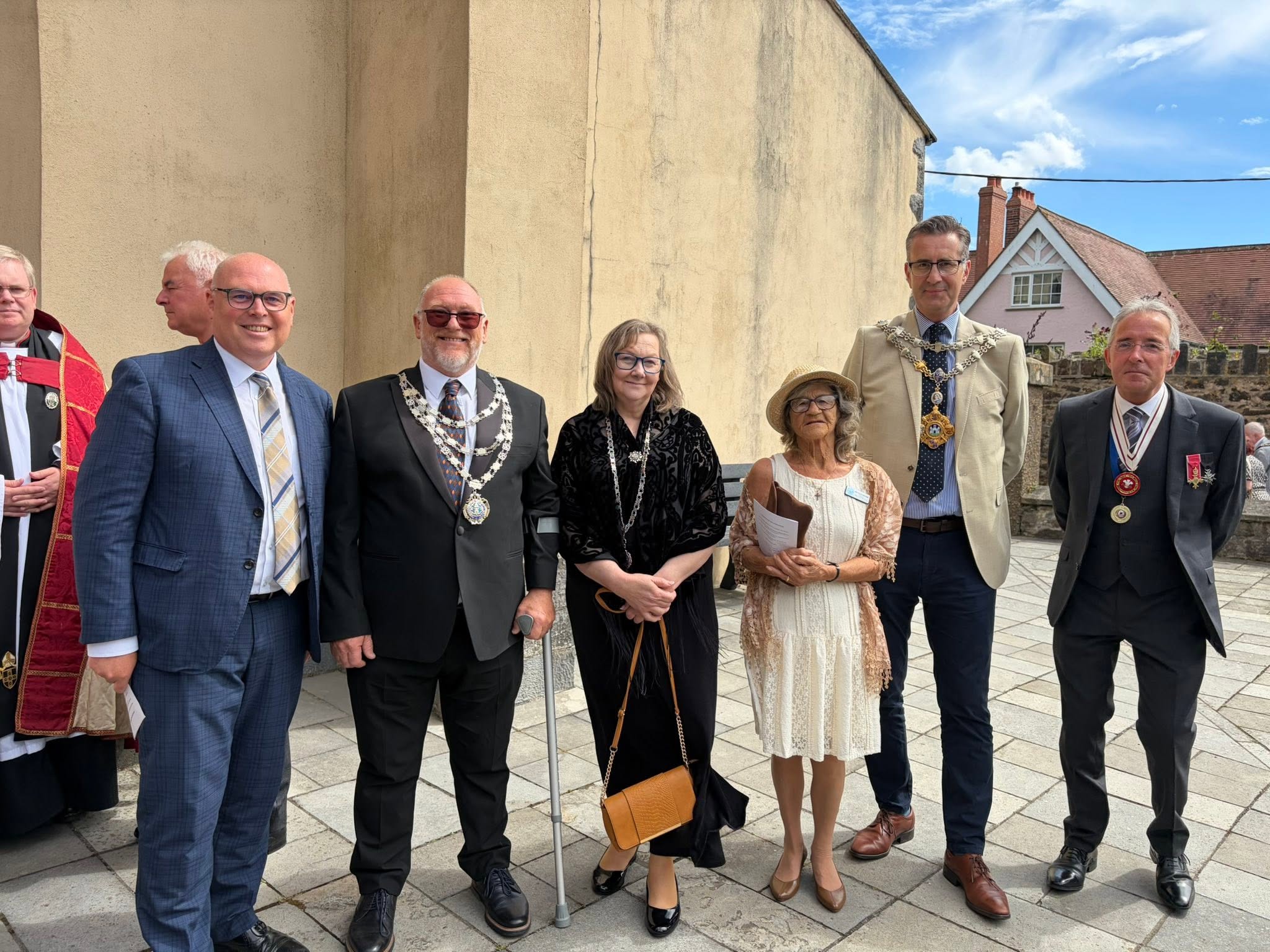
Mayor’s charities named as civic leaders gather at St Katharine and St Peter’s Church
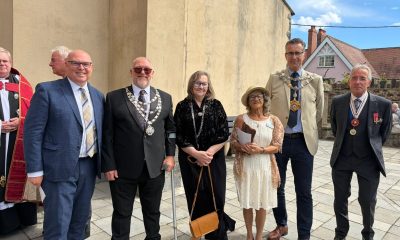
THE CIVIC SERVICE of the Mayor of Milford Haven, Cllr Mark Woodward, took place at St Katharine and St Peter’s Church on Saturday (June 20).
The service marked Cllr Woodward’s election as Mayor and First Citizen of Milford Haven.
It was conducted by Rev Dr Adrian Furse and Canon John Cecil, with music from church organist Richard Stephens, Gelliswick Community Choir and Milford Haven Town Band.
Guides and Brownies, Milford Haven Sea Cadets and Royal Marines Cadets were also among those taking part, with councillors Colin Sharp and Yvonne Southwell acting as ushers.
Refreshments followed at Milford Haven Bowling Club.
Local MS Paul Davies was among those attending the service and wished the new mayor all the best for his term in office.
Cllr Woodward’s chosen charities for the year are Patch Charity and Greenacres Rescue.
Photo caption:
Civic guests attended the Mayor of Milford Haven’s service at St Katharine and St Peter’s Church on Saturday (Pic: Supplied)



Charity20 hours ago
Toy Story fans fill charity toy box at Haverfordwest cinema
Donations pour in for SNAP Specialist Play as families embrace Toy Story 5 launch A TOY STORY-themed charity appeal at...


Community1 day ago
Lord Rhys emerges from the mist in St Davids
Giant puppet begins historic journey marking 850 years since the first Eisteddfod MIST swirled around St Davids Cathedral on Friday...

News2 days ago
Tragic tribute paid to Haverfordwest man after A4075 collision
FAMILY REMEMBERS “KIND AND LOVING” CALLUM HANSON THE FAMILY of a 22-year-old man from Haverfordwest who died following a road...


News3 days ago
Motorcyclist, 22, dies in A4075 crash in Pembrokeshire
A 22-year-old woman remains in hospital after two-vehicle collision A MOTORCYCLIST has died following a serious two-vehicle crash on the...

Community3 days ago
Why police will be visiting every home in Pembrokeshire
New operation aims to knock on more than 257,000 doors across Dyfed-Powys over the next three years DYFED-POWYS POLICE has...


Crime3 days ago
Prisons at breaking point: MPs warn Wales is paying the price of a failing system
Frozen healthcare budgets, overcrowded jails, homelessness on release and mounting pressure on staff are undermining rehabilitation across Wales, according to...


News4 days ago
Brexit at 10: How Britain was sold a dream that cost us dearly
A decade after the referendum, the promised benefits remain hard to find while the economic costs are increasingly difficult to...

Crime4 days ago
Worcestershire man jailed after violent attack on woman in Tenby
Defendant was already serving a suspended sentence when serious assault took place A WORCESTERSHIRE man has been jailed for more...


Climate4 days ago
Offshore wind ‘could bring new generation of jobs to Milford Haven’
Pembrokeshire ports and Celtic Sea projects placed at centre of Wales’ green energy ambitions MILFORD HAVEN and Pembroke Dock could...

Community5 days ago
Police officer hailed hero after midnight sea rescue in Milford Haven
PC swam 100 metres offshore to save distressed woman heard calling for help in darkness A DYFED-POWYS POLICE officer has...
-

 Community7 days ago
Pembrokeshire Chess Club crowned Welsh champions
-

 Crime3 days ago
Milford Haven man jailed for breaching domestic violence protection order
-

 Local Government5 days ago
Security privately arranged by Mayor at Beating of the Bounds
-

 News3 days ago
Crash on Freeman’s Way causes school-run chaos across Haverfordwest
-

 Crime5 days ago
Man wanted by court after failing to attend hearing over alleged shop thefts
-
 Crime5 days ago
Man banned from roads after drink-driving offence
-

 Crime5 days ago
Man jailed after admitting strangulation and assaults
-
 Crime5 days ago
Man sentenced over stalking campaign and lock knife offence