


News
Protest against ‘draconian’ Police and Crime Bill takes place in Haverfordwest


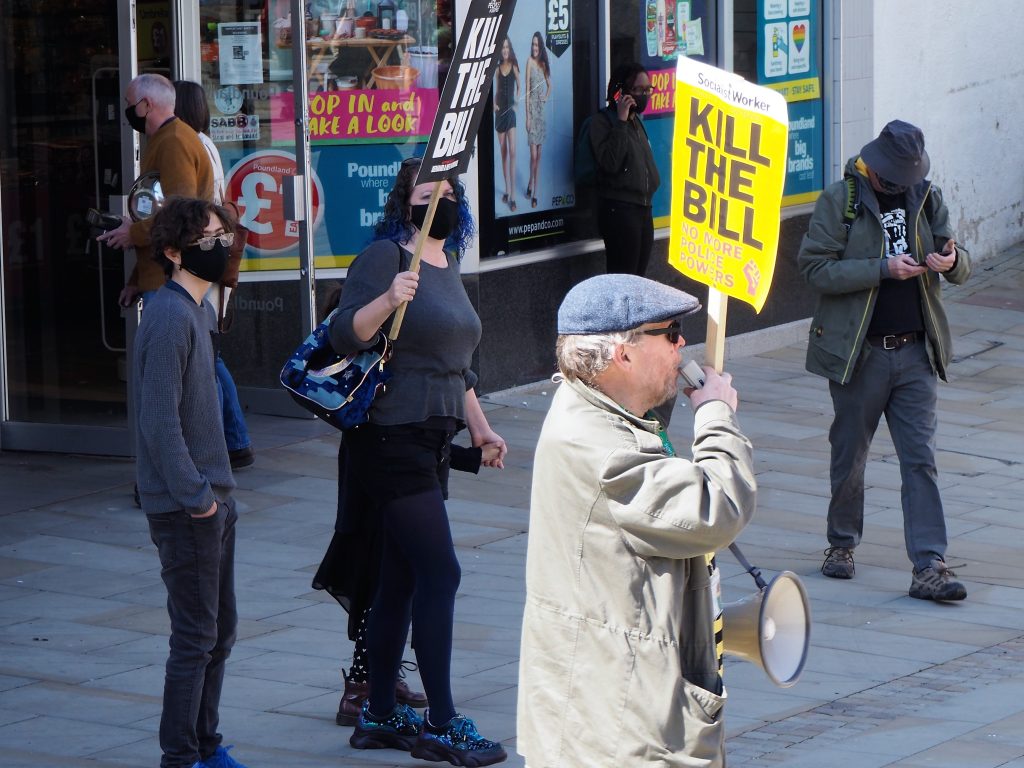
A SECOND Kill the Bill protest took place in Haverfordwest on Saturday (Apr 17).
One of the organisers told The Herald: “The new law will be an enormous piece of draconian legislation that includes significant expansion in police powers to curtail the right to protest. The right to peacefully assemble and protest are a fundamental part of any democracy; empowering people to have their voices heard, in addition to holding the Government to account. These rights are universal –they protect peaceful and legitimate protest whatever the cause.“The events at the Clapham vigil and at demonstrations over the last few weeks are a dangerous indication of what the future of protest will look like if the police powers bill gets through parliament.”
A local campaigner, a mother and grandmother said “We are in the process of losing a fundamental part of our democracy, It is important we protect it for future generations. We have messed up so much of their future already-we need to hold the Government to account”.
Aspects of the Bill include:
- The power for Police forces to shut down protests that they deem too disruptive at their own discretion.
- Up to a 10-year sentence for demonstrators considered to be causing a “public nuisance”.
- The power for police forces to impose start and end times on static protests of any size.
- The power to expand stop and search powers, which already discriminate against marginalised communities. If you live in the Dyfed Powys police area, you are 5 times more likely to be stopped and searched if you are black than white.
- Up to 10-year sentences for damage to public monuments’ Police powers will be expanded and custodial sentences increased to “protect” women.
- These measures are not sufficient to prevent violence and are troubling, considering some police officers’ involvement in cases of violence against women. Significant restrictions on where protests around Parliament may take place.
- The elevation of trespass from a civil offence to a criminal offence, meaning police and courts can give harsh sentences to Travellers.
- Increased power of police to seize vehicles and homes from Gypsy, Roma, and Traveller communities and demanding proof of permission to travel.
- The bill will criminalise a way of life for these communities.
Some of the proposals in the new bill which is the subject of the protest include putting start and finish times on protests, as well as noise limits. The bill also says damage to memorials could lead to up to 10 years in prison. The bill could also expand stop-and-search powers and includes an offence of “intentionally or recklessly causing public nuisance,” which is designed to stop people occupying public spaces and doing things like hanging off bridges or gluing themselves to windows.


The bill will be reintroduced to Parliament after the Queen’s Speech, according to the Home Office, with Commons Committee Stage expected to be completed by 24 June.
“The Police, Crime, Sentencing and Courts Bill delivers on the government’s commitment to crack down on crime and build safer communities,” a Home Office spokesperson says. “We are equipping the police with the tools they need to stop violent criminals in their tracks.” They add that the bill “enshrines our commitment to those brave officers who put themselves in danger to keep rest of us safe into law”.
One protestor told Herald.Wales: “People are getting more angry and more frustrated and they feel like their issues are not being dealt with – but are rather just simply being cracked down on.
“And that is the wrong approach. People are still going to take to the streets and be even more passionate.”
Protests – a senior police officer’s view
A police boss who describes himself as an “experienced protester” says a report on how protests are policed is one sided, illiberal and undermines civil and political rights.
North Wales Police and Crime Commissioner Arfon Jones is so concerned that he has written to Home Secretary Priti Patel to complain about it.
The UK Government used the report by Her Majesty’s Inspectorate of Constabulary, Fire and Rescue Service (HMICFRS),“Getting the balance right?, when they were drafting the controversial Police, Crime, Sentencing and Courts Bill.


According to the inspectors, the balance had tipped too heavily in favour of protesters.
The legislation will give the police powers to set start and end times for static protests and stop protests if they are judged to be too noisy or too “disruptive”.
Protesters face fines of up to £2,500 and up to 10 years in jail if they are convicted.
Mr Jones, a former police inspector, said: “Although equilibrium should be struck between individual rights to protest and the general interests of the community, I simply do not agree the balance tips too readily in favour of protestors.
“The recommendations in the report are one sided, illiberal and undermine civil and political rights and are not in the public interest.
“The new powers in the proposed act are not necessary and will prevent protest as we know today. The whole purpose of protest is to disrupt and to seek change.
“The police have enough powers to police protests and do not need more. I do not believe that HMICFRS have the balance right in this report and as an *experienced* protestor for the last 50 years the perception that police are favourable towards protestors rights is a fallacy.
“Policing protests has always been, and always will be, a tool of the state to control its citizens and I will have no truck with it.
“Automatic Facial Recognition in non-violent protests is a privacy intrusion and should not be used.
“Non-violent protests should be policed as events not as a public order exercise.
“The Police, Crime, Sentencing and Courts Bill will afford new powers to officers to tackle protests, including measures aimed at static protests and a new offence of ‘intentionally or recklessly causing public nuisance’, which is in part defined as causing ‘serious annoyance’ or ‘serious inconvenience’.
“In a democracy the right to protest sometimes means people are inconvenienced, such is the price of living in a society where voicing support for a cause of your choosing is permitted. “These proposals seek to whittle that right down to such a degree that any demonstration, large or small, may be heavily restricted or even curtailed altogether. The effect on free expression will be substantial.
“The report is short-term and politically driven. Policing should be very careful not to be drawn into the situation of being arbiters of which protests can go ahead and become stuck in the middle.
“The policing of industrial action in the 1970s reminds us that policing protests may cause long-term damage on the relationships between community and police.
“The United Kingdom and its people have been through a very difficult year, with exceptional Covid-19 restrictions coming to an end as the pandemic recedes.
“This is a time for reflection and consideration, not a time to be rushing through poorly thought out measures to impose disproportionate controls on free expression.
“Such laws may shield ministers and corporations from public dissent, but who would wish to live in a society where such matters are guiding principles of legislation?”









Mayor’s charities named as civic leaders gather at St Katharine and St Peter’s Church
THE CIVIC SERVICE of the Mayor of Milford Haven, Cllr Mark Woodward, took place at St Katharine and St Peter’s Church on Saturday (June 20).
The service marked Cllr Woodward’s election as Mayor and First Citizen of Milford Haven.
It was conducted by Rev Dr Adrian Furse and Canon John Cecil, with music from church organist Richard Stephens, Gelliswick Community Choir and Milford Haven Town Band.
Guides and Brownies, Milford Haven Sea Cadets and Royal Marines Cadets were also among those taking part, with councillors Colin Sharp and Yvonne Southwell acting as ushers.
Refreshments followed at Milford Haven Bowling Club.
Local MS Paul Davies was among those attending the service and wished the new mayor all the best for his term in office.
Cllr Woodward’s chosen charities for the year are Patch Charity and Greenacres Rescue.
Photo caption:
Civic guests attended the Mayor of Milford Haven’s service at St Katharine and St Peter’s Church on Saturday (Pic: Supplied)

Donations pour in for SNAP Specialist Play as families embrace Toy Story 5 launch
A TOY STORY-themed charity appeal at a Haverfordwest cinema has got off to a flying start, with families donating toys to support children with additional needs across Pembrokeshire.
The Palace Cinema has teamed up with local charity SNAP Specialist Play to collect new and pre-loved toys during screenings of the newly released Toy Story 5.
The appeal centres around an “Andy’s Toys” donation box, inspired by the beloved Pixar films, which has already been filled by generous filmgoers.

Cinema manager Hannah Cramp said the response from the community had exceeded expectations.
Families attending opening screenings have arrived carrying bags of toys, with many children keen to share their own treasured items to help others.
The cinema has transformed its foyer into a colourful Toy Story-themed experience, complete with hand-painted decorations, character silhouettes, bunting and famous film slogans including “Reach for the Sky” and “To Infinity and Beyond”.
Many visitors have also embraced the spirit of the occasion by attending in costume as their favourite Toy Story characters.

The toys are being donated to SNAP Specialist Play, a charity based within the Child Health Department at Withybush Hospital.
SNAP supports pre-school children with additional and complex needs through specialist play sessions designed to encourage communication, physical development and sensory learning.
Its facilities include sensory rooms, therapeutic play spaces and bespoke equipment used by speech and language therapists, occupational therapists and physiotherapists.
Project manager Cindy Jenkins said the charity was delighted by the partnership and grateful for the generosity shown by local families.

She said every toy donated would be put to good use, either during specialist play sessions, at family events, or through seasonal initiatives such as Christmas gift boxes for children and their siblings.

The appeal will continue until mid-July, with organisers hopeful that even more donations will be received over the coming weeks.
Anyone attending Toy Story 5 at the Palace Cinema is invited to bring along a new or good-quality pre-loved toy to support the appeal.

Cover photo:
Fancy dress fun: Palace Cinema manager Hannah Cramp helping launch the Toy Story charity appeal.

PATIENTS are facing some of the worst medicine shortages ever seen in the UK, with pharmacists warning the situation now poses a serious risk to safety.
The National Pharmacy Association said shortages affecting commonly used medicines are becoming more frequent, lasting longer, and causing increasing disruption for patients, GP surgeries and pharmacies.
The warning comes as Serious Shortage Protocols for Creon, used by people with pancreatic cancer and cystic fibrosis to help digest food, have been in place since May 2024 and have now been extended until July 10, 2026.
HRT treatment Estradot has also been under a Serious Shortage Protocol since December 2024, with the current extension also running until July 10.
Patients travelling between pharmacies
A survey by the National Pharmacy Association found that 98 per cent of pharmacies had encountered patients who had visited several pharmacies in one day to find a prescription.
It also found that 96 per cent of pharmacies believed the current situation posed a serious risk to patient safety, while 89 per cent said they had been unable to dispense a medicine at least once a day because of supply problems.
Some pharmacy teams have also faced anger and abuse from patients unable to obtain medication.
Olivier Picard, Chair of the National Pharmacy Association, said: “Medicine shortages are becoming more frequent, lasting longer and causing increasing disruption for patients.
“These shortages are some of most severe the UK has experienced.
“It is deeply distressing to find patients who have travelled from pharmacy to pharmacy to find the medicines they need without success.”
Calls for urgent taskforce
The NPA is calling on the government to convene an emergency taskforce involving manufacturers, wholesalers, clinicians and pharmacists.
It also wants changes to rules which currently stop pharmacists from making simple substitutions, such as changing a tablet to a capsule or a cream to an ointment, even where a safe alternative is available.

Professor Victoria Tzortziou Brown, President of the Royal College of GPs, said medicine shortages were frustrating for patients, GPs and pharmacists, and added pressure to already stretched services.
She said the College supported pharmacists being able to make limited changes to prescriptions where a medicine is unavailable and a safe alternative exists.
She added: “The most important thing is that patients are able to access the medication they need safely and without delay.”
The Cystic Fibrosis Trust and Pancreatic Cancer UK have also raised concerns about the impact of shortages of pancreatic enzyme replacement therapy, including Creon, on people who rely on the medication to digest food, maintain weight and stay well enough for treatment.



Charity16 hours ago
Toy Story fans fill charity toy box at Haverfordwest cinema
Donations pour in for SNAP Specialist Play as families embrace Toy Story 5 launch A TOY STORY-themed charity appeal at...


Community20 hours ago
Lord Rhys emerges from the mist in St Davids
Giant puppet begins historic journey marking 850 years since the first Eisteddfod MIST swirled around St Davids Cathedral on Friday...


News2 days ago
Tragic tribute paid to Haverfordwest man after A4075 collision
FAMILY REMEMBERS “KIND AND LOVING” CALLUM HANSON THE FAMILY of a 22-year-old man from Haverfordwest who died following a road...

News3 days ago
Motorcyclist, 22, dies in A4075 crash in Pembrokeshire
A 22-year-old woman remains in hospital after two-vehicle collision A MOTORCYCLIST has died following a serious two-vehicle crash on the...


Community3 days ago
Why police will be visiting every home in Pembrokeshire
New operation aims to knock on more than 257,000 doors across Dyfed-Powys over the next three years DYFED-POWYS POLICE has...


Crime3 days ago
Prisons at breaking point: MPs warn Wales is paying the price of a failing system
Frozen healthcare budgets, overcrowded jails, homelessness on release and mounting pressure on staff are undermining rehabilitation across Wales, according to...


News4 days ago
Brexit at 10: How Britain was sold a dream that cost us dearly
A decade after the referendum, the promised benefits remain hard to find while the economic costs are increasingly difficult to...


Crime4 days ago
Worcestershire man jailed after violent attack on woman in Tenby
Defendant was already serving a suspended sentence when serious assault took place A WORCESTERSHIRE man has been jailed for more...


Climate4 days ago
Offshore wind ‘could bring new generation of jobs to Milford Haven’
Pembrokeshire ports and Celtic Sea projects placed at centre of Wales’ green energy ambitions MILFORD HAVEN and Pembroke Dock could...


Community4 days ago
Police officer hailed hero after midnight sea rescue in Milford Haven
PC swam 100 metres offshore to save distressed woman heard calling for help in darkness A DYFED-POWYS POLICE officer has...
-

 Community7 days ago
Pembrokeshire Chess Club crowned Welsh champions
-

 Crime3 days ago
Milford Haven man jailed for breaching domestic violence protection order
-

 Local Government5 days ago
Security privately arranged by Mayor at Beating of the Bounds
-

 News3 days ago
Crash on Freeman’s Way causes school-run chaos across Haverfordwest
-

 Crime4 days ago
Man wanted by court after failing to attend hearing over alleged shop thefts
-
 Crime4 days ago
Man banned from roads after drink-driving offence
-

 Crime4 days ago
Man jailed after admitting strangulation and assaults
-

 Crime4 days ago
Man sentenced over stalking campaign and lock knife offence