


News
Criticism at large bonuses for Welsh Water bosses despite 100,000 ‘sewage events’


THE BOSSES of Welsh Water have awarded themselves over £930,000 in bonuses over the past two years despite pumping out raw sewage into Welsh waterways 100,000 times last year, figures from the Welsh Liberal Democrats have revealed. The bosses of Severn Trent, which covers parts of mid and north Wales also awarded themselves bonuses of £5.56 million.
An analysis of company house records by the Welsh Liberal Democrats shows that executives at Dwy Cymru were paid £2.6 million in 2020 and 2021 including £931,000 in bonuses, benefits and incentives.
The eye-watering executive pay packets and company profits were made despite the 100,000 sewage dumping events taking place in 2020 and 2021 alone.
The Welsh Liberal Democrats are calling on the Welsh Labour Government to ban new bonuses for Dwy Cymru executives until sewage offences are brought to an end. The party is also calling on Dwy Cymru and Severn Trent bosses to hand back last year’s bonuses and for the funds to be used to clean up rivers and lakes that have been polluted by sewage.
Welsh Liberal Democrat Leader and Senedd Member Jane Dodds said: “Both Labour in Wales and the Conservatives in England are allowing water companies to pump raw sewage into our precious rivers and lakes while awarding themselves obscene bonuses.

“I’ve watched first-hand as my local river, the River Wye struggles to survive. It has been given just two years until it is declared biologically dead. We cannot put off action any longer.
“Welsh Liberal Democrat plans for a sewage bonus ban would stop water company execs being paid a penny in bonuses more until our waterways are protected from sewage dumps. These bosses should be made to hand back the millions of pounds already received in bonuses to help clean up their mess.
“It’s time to send a message to the Welsh Labour Government that they cannot let water company bosses get away with pumping raw sewage into our rivers and beaches any longer. Every vote for the Welsh Liberal Democrats in May is a vote for a strong local champion who will stand up for their local community, clean rivers and countryside.”
Last Wednesday, 265 MP’s, including Preseli Pembrokeshire’s Stephen Crabb, voted with the Government to reject an attempt by the House of Lords to toughen up the approach to the discharge of sewage into rivers and the sea. 22 Conservative MP’s rebelled and voted against the Government.
The Lords Amendment 45 to the Environment Bill would have placed a legal duty on water companies in England and Wales “to make improvements to their sewerage systems and demonstrate progressive reductions in the harm caused by discharges of untreated sewage”.
Despite this Pembrokeshire MP Stephen Crabb has expressed dismay at the lack of a plan from Welsh Government to tackle storm sewage discharges in Wales, saying it was their problem. Legally speaking, in Wales, these issues are the responsibility of Welsh Government.
In November, Mr Crabb wrote to the First Minister asking for an update on what steps are being taken to tackle the issue of raw sewage being pumped into Welsh waterways. The reply stated that ‘The Welsh Government is taking an approach to improving water quality which is best suited for the specific circumstances in Wales’. But no specific plans to achieve this have been released.

The plan launched by UK Government today for England will deliver the largest programme to tackle storm sewage discharges in history. It outlines a change in how water companies tackle the number of discharges of untreated sewage. Views are sought from the public on the targets as part of a collection of measures to be considered for the final Storm Overflows Discharge Reduction Plan, which will be published in September.
Stephen Crabb said: “The amount of sewage discharged by water companies into our rivers and beaches is unacceptable. I am very pleased to see that UK Government are leading by example through imposing strict limits on when water companies can make use of storm overflows. However, devolution means these changes have little impact in Wales.”
“This issue is especially important for us in Pembrokeshire. I have previously met with Natural Resources Wales and local Surfers Against Sewage representatives to discuss what action is required. It’s a complicated and very costly problem due to the sheer amount of ageing pipework involved. But the first step is getting a plan in place to reduce the discharges. We really do need to hear from Welsh Government now on how they will use their powers to fix the problem in Wales.”
Across Wales as a whole, raw sewage, including human waste, wet wipes and used condoms, was dumped into Welsh rivers more than 100,000 times last year, for almost 900,000 hours.





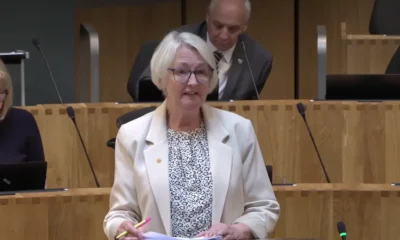






£15m investment will support Year 7 and 8 pupils in Universal Credit households from September
THE WELSH GOVERNMENT has confirmed an additional £15m investment to begin expanding free school meals for eligible secondary school pupils.
The funding will support plans to extend free school meal entitlement to secondary pupils whose households receive Universal Credit, removing the current household income threshold.
At present, secondary school pupils can only receive free school meals if their family receives Universal Credit and household earnings are below £7,400, excluding benefits.
From September, parents of pupils in Years 7 and 8 are expected to be able to apply under the new scheme, regardless of household income, provided the family receives Universal Credit.
The £15m package forms part of the Welsh Government’s supplementary budget for 2026-27.
It will include £10m in capital funding for school kitchens and dining areas, alongside £5m in revenue funding to help introduce the expanded scheme.
The move follows the previous roll-out of free school meals to all primary school children in Wales, which was delivered as part of the former co-operation agreement between the Welsh Government and Plaid Cymru.
Cabinet Minister for Education and Welsh Language, Anna Brychan, said the funding marked “the first step” in extending free school meals to more secondary pupils.
She said: “This work is about removing barriers to learning and supporting wellbeing.
“We know that access to nutritious food improves concentration, attainment and overall health.
“Building on the success of universal primary free school meals, we will ensure that as children move into secondary education those who need it most will continue to receive the support they need to thrive.”
First Minister Rhun ap Iorwerth said extending eligibility to more families on Universal Credit was part of wider efforts to tackle child poverty.

He said: “Starting this work is a key aspect of our 100 Day Plan and beyond — taking practical action by putting money back into families’ pockets and ensuring every young person has the opportunity to succeed, regardless of their background.”
Further details on the roll-out are expected to be announced in due course.

Giant puppet begins historic journey marking 850 years since the first Eisteddfod
MIST swirled around St Davids Cathedral on Friday evening as a giant Lord Rhys puppet emerged from the fog to begin a journey celebrating 850 years since the first recorded Eisteddfod.
Accompanied by traditional musicians and followed by crowds of spectators, the towering figure cut an imposing sight against the backdrop of the ancient cathedral.
The procession marked the start of Taith yr Arglwydd Rhys (The Journey of Lord Rhys), a cultural pilgrimage retracing the legacy of the Welsh prince whose gathering of poets and musicians at Cardigan Castle in 1176 is widely regarded as the first recorded Eisteddfod.
As fog drifted across the city and church towers faded into the background, the scene felt more like a chapter from Welsh folklore than a modern-day celebration.
The giant puppet, accompanied by fellow performers and musicians, travelled from St Davids Cathedral to Oriel y Parc before beginning a wider journey through west Wales.
The travelling celebration will visit communities across Pembrokeshire and Ceredigion before culminating in Cardigan, where Lord Rhys originally staged his famous cultural gathering eight and a half centuries ago.
Video and photographs shared by DrifterStDavids captured the remarkable atmosphere, with many describing the spectacle as one of the most memorable cultural events seen in St Davids for years.
Photo caption: Lord Rhys emerges from the mist outside St Davids Cathedral as celebrations begin to mark the 850th anniversary of the first recorded Eisteddfod
(Pic: SmallWorld – Video: Drifter St Davids)

Campaigners say Carmarthenshire must properly consider alternatives after judge’s ruling and last-minute amendment to statutory notice.
A HIGH COURT judge has warned Carmarthenshire County Council that alternative proposals to closing Ysgol Meidrim must be given proper and conscientious consideration before any final decision is made.
The ruling follows a judicial review challenge brought by parent Leia Perry over the council’s decision to consult on the future of the Welsh-medium rural primary school.
Although the High Court did not halt the closure process, campaigners say the judgment raises serious questions about the way the council has handled the matter.
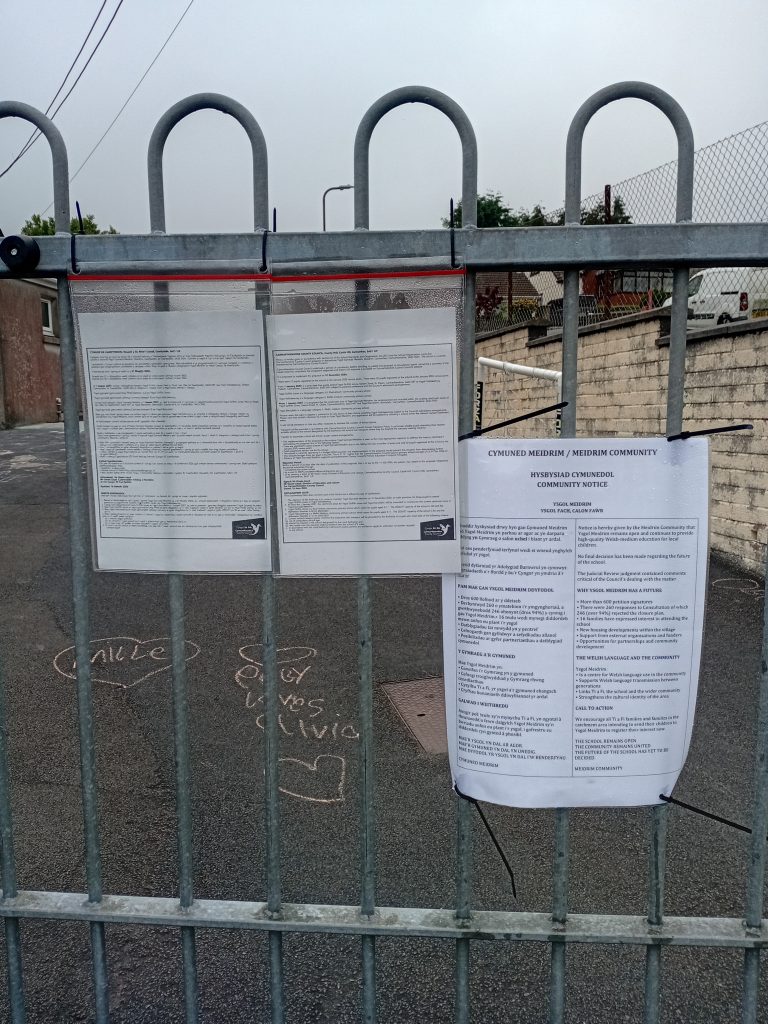
Ysgol Meidrim, near St Clears, currently has around 30 pupils and has been earmarked for closure, with children expected to transfer to other schools from January 2027.
But the school community has mounted a determined campaign to keep it open, arguing that the school remains central to the future of the village, the Welsh language and rural life in the area.
The judgment, handed down by His Honour Judge Jarman KC, found that the challenge should be allowed to proceed, but ultimately dismissed it on the basis that the council still has an opportunity to properly consider alternatives during the ongoing process.
However, the judge made clear that those alternatives must now be considered conscientiously.
Campaigners say this is a significant warning to the council.
Ffred Ffransis, speaking on behalf of Cymdeithas yr Iaith in Carmarthenshire, said the organisation was not a party to the legal action, but understood why a parent of a child with severe medical needs had taken the case.
He said: “The judge criticised the lack of clear communication from the council and that governors had the impression that the council had not yet seriously considered alternatives to closure of Ysgol Meidrim, but found that the evidence did not yet reach the high threshold for legal intervention.
“He has warned the council that they must give conscientious consideration to the alternative proposals drawn up by governors.”
The governors’ proposals include developing the school as part of a wider community hub and exploring federation options rather than closure.

Cymdeithas yr Iaith said the council now had two choices: to press ahead regardless, or to withdraw the closure notice and enter into genuine discussions with governors over their plans.
Mr Ffransis added: “The council must at least demonstrate a new open attitude during the objections period to discussing the alternative proposals.”
The row has deepened after Carmarthenshire County Council was forced to withdraw and reissue its closure notice just three days after it was first published.
According to Cymdeithas yr Iaith, the original notice, issued on June 16, listed nearby Ysgol Bancyfelin as one of three receiving schools. The notice was then withdrawn after it emerged that Ysgol Bancyfelin was already over capacity.
A revised closure notice has now been issued, with the objection period extended until July 17.
The campaign group said this raised further concerns about the way the process was being handled.
Notices have also been placed at the school gates by supporters, making clear that Ysgol Meidrim remains open and encouraging parents to register children there.
One notice states that the judicial review judgment was critical of the council’s handling of the matter and that the future of the school has not yet been decided.
The campaign has attracted wider attention because of the Welsh Government’s presumption against closing rural schools.
Under the School Organisation Code, councils must carefully consider all reasonable alternatives before deciding to close a rural school, including federation and wider community use.
Campaigners argue that Ysgol Meidrim is not simply an education issue, but a question about the survival of Welsh-speaking rural communities.
The council has previously cited low pupil numbers, surplus places, budget pressures and curriculum challenges as reasons for proposing closure.
But opponents say the financial savings are small compared with the impact on the village and its Welsh-medium provision.



Community45 minutes ago
Lord Rhys emerges from the mist in St Davids
Giant puppet begins historic journey marking 850 years since the first Eisteddfod MIST swirled around St Davids Cathedral on Friday...


News23 hours ago
Tragic tribute paid to Haverfordwest man after A4075 collision
FAMILY REMEMBERS “KIND AND LOVING” CALLUM HANSON THE FAMILY of a 22-year-old man from Haverfordwest who died following a road...


News2 days ago
Motorcyclist, 22, dies in A4075 crash in Pembrokeshire
A 22-year-old woman remains in hospital after two-vehicle collision A MOTORCYCLIST has died following a serious two-vehicle crash on the...


Community2 days ago
Why police will be visiting every home in Pembrokeshire
New operation aims to knock on more than 257,000 doors across Dyfed-Powys over the next three years DYFED-POWYS POLICE has...


Crime2 days ago
Prisons at breaking point: MPs warn Wales is paying the price of a failing system
Frozen healthcare budgets, overcrowded jails, homelessness on release and mounting pressure on staff are undermining rehabilitation across Wales, according to...


News3 days ago
Brexit at 10: How Britain was sold a dream that cost us dearly
A decade after the referendum, the promised benefits remain hard to find while the economic costs are increasingly difficult to...


Crime3 days ago
Worcestershire man jailed after violent attack on woman in Tenby
Defendant was already serving a suspended sentence when serious assault took place A WORCESTERSHIRE man has been jailed for more...


Climate3 days ago
Offshore wind ‘could bring new generation of jobs to Milford Haven’
Pembrokeshire ports and Celtic Sea projects placed at centre of Wales’ green energy ambitions MILFORD HAVEN and Pembroke Dock could...


Community4 days ago
Police officer hailed hero after midnight sea rescue in Milford Haven
PC swam 100 metres offshore to save distressed woman heard calling for help in darkness A DYFED-POWYS POLICE officer has...


Local Government4 days ago
Security privately arranged by Mayor at Beating of the Bounds
HAVERFORDWEST TOWN COUNCIL has confirmed that security personnel seen at this year’s Beating of the Bounds were privately arranged and...
-

 Community6 days ago
Pembrokeshire Chess Club crowned Welsh champions
-

 Crime2 days ago
Milford Haven man jailed for breaching domestic violence protection order
-
Local Government4 days ago
Security privately arranged by Mayor at Beating of the Bounds
-

 News2 days ago
Crash on Freeman’s Way causes school-run chaos across Haverfordwest
-

 Crime4 days ago
Man wanted by court after failing to attend hearing over alleged shop thefts
-

 Crime4 days ago
Man jailed after admitting strangulation and assaults
-
 Crime4 days ago
Man banned from roads after drink-driving offence
-

 Crime4 days ago
Man sentenced over stalking campaign and lock knife offence