


News
Bryn knew of Smith allegations in 2005

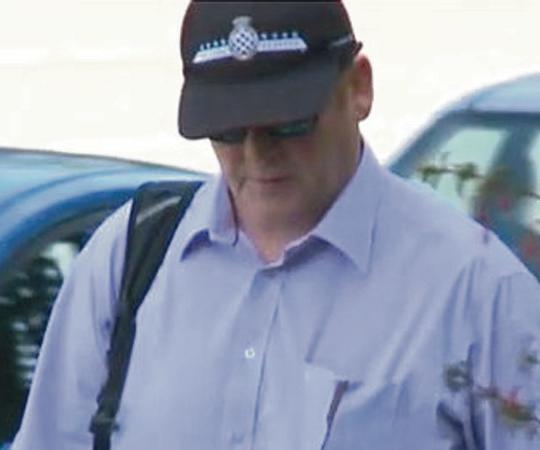

Mik Smith: Bryn Parry Jones knew about allegations
THERE were fresh calls this week for Bryn Parry Jones, Wales’ highest paid council chief, to resign. This time there is mounting pressure on him over the way Pembrokeshire County Council dealt with allegations about a former senior council youth worker who went on to be jailed for six years for sexually abusing a child. And as a result of a BBC Wales Week In Week Out investigation into the case, the Children’s Commissioner for Wales says he wants to re-open the case files at the Council to discover whether children were left at risk. Children’s Commissioner Keith Towler told the press: “I’ll take look at it because I think what you’re raising there are very serious allegations. That probably needs an independent look. In terms of my responsibility as Children’s Commissioner, if I take the view that things happened to children in the past could help to improve the lives of children today then I certainly have got the powers of remit to take look at it.” The Herald can reveal that claims made by IPPG leader Jamie Adams at Thursday’s full Council meeting that the Council’s CEO knew nothing about the serious allegations made by colleagues against Mik Smith are untrue. The Pembrokeshire Herald has a series of explosive internal documents that reveal that when allegations were made about Mik Smith’s inappropriate conduct towards children, Council officers tried to sweep them under the carpet. Those documents reveal that Bryn Parry Jones was told: * At least EIGHT professional youth workers had concerns about Mik Smith’s conduct toward children and that those concerns spanned ‘many years’. * Youth workers felt intimidated and threatened when they reported concerns about Mik Smith to their managers. * Officers treated Mik Smith as though he was the victim of a campaign against him by other staff members and allowed him to chair a meeting which disciplined a member of staff for making allegations about Smith’s inappropriate conduct towards children. * Concerns were expressed about the way in which two officers, County Youth Officer Eirian Evans and Personnel Officer Catherine Davies held a meeting for staff to discuss their concerns about Mik Smith with the now convicted paedophile, who was their line manager, present. One member of staff left that meeting allegedly in ‘floods of tears’. In 2004, a whistle-blower warned bosses that Smith was behaving inappropriately with children and could pose as a risk – but Smith, from Haverfordwest, was given a verbal warning. Paedophile Smith was jailed for six years for sexually abusing an eight-year-old boy a few weeks ago. The offences happened after he had been sacked. Whistle-blower Sue Thomas – who originally warned bosses about Smith’s inappropriate behaviour – thinks that the Council made a serious mistake when they gave Mik Smith a verbal warning in 2005: “I still can’t get my head round it because there were so many good hard-working professional people that came forward with complaints – I cannot understand why we were not listened to. “I can’t comprehend what type of person in management wouldn’t listen to it and wouldn’t be concerned and wouldn’t want to deal with it – I’m lost for words.” Further complaints were made about Smith in 2009 and 2011, and he was eventually sacked in 2012 after a re-investigation was ordered by the Welsh Government when the Authority’s education service was placed into special measures. Had that re-investigation not been ordered, Smith might have remained in the Council’s employment dealing with vulnerable children. The Herald understands that one member of staff, who was supposed to supervise Smith, was subsequently moved from a frontline role dealing with children to a desk job at County Hall. Mik Smith’s recent court case has prompted questions about whether the Council should have sacked Smith sooner and whether it did enough to protect children who he came into contact with. A Council spokesperson told the Herald: “It is a matter of fact that there were significant failings in the disciplinary standards within the Council’s Education directorate in 2005 when Mr Smith was the subject of various allegations about inappropriate behaviour. “Since that time the Council has completely changed its procedures and management of the Education department and is confident that the failings of nine years ago would not be repeated now. “No manager from the former Education directorate involved in the decision-making in 2005 is currently employed by the Authority.” Joyce Watson AM says this is the latest in a series of failures by the Council to properly protect vulnerable children. She wants Bryn Parry Jones – who earns more than the £228,000 a year – to step down. She told The Herald: “I think it’s time for him to go and I’m not shy of saying that – he has been the permanency in all of the negative reports that have been there and there have been a number of them. You cannot be the highest paid Chief Executive in Wales because you are worth that money, and reside over failure. Repeated failure.” The BBC told The Herald that they have spoken to an independent social worker who investigated the allegations against Mik Smith on behalf of the Council in 2005. The social worker told the broadcaster that she was ‘surprised’ that Smith had been dealt with by way of a verbal warning at the time. Bryn Parry Jones said that the council’s investigation at the time revealed no evidence of criminal activity and that since that time the Council has completely changed its procedures and management of the Education department and is confident that past failings would not be repeated now. The Council also said: “No manager from the former Education directorate involved in the decisionmaking in 2005 is currently employed by the Authority.” The Herald has an email from one youth worker sent to Council CEO Bryn Parry Jones and Gerson Davies (then Director of Education), which states: “I do recall that at my induction into PCC several years ago Mr Parry-Jones, you did say that if we had any problems which weren’t getting resolved by management that we had to come and knock on your door – I’m doing that now. I am asking for a meeting between yourself, the directors concerned and those team members involved (excluding Mik Smith) to discuss how this matter can be sorted out.” Bryn Parry Jones responded by ignoring the allegations regarding Mik Smith and said: “I think I made it clear that I was talking about a facility for direct communication in the event of line managers not listening to reasonable suggestions for organisational improvement. It would be inappropriate for me to intervene personally.” That letter is dated November 16, 2005. Sue Perkins, the Labour turncoat who is the IPPG’s spokesperson on Education and Safeguarding, rejected calls for a public inquiry. She told Thursday’s Council meeting that one was not needed as previous investigations had been carried out into the Authority’s failure to adequately safeguard children and that the Council had taken steps to ensure that such a situation was very unlikely to re-occur. Cllr Perkins told the meeting: “The disciplinary process nine years ago was flawed. The monitoring done in 2005 was inadequate. Children were interviewed in 2005 but none made allegations of sexual abuse. “We had two separate intervention boards; this case was one of 26 they discussed. It was dealt with by senior management. It was carried out by very eminent people. “The leader has apologised publicly for the outcome.” IPPG Leader Jamie Adams added: “I express my regret at the decision that was made by the disciplinary committee. “There were faults with safeguarding and education at that time – Mik Smith should have been given a final warning.” Cllr Adams went on to claim: “The allegations were taken seriously but the outcome was not as robust as it should have been.” The leader asked if any members present in the chamber were aware of the issue at the time, as if they were they were bound to have raised it. Cllr Reg Owens responded to the leader’s apparently rhetorical question by revealing that he and other members of staff did raise concerns at the time and that they were ignored. A question from Cllr Mike Stoddart asked whether or not one of the whistle-blowers, Sue Thomas, should receive an apology for how she was dealt with. Cllr Adams responded saying: “This was to do with relationships between staff, it was addressed to six officers. “The evidence at the time was the subject of a joint investigation, had they found examples of child abuse the Police would have prosecuted. “The authority has reviewed its process, I apologise to everyone that has been involved with this”. Towards the end of the meeting there was a motion from Cllr Paul Miller asking for an investigation examining the circumstances surrounding the 2005 disciplinary investigation. He asked that the Minister for Local Government be asked to do this but it was revealed that the Children’s Commissioner for Wales, Keith Towler, was already conducting his own investigation. Cllr Miller said: “As the Children’s Commissioner is already involved in this I shall withdraw my motion.”



THE WELSH GOVERNMENT’s key Child Poverty Strategy lacks clarity, has no reliable way of measuring success or failure, and, crucially, does not account for the Welsh Government’s lack of control over the levers needed to deliver on it.
Those are the findings of a new report by the UK’s leading economic policy research body, the Institute for Fiscal Studies (IFS), which looks at Wales’s economic performance and poor employment record.
The IFS report, published on Wednesday (April 1), shows that Wales’s economic performance is the worst of the UK nations, with the lowest employment rate, the lowest incomes, the lowest productivity, and the worst poverty levels.

POVERTY STRATEGY LACKS FOCUS
The Welsh Government launched its Child Poverty Strategy in 2018, with five broad aims to reduce child and youth poverty. However, the IFS criticises how those aims have been set out, finding that the definitions are too broad to be measured accurately and lack focus. In particular, the IFS says the strategy’s aims are so nebulous that they ignore the impact of policy areas over which the Welsh Government exercises direct control, for example, health and education, on how outcomes might be measured.
The IFS report says: “Issues with the data mean a material risk that the Welsh Government might either appear to have met a future poverty target or missed it, by a large margin, when in fact the reverse is true.”

WG NOT IN CONTROL OF OWN POVERTY STRATEGY
In any event, several of the most direct policy levers available to influence employment and earnings, including minimum wages, employment law and benefits policy, are reserved to Westminster. However, even if these policy levers were available, it would be very challenging to achieve large, rapid reductions in child poverty with them. In addition, Labour has ruled out using the tax system to generate additional income to help it meet its aims.
Wales’s highest-earning regions are along the North East Wales border with England and in the Cardiff and Newport areas. In addition, proportionately more Welsh employees are public sector workers, who are also, far and away, the best paid in Wales. The average public sector wage is around £5,000 higher than the average private sector wage. And those jobs, too, are disproportionately centred in Cardiff, Newport and North East Wales. The best-performing areas by employment rate, Monmouthshire and Newport, are within easy reach of the English border.
POVERTY CONCEALED BY LOWER PROPERTY VALUES
Compared with the rest of the UK, the gap between men’s and women’s pay is lower in Wales, as are the differences in income and in the highest and lowest property prices. However, property prices are far lower in Wales than in England, as are incomes overall; in addition, there are so few higher-rate tax earners in Wales that the Welsh Government increasing their income tax would have a negligible effect on its revenue. In addition, because Welsh housing prices are much lower than elsewhere in the UK, and because housing costs are a factor in how poverty is measured, housing costs improve one of the key poverty metrics.
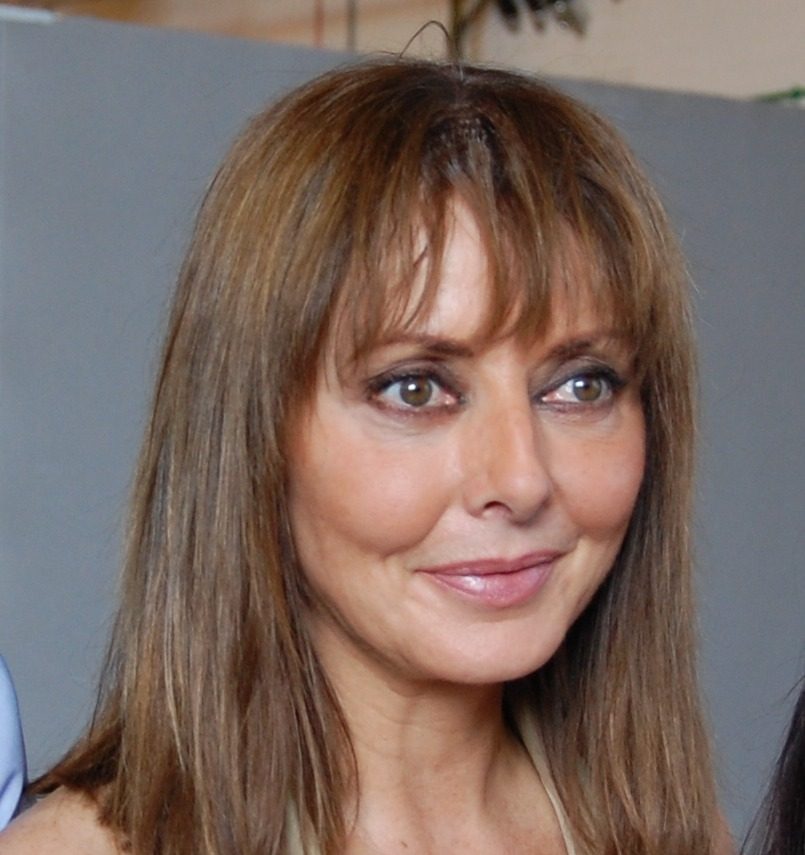
TV presenter and commentator to appear at Cardiff event aimed at mobilising anti-Reform voters before May 7
CAROL VODERMAN has urged voters in Wales to reject Reform UK at next month’s Senedd election, as she prepares to appear at a live political event in Cardiff focused on keeping the party out of power.
Speaking ahead of an emergency Guilty Feminist Welsh Election Special at the New Theatre, Cardiff, on Sunday, April 12, Vorderman said Wales faced a crucial choice at the ballot box.
She said: “Wales has a chance for a new beginning in May. But Reform, the chaotic London-based, privately educated, failed Tory party, needs to be sent packing.
“Already numerous of their 96 Welsh candidates have resigned or been sacked for revolting actions. Their last Welsh Reform leader Nathan Gill is serving time in jail for accepting Russian bribes while serving in the European Parliament. Their new Welsh leader was a Tory living in London until a few months ago.
“Farage is a thin-skinned and proven liar. Everyone must come out to vote to save our country. Cymru Am Byth.”

Vorderman is due to appear alongside Guilty Feminist host Deborah Frances-White, with Welsh comedians Kiri Pritchard-McLean and Priya Hall also on the bill. Organisers say the night will mix comedy, music and political discussion, with the aim of building strategy ahead of the election.
Frances-White said polling suggested the Senedd result could be close and argued that “it really matters who ends up making decisions about our lives”, adding that the event was intended as a “get-in-the-room” night to work out how to respond.
Reform UK’s current leader in Wales is Dan Thomas, who was unveiled by Nigel Farage in Newport in February. Thomas is a former Conservative leader of Barnet Council in London, although he grew up in Blackwood.
Vorderman’s reference to Nathan Gill points to a highly embarrassing chapter in the party’s recent history. Gill, a former Reform UK politician and ex-MEP, was jailed last year after admitting taking bribes from pro-Russian figures in exchange for speeches and statements in the European Parliament.

Asked for a response to Vorderman’s remarks, a Reform UK Wales source replied briefly: “Does she even live in Wales?”
It was a short answer, but perhaps not one likely to end the argument. With the campaign heating up, and with high-profile voices now piling in from outside formal party politics, the battle for attention ahead of May 7 is only getting louder.


ANYONE who hosts paying guests in Wales will soon be required by law to register their visitor accommodation with the Welsh Revenue Authority (WRA).
The new legal requirement will apply to all paid visitor accommodation across Wales, including spare rooms, holiday cottages, cabins, campsites and hotels. Registration will be required whether accommodation is let for a single night, occasionally, seasonally or all year round.
The register is being introduced to give a clearer picture of the visitor accommodation available in Wales and to support councils that decide to introduce the Visitor Levy. Registration will open in October 2026, and both informal hosts and professional accommodation providers will be required to comply or risk facing penalties.
Accommodation providers can prepare now by visiting gov.wales/registeryourplace to find out what information they will need and sign up for updates and reminders. Registration is free for providers and is expected to take less than 15 minutes to complete.
When registration opens, accommodation providers will be asked to provide information, including:
• contact details
• accommodation address
• type of accommodation
• how many people can stay
• when the accommodation is usually open for bookings
Who needs to register?
Any individual or business that takes bookings for overnight accommodation must register by law.
This includes:
• self-catering accommodation and homestays, including on Airbnb or similar
• hotels, guesthouses or bed and breakfasts
• campsites or camping pitches
• hostels or bunkhouses
• caravans, chalets, lodges, shepherd’s huts or glamping
• temporary accommodation for events, including festivals
Rebecca Godfrey, Welsh Revenue Authority Chief Executive, said: “If you take bookings for overnight stays in Wales, you’ll need to register with us. We want to make this process as straightforward as possible, and we’re here to support accommodation providers to register correctly and on time.

“We’ll be publishing further guidance before registration opens in October 2026. In the meantime, I’d encourage providers to visit gov.wales/registeryourplace to find out what to expect and sign up for updates.”





Crime2 days ago
Driver spared jail after crash killed young couple
A PEMBROKE DOCK driver who caused the deaths of a young couple in a road crash has been given a...


Entertainment2 days ago
BBC unveils major new Welsh dramas with Tenby set for prime-time spotlight
New crime series Old Town Murders and supernatural thriller The Witch Farm will both be filmed and set in Wales...


Health2 days ago
No jobs for new paramedics in Wales as graduates told to apply for technician roles
Students trained at public expense urged to take lower-grade jobs as anger grows over NHS workforce planning NEWLY qualified paramedics...


News3 days ago
Health minister refuses to act on Withybush despite 15,000-signature petition
Senedd pressure grows as Welsh Government declines to intervene over surgery fears THE WELSH GOVERNMENT has refused to step in...


Business3 days ago
Fishguard to Wexford rail tunnel plan backed by Elon Musk firm
Six-hour London to Dublin service proposed in £32bn project ahead of Senedd election PLANS for a rail tunnel linking west...

Charity4 days ago
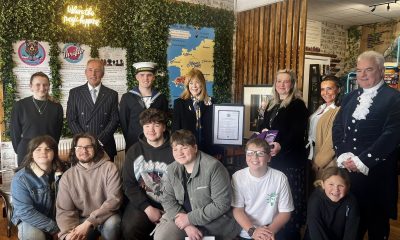
Milford Haven charity honoured with King’s Award for voluntary service
A PEMBROKESHIRE charity supporting vulnerable young people has received one of the highest honours in the UK for voluntary work....

News5 days ago
Plaid Cymru launches bid to lead next Welsh Government
Party positions itself as ‘government-in-waiting’ ahead of May election PLAID CYMRU has formally launched its campaign for the 2026 Senedd...


Crime5 days ago
Police appeal after attempted child abduction in Haverfordwest
DYFED-POWYS POLICE has launched an appeal for witnesses following a reported attempted abduction of a 12-year-old girl in Haverfordwest. The...


Crime6 days ago
Gunshot fired by police during incident in Milford Haven
A POLICE officer discharged a firearm during an incident in Milford Haven on Saturday evening (March 28), prompting an investigation...


Community7 days ago
Three Amigos Easter Run roars through Pembrokeshire
MOTORCYCLE enthusiasts turned out in force today (Saturday, March 28) as the popular Three Amigos Easter Run returned to the...
-

 News22 hours ago
Accommodation providers in Wales will be required to register under new law
-
Business3 days ago
Fishguard to Wexford rail tunnel plan backed by Elon Musk firm
-
Entertainment2 days ago
BBC unveils major new Welsh dramas with Tenby set for prime-time spotlight
-

 Charity5 days ago
RSPCA calls for stronger animal welfare measures as Welsh Labour launches manifesto
-

 Community7 days ago
Residents return home after major Carmarthenshire fire as probe continues
-

 News7 days ago
West Wales man remanded in custody over serious sexual assault charge
-

 Entertainment1 day ago
From Milford Haven to the world: The story of The Evolution Experience
-
Crime6 days ago
Gunshot fired by police during incident in Milford Haven
tomos
August 2, 2014 at 10:39 pm
As far as I’m concerned If you’re not against this disgusting illegal behaviour then you are for it and are as guilty as Mik Smith
Morlais
August 8, 2014 at 12:33 pm
Was he a freemason? could explain it 🙁
Morlais
August 8, 2014 at 12:35 pm
Mr Smith I mean