


News
Swansea Crown Court continues to consider if Lily Sullivan’s murder was sexually motivated


THE MAN who murdered an 18-year-old on a night out and left her body in a reservoir confessed to his girlfriend “I’ve strangled somebody”, a court has heard.
Lewis Haines killed Lily Sullivan after meeting her at Out nightclub, formerly known as Paddles nightclub, in Pembroke, south-west Wales, on December 16 last year.
The 31-year-old admits murdering Ms Sullivan, but denies it was sexually motivated.
A trial of facts is being held at Swansea Crown Court to determine whether there was a sexual element to the killing before Haines can be sentenced.

He could face a life sentence with a minimum term of 30 years if Judge Paul Thomas finds the killing was sexual, compared with a minimum term of 15 years if he does not.

The court heard how Ms Sullivan was discovered face down in Mill Pond, a two-mile long fresh water reservoir near the town.
She had been strangled and was no longer wearing the cream lace crop top she had been pictured in that night.
Just hours before, she had been seen partying with friends in the club where she had met Haines through their mutual friend Charlene Jones.

In a statement read to the court, Ms Jones said: “I could tell he was trying to chat Lily up. He was buying her drinks and standing close to her.
“He was being very flirtatious with her. I think he wanted to have sex with her.”
After the club closed, Ms Jones said she saw Haines and Ms Sullivan walk away down the street together and shouted: “You’ve got a girlfriend and a baby at home. She’s only 18.”
CCTV footage shows Haines and Ms Sullivan ended up in Morgans Way, an alleyway leading to Mill Pond.
William Hughes QC, prosecuting, said “a substantial part of the incident” must have taken place there because it was the location where Ms Sullivan’s phone and Haines’ baseball cap were later found.

Two people living nearby the alleyway said they heard a man and woman arguing in the early hours of the morning, with one witness saying she heard a woman scream.
During this time, Ms Sullivan’s mother Anna – who was supposed to pick her daughter and friend Lara Wood up at 2am – was becoming concerned.
She eventually spoke to Ms Wood who told her she was no longer with Ms Sullivan.
After dozens of calls and text messages to her daughter, Ms Sullivan answered the phone and told her mother she would meet her at a nearby garage, but she never arrived.
She last spoke to her daughter just before 3am when Ms Sullivan answered the phone again and said she was just “minutes away”.

The phone call was cut off mid-sentence.
Sometime later Ms Sullivan’s mother said she saw a man walking casually past her car swinging his arms before his behaviour changed and he began wringing his hands, shaking his head and running across the road.
Mr Hughes told the court on Monday: “While she’d not seen him before, her description of the man is similar to Lewis Haines.
“The prosecution believe the person Anna Sullivan saw was her daughter’s killer.”
Haines arrived home at 3.40am and told his girlfriend Maisie John: “I’ve strangled somebody. They’re in Mill Pond.”
Ms John said Haines’ jeans were damp and he had blood on his arms.
She said he was “hysterical” and repeatedly asked to be taken to his mother’s house.
Admitting to her while in the car: “I think she’s dead.”
He later told his mother that Ms Sullivan had called him a rapist and hit him, and that he had strangled her, hit her and pushed her into the water.
Haines claimed to have tried to pull Ms Sullivan out of the water but said she was a “dead weight”.
Ms Sullivan was declared dead at 6.02am despite paramedics’ attempts to revive her.
A post-mortem examination revealed she had bruising to her face and had been strangled, but there was no evidence she had been sexually assaulted.
Central to understanding whether the crime was sexually motivated or not is when Ms Sullivan’s top was removed, the court was told.
The prosecution believe the bralette was removed while Ms Sullivan was on land.
Defence barrister John Hipkin QC said when the item arrived at the laboratory, it was noted as being “slightly damp”.
Crime scene investigator for Dyfed-Powys Police Alexander Morgan confirmed the top was dry when he recovered it, but said it was a cold day and he was wearing two pairs of gloves.
Haines, a father-of-one, of Flemish Court, Lamphey, previously denied murdering Ms Sullivan but pleaded guilty a week before his trial was due to begin.
On Tuesday (Aug 23) the court heard that on the white top Lily was wearing that was found by the Millpond, Mr Hipkins QC said there is absolutely no evidence to suggest it was forcibly removed.
It was explained that the area the top was located is an unlikely area for any sexual misconduct to have taken place.
Mr Hipkins QC said that the defendant did get into the water to try get Lily out, and the cutting off of the phone call at 2.47am does not assist the court in identifying whether any sexual misconduct was committed during the murder.
Prosecuting solicitor William Hughes QC summed up the prosecution’s case by saying there are several different strands in the case which suggest Haines was sexually motivated.
He highlighted two witness statements that had formed the views Haines had shown sexual interest in Lily on the night, and that he was warned off Lily more than once, including that he had a child and reminding him of the age difference between the pair.
Mr Hughes QC said that up to a point Lily was also prepared to have a degree of intermate contact, and in addition, Haines had admitted kissing Lily in the nightclub. Haines also accepts he kissed Lily down the lane.
In CCTV footage between 1.25am and 1.55am in Main Street there is a doorway to which Lily and Haines ‘absconded’ and it is not unreasonable to say there was some form of intimacy happening at that point.
Prosecution highlighted the evidence of Dyfed-Powys crime scene investigator Alex Morgan who found Lily’s jacket and Haines’ jacket in the alleyway, which were all dry. Prosecution argued that these clothes must have been removed in that location and that it was indicative some sexual activity increased in intensity at that point.
Mr Hughes QC said the actions to leave OUT nightclub, formally Paddles, towards the Millpond, were sexually motivated.
Judge Paul Thomas QC: “Two adults have been drinking, go off together down a dark secluded lane, they spend some time in a doorway together and they spend a long period of time down the alleyway.”
THE CASE CONTINUES















NEW NHS funding must be matched by proper workforce planning if it is to cut waiting lists and improve patient care, nursing leaders have warned.
The Royal College of Nursing Wales has responded to a Welsh Government announcement of an additional £145 million investment in NHS Wales.
The package includes £100 million in revenue funding to reduce waiting times, £25 million capital funding for new surgical and diagnostic hubs, and £20 million for essential maintenance across the NHS estate.
The Welsh Government says the investment is intended to increase capacity, speed up diagnosis and help more patients receive planned treatment more quickly.
Up to ten surgical and diagnostic hubs are expected to be developed across Wales over the next four years. These facilities are designed to carry out high-volume planned treatment and tests away from the day-to-day pressure of emergency hospital care.
But RCN Wales said the success of the plan would depend not only on buildings and equipment, but on having enough trained staff to run the services safely.
Nicola Williams, Executive Director of RCN Wales, said: “RCN Wales welcomes this additional investment in NHS Wales and the Welsh Government’s commitment to reducing waiting times and improving patient care and outcomes.
“Investment in surgical and diagnostic hubs, alongside funding for essential maintenance, has the potential to significantly improve our population’s health, reduce delays, improve experiences and increase NHS capacity.
“However, buildings and equipment alone will not reduce waiting lists. Delivering sustainable improvements depends on having the right, appropriately trained and skilled workforce in place, and nurses will play a pivotal role in the provision of safe, effective and efficient care.”
She said robust workforce modelling and planning would be “critically important” if the hubs were to achieve their ambitions.
The announcement comes as RCN Wales joins healthcare leaders, employers and government representatives at a Graduate Summit to discuss employment opportunities for this year’s nursing graduates.
RCN Wales said it welcomed the Welsh Government’s focus on the issue, but warned that newly qualified nurses had faced uncertainty about securing permanent employment despite continuing pressure across NHS services.

Ms Williams said: “Nursing staff are telling us consistently and across Wales that, despite there being no vacancies, there is insufficient staff to meet increasing patient complexity and demand.
“Nurses are going without breaks and feel most shifts that they are unable to give the care that patients need.
“It is therefore deeply concerning that newly qualified nurses have faced uncertainty about securing substantive employment.
“Wales cannot afford to lose the talent, skills and commitment of a generation of nursing graduates that our health and care services desperately need.”
RCN Wales said retaining newly qualified nurses was essential for the future sustainability of NHS and social care services.
The union also welcomed the Welsh Government’s commitment to strengthening primary and community care, but said any shift towards treating people closer to home must be matched by investment in the nursing workforce.
Ms Williams added: “Nurses are central to delivering care closer to home and helping people stay healthier for longer.
“Any shift in resources towards primary care must be matched by investment in the nursing workforce needed to deliver these ambitions.”
The key question for west Wales is whether any of the proposed surgical or diagnostic hubs will be located in the Hywel Dda area, and whether Pembrokeshire patients will see a direct benefit from the new funding.
No specific locations have yet been confirmed.
RCN Wales said it looked forward to working with the Welsh Government and health service partners to ensure the investment delivered lasting improvements for patients and supported the nursing workforce on which those improvements depend.

Party calls for UK to rejoin Single Market as Brexit anniversary approaches
THE LIBERAL DEMOCRATS have called for Britain to rebuild closer links with Europe, saying a return to the Single Market and Customs Union could help businesses, exporters and major energy projects in Pembrokeshire.
The party says its proposed “Growth and Defence Partnership” with the European Union would cut trade barriers, strengthen national security and help repair what it describes as the economic damage caused by Brexit.
The announcement comes ahead of the tenth anniversary of the 2016 referendum, which saw the UK vote to leave the EU.
For Pembrokeshire, the debate has particular relevance. The county’s economy is closely tied to agriculture, food production, tourism, ports, energy and international trade. Businesses exporting goods into Europe have faced additional paperwork and costs since Brexit, while major projects around Milford Haven, the Celtic Freeport and offshore wind are expected to depend heavily on international investment and cooperation.
Liberal Democrat leader Sir Ed Davey is expected to use a speech to the European Movement to call for immediate talks with the EU on a new deal.
The party wants the UK to join the Single Market through the European Economic Area, alongside countries such as Norway, Iceland and Liechtenstein. It is also calling for a new customs union with the EU.
The Liberal Democrats say this would remove many of the barriers currently faced by businesses trading with Europe.
Welsh Liberal Democrat Westminster spokesperson David Chadwick MP said Wales had been badly affected by Brexit.
He said: “Wales was one of the hardest hit parts of the UK by the failed Brexit experiment that was masterminded by the likes of Nigel Farage and Boris Johnson.
“We shouldn’t have to live with the bad deal they’ve lumped us with. People deserve far better than that.
“That’s why we are calling for a bold new deal with Europe to boost growth, create jobs and keep our country safe.”
The party is also calling for closer defence cooperation with European allies, including a new European Security Council and greater joint procurement.
Sir Ed is expected to argue that the threat from Vladimir Putin’s Russia, together with uncertainty over American foreign policy under Donald Trump, makes closer UK-European defence cooperation essential.
The proposals are likely to reopen political arguments over Brexit. Labour has so far ruled out rejoining the Single Market or Customs Union, while the Conservatives and Reform UK remain opposed to reversing Brexit.
But the Liberal Democrats say the economic case for closer European ties is now impossible to ignore.
For Pembrokeshire, the question is not only ideological. Farmers, food producers, hauliers, tourism businesses, port operators and energy companies all depend on smooth trading links, investment confidence and international cooperation.
Ten years after the referendum, the party says Britain must stop treating closer European cooperation as a taboo and start focusing on what would help communities, businesses and public services.

A PEMBROKESHIRE-made feature film is to receive its big-screen premiere next month in the very harbour where much of it was shot.
Near and Distant Things, written and directed by Saundersfoot filmmaker Emily Batty, will be shown outdoors at Saundersfoot Harbour on Saturday, July 18, as part of the Torch Theatre’s Sunset Cinema series.
The drama, filmed in summer 2025, tells the story of a grieving fisherman trying to support his daughter after she returns home, while experiencing dreamlike visions of his late wife.
The film makes strong use of the Saundersfoot landscape, with scenes filmed at the harbour, The Royal Oak pub, Monkstone Point and other familiar local locations.
Emily, 22, who grew up in Saundersfoot and recently graduated from the University of Oxford with a geography degree, has described the project as “a love letter to home”.
She said: “Watching a film set in Saundersfoot, with recognisable faces and locations on screen, in the heart of the harbour itself where we filmed many scenes, feels incredibly full-circle.

“I can’t wait to share that experience with people.”
The film was made with the support of a small team and a largely local cast and crew.
Emily said the production had only been possible because of the “incredible amount of local support” received during filming.
She also praised composer and sound designer Zach Worthington, whose work helped shape the atmosphere of the film.
She said: “The score and soundtrack feel so entangled with the landscape of home.
“It’s a little bit folk, a little bit Celtic, and rather emotional.”

Emily, who has written and directed the film under the name Emily Florence, said some of the ideas behind the film had been with her for several years.

She said: “Some of the images within the film have been in my head since I was 18.”
She added that Pembrokeshire remains a major source of inspiration for her future work.
“I have a couple of screenplays in the works – I never stop writing – and I’m looking to get agented,” she said.
“I’m excited to continue to tell stories, in whatever capacity that may be.
“I can say that Pembrokeshire is still my muse, and I don’t think I’m done telling stories about home.”
The outdoor screening will take place on the harbour decking, with gates opening at 6:00pm and the film beginning at 7:00pm.
The film is rated PG, but includes themes of bereavement, mental health, domestic abuse and references to suicide which some viewers may find upsetting.
Emily said she hoped the premiere would be a moment of shared pride for the village.
She said: “So many people helped bring this film to life.
“There’s something very special about sharing a story set in Saundersfoot, surrounded by the landscape that inspired it.”
Tickets are available through the Torch Theatre website, with advance booking recommended.



News9 hours ago
Brexit at 10: How Britain was sold a dream that cost us dearly
A decade after the referendum, the promised benefits remain hard to find while the economic costs are increasingly difficult to...


Crime11 hours ago
Worcestershire man jailed after violent attack on woman in Tenby
Defendant was already serving a suspended sentence when serious assault took place A WORCESTERSHIRE man has been jailed for more...


Climate13 hours ago
Offshore wind ‘could bring new generation of jobs to Milford Haven’
Pembrokeshire ports and Celtic Sea projects placed at centre of Wales’ green energy ambitions MILFORD HAVEN and Pembroke Dock could...


Community1 day ago
Police officer hailed hero after midnight sea rescue in Milford Haven
PC swam 100 metres offshore to save distressed woman heard calling for help in darkness A DYFED-POWYS POLICE officer has...


Local Government2 days ago
Security privately arranged by Mayor at Beating of the Bounds
HAVERFORDWEST TOWN COUNCIL has confirmed that security personnel seen at this year’s Beating of the Bounds were privately arranged and...


Business3 days ago
Celtic Freeport five-year plan puts Milford Haven at centre of green energy future
Strategy promises investment, skilled jobs and new supply chains, but major barriers remain over grid connections, planning and delivery THE...


Education3 days ago
Closure of Ysgol Clydau approved after emotional council debate
COUNCILLORS WARNED RURAL COMMUNITIES WILL REMEMBER DECISION PEMBROKESHIRE councillors have voted to close Ysgol Clydau following an emotional debate over...


Education3 days ago
Manorbier school closure process to continue after narrow council vote
Questions remain over insurance, rebuilding costs and possible legal action by Diocese PEMBROKESHIRE councillors have voted to press ahead with...

Community3 days ago
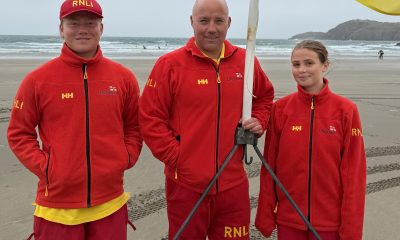
The father, son and daughter lifeguard trio saving lives in Pembrokeshire
A FATHER, son and daughter are preparing to help keep beachgoers safe on the Pembrokeshire coast this summer as part...


Charity3 days ago
Children turn to Childline as loneliness cases rise
CHILDREN and young people struggling with loneliness are increasingly turning to Childline for support, new figures show. The NSPCC-run service...
-

 Community3 days ago
Pembrokeshire Chess Club crowned Welsh champions
-
Local Government2 days ago
Security privately arranged by Mayor at Beating of the Bounds
-

 Crime7 days ago
Pembroke Dock teenager sentenced over train strangulation attack
-

 Education5 days ago
Diocese threatens legal action as Manorbier school closure battle intensifies
-

 Crime7 days ago
Man accused of six rapes including alleged Haverfordwest offence
-

 Crime1 day ago
Man wanted by court after failing to attend hearing over alleged shop thefts
-

 Local Government6 days ago
Taxi suspended after county-wide licensing checks
-

 Crime7 days ago
Brothers found guilty of causing death of Welsh dad in ‘reckless’ race