


News
Initiative in place to curb the sale of fake goods on local social media groups


EFFORTS to protect local consumers and small businesses from the harm caused by the growing trade in fake goods on local social media buying-and-selling groups are being boosted thanks to an important initiative.
The Real Deal Online programme is a national initiative that makes sure social media buying-and selling groups are not promoting the sale of counterfeit goods and other illicit products. It encourages closer working relationships between the groups and their local Trading Standards service.
During the run up to Christmas Trading Standards across Wales supported by the National Markets Group, Intellectual Property Office and National Trading Standards eCrime Team will be identifying buying-and-selling groups in Wales that are operating on social media. Contact will be made with administrators of the groups to make them aware of their legal responsibilities and to invite them to follow the Real Deal Online Code of Practice.
The Code of Practice requires group administrators to welcome officers of Trading Standards as members of the group and to agree to five simple steps:
1. To prohibit the sale of counterfeit and other illicit goods;

2. To act on information from IP rights owners and their representatives who highlight the sale of illegal goods;
3. To notify trading standards if they believe that illegal goods are being sold within the group and to exclude the sellers of these goods;
4. To highlight warnings and advice notices posted by trading standards;
5. To make sure that all members of the group are aware of its fake-free policy.

Selling groups that agree to follow the Real Deal Code of Practice will be allowed to display the Real Deal logo which will act as a visual assurance to shoppers and to traders that it is a fake-free shopping zone.
The new initiative is a natural extension of the Real Deal campaign which has been in place at physical markets and car boot fairs since 2009 and has seen over 500 markets across the UK sign-up to the voluntary Real Deal Charter to prevent the sale of fake goods. The campaign has been so successful that it has now been extended into the digital arena of online and social media marketplaces and is being rolled out by local authority Trading Standards Services across the UK.
It is vital that any illicit traders, who thinks they can make easy money by ripping off consumers with illegal, sub-standard, often dangerous counterfeits, are deterred at the earliest stage.

Judith Parry, Chair of Trading Standards Wales, said: “This programme demonstrates that Trading Standards are engaged in seeking out those who advertise fake goods on social media sites and will take appropriate action against them. Neither the internet nor social media offer an easy hiding place for those who attempt to trade illegally.
“Trading Standards services within Wales carry out excellent work to protect consumers and support traders. I hope that anyone running a buying-selling group across social media, will be motivated to engage in this project, and seek advice from Trading Standards to enable them to run their buying-selling group legally and responsibly.
“Adopting the Real Deal Code of Practice and displaying the logo provides reassurance for group members that it is a safe place to buy and sell. It also enables the administrator of a group to send a strong ‘keep out’ message to those seeking to use that group to sell counterfeit products and who clearly have no scruples about ripping off consumers, selling unsafe products or damaging local businesses.”
Gavin Terry, Chair of the National Markets Group for IP Protection, said: “Online and social media marketplaces are a growing phenomenon, offering many economic and social benefits. Just like markets and car boot fairs in the physical world, local buy-sell groups on social media platforms can provide great bargains and a friendly, lively environment for individuals to trade with each other. However, as online and social media marketplaces are not uniformly regulated, they can offer easy opportunities for those who wish to stay below the radar and trade illegally, particularly in counterfeits and copyright infringing products.
“When illicit traders move into a local selling group, a whole host of problems follow. Consumers are ripped off and sold inferior, potentially dangerous goods; revenue is lost from the economy to the black market; and often the trade in fakes is linked to the funding of organised crime.”
Mike Andrews, National Co-ordinator of the National Trading Standards eCrime Team, said: “Most shoppers and the administrators of buy-sell groups would be horrified to think that they may, unwittingly, be funding organised crime. And many administrators are not aware that, ultimately, they could be held responsible for allowing illegal products to be advertised by members of their group. The Real Deal Online programme is designed to help. It offers anyone running a local selling group the opportunity to work closely with participating Trading Standards Services who will help them to introduce procedures to deter illicit traders from joining the group and causing harm.”
Anyone running a buy-sell group in their area, who wishes to sign-up to the Real Deal Online Code of Practice, should contact their local Trading Standards Service.
More information on the Real Deal campaign is at www.realdealmarkets.co.uk


Church says council could face judicial review over fire-hit school
A BITTER row over the future of Manorbier Church in Wales VC School has escalated dramatically, with the St Davids Diocese threatening legal action against Pembrokeshire County Council over plans to close the fire-damaged village school.
In an extraordinary intervention ahead of a Cabinet meeting on Monday (Jun 15), solicitors acting for the St Davids Diocesan Board of Finance (DBF) accused the council of running a “procedurally flawed” consultation and warned that councillors risk judicial review if they press ahead with proposals to discontinue the school.
The legal letter, sent by Carreg Law and marked “urgent”, claims the council is using the closure process to avoid responsibility for rebuilding the school following the devastating fire in October 2022.
The future of the school has been hanging in the balance since the blaze forced pupils to relocate to temporary accommodation at Jameston Community Hall.
Legal warning to council
The Diocese, in a letter from Bishop Dorrien Davies, has formally objected to the proposed closure and says the school should instead be fully reinstated.
Lawyers acting for the Church claim the council has failed to respond adequately to previous correspondence dating back to 2023 and warned that Pembrokeshire County Council could face legal claims arising from the handling of the fire and its aftermath.
The letter states: “Our client formally objects to the proposed closure, demands full structural reinstatement of the school premises and places Pembrokeshire County Council on notice that the statutory consultation on the proposed closure and decision-making process undertaken to date is procedurally flawed.”
The Diocese argues that the council has a statutory duty to maintain the school and says any insurance money arising from the fire should be used to restore the building to its pre-fire condition.
It also alleges the council’s actions have left the Diocese exposed to mounting costs because the school remains structurally compromised.
Claims of ‘pre-determination’
The legal challenge goes further, alleging the closure process was effectively decided before the consultation had finished.
Lawyers claim council human resources staff began redundancy consultations with school staff in February 2026, before elected members had formally decided the school’s future.
According to the Diocese, this suggests the public consultation was “a perfunctory exercise rather than a genuine consideration of alternatives”.

The Diocese also accuses the authority of withholding key financial information relating to rebuilding costs, despite repeated requests.
Community opposition highlighted
The intervention comes after council consultation figures showed overwhelming opposition to closure.
Of 252 responses received, more than ninety per cent opposed plans to shut the school.
Parents and campaigners have consistently argued that Manorbier School provides a nurturing environment for children, particularly those requiring additional support, and warned that closure would damage the wider community.
The issue sparked protests outside County Hall in Haverfordwest when councillors met on Thursday (Mar 5) to consider the proposal.
Demonstrators held placards urging the council to save the school, with many arguing that promises had been made to rebuild after the fire.
Church accuses council of discrimination
In one of the strongest claims contained in the letter, the Diocese alleges Pembrokeshire County Council is showing hostility toward Church in Wales education.
The DBF argues that the proposed closure of Manorbier, alongside separate issues affecting other faith schools, demonstrates what it describes as a “systemic pattern” of undermining faith-based education in Pembrokeshire.
Lawyers claim this could amount to discrimination under the Equality Act 2010 because religion and belief are protected characteristics.
The letter also criticises the council for allegedly failing to engage properly with the Diocese over the future of the site and says decisions should not be made without a full understanding of legal and financial liabilities.
Judicial review threat
The Diocese has urged Cabinet to halt the closure proposal and instead enter into negotiations over restoring the school building.
However, if councillors proceed with plans to discontinue the school, the Church says it is prepared to seek judicial review.
The letter warns: “Should the Cabinet proceed to ratify the statutory proposal to discontinue the school on what we say are illegal and discriminatory grounds, our client reserves its rights to pursue all available legal remedies including but not limited to an application for Judicial Review.”
Council officers have previously recommended moving forward with a statutory notice to discontinue the school, arguing that closure is the most sustainable option based on falling pupil numbers, spare capacity at nearby schools, the condition of the building and value for money.
But with legal action now looming, the battle over the future of Manorbier School appears far from over.
UPDATE:
Late on Friday (Jun 12), councillors were sent a further letter from the Diocese of St Davids urging them to think carefully before Monday’s vote. The Church questioned whether a required Community Impact Assessment had been properly undertaken or disclosed, argued Manorbier’s educational standards could not fairly be criticised following a positive Estyn report in 2023, and warned members to ensure they had been given ‘accurate and full information’ before making a decision. The letter also referenced Pembrokeshire County Council’s recent High Court defeat over its Article 4 direction, where judges found councillors had been presented with flawed and incomplete information

Seven candidates confirmed for Market ward by-election following death of long-serving councillor Brian Hall
AN INTENSIVE CARE nurse from Pembroke Dock has been selected as Plaid Cymru’s candidate in a seven-way contest for a vacant seat on Pembrokeshire County Council following the death of long-serving councillor Brian Hall.
Chloe Richards, who works as a Clinical Practice Educator in the Intensive Care Unit at Withybush Hospital, will contest the Pembroke Dock: Market by-election on Thursday (Jul 9).
Richards lives in the ward and volunteers to encourage young people into nursing careers. She is also a trade union representative with the Royal College of Nursing Wales and sits on the organisation’s national steering committee for critical care.
Speaking after her selection, Richards said she was proud to stand for Plaid Cymru and paid tribute to the late Brian Hall, who had represented the community since 1996.
She said: “I am proud to stand as a Plaid Cymru candidate for the Pembroke Dock: Market by-election. I have lived in the ward since I was a teenager and know the community and its people well.
“Unfortunately, this election comes at a sad time. I would like to pay tribute to Brian Hall, who served this community as a dedicated County Councillor since 1996.
“As a nurse and as an active member of the Royal College of Nursing, I have learned how to represent people, campaign for change, and speak confidently on behalf of others. These are exactly the skills I will use to serve Pembroke Dock on Pembrokeshire County Council. I am committed to making a real difference to our community.”
Ceredigion Penfro MS Elin Jones backed Richards’ candidacy, saying: “Chloe is an excellent candidate for Pembroke Dock: Market. She already represents her colleagues in the nursing sector at a national level, and she is determined to be a strong voice for residents in the ward where she lives.”
Richards joins a crowded field of candidates contesting the by-election.
The full list of candidates published following the close of nominations is:
Paul Haywood Dowson – Independent
Claire Francis-Boswell – Independent
Lee Herring – Welsh Liberal Democrats
Ryan Morgan – Reform UK
Chloe Louise Richards – Plaid Cymru
Jamie Street – Welsh Conservative
Hayley Wood – Independent
The seat became vacant following the death of Councillor Brian Hall in April. Hall had served as county councillor for the ward for almost 30 years and was widely respected across the political divide.

Applications to register to vote must be received by midnight on Monday (Jun 23). Postal vote applications must be submitted by 5:00pm on Tuesday (Jun 24), while applications to vote by proxy must be received by 5:00pm on Wednesday (Jul 1).

WEST WALES HEALTH BOARD ASKED HOW MANY FAMILIES MAY BE PAYING CARE HOME FEES UNNECESSARILY
A FAMILY has been reimbursed more than £22,000 after challenging an NHS decision over care home fees paid for a woman with dementia in Carmarthenshire.
Mrs Hughes, who lived at Towy Castle Care Home in Carmarthen, had been paying around £3,400 a month for her care before her family sought legal advice over whether the NHS should have been funding it through Continuing Healthcare.
The case has raised wider questions about whether families across west Wales may be paying thousands of pounds for care which should legally fall to the NHS.

Mrs Hughes was a resident at Towy Castle Care Home from March 2012 until her death in October 2023. She suffered from dementia and was described as disorientated to time, place and person.
Her son, Mr Hughes, contacted Hugh James Solicitors in October 2023 after the family had exhausted life savings and run out of options to meet the rising cost of care.
Following an assessment, the health board initially recommended NHS Continuing Healthcare eligibility from October 10, 2023, citing a rapid deterioration in Mrs Hughes’ condition shortly before her death.
However, lawyers acting for the family argued that the evidence showed her needs had increased from January 2023, particularly because of escalating challenging behaviour linked to her dementia.
After representations were made, the health board revised its position and accepted that Mrs Hughes met the criteria for Continuing Healthcare from January 2023 to October 2023.
The estate was subsequently reimbursed for the care fees paid during that period, together with interest, totalling just over £22,000.
Continuing Healthcare
NHS Continuing Healthcare, often referred to as CHC, is a package of care arranged and funded solely by the NHS for people who are assessed as having a primary health need.
Unlike social care, it is not means-tested. This means that if someone qualifies, the NHS is responsible for meeting the full cost of their assessed care needs, including care home fees where appropriate.
However, the distinction between health needs and social care needs can be complex, particularly in cases involving dementia.

The issue comes as care costs continue to rise sharply. Healthcare analysts LaingBuisson reported this year that the average weekly fee for a frail older person had reached £1,465, a rise of 10% over the previous year.
Families are often left selling homes or using lifetime savings to meet care home bills, despite some residents potentially being eligible for NHS-funded support.

Legal challenge
Lisa Morgan, of Hugh James Solicitors, works on cases involving wrongly paid care home fees and NHS Continuing Healthcare disputes.
Her team says it has recovered more than £200m from the NHS in recent years on behalf of families who had paid for care later found to be the responsibility of the health service.
The Carmarthenshire case is being highlighted as an example of why families may need to question decisions, particularly where a relative’s condition has deteriorated or where dementia-related behaviour has become more complex.
The Herald understands that Mrs Hughes’ family accepted the revised eligibility period after the health board agreed to backdate funding to January 2023.
Health board asked
The Pembrokeshire Herald has approached Hywel Dda University Health Board for comment on the case, while recognising patient confidentiality restrictions.
The Health Board has also been asked what safeguards are in place to ensure patients who may qualify for Continuing Healthcare are identified at the earliest possible stage.
The Herald has requested figures for the number of CHC assessments carried out across Carmarthenshire, Pembrokeshire and Ceredigion in each of the last three years, including how many resulted in funding being approved, declined, or overturned on review or appeal.
The Health Board has also been asked whether it has seen an increase in applications, reviews or successful appeals involving dementia patients, and whether it has concerns that some families may be self-funding care unnecessarily because of a lack of awareness.
A response was awaited at the time of publication.
Advice to families
Families who believe a relative may qualify for NHS Continuing Healthcare can request an assessment through the NHS or local authority.
A person does not need to have a particular diagnosis to qualify. The assessment should look at the nature, intensity, complexity and unpredictability of their needs.
Where funding is refused, families can ask for the decision to be reviewed.
The case is likely to add to concern that many families are struggling to understand a complicated system while already dealing with the emotional and financial pressure of caring for a loved one.



Education17 hours ago
Diocese threatens legal action as Manorbier school closure battle intensifies
Church says council could face judicial review over fire-hit school A BITTER row over the future of Manorbier Church in...


Health19 hours ago
Baby loss charity calls for urgent action after latest Wales figures published
Sands says Welsh Government must set clearer targets to reduce stillbirths and neonatal deaths A BABY loss charity has called...

Health20 hours ago
Cancer delays worsening as west Wales hospitals struggle to recruit specialists
Health board admits standards are difficult to meet as doctors warn of “extremely dangerous” shortages PATIENTS in west Wales are...


News22 hours ago
Rhun ap Iorwerth highlights first 25 days in office as First Minister
Plaid Cymru leader says government is moving quickly on NHS, farming and economic priorities FIRST MINISTER Rhun ap Iorwerth has...


Crime2 days ago
Man accused of six rapes including alleged Haverfordwest offence
A MAN has been sent to Crown Court accused of six rapes, including an alleged offence at a Haverfordwest campsite....


News2 days ago
Childcare row erupts as Plaid faces questions over costs and delivery
Opposition parties clash over flagship pledge as Senedd debate exposes growing divisions PLAID CYMRU’S flagship promise to create what it...


Crime3 days ago
Farmers fined in bovine TB scandal face fresh court action
Hartt family members listed at Haverfordwest Magistrates’ Court over unpaid penalties linked to major cattle prosecution TWO PEMBROKESHIRE farmers convicted...


Crime3 days ago
Pembrokeshire child killer stabbed to death in prison cell, murder trial hears
Kyle Bevan, jailed for the murder of Haverfordwest toddler Lola James, was allegedly stabbed 25 times and left ‘as if...


News3 days ago
Pendine cliff fall victim recovering after major emergency response
A 22-YEAR-OLD man who suffered serious injuries after falling from cliffs overlooking Pendine Beach is recovering well following emergency surgery....


Community3 days ago
Commissioner launches free course to help tackle ageism in Wales
A NEW free learning course has been launched to help people across Wales recognise and challenge ageism. The Older People’s...
-

 Crime7 days ago
Milford Haven man admits harassment and assault
-

 News7 days ago
Community appeal for privacy after serious emergency in Pendine
-

 Crime5 days ago
Sex offender in senior role at Tenby family hotel
-
 Crime4 days ago
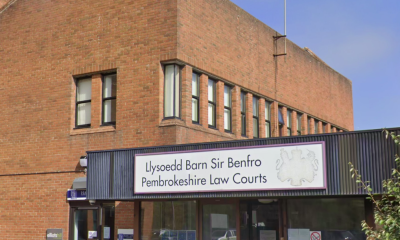
Haverfordwest pair accused of £80,000 rogue trading frauds
-

 Community5 days ago
Forgotten wartime archive found in Pembroke Dock attic after 80 years
-

 Crime4 days ago
Families condemn failed appeal by paddleboard boss jailed over Haverfordwest tragedy
-
 Crime4 days ago
Knife blankets call as school staff face rising violence fears
-

 Community7 days ago
Founders Day hailed a success despite rising costs and extra security