
News
How to Support Gifted and Talented Students in Mainstream Education


Supporting gifted and talented students in mainstream classrooms is crucial to ensure these high achievers are challenged and engaged in their educational journey. It requires thoughtful approaches and strategies that cater to their advanced learning abilities while maintaining a balanced and inclusive environment. Here are effective ways to support gifted and talented students and ensure they thrive within the mainstream education system.
1. Differentiate Instruction
Differentiated instruction is vital in meeting the diverse needs of gifted and talented students in a mainstream classroom. It involves tailoring teaching methods, resources, and learning activities to challenge and support students at varying ability levels.
- Use tiered activities: Design activities that address the same core content but vary in complexity and depth to suit different readiness levels.
- Offer choice: Students should be able to choose from various assignments or projects that match their specific interests and abilities.
- Implement compacting: Reduce the amount of introductory content the gifted students are already proficient in and replace it with more advanced materials.
- Encourage independent projects: Allow gifted students to work on independent projects that delve deeper into subjects of interest or explore new topics.
By differentiating instruction, teachers can help gifted students stay engaged and motivated and ensure they progress academically. Integrating writing services into this differentiated approach can further tailor learning experiences, allowing talented students to explore more complex topics and enhance their writing skills. If you wonder, “Who can write me an essay?” these services can offer advanced research assistance, editing, and proofreading, helping students refine and express their ideas more effectively. This support is particularly beneficial for students who seek more profound academic opportunities and can thrive with the additional resources that professional writing services provide.
2. Provide Opportunities for Enrichment
Beyond the regular curriculum, gifted and talented students often benefit from enrichment activities that allow them to explore subjects more deeply or broadly. These opportunities help maintain their enthusiasm and commitment to learning.
- Special interest clubs: Schools can offer clubs focusing on areas like science, math, literature, or history, providing an outlet for in-depth exploration.
- Advanced courses: Allow gifted students to take advanced courses or participate in higher grade-level work in their areas of strength.
- Competitions and challenges: Encourage participation in academic competitions such as debates, math leagues, or science fairs.
- Field trips and guest lectures: Organize outings and invite experts that align with gifted students’ interests to stimulate learning beyond the classroom.
Enrichment activities keep gifted students intellectually challenged and help them develop a richer, more rounded educational experience.
3. Foster Emotional and Social Development
The emotional and social development of gifted and talented students is as important as their academic growth. Due to their advanced cognitive abilities, they may experience social and emotional issues that need addressing to help them thrive.
- Social skills groups: Help gifted students interact with peers and improve their social skills.
- Counseling services: Provide access to counseling to support students who may feel isolated or stressed due to their academic abilities.
- Peer mentoring: Pair gifted students with older students who can guide them, share experiences, and offer advice.
- Emphasis on teamwork: Involve gifted students in group projects with diverse teams to enhance their collaborative skills and reduce feelings of isolation.
Supporting gifted students’ emotional and social well-being helps them develop into well-rounded individuals who can navigate the complexities of school and beyond.
4. Engage Parents and Guardians
Involving parents and guardians in the educational process is crucial for consistently supporting gifted and talented students. Effective communication between the school and home can enhance the educational strategies employed for these students.
- Regular updates: Keep parents informed about their child’s progress and any challenges they might face.
- Resource sharing: Provide parents with materials and resources that can help them support their child’s learning at home.
- Parent workshops: Offer workshops that help parents understand the needs of gifted children and how to advocate for them effectively.
- Collaborative planning: Involve parents in planning educational paths for their children, including course selections and extracurricular activities.
Engaging parents in the educational process ensures that gifted and talented students receive support at school and home, creating a cohesive framework for their development.
Summing Up
By implementing these strategies, educators can significantly enhance the educational experience for gifted and talented students within mainstream schools. These approaches address their academic needs and support their emotional and social development, ensuring a comprehensive educational support system.


Council admits demand exceeds supply as housing issues contribute to hospital discharge delays
PEMBROKESHIRE COUNTY COUNCIL has acknowledged that there is not enough suitable accessible housing in the county to meet demand, with more than 400 people currently waiting for accommodation that meets their needs.
The admission came in response to questions from The Pembrokeshire Herald about housing, health and accessibility in Pembrokeshire.
The council revealed that 403 people are currently registered on the Pembrokeshire Accessible Housing Register waiting for accessible social housing.
Of those, 81% are in the highest-priority gold band, while 62% require one-bedroom accessible accommodation.
The authority also disclosed that 111 cases are currently awaiting occupational therapy assessment through to approval of assessed works under Disabled Facilities Grants and discretionary disabled assistance grants.
The figures highlight growing pressure on housing services in a county with an ageing population and increasing demand for homes that can accommodate people with disabilities, mobility problems and long-term health conditions.
A council spokesperson said: “Within Pembrokeshire, we recognise that there are challenges around unsuitable housing, often linked with an ageing housing stock across all tenures of accommodation.
“We recognise that poor and inaccessible housing can be a contributing factor to ill health and increased demand on housing, health and social care services.”
Hospital discharge concerns
The council also confirmed that housing-related issues can affect hospital discharge planning.
Officials said there had been an increase in housing-related discharge delays in recent years, often because people leaving hospital require home adaptations or alternative accommodation that better suits their needs following changes in their health or mobility.
The spokesperson said: “There are concerns related to housing-related delays which impact hospital discharge planning locally.
“There has been an increase in housing related delays due to a range of factors, including the need for suitable accommodation following changes in an individual’s health or functioning, which subsequently can lead to a need for home adaptations, or alternative accessible accommodation sourced.”
The council stressed that housing-related factors still represent a relatively small proportion of overall discharge delays in Pembrokeshire.
Shortage recognised
Asked whether enough suitable housing exists locally for older residents and people with disabilities or long-term health conditions, the council accepted that current provision falls short of demand.
The spokesperson said: “Given the numbers we have on our Accessible Housing Register as well as the ageing population in the county, we acknowledge that there is insufficient suitable accessible housing to currently meet demand.”
The authority said the issue has already been identified within the Local Housing Market Assessment 2023 and the Pembrokeshire Housing Strategy 2024-2027.
Working to improve provision
The council said its Occupational Therapy Service works closely with housing providers across Pembrokeshire to assess needs and support the delivery of appropriate housing solutions, including adaptations to existing homes and the development of adapted properties.
For social housing tenants requiring adaptations, needs are assessed by occupational therapists, with work either carried out by landlords or, where necessary, alternative accommodation sought.
The authority also said that new social housing developments are designed to meet Lifetime Homes standards under Welsh Government housing requirements.
Housing and social care teams work together to help shape the type and design of new homes being developed in the county, using information from the Accessible Housing Register to identify future demand.
The comments come amid growing national concern over the impact of unsuitable housing on health, independence and demand for public services, particularly as Wales’ population continues to age.
This is a cleaner local government/housing story that stands on its own and avoids repeating the earlier Welsh Government/NHS-focused piece.

Cancer treatment targets missed again as opposition says Plaid must share responsibility for health service performance
NHS WALES is facing renewed pressure after the latest performance figures showed waiting lists rising, cancer treatment targets being missed again and more patients waiting over 12 hours in emergency departments.
The figures come as the Welsh Government announced an additional £145m for NHS Wales, including £100m to reduce waiting times and £25m for new surgical hubs.
In April, performance against the 62-day target for patients starting cancer treatment fell to 56.7%, well below the 75% target.
In Swansea Bay, just 48.4% of cancer patients began treatment within the target time.
Treatment waiting lists also increased, with 680,003 patient pathways recorded in April. The estimated number of individual patients waiting for treatment stood at 536,500.
Two-year waits rose to 3,694. In England, the comparable figure was 191.
Emergency care also came under further strain in May. The proportion of patients spending less than four hours in Welsh emergency departments fell to 64.4%, against a target of 95%.
A total of 11,066 patients waited 12 hours or more before being admitted, transferred or discharged, up from 10,287 in April. The target is zero.
Ambulance performance remained under pressure. For red calls, the median response time improved to nine minutes and 12 seconds, but the 90th percentile increased to 22 minutes and 39 seconds, meaning response time targets were still not met.
Welsh Conservative criticism
The Welsh Conservatives said the figures showed a “worrying backslide” in NHS performance and accused Plaid Cymru of sharing responsibility for the state of the health service.
Natasha Asghar MS, Welsh Conservative Shadow Cabinet Secretary for Health and Social Care, said: “These figures show a worrying backslide in NHS performance in Wales. Cancer treatment times have fallen, waiting lists have risen, two-year waits are up and more patients are being left waiting over 12 hours in emergency departments.
“Plaid Cymru cannot escape responsibility for this. They propped up the previous Welsh Labour Government by backing their budgets and are now in Government themselves. Patients across Wales need action, not more talk of improvement.
“Whilst any extra funding for the NHS is welcome, £145m will not be enough unless it is accompanied by urgent reform, a comprehensive workforce strategy and real delivery for patients.
“The Welsh Conservatives have been clear that the Welsh Government needs to declare a health emergency in our NHS. We need more beds in our hospitals, a robust NHS workforce and a serious plan to cut waiting lists and to support our emergency departments.”
Funding announced
The Welsh Government says the extra £145m will support work to reduce waiting times and improve access to treatment.
Of that, £100m has been allocated to reducing waiting lists, while £25m will be invested in new surgical hubs.
Health leaders have welcomed the additional funding, but warned that money alone will not solve the pressures facing hospitals, GP services, social care and emergency departments.
The latest figures are likely to increase pressure on ministers to show clear progress before the winter, when demand on the NHS is expected to rise further.
Welsh Government response
The Welsh Government said the figures related to April, before the new administration took office, and showed that both treatment waiting lists and the longest waits had increased.
Health and Care Minister Mabon ap Gwynfor said too many people were waiting too long for treatment, and said emergency care performance was not yet at the level patients and staff should expect.
He said: “Our focus is clear — cut waiting times, prioritise those who have been waiting the longest, improve access to services and build an NHS that can keep up with demand in the long term.
“To bring waiting times down and keep them down, we need to change the way the NHS works — making sure patients move through the system more smoothly, from their first referral all the way to treatment.
“We’ve got a plan to do this, working with the fantastic NHS staff right across Wales. The £145 million we’re announcing today will be important in tackling the waiting list and waiting times and helping people be seen quicker.”
The Welsh Government said £100m would be used to help reduce waiting lists and waiting times, £25m would be invested in new surgical and diagnostic hubs, and £20m would go towards essential maintenance across the NHS estate.
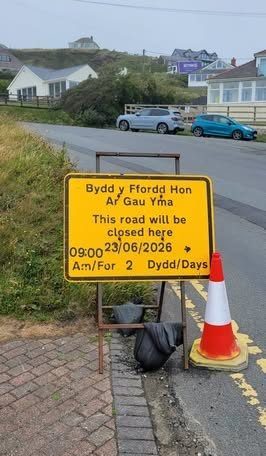
A STRETCH of road at Newgale will close for two days next week while resurfacing works are carried out.
The closure is planned for Tuesday (Jun 23) from 9:00am to 3:30pm, and Wednesday (Jun 24) from 9:00am to 4:00pm.
The affected section runs from Penycwm to just above Beachcroft bungalow in Newgale.
Traffic will be diverted via Roch Bridge and Eweston, between the Victoria Inn and Penycwm.
Businesses including the campsite, Landsker Line, Newsurf, Sands Café and the hardware shop are expected to remain open as normal. The car parks and the Welsh Road will also remain accessible, but traffic will not be able to travel up the hill towards Solva after the shop.
School buses are expected to run as normal, but the T11 service will operate to a special timetable between Haverfordwest and Roch. There will be no T11 service from Newgale to St Davids during the works. The 400 service will run as normal, but via the diversion route.
Cllr Mark Carter said he had asked for signs to be placed at Haverfordwest and St Davids, advising larger vehicles and those towing to consider using the A40 via Letterston, Mathry and St Davids instead.
An alternative route is via Crowhill, Hayscastle and Llandeloy crossroads, before rejoining the A487 at the top of Solva Hill.
Cllr Carter warned that the diversion route is likely to be busy, adding that drivers may need to reverse in places. He said the route had been cut back and overhanging branches removed.
Motorists are being urged to follow the signage and not to enter any road marked with a no-entry sign.
The closure times are a guide only, as resurfacing may take longer if the tarmac is slow to set in hot weather or if there is a mechanical breakdown.


Motorcyclist, 22, dies in A4075 crash in Pembrokeshire
A 22-year-old woman remains in hospital after two-vehicle collision A MOTORCYCLIST has died following a serious two-vehicle crash on the...


Why police will be visiting every home in Pembrokeshire
New operation aims to knock on more than 257,000 doors across Dyfed-Powys over the next three years DYFED-POWYS POLICE has...


Prisons at breaking point: MPs warn Wales is paying the price of a failing system
Frozen healthcare budgets, overcrowded jails, homelessness on release and mounting pressure on staff are undermining rehabilitation across Wales, according to...


Brexit at 10: How Britain was sold a dream that cost us dearly
A decade after the referendum, the promised benefits remain hard to find while the economic costs are increasingly difficult to...


Worcestershire man jailed after violent attack on woman in Tenby
Defendant was already serving a suspended sentence when serious assault took place A WORCESTERSHIRE man has been jailed for more...


Offshore wind ‘could bring new generation of jobs to Milford Haven’
Pembrokeshire ports and Celtic Sea projects placed at centre of Wales’ green energy ambitions MILFORD HAVEN and Pembroke Dock could...


Police officer hailed hero after midnight sea rescue in Milford Haven
PC swam 100 metres offshore to save distressed woman heard calling for help in darkness A DYFED-POWYS POLICE officer has...


Security privately arranged by Mayor at Beating of the Bounds
HAVERFORDWEST TOWN COUNCIL has confirmed that security personnel seen at this year’s Beating of the Bounds were privately arranged and...


Celtic Freeport five-year plan puts Milford Haven at centre of green energy future
Strategy promises investment, skilled jobs and new supply chains, but major barriers remain over grid connections, planning and delivery THE...


Closure of Ysgol Clydau approved after emotional council debate
COUNCILLORS WARNED RURAL COMMUNITIES WILL REMEMBER DECISION PEMBROKESHIRE councillors have voted to close Ysgol Clydau following an emotional debate over...
-

 Community4 days ago
Pembrokeshire Chess Club crowned Welsh champions
-
Local Government2 days ago
Security privately arranged by Mayor at Beating of the Bounds
-

 Crime11 hours ago
Milford Haven man jailed for breaching domestic violence protection order
-

 Education6 days ago
Diocese threatens legal action as Manorbier school closure battle intensifies
-

 Crime2 days ago
Man wanted by court after failing to attend hearing over alleged shop thefts
-

 News6 hours ago
Crash on Freeman’s Way causes school-run chaos across Haverfordwest
-

 Local Government6 days ago
Taxi suspended after county-wide licensing checks
-
 Crime2 days ago
Man banned from roads after drink-driving offence