
News
How Pembrokeshire’s beaches were used as practice for the world’s biggest invasion

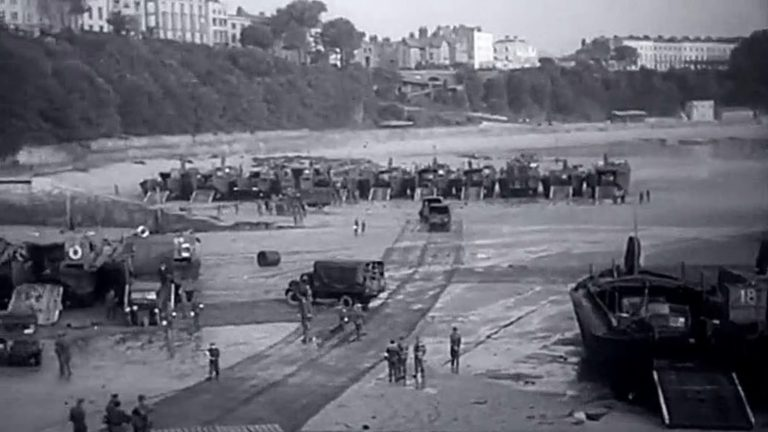
TODAY marks the 80th anniversary of D-Day, when the Allied forces landed on the beaches of Normandy, France as part of Operation Overlord; a concerted and successful attempt to liberate Europe from the grip of German occupation under Hitler.
The invasion of Normandy (codenamed Operation Neptune) was a massive amphibious assault involving 7,000 ships and 11,000 aircraft. A decoy plan, Operation Fortitude, led the Germans to believe the main target was Pas de Calais. It was a major milestone in securing victory for the allied forces.
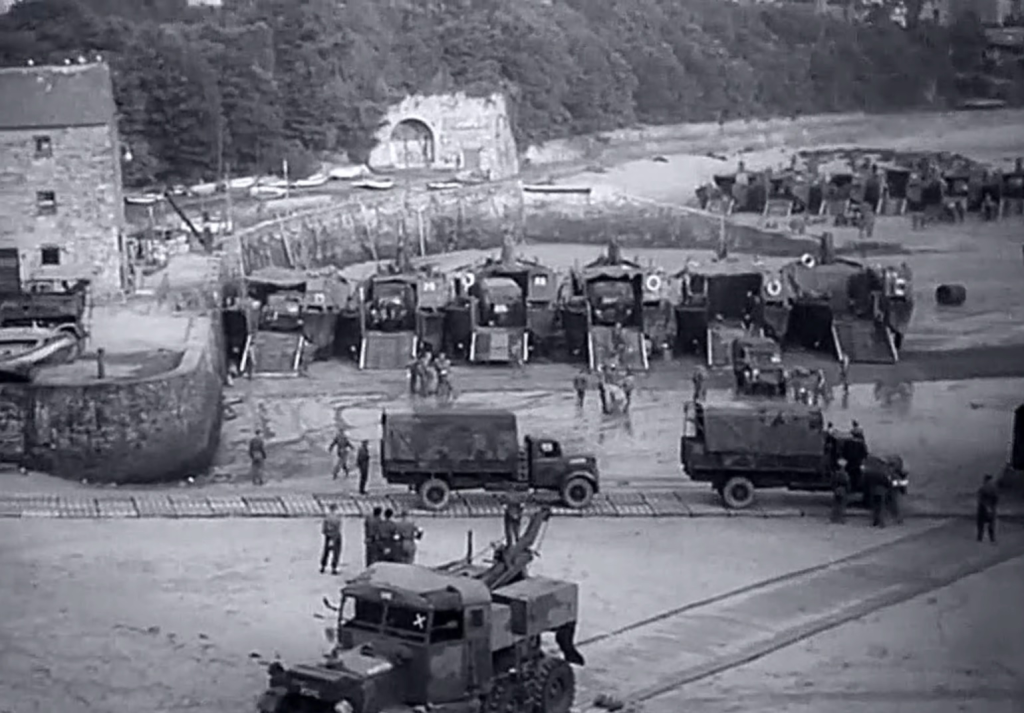
Tenby, Saundersfoot, Amroth and Laugharne had already experienced their own version of the Normandy landings – in practice form.
Our local beaches were the location for an extensive two-week-long practice, Operation Jantzen. The exercise commenced on July 22, 1943, and was, thankfully, the only land invasion of Wales during World War II.
Under the watchful eyes of Winston Churchill and Lord Mountbatten (rumour has it that Eisenhower also attended), 100,000 American, Australian, British and Canadian forces had a rare opportunity to practice every element needed for a successful attack on “Fortress Europe”, this involved the initial landings, the setting up of Headquarters and even the moving and stockpiling of vital supplies that would be needed by troops on the front line.
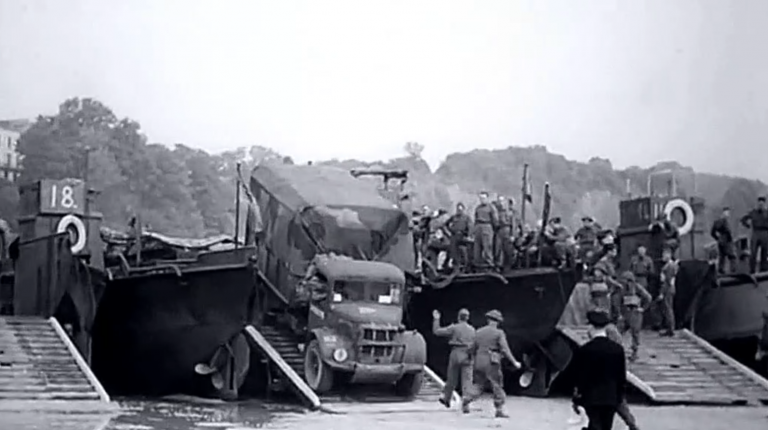
Newsreel footage clearly shows trucks somehow being driven onto flat-bottomed transports in preparation for the training excercise on Tenby Beach, a beach more commonly associated with bathing, swimming and making sandcastles.
The Regimental War Chronicles of the Oxfordshire & Buckinghamshire Light Infantry Vol3 1942-1944 records that the First Bucks Battalion had been training in Ayrshire before moving to West Wales.
The road convoy of over 200 vehicles left Ayr on the July 8, 1943, and the main body departed by train three days later. Troops disembarked at Haverfordwest station, where three-ton lorries lifted them to Picton Park.
Picton Park, consisting of Nissen huts and tents, provided an excellent concentration area and preparations for Exercise “Jantzen,” due to start on the July 17, were pressed forward.
All was ready, but the exercise was postponed owing to bad weather, and the move to the assembly area at Cresselly did not begin until July 20.
The area allotted to No. 6 Beach Group consisted of the village of Saundersfoot and its immediate hinterland. There were two small beaches and a tiny port, and the country behind the beaches was hilly and heavily wooded, with narrow country lanes.
No. 5 Beach Group had an equally difficult area some miles to the east with a steep, shingle bank at the head of the beach which made exits and entrances serious problems.
The first key plan prepared before the exercise needed little adjustment and the deployment of thousands of men and hundreds of vehicles and guns proceeded most smoothly.
Coasters and barges were loaded at Tenby and beached at Saundersfoot on a falling tide.
Stores were unloaded first to barge and then to lorry, and, when the coasters had dried out, direct to lorry. Folding boats were not used and the DUKW had still not made its appearance.
On August 5 (D+14) the exercise was closed.
A great many lessons had been learned from “Jantzen.” The organisation and training of the group were sound. The complicated deployment drill had worked smoothly although it had been shown how vulnerable any beach organisation is to deterioration in the weather.
The effort was not only limited to troop movements.
The first major supply exercise involving barges (36 in 3 flotillas), 36 coasters and other forces, took place at Tenby, South Wales in July/August 1943 in Exercise “Jantzen”.
As part of the preparation for sailing across the English Channel for the Normandy landings, “dumb” Thames River barges sailed from the south coast of England around Land’s End and across the Bristol Channel under their own power.
The barges acted as kitchen vessels and troop transports during the exercise.
They subsequently made even longer coastal voyages over to Normandy as supply vessels.
The beaches of west Wales were chosen because they mimicked the conditions of Normandy being a mixture of salt flats, shingle and wide sandy areas overlooked by dunes. In addition, earlier in the war some of them had been extensively fortified and defensive measures put in place as part of the preparations for invasion.
The importance of experiencing the ‘draft’ of landing beaches was vitally important as were the changing tidal conditions around the West Wales coast.
The area’s roads were also used to give troops experience of moving along thin, rural roads with heavy armour like Tanks and Armoured Troop Carriers.
Speaking to the BBC in 2007, Bentley Howell, whose family lived at Wiseman’s Bridge Inn at the time, remembered some of the events surrounding Operation: Jantzen.
“My half-brother, who was about 40 years old, was at the time the licensee of the Wiseman’s Bridge Inn, Permbrokeshire. In his old age, he used to tell me of his wartime memories and particularly about the day that Winston Churchill called in for a pot of tea.
“A full scale invasion landing practice took place, involving up to 100,000 men, DUKW’s, other landing craft, and troopships disgorging their loads onto the sands of the Saundersfoot bay.
“The publican, John Henry Mathias, or ‘Jack the Bridge’ as he was affectionately known, was appointed a Coastguard because of his local knowledge, and although the whole area had been sealed off for security reasons and a 10pm curfew imposed, Jack was exempt from this and wandered at will.
“Officially, the troops were not allowed to drink, but for 1s 6d they had all they could eat – home killed ham, eggs, fried bread and apple tart. Jack entertained them with tales of a ghostly monk who roamed the tunnels between Saundersfoot and Wiseman’s Bridge.
“One day, several large staff cars swept down the narrow lane to the pub. It was about 3pm, but in those days the pub was open all hours. A blonde woman in an ATS uniform carried out ‘a plain Welsh tea’ to the party of about 15 high ranking officers – later it was learned that she was Sarah Churchill; Winston Churchill surveyed the troops on the beaches together with Admiral Viscount Mountbatten. It was rumoured that Eisenhower was also present”.
For several years after the War, the letter signed by Churchill, thanking the licensee for his hospitality hung on the wall in the pub premises.
In fact, the rumours about Eisenhower’s presence in Pembrokeshire were true, but not quite in the way supposed.
The late and much-missed Vernon Scott wrote in his book An Experience Shared: “Had residents been told on the first day of the fourth month of 1944 that the Supreme Allied Commander, General Dwight D Eisenhower, was in Pembroke Dock, they would have surely dismissed it as an April Fool leg pull. But America’s top soldier in the European Theatre of Operations, really was in the area.”
Eisenhower came to west Wales to inspect the men of the 110th Infantry Regiment, at that time based at Llanion Barracks in Pembroke Dock.
By April 1944, the Regiment was going through last-minute training for the Normandy landings and push for victory.
The Supreme Commander Allied Forces’ visit came as a surprise to the GIs stationed in the County. ‘Ike’ arrived in secrecy at Tenby and was whisked to Pembroke Dock in a staff car kitted out with miniature stars and stripes for the occasion.
The GIs called Pembroke Dock ‘Blitz Ville’, surprised at the extent of the bomb damage in such a small town on the far fringes of Wales.
Pembrokeshire wears its battle-scars proudly, from the huge castles built hundreds of years ago to suppress the native Welsh, to the fuel depots, RAF airfields and anti-aircraft gun bases that were literally thrown up around the county to help protect Great Britain from the power of the Nazi war machine.
The south of the county bore the brunt of Hitler’s wrath. On August 19, 1940, a fuel depot at Llanreath, Pembroke Dock, was bombed by the Luftwaffe. The resulting fire spewed thick, black, oily smoke into the blue skies of Pembrokeshire for 18 days.
The dense plume of smoke could be seen from as far away as the North Devon coast and the fire claimed the lives of 5 Cardiff-based firemen who had been sent down to help deal with the raging inferno as an estimated 100,000 gallons of oil burned.
600 German prisoners of war were also imprisoned in Pembrokeshire during the conflict, with many being placed at local farms to plough, plant and help the Allied war effort ‘dig for victory’.
Looking around today, it’s hard to imagine the full military might of the Allies being put through their paces on our beaches, but our county’s role as a staging area for the biggest naval landing in human history cannot be underestimated











Donations pour in for SNAP Specialist Play as families embrace Toy Story 5 launch
A TOY STORY-themed charity appeal at a Haverfordwest cinema has got off to a flying start, with families donating toys to support children with additional needs across Pembrokeshire.
The Palace Cinema has teamed up with local charity SNAP Specialist Play to collect new and pre-loved toys during screenings of the newly released Toy Story 5.
The appeal centres around an “Andy’s Toys” donation box, inspired by the beloved Pixar films, which has already been filled by generous filmgoers.

Cinema manager Hannah Cramp said the response from the community had exceeded expectations.
Families attending opening screenings have arrived carrying bags of toys, with many children keen to share their own treasured items to help others.
The cinema has transformed its foyer into a colourful Toy Story-themed experience, complete with hand-painted decorations, character silhouettes, bunting and famous film slogans including “Reach for the Sky” and “To Infinity and Beyond”.
Many visitors have also embraced the spirit of the occasion by attending in costume as their favourite Toy Story characters.

The toys are being donated to SNAP Specialist Play, a charity based within the Child Health Department at Withybush Hospital.
SNAP supports pre-school children with additional and complex needs through specialist play sessions designed to encourage communication, physical development and sensory learning.
Its facilities include sensory rooms, therapeutic play spaces and bespoke equipment used by speech and language therapists, occupational therapists and physiotherapists.
Project manager Cindy Jenkins said the charity was delighted by the partnership and grateful for the generosity shown by local families.

She said every toy donated would be put to good use, either during specialist play sessions, at family events, or through seasonal initiatives such as Christmas gift boxes for children and their siblings.
The appeal will continue until mid-July, with organisers hopeful that even more donations will be received over the coming weeks.
Anyone attending Toy Story 5 at the Palace Cinema is invited to bring along a new or good-quality pre-loved toy to support the appeal.
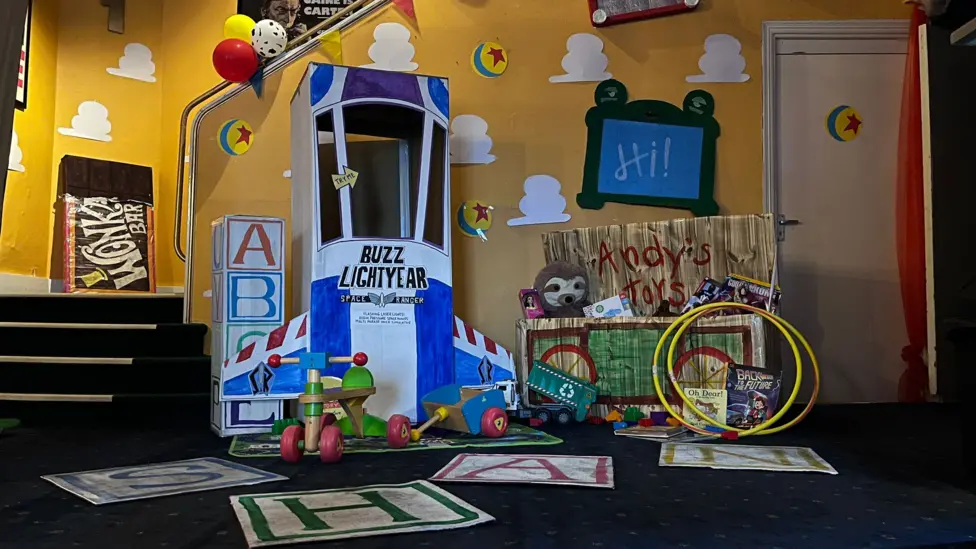
Cover photo:
Fancy dress fun: Palace Cinema manager Hannah Cramp helping launch the Toy Story charity appeal.

PATIENTS are facing some of the worst medicine shortages ever seen in the UK, with pharmacists warning the situation now poses a serious risk to safety.
The National Pharmacy Association said shortages affecting commonly used medicines are becoming more frequent, lasting longer, and causing increasing disruption for patients, GP surgeries and pharmacies.
The warning comes as Serious Shortage Protocols for Creon, used by people with pancreatic cancer and cystic fibrosis to help digest food, have been in place since May 2024 and have now been extended until July 10, 2026.
HRT treatment Estradot has also been under a Serious Shortage Protocol since December 2024, with the current extension also running until July 10.
Patients travelling between pharmacies
A survey by the National Pharmacy Association found that 98 per cent of pharmacies had encountered patients who had visited several pharmacies in one day to find a prescription.
It also found that 96 per cent of pharmacies believed the current situation posed a serious risk to patient safety, while 89 per cent said they had been unable to dispense a medicine at least once a day because of supply problems.
Some pharmacy teams have also faced anger and abuse from patients unable to obtain medication.
Olivier Picard, Chair of the National Pharmacy Association, said: “Medicine shortages are becoming more frequent, lasting longer and causing increasing disruption for patients.
“These shortages are some of most severe the UK has experienced.
“It is deeply distressing to find patients who have travelled from pharmacy to pharmacy to find the medicines they need without success.”
Calls for urgent taskforce
The NPA is calling on the government to convene an emergency taskforce involving manufacturers, wholesalers, clinicians and pharmacists.
It also wants changes to rules which currently stop pharmacists from making simple substitutions, such as changing a tablet to a capsule or a cream to an ointment, even where a safe alternative is available.
Professor Victoria Tzortziou Brown, President of the Royal College of GPs, said medicine shortages were frustrating for patients, GPs and pharmacists, and added pressure to already stretched services.
She said the College supported pharmacists being able to make limited changes to prescriptions where a medicine is unavailable and a safe alternative exists.
She added: “The most important thing is that patients are able to access the medication they need safely and without delay.”
The Cystic Fibrosis Trust and Pancreatic Cancer UK have also raised concerns about the impact of shortages of pancreatic enzyme replacement therapy, including Creon, on people who rely on the medication to digest food, maintain weight and stay well enough for treatment.
A SPITTAL man is to stand trial accused of assaulting a man and causing actual bodily harm.
Robert Hedley, 41, of Wesley Way, Spittal, Haverfordwest, is charged with assaulting Liam Morley-Trivett at St Clears on August 30, 2025.
The case was before Haverfordwest Magistrates’ Court on Thursday (Jun 18).
Hedley was granted unconditional bail and is due to stand trial at the same court on Monday, June 29.
The trial is listed for 10:00am and has been given a time estimate of twenty minutes.


Toy Story fans fill charity toy box at Haverfordwest cinema
Donations pour in for SNAP Specialist Play as families embrace Toy Story 5 launch A TOY STORY-themed charity appeal at...


Lord Rhys emerges from the mist in St Davids
Giant puppet begins historic journey marking 850 years since the first Eisteddfod MIST swirled around St Davids Cathedral on Friday...


Tragic tribute paid to Haverfordwest man after A4075 collision
FAMILY REMEMBERS “KIND AND LOVING” CALLUM HANSON THE FAMILY of a 22-year-old man from Haverfordwest who died following a road...

Motorcyclist, 22, dies in A4075 crash in Pembrokeshire
A 22-year-old woman remains in hospital after two-vehicle collision A MOTORCYCLIST has died following a serious two-vehicle crash on the...

Why police will be visiting every home in Pembrokeshire
New operation aims to knock on more than 257,000 doors across Dyfed-Powys over the next three years DYFED-POWYS POLICE has...


Prisons at breaking point: MPs warn Wales is paying the price of a failing system
Frozen healthcare budgets, overcrowded jails, homelessness on release and mounting pressure on staff are undermining rehabilitation across Wales, according to...


Brexit at 10: How Britain was sold a dream that cost us dearly
A decade after the referendum, the promised benefits remain hard to find while the economic costs are increasingly difficult to...


Worcestershire man jailed after violent attack on woman in Tenby
Defendant was already serving a suspended sentence when serious assault took place A WORCESTERSHIRE man has been jailed for more...


Offshore wind ‘could bring new generation of jobs to Milford Haven’
Pembrokeshire ports and Celtic Sea projects placed at centre of Wales’ green energy ambitions MILFORD HAVEN and Pembroke Dock could...

Police officer hailed hero after midnight sea rescue in Milford Haven
PC swam 100 metres offshore to save distressed woman heard calling for help in darkness A DYFED-POWYS POLICE officer has...
-
 Community6 days ago
Pembrokeshire Chess Club crowned Welsh champions
-

 Crime3 days ago
Milford Haven man jailed for breaching domestic violence protection order
-

 Local Government4 days ago
Security privately arranged by Mayor at Beating of the Bounds
-

 News2 days ago
Crash on Freeman’s Way causes school-run chaos across Haverfordwest
-

 Crime4 days ago
Man wanted by court after failing to attend hearing over alleged shop thefts
-

 Crime4 days ago
Man jailed after admitting strangulation and assaults
-
 Crime4 days ago
Man banned from roads after drink-driving offence
-
 Crime4 days ago
Man sentenced over stalking campaign and lock knife offence