

Community
Rubbish mounting in Milford estate due to ‘recycling confusion’

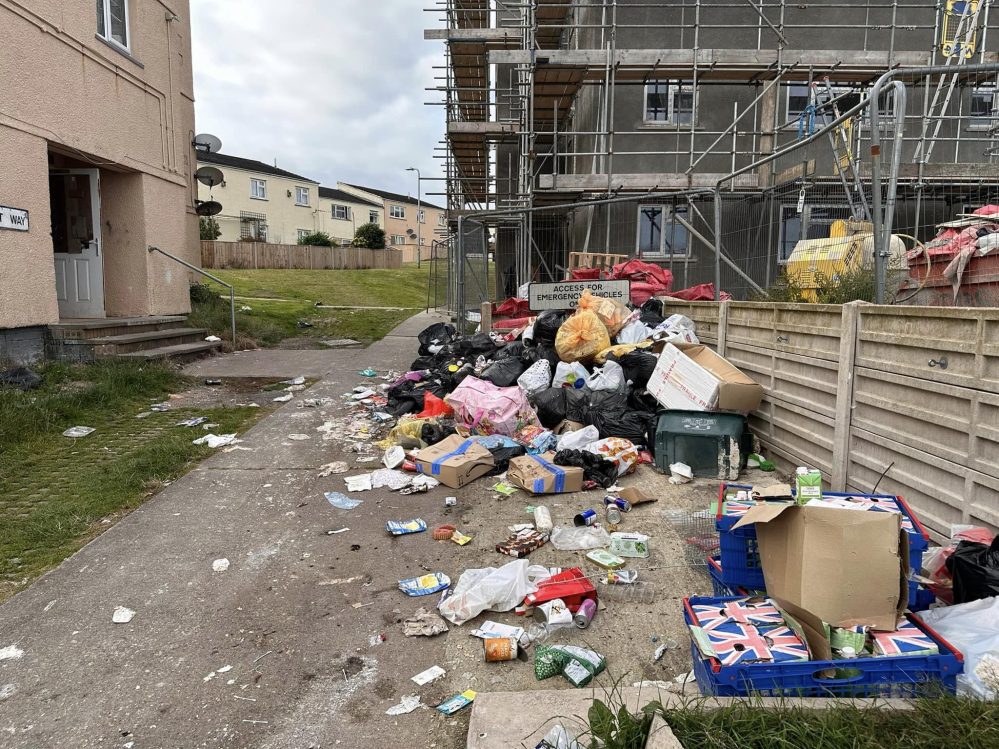
RESIDENTS of the Mount Estate in Milford Haven are voicing their frustrations and concerns as the area has turned into what they describe as ‘a landfill’. The disarray follows the Pembrokeshire County Council’s implementation of a new recycling scheme, which, according to locals, is the main cause of the problem. Residents have said that the scheme is confusion, they lack information, and there is not sufficient to storage for black bag waste whilst it is waiting for be collected.
Photographs taken on July 18, depict piles of bin bags and rubbish strewn across the estate, a shocking sight that residents say has become the norm. The council’s initiative aimed to align the estate’s waste management with the rest of the county. However, the removal of wheelie bins, which previously protected waste from rats and seagulls, and the introduction of black bag collections every three weeks have led to severe waste accumulation.

One resident, who preferred to remain anonymous, told The Pembrokeshire Herald that those living in blocks of flats were instructed by the council to leave their bin bags on the road, resulting in widespread littering. “It’s a recipe for disaster,” the resident lamented.
Kat Cullen, writing on Facebook, expressed her frustration, stating, “Unfortunately this is nothing new. It’s been like this for years but 10 times worse since the new recycling scheme. It’s just not working. It’s turning the estate into a landfill.”
Brian Phillips, also on social media, remarked: “If all residents participated in the recycling scheme it wouldn’t be like this.” However, he acknowledged the council’s historical hesitancy to include the Mount Estate in such schemes due to past littering issues.

Former resident Dave Fairbairn did not mince words, calling the estate a “stinking hovel” that has seen little to no improvement over the years. Marty Jones added, “There are some lovely people living there, ruined by a minority of wasters. Such a shame.”
Another resident Billy Roberts acknowledged the good intentions behind the recycling scheme. However, he pointed out its impracticality for the Mount Estate, suggesting a more centralised collection system could be more effective.

The situation has also highlighted issues with communication and information dissemination. Christine Russell, who lives in one of the new houses, said: “It doesn’t help matters that the council website isn’t up to date as to what bags go out and when. We had to ask the bin men.”
Despite the clear evidence of widespread non-compliance and mismanagement, some residents believe that better adherence to recycling guidelines could mitigate the problem.
Wendy Goldsworthy criticised the current system, highlighting the challenges faced by those without adequate storage space for the new recycling bags. “When will we follow schemes that actually work?” she said.
The Mount Estate’s current predicament serves as a stark reminder of the complexities involved in municipal waste management and the necessity for well-considered, adaptable solutions that address the unique needs of different communities.
Last year, a county councillor questioned the fairness of the waste recycling system, as some housing estates and flats were subject to the same conditions as the rest of the county.

In late 2019, Pembrokeshire introduced a colour-coded kerbside waste recycling system, with coloured different bags for different types of waste. However, some flats and estates in the county were initially exempt from the new, more complicated system, sticking to the previous options of orange recycling bags and black/grey normal waste bags.
In a submitted question to council, Cllr Carey said: “Since the introduction of the kerbside collection policy, the majority of Pembrokeshire residents have done their part to fulfil their end of the deal.
“As far as I am aware, Mount Estate is not required to put the same effort into their recycling as the rest of the county”, Cllr Carey said.
The Local Authority have now obviously made efforts to change that, but will it work?
Pembrokeshire has been named as the best recycling county in the whole of Wales.
A Pembrokeshire County Council spokesman, said: “As part of the roll-out of the final phases of the kerbside sort recycling scheme in Pembrokeshire, the Mount Estate was moved onto the Kerbside Sort Recycling system in March 2024.
“Each household was provided with the appropriate recycling containers, calendars of collections and literature surrounding the system in addition to a campaign of educational door knocking visits by our Environment Advisors to support households with the changes.
“A large number of properties at the Mount Estate, as per the rest of Pembrokeshire, are presenting their waste and recycling correctly which has resulted in Pembrokeshire being one of the top performing recycling authorities in Wales. This is something we are extremely proud of and thankful for.
“However as the image taken the day before collections show there are some isolated areas which are not fully participating in the recycling scheme at present.
“We are continuing to work with the residents and the housing team surrounding their waste and recycling provisions and to ensure appropriate storage facilities are in place for households.
“We are also taking appropriate action when evidence of fly tipping or non-compliance is found.”














OFFICERS from Haverfordwest Neighbourhood Policing and Prevention Team have taken part in the Prostate Cymru Walk of Wales, completing the scenic leg from Porthclais to Whitesands.
The walk gave the team the chance to support an important cause while helping raise awareness of prostate cancer, which affects one in eight men in the UK and is the most common cancer among men in Wales.
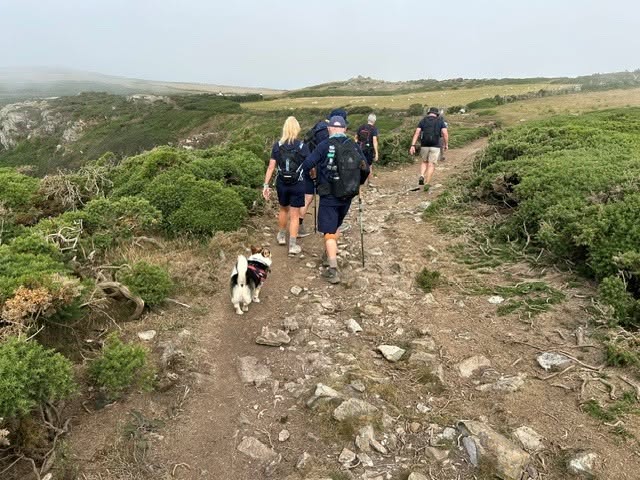
Taking in one of Pembrokeshire’s most beautiful stretches of coastline, the route formed part of a much larger challenge being undertaken between June and August 2026.
Walkers are travelling around Wales via the Wales Coast Path, averaging around 40km a day over 44 days to raise awareness and support the work of Prostate Cymru.
Police praised everyone taking part in the challenge and thanked those supporting the initiative.
Every step helps make a difference.


Former Eisteddfod president says music can “breathe harmony into the soul” as he continues humanitarian work
SIR TERRY WAITE returned to the Llangollen International Musical Eisteddfod on its 2026 opening day, six years after stepping down as president, to praise the festival’s continuing role in bringing people together through music.
Sir Terry, who rose to international prominence after being held hostage in Beirut for almost five years, was captured in 1987 while attempting to negotiate the release of other hostages. He was freed in 1991 and has since devoted much of his life to humanitarian work, peacebuilding and supporting people affected by conflict, homelessness and captivity.
Now in his late eighties, he remains closely connected to the Llangollen Eisteddfod, having served as its president from 2006 until 2020. During that time he became a much-loved and respected figure at the festival, and he has continued to visit regularly since leaving the role.
This year he was welcomed warmly by trustees and volunteers, as well as by Sir Karl Jenkins, who has become the 2026 Eisteddfod president and was preparing to feature in the opening concert, Uniting Nations: One World.
Sir Terry said: “It’s great to be back again because the International Eisteddfod has got a very important role to play in the world by bringing people from different communities together.
“The Eisteddfod has had a very rough time, during Covid and beyond. But it has managed to get back on its feet and it has been absolutely vital that international music goes on.”
Reflecting on the challenges the festival has faced over the years, he said: “Over the years, and I saw it when I was president, this festival has faced some very unusual challenges.
“One of them has been getting the people we want to come here from countries that are, some would say, beyond the pale politically, and getting visas for such people is exceptionally difficult. The team here struggle with that problem.
“I remember years ago we got hold of the chief officer in charge of visas in London. We invited him here to speak to us. He saw what was happening and understood the problem. But like all civil servants he was moved on.
“We’re now in an even more complex situation and some of our politicians, I can’t say who, but certainly some prominent people, have not necessarily helped matters at all.
“But I’ve often said that music has the capacity to breathe harmony into the soul, and that’s something that Llangollen certainly does.”
Since stepping down from the Eisteddfod presidency, Sir Terry has continued his work with a number of humanitarian organisations. He is co-founder and president of Hostage International and president of the homelessness charity Emmaus.

He said: “With Hostage International, one hour before coming here this afternoon I was talking to someone who has been held in arbitrary detention in Iraq for the last five years. I’ve been trying to help him and we’ve been giving support to his family. And that’s just one of 100 cases that we have.
“Then with the homeless, there’s also a lot of work to do. I’m still involved in this. We started off with a portable building and we now have 30 communities around England, Wales and Scotland.
“Then there’s the work I do with the children of war, who are often left without parents and left without education. Sometimes they are also highly traumatised.
“When you see what’s happening in places like Gaza and others, my goodness, so many children will grow up with no parents, no home, no education, nothing, and we have to try and do something about this.”
Sir Terry’s return added a poignant note to the opening day of the festival, underlining the Eisteddfod’s founding mission of promoting peace and friendship through music.
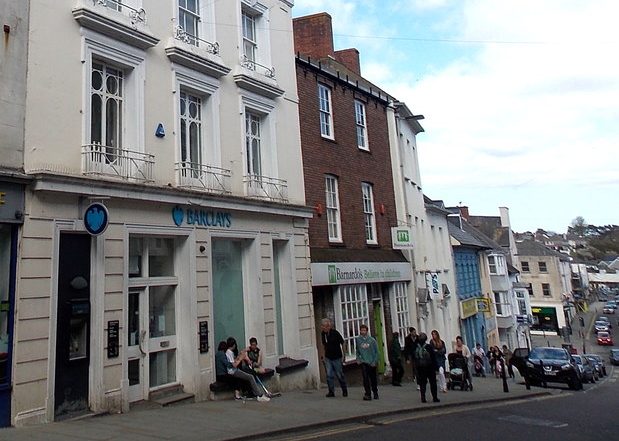
BARCLAYS has given no commitment to reopening bank branches in west Wales, despite calls for the banking giant to restore full services in Pembrokeshire and Ceredigion.
Paul Davies MS, Senedd Member for Ceredigion Penfro, wrote to Barclays UK Chief Executive Vim Maru urging the bank to consider reopening branches in Haverfordwest and Aberystwyth, with Tenby and Cardigan also suggested for review.
The call followed reports that Barclays is looking again at its high street presence and considering investment in its branch network.
But in a response to The Herald, Barclays stopped short of saying whether any west Wales towns were being considered for a reopened branch.
A Barclays spokesperson said: “Over the past year, we’ve added 47,000 hours of in-branch availability across the UK. We are now looking to enhance and invest in our branch footprint alongside our contact centres and app as we continue to meet the changing preferences of our customers. We’ll make more details known on proposed new branch locations at the appropriate time.
“Across Pembrokeshire and Ceredigion, we provide in person banking services from our local banking hubs in Pembroke Dock, Haverfordwest, Cardigan and Aberystwyth, and offer full branch services in neighbouring Carmarthen. Details of opening hours can be found on our website. We also operate a dedicated Welsh language telephone service available on 0333 202 7450, from 9am to 5pm, Monday to Friday.”
Barclays closed its Haverfordwest branch in May 2024. Its Aberystwyth and Cardigan branches also closed that year, leaving customers in large parts of west Wales without access to a full Barclays branch.
Mr Davies said the lack of branches in Pembrokeshire and Ceredigion represented a significant reduction in service provision for both personal and business customers.
He said: “It’s extremely disappointing that Barclays Bank currently has no branches in either Pembrokeshire or Ceredigion. This represents a significant reduction in service provision for both personal and business customers across the two counties.
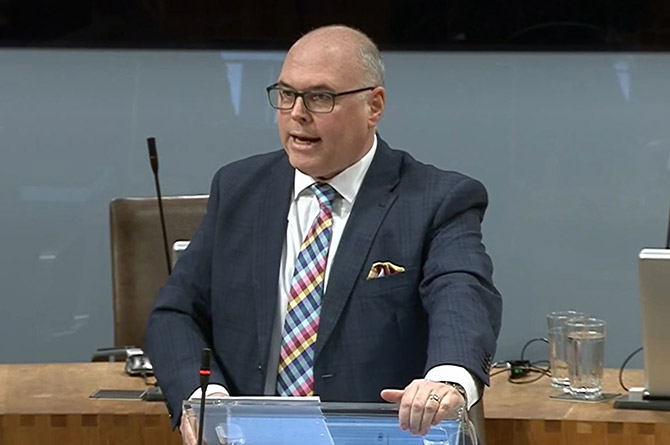
“However, I welcome the bank’s recent announcement and have written to the Chief Executive to encourage Barclays to take this opportunity to restore banking services in our area by reopening branches in Pembrokeshire and Ceredigion.
“Access to face-to-face banking services remains vital for many residents, businesses and community organisations, and I hope the bank will give serious consideration to reopening the high street branches in west Wales.”
The issue is likely to be particularly significant in rural areas, where older residents, digitally excluded customers, small businesses, charities and community groups may still rely on in-person banking.
While Barclays says alternative services are available, critics argue that local banking points and hubs do not offer the same service as a fully staffed branch.
Barclays Local sites are generally cashless, while full branches offer a wider range of services. Banking hubs, operated separately through the national cash access scheme, provide counter services for basic cash transactions and access to community bankers on set days.
Mr Davies has called on Barclays to place Haverfordwest and Aberystwyth at the front of the queue if the bank proceeds with any programme to expand or reopen branches.
For now, however, Barclays has not confirmed whether any branch in Pembrokeshire or Ceredigion will return.



Crime10 hours ago
Teacher stabbing trial: The first week of evidence
Jury hears accounts of alleged planned classroom attack, teacher’s fear she was dying, and boy’s words after leaving school A...


Community13 hours ago
Haverfordwest Castle refurbishment reaches new heights as roof goes on
Major milestone reached in project to transform historic gaol building into flagship visitor attraction A MAJOR milestone has been reached...


Business2 days ago
Pembrokeshire lands £98m share of Wales marine energy boom
New industry report says county has received the second highest level of marine energy investment in Wales, supporting more than...
Crime2 days ago
First aider tells jury teacher was “crying, shaking” after classroom stabbing
A SCHOOL first aider has told a jury that teacher Vicki Williams was “crying, shaking” and in “complete shock” after...

Crime2 days ago
Teacher feared she was dying after Milford Haven classroom stabbing
A TEACHER allegedly stabbed in the head at Milford Haven Comprehensive School told a jury she feared she was dying...


News2 days ago
Farage to resign as MP and fight Clacton by-election amid finance row
NIGEL FARAGE has announced he will resign as MP for Clacton and stand again in the by-election he intends to...
Crime3 days ago
Teacher tells jury there were ‘no issues’ with accused pupil hours before ‘stabbing’
Milford Haven teacher gives evidence as trial of 15-year-old continues at Swansea Crown Court A TEACHER allegedly stabbed at Milford...


News3 days ago
Major incident stood down after fire at Impala Terminal in Milford Haven
Fire involved decommissioned oil tank containing residual crude oil and around 60 cylinders A MAJOR incident declared during a fire...


News3 days ago
Large fire breaks out at Impala Terminal in Milford Haven
Black smoke seen for miles as emergency services respond to incident at former Puma Energy site A LARGE fire has...
Crime3 days ago
Prosecution outlines ‘planned attack’ as Milford Haven teacher stabbing trial opens
Jury hears teenager allegedly brought kitchen knife into school before teacher was stabbed in the head THE JURY in the...
-
 Education7 days ago
Education secretary vows to tackle ‘root causes’ of antisocial behaviour in schools
-

 Education6 days ago
Ysgol Glannau Gwaun celebrates prestigious Gold Active Travel award
-

 Community7 days ago
Closure-threatened Stepaside school expected to remain open
-
 Education7 days ago
First Minister pressed on biological sex, additional learning needs, and NHS jobs
-

 Farming3 days ago
Pembrokeshire slaughterhouse given urgent improvement rating after audit failure
-
News3 days ago
Large fire breaks out at Impala Terminal in Milford Haven
-

 Entertainment2 days ago
Swing and big band classics heading to Torch Theatre
-

 News3 days ago
From boccia to boxing: ALN multisport events give youngsters chance to try activities