


News
Campaigners warn of ‘dangerous experiment’ as nuclear plans face backlash


Climate Camp Cymru supports Llynfi Valley protest against small modular reactors – campaigners urge Pembrokeshire to stay alert
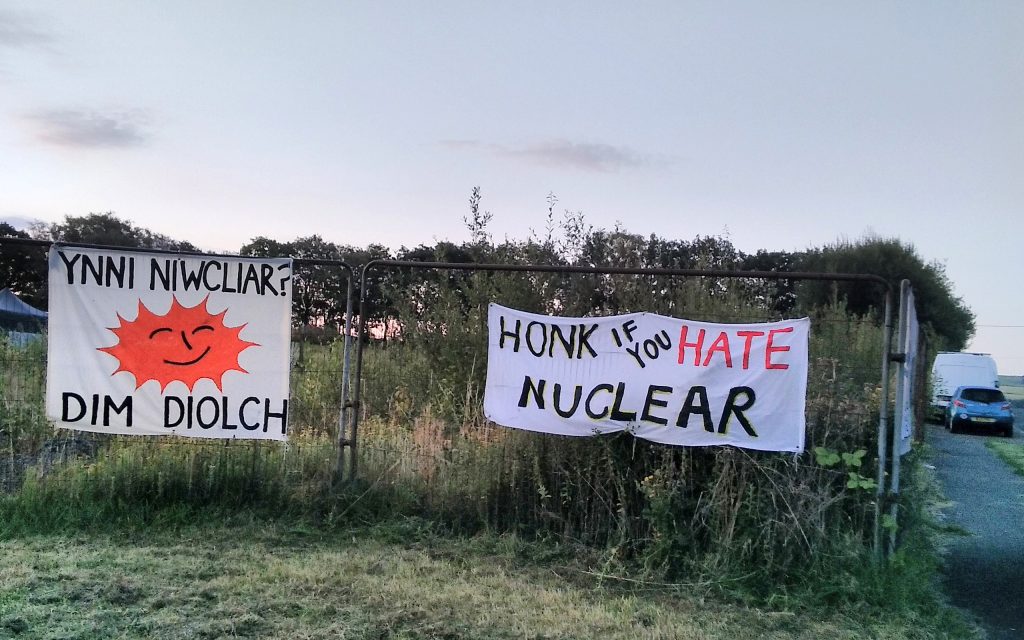
ENVIRONMENTAL activists from across Wales – including several from Pembrokeshire – joined forces with Climate Camp Cymru this summer to support the No Nuclear Llynfi campaign near Llangynwyd in the Llynfi Valley, South Wales.
The group is opposing plans by American company Last Energy to build four small modular nuclear reactors (SMRs) on land within a mile of residential homes and two schools.
The company, a venture capital-backed start-up that has never built a reactor before, is currently seeking UK planning approval. Campaigners say it is deeply concerning that Last Energy is also suing the US Nuclear Regulatory Commission, claiming its safety regulations are “overburdensome” – while applying similar pressure in the UK to reduce oversight and speed up development.
Concerns over waste and flood risk
No Nuclear Llynfi campaigners have highlighted several risks, including plans to store radioactive waste on-site indefinitely, and the fact that the proposed location lies below the water table in a Zone 3 flood risk area – the highest flood designation.
Other worries include the need for 24-hour armed security, the site’s proximity to homes and schools, and the potential use of generated power for data centres running artificial intelligence systems, rather than for local homes or industry.

A spokesperson for Climate Camp Cymru said the project “treats post-industrial communities as expendable,” adding that “people in the valleys, and in places like Pembrokeshire too, are being used as testing grounds for risky new energy technologies.”
Raising awareness
The summer camp, set up over the August bank holiday weekend, occupied open land near the proposed nuclear site. Volunteers raised banners along the A4063, distributed flyers, and knocked on around 1,000 doors to alert residents.
Most locals, campaigners said, were unaware of the nuclear proposal – despite claims by Last Energy that it had consulted the community. “There’s a legal duty to inform residents, and that simply hasn’t been met,” organisers said.
An open meeting at Maesteg Rugby Club on September 25 drew strong attendance and marked the beginning of organised local opposition.

Workshops and wider links
Throughout the weekend, the camp hosted workshops and talks from campaigners behind Save Kilvey Hill in Swansea – where activists are fighting a proposed adventure park development – and from CND, the Initiative for Nature Conservation Cymru (INCC), and academics from Cardiff University.
Discussions focused on linking environmental struggles across Wales, from open-cast mining and deforestation to speculative energy projects. Evenings featured live music and Welsh-language sessions celebrating Wales’ radical protest heritage.
Call for local action
Organisers say the success of the Llynfi camp shows the power of grassroots resistance. The camp was left clean and intact, with the landowner’s permission granted after the first day and support from nearby residents.

Pembrokeshire campaigners are now being encouraged to stay alert to similar proposals in the west. Sites such as Trawsfynydd and Wylfa are already under consideration for future SMR projects, and environmental groups warn that West Wales could be next.
Anyone interested in hosting or seeking support from next year’s Climate Camp Cymru can contact the group via email at [email protected].


Rider treated by paramedics following collision with van pulling out from junction
A MOTORCYCLIST was treated by paramedics after a collision with a van in Johnston on Monday morning (Mar 16).
The crash happened shortly after 9.15am as the rider was overtaking a lorry through slow-moving traffic on the main road. It is understood the lorry blocked the rider’s view of a van pulling out from a junction near KO Carpets.
Police units attended promptly to assist at the scene.
The motorcyclist is not believed to have been seriously injured.
The van suffered slight damage, including a broken wing mirror.
The road was not closed, police said.

Candidates say residents must be heard after emergency services decision
PLAID CYMRU candidates for the Ceredigion Penfro constituency will host a public meeting in Pembrokeshire to discuss concerns over the future of services at Withybush Hospital.
The event will take place at 6:30pm on Monday (Mar 31) at Letterston Village Hall, giving residents the opportunity to share their experiences and concerns following Hywel Dda University Health Board’s decision last month to remove emergency general surgery from the hospital.
Campaigners say the move will force many patients requiring urgent treatment to travel further for care, raising fears about the potential impact on patient safety in rural west Wales.
Elin Jones, Plaid Cymru lead candidate for Ceredigion Penfro, said: “Withybush is such an important hospital for the community and residents of Pembrokeshire. The decision to remove its emergency general surgery will severely weaken the life-saving capacity of this hospital.
“Plaid Cymru has long championed small rural hospitals such as Bronglais and Withybush. We need to ensure these hospitals remain strong local services within our communities. Withybush should have the basic life-saving and everyday treatment services it needs to function as a full general hospital.”
Kerry Ferguson, Plaid Cymru candidate for Pembrokeshire within the Ceredigion Penfro constituency, said the recent success of a public petition had demonstrated the strength of local feeling.
“It’s great to see that the online petition calling for Welsh Government intervention to restore emergency surgery and essential services at Withybush has reached its target, meaning it will now be debated in the Senedd,” she said.
“We are extremely disappointed by the Health Board’s decision to remove emergency general surgery at Withybush. Increased journey times for anyone in need of urgent medical treatment will put lives at risk. We need government intervention now to overturn this decision.”
Residents across Pembrokeshire have continued to raise concerns about the future of services at the hospital, which has long been a focal point in debates about healthcare provision in rural west Wales.


Bangor University scientists join £2.1m project investigating the impact of bottom trawling on carbon stored beneath the seabed
A STATE OF THE ART research vessel has set sail from Liverpool to investigate how bottom trawling may affect carbon stored in the seabed of the Irish Sea.
The scientific expedition is part of a £2.1 million research project funded by the Natural Environment Research Council and led by Professor Jan Geert Hiddink of Bangor University.
A team of eighteen scientists has embarked on the RRS Discovery, one of the world’s most advanced research vessels, for a three-and-a-half-week voyage studying the impact of fishing activity on carbon held in seabed sediments.
Before the ship departed, a number of local dignitaries were invited aboard for a tour of the vessel, including Liverpool City Region Mayor Steve Rotheram and National Oceanography Centre Operations Director Natalie Campbell.
Professor Jan Geert Hiddink, from Bangor University’s School of Ocean Sciences, said bottom-trawl fishing is both vital to global food supply and a major disturbance to seabed environments.

“Bottom-trawl fishing provides around a quarter of global seafood but is also the most extensive physical disturbance caused by human activities to stocks of carbon locked in seabed sediments,” he said.
“This is important because recent evidence suggests that disturbing the seabed could lead to the release of significant amounts of greenhouse gases from the seabed into the atmosphere.
“There are still major uncertainties about how this disturbance affects carbon stored beneath the seabed. As a result, the impact of these disturbances is largely unquantified and currently unregulated.
“The aim of this project is to gain a much clearer understanding of what is happening so that scientists, policymakers and regulators can make informed decisions in the future.”
Seven research organisations are collaborating on the project: Bangor University, the Centre for Environment, Fisheries and Aquaculture Science (CEFAS), Heriot-Watt University, the University of Leeds, Plymouth Marine Laboratory, the University of St Andrews, and Imperial College London.
Caption: Scientists prepare to begin their research aboard the RRS Discovery, one of the world’s most advanced research vessels.



Education21 hours ago
New facilities open at Portfield School as redevelopment reaches key milestone
THE FIRST phase of a major redevelopment programme at Portfield School in Haverfordwest has been completed, marking a significant step...


News21 hours ago
£377m spent saving blast furnaces months after Port Talbot closure
Government intervention keeps UK’s last primary steelmaking furnaces running THE UK GOVERNMENT spent £377 million to prevent the closure of...


Sport2 days ago
France crowned Six Nations champions after extraordinary final-day drama
Ramos penalty in Paris seals title as Ireland fall just short and Wales end losing run FRANCE were crowned 2026...


News2 days ago
Fishguard linked to allegations in Many Tears Animal Rescue investigation
Claims about puppies arriving through Pembrokeshire port emerge as licensing probe continues FISHGUARD has been named in allegations linked to...

Local Government3 days ago
Investigation confirmed after inspectors visit Many Tears Animal Rescue
Licensing authority declines to comment as police confirm attendance at Carmarthenshire rescue centre AN INVESTIGATION is underway following a visit...

Business4 days ago
Work set to begin on £50m hydrogen plant in Milford Haven
A MAJOR new hydrogen production facility worth around £50 million is expected to begin construction in Milford Haven later this...


Education5 days ago
Manorbier school closure approved while insurance claim still unresolved
Council confirms negotiations with insurer ongoing following 2022 fire PEMBROKESHIRE COUNTY COUNCIL has confirmed that negotiations with its insurer over...


Crime6 days ago
‘Knife attack’ at Spittal property leaves man in hospital
POLICE have arrested a woman following what is being described as a ‘knife attack’ at a property in Spittal on...


Community6 days ago
Pembrokeshire to receive its first banking hub in Pembroke Dock
LINK, the UK’s Cash Access and ATM network, has today announced local people and businesses in Pembroke Dock will benefit from a new banking...


Health7 days ago
Future of Withybush Hospital petition sparks urgent call for Senedd debate
CALLS have been made for an urgent debate in the Senedd over the future of services at Withybush Hospital as...
-

 Health4 days ago
Welsh Ambulance Service to host bi-monthly Board meeting
-

 News3 days ago
Rayner and Lammy visit Wales to discuss justice and community safety
-

 Local Government6 days ago
Register now to vote in May’s Senedd election
-
News2 days ago
Fishguard linked to allegations in Many Tears Animal Rescue investigation
-

 Crime7 days ago
E-bike rider who sped through pedestrian alley sentenced by court
-

 Entertainment7 days ago
How the Cheltenham Festival Captivates Racing Fans Every Year
-

 Crime7 days ago
Driver caught with three illegal drugs in system on way to MOT test
-

 Community6 days ago
Modern-day maritime hero backs exhibition marking 200 years since launch of HMS Erebus