


Crime
Drug crisis deepens as Parc deaths linked to synthetic opioids


Commons report warns of ‘endemic’ drug culture in prisons as scrutiny intensifies over G4S-run jail
DEATHS connected to HMP Parc in Bridgend have now been linked to the volatile threat of synthetic opioids, according to a damning new report published by the House of Commons Justice Committee.
The report warns that the trade and use of illicit drugs in prisons has reached endemic levels, with inspectors identifying a prevailing culture of acceptance that tolerates drug use and undermines safety, control and rehabilitation.
It follows confirmation from the Prisons and Probation Ombudsman (PPO) that two further deaths connected to Parc — those of Eric McShane, 27, and Peter Kaminsky, 57 — remain under investigation.
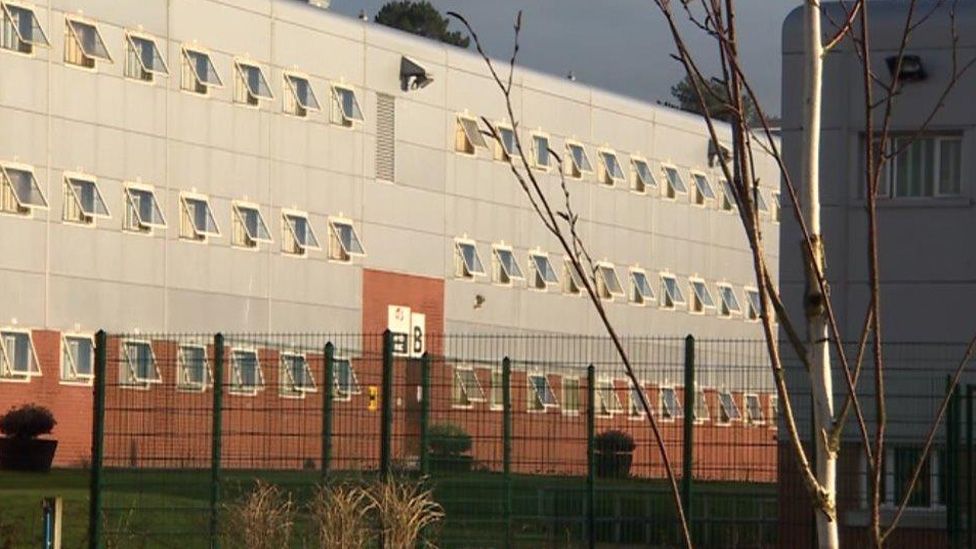
Two more deaths under investigation
As we reported last week, the latest cases concern Eric McShane, born 13 February 1997, who died on 11 September 2025, and Peter Kaminsky, born 2 February 1968, who died on 4 October 2025.
Both men died in the community — McShane nine days after his release from custody, and Kaminsky while on compassionate release to receive end-of-life care at home. Both deaths are being investigated by the PPO as part of its remit to review fatalities occurring within 14 days of release.

An HMP Parc spokesperson said: “A prisoner aged 57 died at home on 4 October 2025 while on compassionate release to receive end-of-life care. Our thoughts are with his family and friends at this difficult time.
“A former prisoner, aged 27, died in the community on 11 September 2025, nine days after his release from HMP Parc. Our thoughts are with his loved ones and friends.
“All deaths in custody, and those that occur within 14 days of release, are investigated by the Prisons and Probation Ombudsman. The cause of death is ultimately for the coroner to determine.”
The prison added that there has not been an apparent or confirmed drug-related death at Parc since April 2024.


Commons report exposes scale of crisis
The Justice Committee report paints a grim picture of life inside UK prisons, warning that 39% of prisoners say it is easy to acquire drugs, and that 11% of men and 19% of women develop a new drug or alcohol problem after entering custody.
It found that synthetic opioids such as nitazenes — many times stronger than heroin — are fuelling a surge in overdoses and deaths.
“These substances are significantly more potent than heroin and present an acute threat of overdose, having already been linked to deaths at HMP Parc in 2024,” the report states.

The Ombudsman previously confirmed that four drug-related deaths at Parc in 2024 were linked to nitazene use, prompting warnings to prisoners about the lethal risk.
‘Guinea pigs’ for new drugs
The committee said inmates are being coerced into using new, unregulated drugs as guinea pigs, while boredom and prolonged confinement — often up to 22 hours a day in cells — are driving widespread substance use.
“The system is failing, and the human cost is unacceptable,” MPs said. “Once exposed to the menu of drugs available in prison, pressure from the established subculture makes it exceptionally difficult to resist.”
The Prisons and Probation Ombudsman investigated 833 deaths between December 2022 and December 2024, of which 136 (16%) were classified as drug-related.
Protest outside Parc Prison

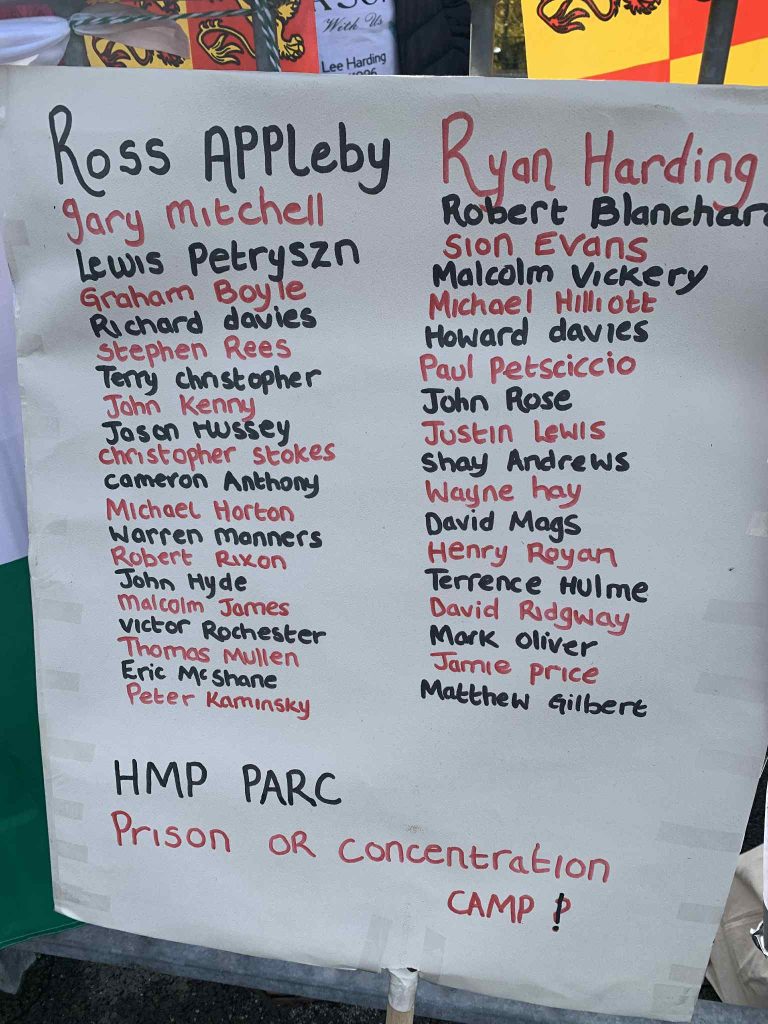
On Saturday (November 1), campaigners gathered outside HMP Parc to demand accountability for the growing number of deaths linked to the Bridgend jail. Around 30 protesters attended the event called “G4S Out of HMP Parc , carrying banners and flags calling for change and an end to private prison contracts.
Leading the demonstration was Zack Griffiths, of the UK Prisons for Justice group, who has been campaigning for reform following his own time in custody. Addressing the crowd, he said: “People have lost brothers, sons, parents, uncles – so many families are affected and G4S, who run this prison, need to be held accountable for these deaths. There is no accountability, things are not improving and we need to keep fighting so that the voices of the families of those who died, and those still in the jail, are heard.”
It was not the first protest to take place at the prison. Similar demonstrations have been held in previous years, as public anger grows over safety standards, drug use, and the rising number of deaths connected to the facility.
Campaigner recovering after stabbing
The most recent deaths were highlighted by Zack Griffiths, who was himself released from custody only days ago.
Mr Griffiths is currently recovering after being stabbed shortly after his release, an incident now under police investigation.
Before the attack, he warned of a continuing crisis at Parc, accusing management of failing to stop the spread of synthetic drugs and calling for an end to private prison contracts.

Supporters of Mr Griffiths say his recall to prison earlier this year — for alleged criminality that was later found unproven in court — was an attempt to silence him.
Another prison campaigner, working closely with Griffiths was arrested this week on allegations of making threats to kill. Tom Blewitt took to social media to state that the arrest was politically motivated. He stated: “South Wales Police why are you making false allegations against me. I’ve got all the evidence on camera… you will be exposed officer!”
The Herald has asked the police for a comment.
The Herald’s campaign for change
Over the past year, The Pembrokeshire Herald and Herald.Wales have led sustained coverage of the growing crisis at Parc Prison — exposing multiple deaths, highlighting families’ experiences, and pressing both G4S and the UK Ministry of Justice for transparency.
Our reporting has documented the shocking rise in drug-related fatalities, the availability of synthetic substances, and the urgent need for independent oversight of private-run prisons in Wales.
We continue to campaign for accountability, safer custody standards, and a public inquiry into how so many lives have been lost under the current system.
Calls for accountability
Welsh Members of the Senedd have urged the UK Government to review safety standards at Parc, which houses more than 1,700 men and young offenders.
With the Ombudsman continuing to examine the deaths of McShane and Kaminsky, campaigners say pressure is mounting for a full independent inquiry into drug use, post-release deaths, and the wider management of Wales’s largest prison.
The Herald understands both investigations remain active, and reports will be published once the Ombudsman’s findings are complete.












Restraining order imposed by Haverfordwest magistrates
A MAN has been sentenced after admitting stalking a woman in Milford Haven.
Andrew Richards, 39, of High Street, Neyland, appeared before Haverfordwest Magistrates’ Court for sentence on Monday (Mar 9).
Richards had previously pleaded guilty to stalking without fear, alarm or distress, contrary to section 2A(1) and (4) of the Protection from Harassment Act 1997.
The court heard that between December 2, 2025 and February 15, 2026, he pursued a course of conduct which amounted to the stalking of a woman and which he knew, or ought to have known, amounted to harassment.
Magistrates imposed a community order running until September 8, 2027.
As part of the order, Richards must undertake alcohol treatment for nine months under the direction of the probation service.
He must also complete up to twenty days of rehabilitation activity as directed by probation.
Richards was ordered to pay a £120 fine, £500 compensation to the victim, £85 prosecution costs and a £114 surcharge.
The court made a restraining order lasting until September 8, 2027.

Under the order, Richards must not contact the victim directly or indirectly and must not post, or cause to be posted, any material on social media or the internet referring to her directly or indirectly.
The court heard a victim personal statement from the complainant, which was read to the court by the prosecutor.
The case was prosecuted by Dennis Davies, with Richards represented by Mike Kelleher.

The hearing was before magistrates Mrs J Morris, Mr C Pattison and Mr J Steadman.

Restraining order imposed after Haverfordwest case
A MAN has been sentenced for stalking after admitting a campaign of unwanted contact and harassment in Haverfordwest.
Michael Lockheart, 80, of Daisy Lane, Haverfordwest, appeared before Haverfordwest Magistrates’ Court for sentence on Monday (Mar 9).
The court had previously heard that between July 27 and September 10, 2025, Lockheart pursued a course of conduct which amounted to stalking.
The offence involved sending numerous unwanted emails after being told to stop making contact, putting up defamatory posters in public places, and sending malicious correspondence to the complainant’s GP and local authority.
Lockheart had entered a guilty plea to stalking without fear, alarm or distress, contrary to section 2A(1) and (4) of the Protection from Harassment Act 1997, on January 27, 2026.

Magistrates imposed a community order running until March 8, 2028.
As part of that order, Lockheart must undergo non-residential mental health treatment for 12 months under Dr Cormac Duffy, as directed by probation.
He must also complete up to 25 days of rehabilitation activity.
Lockheart was ordered to pay £1,000 compensation, a £600 fine, £85 costs and a £114 surcharge.
The court also made a restraining order lasting until March 8, 2028.
Under that order, he must not seek, approach or communicate with the complainant by any means, directly or indirectly. He must not knowingly enter any address where she is living, and must not post, or cause to be posted, any material online or on social media referring to her directly or by implication.
A victim personal statement was read to the court by the prosecutor.

The case was heard by Mrs J Morris, Mr C Pattison and Mr J Steadman.

Case dismissed following hearing at Haverfordwest Magistrates’ Court
A MAN from Milford Haven has been cleared of a sexual assault allegation after magistrates ruled there was no case to answer.
David Fletcher, 45, of Chestnut Way, Mount Estate, appeared before Haverfordwest Magistrates’ Court on Monday (Mar 9).
He had been charged with sexual assault on a woman aged sixteen or over, contrary to section three of the Sexual Offences Act 2003.
The court heard the allegation related to an incident said to have taken place in Johnston, Pembrokeshire, on March 16, 2025.
Due to legal reporting restrictions, the complainant’s identity cannot be published under the Sexual Offences (Amendment) Act 1992.
During the hearing, the prosecution was represented by Dennis Davies, while Fletcher was represented by David Wheel of Welch & Co Solicitors.
After hearing the evidence presented by the prosecution, the magistrates ruled that there was no case to answer.
The bench, comprising Mrs J Morris, Mr C Pattison and Mr J Steadman, formally found Fletcher not guilty.
The case was dismissed and Fletcher was discharged.



News15 minutes ago
£377m spent saving blast furnaces months after Port Talbot closure
Government intervention keeps UK’s last primary steelmaking furnaces running THE UK GOVERNMENT spent £377 million to prevent the closure of...


Sport21 hours ago
France crowned Six Nations champions after extraordinary final-day drama
Ramos penalty in Paris seals title as Ireland fall just short and Wales end losing run FRANCE were crowned 2026...


News1 day ago
Fishguard linked to allegations in Many Tears Animal Rescue investigation
Claims about puppies arriving through Pembrokeshire port emerge as licensing probe continues FISHGUARD has been named in allegations linked to...


Local Government2 days ago
Investigation confirmed after inspectors visit Many Tears Animal Rescue
Licensing authority declines to comment as police confirm attendance at Carmarthenshire rescue centre AN INVESTIGATION is underway following a visit...


Business3 days ago
Work set to begin on £50m hydrogen plant in Milford Haven
A MAJOR new hydrogen production facility worth around £50 million is expected to begin construction in Milford Haven later this...


Education4 days ago
Manorbier school closure approved while insurance claim still unresolved
Council confirms negotiations with insurer ongoing following 2022 fire PEMBROKESHIRE COUNTY COUNCIL has confirmed that negotiations with its insurer over...


Crime5 days ago
‘Knife attack’ at Spittal property leaves man in hospital
POLICE have arrested a woman following what is being described as a ‘knife attack’ at a property in Spittal on...

Community5 days ago
Pembrokeshire to receive its first banking hub in Pembroke Dock
LINK, the UK’s Cash Access and ATM network, has today announced local people and businesses in Pembroke Dock will benefit from a new banking...


Health6 days ago
Future of Withybush Hospital petition sparks urgent call for Senedd debate
CALLS have been made for an urgent debate in the Senedd over the future of services at Withybush Hospital as...


Sport7 days ago
Sean Bowen set for historic Welsh clash at Cheltenham Gold Cup
PEMBROKESHIRE jockey Sean Bowen could be part of a historic all-Welsh showdown when he lines up in the Cheltenham Gold...
-

 Health3 days ago
Welsh Ambulance Service to host bi-monthly Board meeting
-

 News2 days ago
Rayner and Lammy visit Wales to discuss justice and community safety
-

 Local Government5 days ago
Register now to vote in May’s Senedd election
-

 Crime7 days ago
Former Pembrokeshire Army officer stripped of MBE after fraud conviction
-

 Community7 days ago
Tenby still waiting as Wales hits 50 rural mobile mast upgrades
-

 Community7 days ago
Carmarthenshire woman celebrates 100th birthday surrounded by family
-

 News7 days ago
Hustings to focus on learning disability support ahead of Senedd election
-

 Crime6 days ago
E-bike rider who sped through pedestrian alley sentenced by court