


News
BBC apologises for misleading article – after facts are corrected, the ‘scandal’ disappears


FOR six years a narrative has persisted online: “Herald newspaper editor owes £70,000”, “defies court orders”, “treats staff appallingly”. On 4 December 2025, the BBC’s Executive Complaints Unit finally ruled that the central allegation underpinning that narrative — that the editor personally owed £70,000 in unpaid debts — was inaccurate and breached the corporation’s standards of due accuracy.
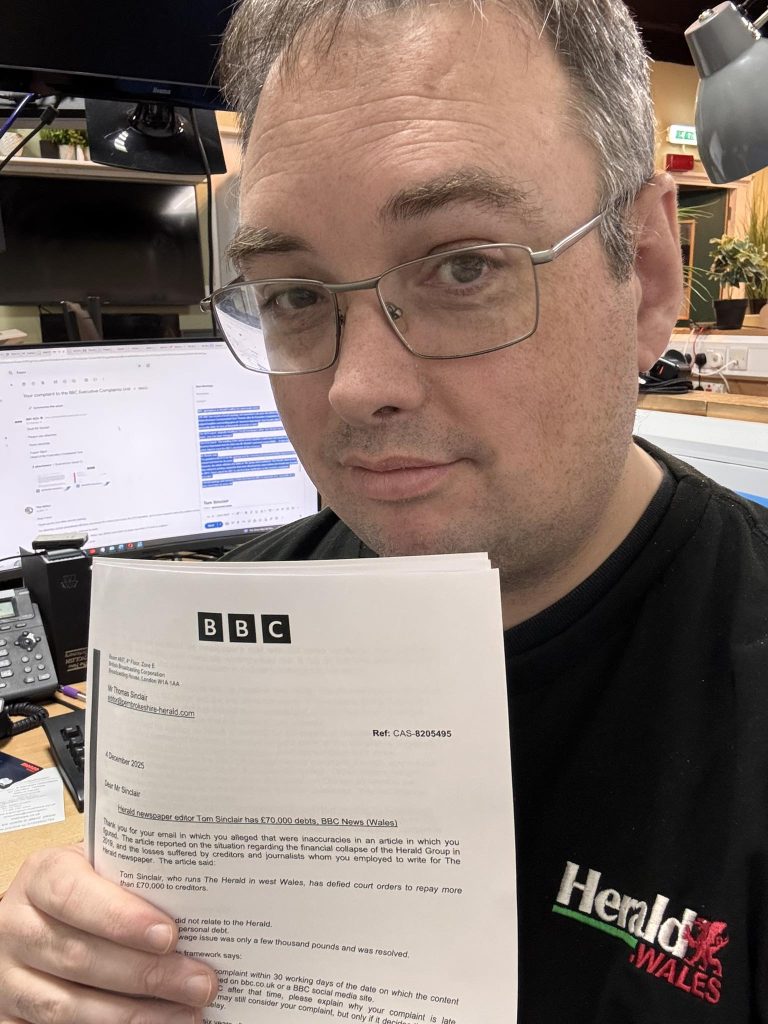
The BBC has now apologised, amended the headline, and corrected the article.
And with that correction, the supposed “scandal” disappears.
What remains is not a tale of a serial debtor or a rogue employer but something far more mundane: a young entrepreneur who ran printing companies with his late father before 2011, closed or sold them in the ordinary way, and later launched a fast-growing but cash-tight local newspaper group in 2013 that hit a crunch point in 2019, paid everyone in the end, and was ultimately stabilised with outside investment.
When placed in proper chronological and factual context, there is simply no misconduct story left to tell.

The BBC article that refused to die
The original BBC Wales article (March 2019) appeared under the headline:
“Herald newspaper editor Tom Sinclair has £70,000 debts.”
It stated that Sinclair, who “runs The Herald in west Wales”, had “defied court orders to repay more than £70,000 to creditors”.
The phrasing implied:

- that the debt was personal,
- that the liabilities were recent,
- and that they were connected to the Herald newspapers.
None of this was true.
Fraser Steel, Head of the BBC’s Executive Complaints Unit, wrote on 4 December 2025:
“…the wording of the headline and the first line of the report… could allow a reader to form the impression that the debt was your personal liability… Accordingly, the article failed to meet the BBC’s standards of due accuracy in that respect.”
The BBC apologised and amended the headline to:

“Herald newspaper editor Tom Sinclair’s group has £70,000 debts.”
Even this corrected headline encourages a casual reader — or an AI system scraping for summary — to assume that the Herald group itself owed £70,000 in unsatisfied judgments in 2019.
It did not.
Where the £70,000 figure really came from — and why it had nothing to do with the Herald
The number traces back to a June 2017 blog post by freelance journalist Gareth Davies. Davies aggregated almost £120,000 of historic County Court Judgments from a variety of dissolved companies — nearly all of them pre-2013 printing or magazine ventures that were long closed before the Pembrokeshire Herald even existed.
Key points:
- The largest sums (£76,973 + £13,667) related to Megaprinter companies, wound down or sold years earlier, some jointly with the editor’s late father (same name).
- Pembrokeshire’s Best Ltd (£15,000+) never traded properly; its co-director dissolved it without opening a bank account.
- A scattering of very small CCJs related to companies that never commenced operations (“for all I know a parking ticket,” Sinclair wrote in 2017).
On 6 June 2017, Davies sent Sinclair a detailed list of the judgments. Sinclair replied the same day, explaining each company, stating clearly:
“I do not personally owe anyone any money,”
and noting that none of the listed CCJs related to the Herald newspapers.
Davies published his piece the following day, presenting the old dissolved-company CCJs as evidence of a pattern of evasion by the man now running a new newspaper group. Many industry observers noted the timing: the post appeared the very week the Ceredigion Herald was launching on the Cambrian News patch.
Two years later, in the middle of the Herald’s genuine 2019 cash-flow difficulties, BBC Wales revived the Davies narrative almost wholesale. No fresh verification appears to have been undertaken. The same £70,000+ figure resurfaced, this time expressed as if it were recent, active, and relevant to Herald operations.
Strip out the misattributed pre-2013 printing-company CCJs and what debt was outstanding in 2019?
A few thousand pounds in short-term wage arrears caused by a cash-flow crunch — all later paid in full.
That is all.
In journalistic terms: a non-story. Cash-flow wobbles happen to small newspapers every year; almost none of them make national headlines.
The real 2019 Herald crisis — and how it ended
Early 2019 was undeniably difficult:
- over-expansion without sufficient working capital;
- delayed wages (weeks, not months);
- one operating company wound up in February 2019;
- legitimate frustrations among staff and freelancers.
But by late 2019:
- a six-figure investment from Rigographic España stabilised the business;
- every staff member and freelancer was paid in full;
- The Pembrokeshire Herald returned to weekly print;
- sister titles moved to a digital-first model;
- by 2025 the Herald network reached 34 million Facebook views per quarter and over 4 million annual pageviews.
In other words: a messy but fairly typical small-business near-death experience, followed by recovery and growth.
When the timeline is restored, nothing about this amounts to a scandal.
Why the corrected article still distorts the record in 2025
Even after the amendment and apology, the BBC article remains online and highly ranked. Most readers — and most AI summarisation tools — skim only the headline.
They see:
“…group has £70,000 debts”
and conclude that the Herald newspapers owed £70,000 in 2019.
They did not.
That is why Sinclair has asked the BBC for one final, modest addition: an editorial note clarifying that the historic CCJs referenced were unrelated to the Herald group, pre-dated it by years, and concerned companies that had ceased trading long before.
Once that simple clarification is added, the entire “debt scandal” narrative collapses.
There is nothing left except a local editor who made business mistakes, learned from them, paid everyone, and kept a community newspaper alive during an era when hundreds of titles have closed.
The wider lesson
This saga is a case study in how a misleading impression published by a trusted outlet can outlive the facts for years — amplified by search engines and by AI systems that prioritise authority over nuance.
It also demonstrates why accuracy standards matter: once the companies are correctly identified, the timeline is respected, and personal/corporate liability is properly distinguished, the lurid “£70,000 scandal” dissolves into something entirely ordinary.
The BBC has now acknowledged its error and apologised. With the full 2017 email exchange and the ECU decision published today on Herald.Wales, the record is finally straight.
- There never was a £70,000 personal debt.
- There never was a £70,000 Herald debt.
- There never was a scandal.
Just a local newspaper that refused to die — and an editor who refused to let the record stay wrong.



Restraining order imposed by Haverfordwest magistrates
A MAN has been sentenced after admitting stalking a woman in Milford Haven.
Andrew Richards, 39, of High Street, Neyland, appeared before Haverfordwest Magistrates’ Court for sentence on Monday (Mar 9).
Richards had previously pleaded guilty to stalking without fear, alarm or distress, contrary to section 2A(1) and (4) of the Protection from Harassment Act 1997.
The court heard that between December 2, 2025 and February 15, 2026, he pursued a course of conduct which amounted to the stalking of Tamsin Matthias and which he knew, or ought to have known, amounted to harassment.
Magistrates imposed a community order running until September 8, 2027.

As part of the order, Richards must undertake alcohol treatment for nine months under the direction of the probation service.
He must also complete up to twenty days of rehabilitation activity as directed by probation.
Richards was ordered to pay a £120 fine, £500 compensation to the victim, £85 prosecution costs and a £114 surcharge.
The court made a restraining order lasting until September 8, 2027.

Under the order, Richards must not contact the victim directly or indirectly and must not post, or cause to be posted, any material on social media or the internet referring to her directly or indirectly.
The court heard a victim personal statement from the complainant, which was read to the court by the prosecutor.
The case was prosecuted by Dennis Davies, with Richards represented by Mike Kelleher.

The hearing was before magistrates Mrs J Morris, Mr C Pattison and Mr J Steadman.

Restraining order imposed after Haverfordwest case
A MAN has been sentenced for stalking after admitting a campaign of unwanted contact and harassment in Haverfordwest.
Michael Lockheart, 80, of Daisy Lane, Haverfordwest, appeared before Haverfordwest Magistrates’ Court for sentence on Monday (Mar 9).
The court had previously heard that between July 27 and September 10, 2025, Lockheart pursued a course of conduct which amounted to stalking.
The offence involved sending numerous unwanted emails after being told to stop making contact, putting up defamatory posters in public places, and sending malicious correspondence to the complainant’s GP and local authority.
Lockheart had entered a guilty plea to stalking without fear, alarm or distress, contrary to section 2A(1) and (4) of the Protection from Harassment Act 1997, on January 27, 2026.
Magistrates imposed a community order running until March 8, 2028.
As part of that order, Lockheart must undergo non-residential mental health treatment for 12 months under Dr Cormac Duffy, as directed by probation.
He must also complete up to 25 days of rehabilitation activity.
Lockheart was ordered to pay £1,000 compensation, a £600 fine, £85 costs and a £114 surcharge.

The court also made a restraining order lasting until March 8, 2028.
Under that order, he must not seek, approach or communicate with the complainant by any means, directly or indirectly. He must not knowingly enter any address where she is living, and must not post, or cause to be posted, any material online or on social media referring to her directly or by implication.
A victim personal statement was read to the court by the prosecutor.
The case was heard by Mrs J Morris, Mr C Pattison and Mr J Steadman.
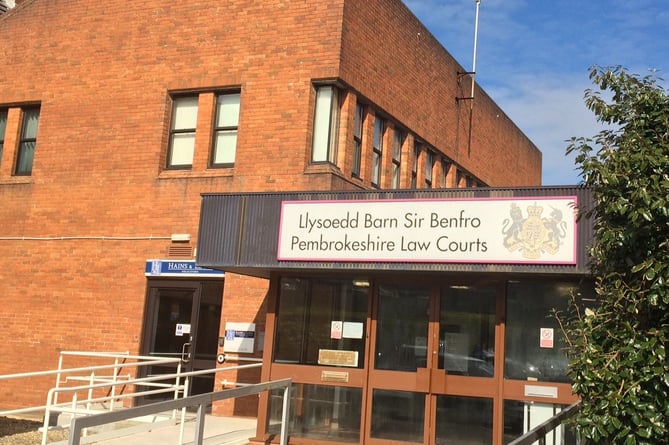
Case dismissed following hearing at Haverfordwest Magistrates’ Court
A MAN from Milford Haven has been cleared of a sexual assault allegation after magistrates ruled there was no case to answer.
David Fletcher, 45, of Chestnut Way, Mount Estate, appeared before Haverfordwest Magistrates’ Court on Monday (Mar 9).
He had been charged with sexual assault on a woman aged sixteen or over, contrary to section three of the Sexual Offences Act 2003.
The court heard the allegation related to an incident said to have taken place in Johnston, Pembrokeshire, on March 16, 2025.
Due to legal reporting restrictions, the complainant’s identity cannot be published under the Sexual Offences (Amendment) Act 1992.
During the hearing, the prosecution was represented by Dennis Davies, while Fletcher was represented by David Wheel of Welch & Co Solicitors.
After hearing the evidence presented by the prosecution, the magistrates ruled that there was no case to answer.
The bench, comprising Mrs J Morris, Mr C Pattison and Mr J Steadman, formally found Fletcher not guilty.
The case was dismissed and Fletcher was discharged.



Sport9 hours ago
France crowned Six Nations champions after extraordinary final-day drama
Ramos penalty in Paris seals title as Ireland fall just short and Wales end losing run FRANCE were crowned 2026...


News13 hours ago
Fishguard linked to allegations in Many Tears Animal Rescue investigation
Claims about puppies arriving through Pembrokeshire port emerge as licensing probe continues FISHGUARD has been named in allegations linked to...


Local Government1 day ago
Investigation confirmed after inspectors visit Many Tears Animal Rescue
Licensing authority declines to comment as police confirm attendance at Carmarthenshire rescue centre AN INVESTIGATION is underway following a visit...


Business2 days ago
Work set to begin on £50m hydrogen plant in Milford Haven
A MAJOR new hydrogen production facility worth around £50 million is expected to begin construction in Milford Haven later this...

Education4 days ago
Manorbier school closure approved while insurance claim still unresolved
Council confirms negotiations with insurer ongoing following 2022 fire PEMBROKESHIRE COUNTY COUNCIL has confirmed that negotiations with its insurer over...


Crime4 days ago
‘Knife attack’ at Spittal property leaves man in hospital
POLICE have arrested a woman following what is being described as a ‘knife attack’ at a property in Spittal on...

Community4 days ago
Pembrokeshire to receive its first banking hub in Pembroke Dock
LINK, the UK’s Cash Access and ATM network, has today announced local people and businesses in Pembroke Dock will benefit from a new banking...


Health6 days ago
Future of Withybush Hospital petition sparks urgent call for Senedd debate
CALLS have been made for an urgent debate in the Senedd over the future of services at Withybush Hospital as...


Sport6 days ago
Sean Bowen set for historic Welsh clash at Cheltenham Gold Cup
PEMBROKESHIRE jockey Sean Bowen could be part of a historic all-Welsh showdown when he lines up in the Cheltenham Gold...


Community6 days ago
Tenby still waiting as Wales hits 50 rural mobile mast upgrades
Seaside town plagued by signal congestion again absent from latest government-backed coverage improvements A NEW milestone in the UK Government’s...
-

 Health2 days ago
Welsh Ambulance Service to host bi-monthly Board meeting
-

 News1 day ago
Rayner and Lammy visit Wales to discuss justice and community safety
-

 Local Government4 days ago
Register now to vote in May’s Senedd election
-

 Crime6 days ago
Former Pembrokeshire Army officer stripped of MBE after fraud conviction
-
Community6 days ago
Tenby still waiting as Wales hits 50 rural mobile mast upgrades
-

 Community6 days ago
Carmarthenshire woman celebrates 100th birthday surrounded by family
-
Sport6 days ago
Sean Bowen set for historic Welsh clash at Cheltenham Gold Cup
-

 Crime5 days ago
E-bike rider who sped through pedestrian alley sentenced by court