


Health
Welsh adults using harmful habits to manage mental health


NEW POLLING shows more than two-thirds of adults in Wales are using potentially harmful coping mechanisms when feeling stressed, anxious or low.
The Mental Health Foundation said the findings, released for Mental Health Awareness Week, show a need for the new Welsh Government to prioritise prevention and action on poor mental health.
The survey found that 69% of adults in Wales had taken harmful actions to cope with their mental health in the past month.
More than a third, 36%, said they had spent time isolating themselves from others, while 34% reported spending more time scrolling social media or going online as a way to deal with anxiety, stress or low mood.
Other commonly reported behaviours included comfort eating or overeating, at 27%, and oversleeping or not getting out of bed, at 31%.

The Mental Health Foundation said these behaviours were concerning because evidence suggests they can make mental health worse over time.
However, the polling also found that many people in Wales are taking positive steps to support their wellbeing.
More than four in five adults, 84%, had taken at least one helpful action to support their mental health. The most common were accessing nature, at 41%, doing something enjoyable such as a hobby, at 37%, and taking part in physical activity or prioritising sleep and rest, at 35%.
The poll of 1,015 people in Wales was carried out by Opinium on behalf of the Mental Health Foundation. It was released to mark Mental Health Awareness Week, which runs from May 11 to 17.

Catherine Razzell, Policy and Public Affairs Manager at the Mental Health Foundation, said: “This polling tells us that, here in Wales, there is a concerning degree of harmful actions taken by people as a way of dealing with their feelings of poor mental health, such as doomscrolling or overeating.
“We are hopeful to see positive actions being taken by individuals to help maintain and improve good mental health. Tried and trusted activities such as connecting with nature, which many of us are fortunate to have access to in Wales, and taking part in physical exercise and rest, in equal measure, are all known to support our mental health.”
Calls for action
The polling found that nearly two-thirds of people in Wales, 64%, are using at least one harmful coping mechanism alongside positive actions.

Only one in five, 20%, reported taking only helpful actions to support their mental health.
The Mental Health Foundation said the results come at a significant moment following the Senedd election, with a new Welsh Government now in place.
Ms Razzell added: “Whilst it is good news people are finding ways to prioritise and protect their mental health and support those around them, more action is needed from our governments to create the conditions to support good mental health.
“We are seeing a once in a generation change politically in Wales. We are one year into the new ten-year mental health strategy for Wales and are keen to see how the new government will implement and resource this.
“In addition to a resourced focus on prevention, which we know has long-term economic benefits, we know that inequalities exist here that are huge barriers to good mental health, keeping people locked in poverty for generations.
“We want to see these issues tackled head-on by the new government for Wales. Now is the time for action and not talk.”
Mental Health Awareness Week is run by the Mental Health Foundation. This year’s theme is “Action”.


HEALTH chiefs are marking International Nurses Day by celebrating the vital contribution made by nurses across mid and west Wales.
Hywel Dda University Health Board said the day, held each year on May 12, is an opportunity to recognise the work nurses do for patients, families and communities.
This year’s theme is Empowered Nurses Save Lives, reflecting the role nurses play in delivering high-quality, compassionate care, often in challenging circumstances and at some of the most critical moments in people’s lives.
Nurses work across a wide range of settings, including hospitals, community services, primary care, education, research and leadership.
The health board said supporting and empowering the nursing workforce is key to enabling nurses to use their skills fully, continue to develop professionally, and lead improvements in care.
Sharon Daniel, Executive Director of Nursing, Quality and Patient Experience at Hywel Dda University Health Board, said: “International Nurses Day is an important opportunity to recognise the incredible difference our nurses make every single day.
“Empowered nurses save lives, and we see this through the skill, compassion and professionalism shown across our services.
“As we review our Nursing and Midwifery Strategic Framework, Empowered to Care, this is a timely moment to reinforce our commitment to supporting the nursing profession to grow, lead and shape services throughout their careers.
“When our staff feel valued, trusted and supported, teams are stronger and patient care is safer and more effective.”
The health board said nursing is founded on teamwork, with nurses working at the heart of multi-disciplinary teams alongside medical colleagues, allied health professionals and others to deliver joined-up, person-centred care.
It said the approach supports its wider ambition of improving health and wellbeing and providing care closer to home.
International Nurses Day is also being used as an opportunity to thank the nursing and midwifery workforce for their dedication, expertise and commitment to caring for others.


Two Welsh patients say free online programmes helped them manage anxiety and stress
TWO people who transformed their mental wellbeing with the help of NHS Wales’ online support services are encouraging others to seek help during Mental Health Awareness Week.
Kate, 39, from Cardiff, and George Ryley, 27, from Aberystwyth, both say free online self-help programmes helped them regain control during difficult periods in their lives.
The pair were supported through SilverCloud Wales, a suite of digital mental health programmes based on Cognitive Behavioural Therapy, managed by Powys Teaching Health Board.
The stories are being highlighted as part of Mental Health Awareness Week, which this year focuses on the theme of “Action”.
Parental anxiety
Kate sought help after her young son began suffering febrile seizures, triggering severe anxiety that quickly escalated.
“My chest would tighten and I’d get this feeling like a wave of nausea,” she said. “I couldn’t eat, couldn’t focus.”
She described becoming consumed by fear, constantly checking on her son and worrying about possible seizure triggers.
“I was so distracted at work that I had to stay behind after hours, and at home I didn’t feel I was always present with my son in the right way,” she said.
After speaking with her GP, Kate was diagnosed with parental anxiety and referred to SilverCloud’s “Space from Anxiety” programme.
She said the flexibility of the online course made it easier to fit around family life.
“I could do it in the evening when my son had gone to sleep, or during breaks in the day. It worked around me,” she said.
Kate says she still regularly uses mindfulness, breathing exercises and writing techniques she learned through the programme.

“I haven’t had a single anxiety attack since I started it,” she added. “I’ve not looked back.”
Stress and illness
Meanwhile, Aberystwyth resident George Ryley turned to the service after work pressures and illness left him physically and mentally exhausted.
“I was used to being busy and active,” he said. “Then suddenly, even having a shower would sap all my energy for the day.”
George said a period of poor health linked to mould toxicity left him bed-bound for several weeks and badly affected his mental wellbeing.
After contacting his GP, he was referred for counselling and encouraged to try SilverCloud’s “Space from Stress” programme.
“I didn’t have the most positive mindset at first,” he said. “But as I worked through it, I was amazed at how effective it was.”
Each SilverCloud user is assigned a dedicated supporter who provides encouragement and advice throughout the course.
“Having such lovely feedback on my progress was really motivating,” George said.
“I’ve recommended SilverCloud to so many people who I know have been struggling with stress.”
Taking the first step
Fionnuala Clayton, project manager for NHS Wales’ Online CBT Service, said the stories showed how small actions could make a major difference.
“This Mental Health Awareness Week reminds us that action doesn’t have to be dramatic or overwhelming – sometimes it’s simply about taking that first step to seek support,” she said.
“SilverCloud Wales gives people the tools to understand their thoughts, manage anxiety and stress, and build resilience in a way that fits around busy working and family lives.”
SilverCloud Wales is free to access through NHS Wales and can be used on phones, tablets or laptops.
The service is not intended as a crisis support platform or for those requiring high levels of intervention.
People can sign up at nhswales.silvercloudhealth.com/signup.

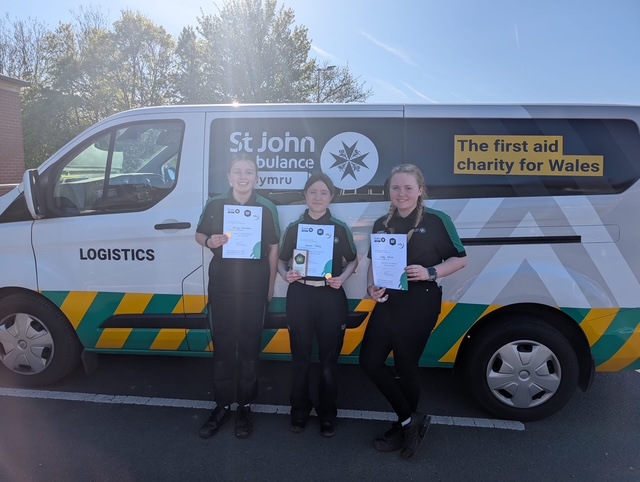
ST JOHN AMBULANCE is proud to share that three local St John Ambulance cadets have been crowned National First Aid champions after competing against eight other cadet teams representing counties across Wales.
The team, comprising Emily Williams (Yr 10, Ysgol Bro Gwaun), Ruby Collins (Yr 10, Ysgol Henri Tudor), and Gemma Tilbury (Yr 11, Ysgol Henri Tudor) represented the whole of Dyfed, and demonstrated exceptional skill, teamwork, and composure throughout three demanding rounds.
The competition consisted of a first aid knowledge quiz and exam, followed by a practical skills challenge assessing communication, teamwork, and the ability to perform under pressure—an area in which they excelled. The final round featured a complex, theatrically produced first aid scenario. Here, the team showed remarkable calm and professionalism as they stabilised a casualty with a severe compound bleed involving a large object lodged in the wound. They also managed distressed and aggressive members of the public, and successfully resuscitated an unresponsive, non-breathing casualty using CPR and a defibrillator—all completed in record time.
In Pembrokeshire, cadets train every Monday evening during term time from 5:45–7:15pm, with sessions focussing on practical, hands-on learning of real-life first aid skills, including CPR, defibrillator use, treatment of severe wounds, allergic reactions, choking, strains and sprains, head injuries, heart attacks, hypothermia, and much more. Training is engaging and interactive, often involving active, game-based learning, ensuring there is rarely a dull moment.
Cadets also have the opportunity to support a wide range of events delivered by St John Ambulance Cymru. Working alongside adult volunteers and healthcare professionals, they engage with the public at events of all sizes, applying their skills in real-world, and sometimes life-saving, situations.
Beyond events, cadets are encouraged to share their knowledge within the community, helping to lead first aid demonstrations and inspire others. Previous outreach has included sessions with Scouts, Cubs, Brownies, and Girlguiding groups, as well as senior community organisations such as the Pembroke Lions and specialist charities like Pembrokeshire People First. On a larger scale, cadets played a key role in organising and delivering “Defibruary,” where they helped lead a team of St John first aiders to train over 950 students at Henri Tudor in a single day in February 2026.
If you are interested in volunteering, opportunities are available for cadets aged 11–16 and adults aged 16+. We are always keen to welcome new members and are happy to discuss opportunities for adults to support the cadet programme as youth leaders.
To find out more visit https://www.sjacymru.org.uk/volunteer



News1 hour ago
Starmer fights for survival as Labour civil war erupts
Cabinet split, ministers resign and MPs revolt as pressure mounts on Prime Minister after disastrous election losses KEIR STARMER is...


News24 hours ago
Starmer accused of ignoring Wales in major ‘reset’ speech
Prime Minister pledges EU reset, British Steel nationalisation and youth jobs guarantee — but critics say Wales was left out...


Community2 days ago
Concern grows after child hospitalised following Tenby sea swim
PARENT SAYS BOY BECAME SERIOUSLY ILL AFTER SWIMMING DURING FAMILY VISIT CONCERN is growing in Pembrokeshire after a parent claimed...


News2 days ago
Rhun prepares for clash with Starmer as Plaid eyes power in Cardiff Bay
PLAID CYMRU leader Rhun ap Iorwerth has signalled he is ready for confrontation with Prime Minister Keir Starmer after the...


News3 days ago
Plaid Cymru celebrates historic victory as Rhun ap Iorwerth arrives at Cardiff Bay
CROWDS gathered outside the Senedd as Plaid Cymru leader Rhun ap Iorwerth arrived in Cardiff Bay following his party’s historic...


Crime3 days ago
Police standoff ends after four-hour incident in Pembroke Dock
ELIZABETH COURT SCENE STOOD DOWN AFTER DOMESTIC INCIDENT A FOUR-HOUR police standoff in Pembroke Dock has ended with a 21-year-old...


Crime3 days ago
Teen denies attempted murder of Milford Haven teacher
TEENAGER REMANDED AHEAD OF JULY TRIAL A 15-YEAR-old boy has denied attempting to murder a teacher during a stabbing incident...


News4 days ago
Catastrophe for Labour as Plaid and Reform reshape Welsh politics
ELUNED MORGAN LOSES SEAT AS OLD CERTAINTIES ARE SWEPT AWAY THE VOTERS of Wales have delivered one of the most...


News4 days ago
Labour wiped out in Ceredigion Penfro as Plaid tops poll and First Minister loses seat
Shock result sends political shockwaves across Wales as Reform also surges in historic Senedd count LABOUR suffered one of the...


News4 days ago
Labour deputy says party ‘will not form next Welsh Government’
LABOUR FACES HISTORIC DEFEAT AS COUNTING CONTINUES ACROSS WALES LABOUR’S Deputy Leader in Wales has effectively conceded the Senedd election,...
-

 News7 days ago
Baby in critical condition after Fishguard emergency
-

 News6 days ago
Former housing officer admits drink-driving in Pembrokeshire retail park
-
 Crime6 days ago
Job loss threat for convicted Pembrokeshire drug-driver
-

 Crime6 days ago
Milford motorist disqualified for drug-driving
-

 Crime6 days ago
Police tip-off leads to driving ban for Milford motorist
-

 Crime5 days ago
Racial abuse suspect barricaded himself inside Johnston lodge
-

 Community6 days ago
Sixth-former firefighter balances schoolwork with saving lives
-
 Crime6 days ago
Delivery driver caught twice over legal drink-drive limit