


Sport
Neyland win Harrison Allen Bowl

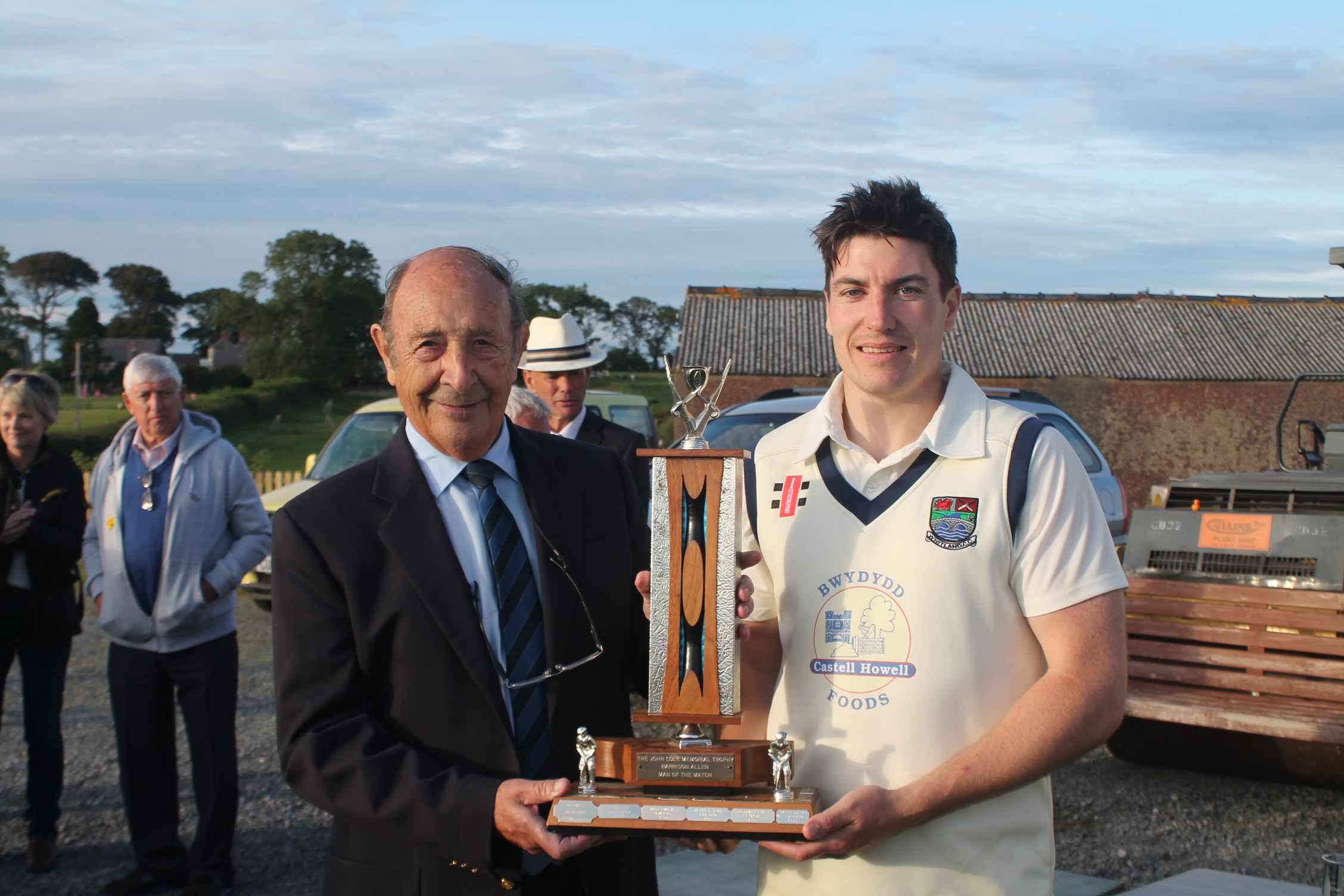
NEYLAND won the Harrison Allen Bowl for the seventh time in their club’s history after they beat Whitland with the last ball of the match in a dramatic final on Saturday, August 1.

Winning Captain: Gregg Miller lifts the Harrison Allen Bowl
Needing 111 to win, Neyland struggled and Whitland capitalised taking eight wickets.
However, Sean and Patrick Hannon remained steady and Patrick hit a four with the last ball to spark scenes of joy amongst the Neyland team and supporters.
Speaking after the match and of his last ball heroics, Patrick Hannon said: “Whitland brought the field in and I was looking to hit it over the top. Thankfully it went straight over and for four.
“Whitland did fantastically well, nobody would have believed, defending 111, that Whitland could have come close. Their bowlers did extremely well so all credit to them.

“This win is fantastic and it means a lot to us. We lost someone close to us earlier in the season in Martin “Ceefax” Rees so we want to dedicate this victory to him.”
Neyland skipper Gregg Miller accepted the Harrison Allen Bowl and also dedicated the win to Martin and thought back tears as he spoke of him.
Earlier in the day, Neyland won the toss and elected to bowl first, meaning they would be batting last.
The game was played at Cresselly Cricket Club in front of a good crowd and despite a short rain break, they enjoyed a thrilling game of cricket.

Paul Davies and Dylan Blain opened the batting for Whitland and made a good start but in the third over, the pair went for two runs but Davies came up short and he was run out.
Kevin Pearce was the new man but was soon sent back as he was caught by Patrick Hannon to leave Whitland 27-2.
Blain was joined at the crease by Jonathan Thomas and the pair put on twenty runs for the third wicket before Blain departed after hitting the ball straight to Nick Koomen on the boundary who made no mistake with the catch.

Iestyn Scourfield then found Patrick Bellerby on the ropes to leave Whitland on 57-4.
Thomas and Leighton O’Connor then shared 33 for the fifth wicket to put Whitland in a good position.
However, Thomas was clean bowled by Andrew Miller and he was sent back to the pavilion having made 31.
O’Connor then hit two sixes but was unlucky on the third occasion as he picked out Nathan Banner and Whitland were now 105-6.
Nathan Banner was brought into the attack and he soon removed Whitland captain Matthew Davies before 2 wickets in as many balls reduced them to 117-9.
Whitland could only add a further eight runs, finishing on 125-9 from their opening 22 overs.
Nathan Banner started the Neyland innings like a house on fire as he made 18 in the first two overs but he was undone and Whitland had their first wicket.
Gregg Miller and Ashley Sutton then took Neyland to 59-1 in the tenth over before rain interrupted.
After taking an early tea, play resumed and it didn’t take long for Sutton to get going as he hit a six from the fourth ball of the over.
Whitland’s Wayne Howells then took two crucial wickets as first he got rid of Gregg Miller for 48 before trapping Sutton Leg before wicket.
Nick Koomen played well in a brief cameo of 24 before another cameo, including two sixes off the last two balls, of 21 from Henry Durrant took Neyland to 154-5, a lead of 29 runs.
Whitland knew they would have to bat well early on in their second innings to clear the deficit and they reached it in the fourth over having lost one wicket.
They were going along at a steady pace and reached 60-2 in the ninth over, a lead of 31.
Jonathan Thomas then hit two big sixes as Whitland looked to get going again but that momentum was soon checked.
Thomas went for another big shot but he was caught on the boundary by Patrick Bellerby.
Three more wickets fell in quick succession, two to Andrew Miller and Whitland were left reeling on 86-6.
Scott Newton and Matthew Davies looked to keep the scoreboard ticking but Newton then hit the ball straight back to Andrew Miller who took the catch.
Whitland had moved on to 115-7 but only lead by 86 and knew they would need more to have a chance of winning the game.
Gregg Sleep was the new man but he was clean bowled having made 9 but Whitland’s lead had crept up to 99.
Disaster then struck for Whitland as captain Matthew Davies, on a score of 25, went for a single but he was sent back but he couldn’t get back in time and was unfortunately run out.
Mark Lee and Wayne Howells saw out the remaining overs as Whitland finished on 139-9, meaning Neyland would need 111 to win.
Some precise bowling early on restricted Neyland to 19-0 after the first five overs and things soon got worse.
Mark Lee bowled Gregg Miller for four before Ashley Sutton hit the ball back to Lee and he was sent back without scoring with Neyland on 21-2.

Out: Gregg Miller is bowled as the momentum swung in Whitland’s favour
Nathan Banner and Nick Koomen steadied the ship taking Neyland to 51-2 after 12 overs.
Banner was then out for 17 as he was caught on the boundary having made 17.
They then took 13 off one over, Koomen hitting a six and four to move on to 44, to move on to 85-3 but the momentum soon swung back in Whitland’s favour.
Andrew Miller was caught by Wayne Howells off the bowling of Jonathan Thomas and Neyland were 85-4.
Nick Koomen was still in on 44 but he attempted a sweep shot which proved to be his downfall as he missed and was given out LBW by the umpire.

Important knock: Nick Koomen’s 44 was crucial for Neyland
With the very next ball Patrick Bellerby walked down the wicket but missed the ball completely and keeper Blain had the easiest of stumpings and suddenly, Neyland were 86-6.
Henry Durrant departed soon after as he was caught on the boundary by Kevin Pearce off the bowling of Leighton O’Connor to leave Neyland on 99-7.
Jonathan Thomas then bowled Scott Jones and Neyland were 104-8.
That meant they would need seven off the last over. Try as they might they could not remove the Hannon brothers. They took five off the first five balls of the final over and the scores were level.
Whitland brought their field right in to save the single but Patrick Hannon lofted the ball back over the bowlers head for four and Neyland had won by two wickets.
It was a closely thought game and Whitland will be disappointed to lose in the way they did but can be proud of the fact that they came close to upsetting the odds.
Whitland’s Jonathan Thomas was named man of the match for his efforts but that will come as consolation to an unlucky Whitland side.

Man of the Match: Whitland’s Jonathan Thomas was named Man of the Match
For Neyland it is their second trophy this season after winning the Duggie Morris Cup and their seventh success in the Harrison Allen tournament.



A PLANNED extraordinary general meeting of the Welsh Rugby Union could now be called off after the district that pushed for it said its main objectives had been achieved following two high-profile departures from the game’s leadership.
Central Glamorgan Rugby Union had secured enough backing from clubs to force the WRU into holding the meeting on Monday, April 13. The district had tabled three motions, including votes of no confidence in WRU chair Richard Collier-Keywood and Professional Rugby Board chair Malcolm Wall.
But the district has now written to clubs saying it intends to withdraw all three motions, arguing there is no longer a need for the EGM in its current form. That follows confirmation that Collier-Keywood will step down on July 16 after deciding not to seek a second term, while Wall left his role in March at the end of his tenure.
In its letter, Central Glamorgan said the exits of both men, together with the prospect of fresh talks with the WRU board over governance reform, meant the campaign had already achieved its key aims. The district said it now wanted constructive engagement with the WRU over future governance changes, including the way council representatives are elected to the board.
A WRU spokesperson said the union was aware of the letter sent to member clubs and was awaiting direct correspondence from Central Glamorgan.
The row had developed against the backdrop of deepening unrest in Welsh rugby over the WRU’s controversial proposal to reduce the number of professional teams from four to three by June 2027. Those plans have triggered fierce criticism, protests and legal action, particularly over fears for the future of the Ospreys.
While the latest letter did not directly settle that issue, Central Glamorgan urged the WRU to pause its plans for the professional game and publish all the evidence behind any decision before moving forward. The district also called on the union to engage with an alternative proposal aimed at preserving all four professional sides.
Central Glamorgan thanked clubs across Wales for their support, saying they had come together to safeguard the future of the game. The district added that Welsh rugby remained at a critical moment, but said it hoped the latest developments would lead to greater openness, respect and transparency between the WRU and its member clubs.
I can also give you a sharper Herald-style headline and subheadline for this.


AMMAN UNITED’S crucial Division 3 West clash with Neyland was abandoned after 70 minutes on Wednesday night following a fight on the touchline.
The home side had led 20-12 under the lights at Cwmamman Park and were on course for a vital win that would have kept alive their hopes of survival.
Amman made the brighter start and enjoyed most of the territory and possession in a strong first-half display. They went ahead within minutes when wing Dan Thomas crossed in the corner.
Outside half Iestyn Griffiths then extended the lead with a well-struck penalty as the Reds continued to dominate. Jordan Poole, Keelan Griffiths and Alun Lewis all made good ground, and Amman looked certain to score again at one stage, only to be held up over the line.
Neyland, however, hit back against the run of play. Scrum half Owen Hamer seized on turnover ball, stepped clear of the defence and raced in from halfway. Rio Phillips added the conversion to cut the gap.

Amman responded well and regained control before the break. From a lineout catch-and-drive, front row forward Matthew Madge powered over, with Griffiths converting to give the hosts a deserved 15-7 lead at half-time.
The home side made full use of their bench after the restart, with Kieran Mackey, Caian Francis, Liam Brooks and Alex Williams all introduced. Youngster Harvey Duncan also came on in the centre for just his second senior appearance.
Captain Rhydian Jones again impressed with a tireless display around the park as Amman piled further pressure on the Neyland try line. That spell was rewarded when wing Dylan Matthews squeezed over in the far corner to make it 20-7.
To their credit, Neyland then enjoyed their best spell of the game, forcing Amman onto the back foot with sustained pressure under the posts. Centre George Williams and wing Josh Watts were prominent as the visitors went through the phases, but Amman’s defence held firm for long periods.
The visitors eventually found a way through when flanker Josh Hamer spotted a gap and touched down under the posts to bring the score back to 20-12.
But before the conversion could be taken, a fight broke out on the touchline. Once order had been restored, the referee decided to abandon the match immediately.
The game will now have to be replayed at a later date.


Mared Pemberton leaves board role after years of service
HAVERFORWEST COUNTY AFC has confirmed that Mared Pemberton has stepped down from her role as Vice-Chair of the Board of Directors due to personal commitments.
Pemberton has played a key role in the club’s development in recent years, most notably leading the delivery of the Ogi Bridge Meadow 3G pitch project.
She has also been closely involved in the club’s community work and fan engagement initiatives, helping to strengthen its reputation and position as a focal point within the local area.
Pemberton will continue her involvement with the club as Head of Trustees for the Bluebirds Foundation, the official charitable arm of Haverfordwest County AFC.
A club spokesperson said: “Everyone at the club would like to thank Mared for her loyalty, hard work and dedication over many years, and we wish her well for the future.”



Health1 hour ago
No jobs for new paramedics in Wales as graduates told to apply for technician roles
Students trained at public expense urged to take lower-grade jobs as anger grows over NHS workforce planning NEWLY qualified paramedics...


News21 hours ago
Health minister refuses to act on Withybush despite 15,000-signature petition
Senedd pressure grows as Welsh Government declines to intervene over surgery fears THE WELSH GOVERNMENT has refused to step in...


Business1 day ago
Fishguard to Wexford rail tunnel plan backed by Elon Musk firm
Six-hour London to Dublin service proposed in £32bn project ahead of Senedd election PLANS for a rail tunnel linking west...


Charity2 days ago
Milford Haven charity honoured with King’s Award for voluntary service
A PEMBROKESHIRE charity supporting vulnerable young people has received one of the highest honours in the UK for voluntary work....


News3 days ago
Plaid Cymru launches bid to lead next Welsh Government
Party positions itself as ‘government-in-waiting’ ahead of May election PLAID CYMRU has formally launched its campaign for the 2026 Senedd...


Crime3 days ago
Police appeal after attempted child abduction in Haverfordwest
DYFED-POWYS POLICE has launched an appeal for witnesses following a reported attempted abduction of a 12-year-old girl in Haverfordwest. The...


Crime4 days ago
Gunshot fired by police during incident in Milford Haven
A POLICE officer discharged a firearm during an incident in Milford Haven on Saturday evening (March 28), prompting an investigation...


Community5 days ago
Three Amigos Easter Run roars through Pembrokeshire
MOTORCYCLE enthusiasts turned out in force today (Saturday, March 28) as the popular Three Amigos Easter Run returned to the...


Education6 days ago
Ysgol Henry Tudor reassures parents over Sikh ceremonial kirpan
School says religious item worn by pupil is secured, symbolic and non-functional YSGOL HENRY TUDOR has moved to reassure parents...

Crime7 days ago
Teen jailed after starting fire while others slept
Fire set in shared home left sleeping residents at risk and caused £130,000 damage A TEENAGER who started a fire...
-

 Community7 days ago
Hero female officer keeps job after sexual touching finding
-

 Business7 days ago
Popular Italian restaurant hit with £278,000 tax bill plus £186,000 fine
-
Education6 days ago
Ysgol Henry Tudor reassures parents over Sikh ceremonial kirpan
-

 Climate7 days ago
Port Talbot confirmed as ‘cornerstone’ for wind — questions remain for Milford Haven
-
 Crime6 days ago
Taylor wins appeal as Crown Court quashes ‘no insurance’ conviction
-

 News7 days ago
Tenby waterman riding high in global hydrofoil rankings
-

 Climate7 days ago
Wind hub row: Where are Milford Haven’s jobs?
-

 Crime6 days ago
Appeal dismissed in blood sample case after court rejects PTSD defence