


News
Buccaneers sponsored swim

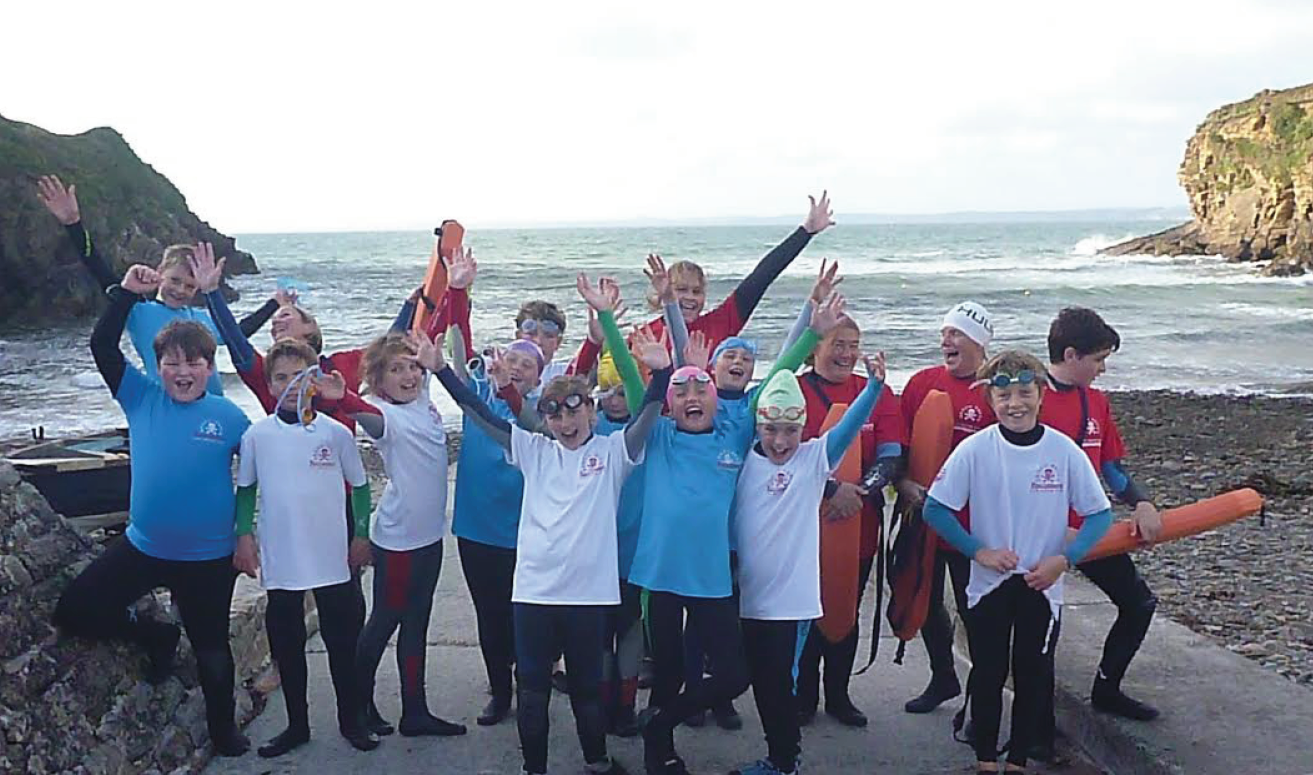

Big smiles: Swimmers enjoy sponsored swim
TO END their season, 12 swimmers from Broad Haven School’s Beach Life Saving Club, The Broad Haven Buccaneers, recently took part in their annual sponsored swim from Little Haven Point to the slipway.
The sea conditions were challenging to even the more experienced Buccaneers with a large swell and westerly wind but with support and encouragement from instructors and volunteers, all swimmers completed the challenge. The faster members completed the swim in a matter of minutes with Travis Christopher-Mullin taking the boys trophy and Ffion Williams taking the girls.
The event was kindly sponsored by Phil Rees at PRAg. Thanks to Chris Vane at The Castle Little Haven for providing hot chocolates for all of the swimmers. The swimmers, aged between 9 and 11, raised £345.20 for Buccaneers and Little and Broad Haven Lifeboat. Sue Christopher, Buccaneers instructor said she would like to thank to all swimmers and parents for their support.
If you would like to know more about Buccaneers or make a donation, please contact Broad Haven School on 01437 781404


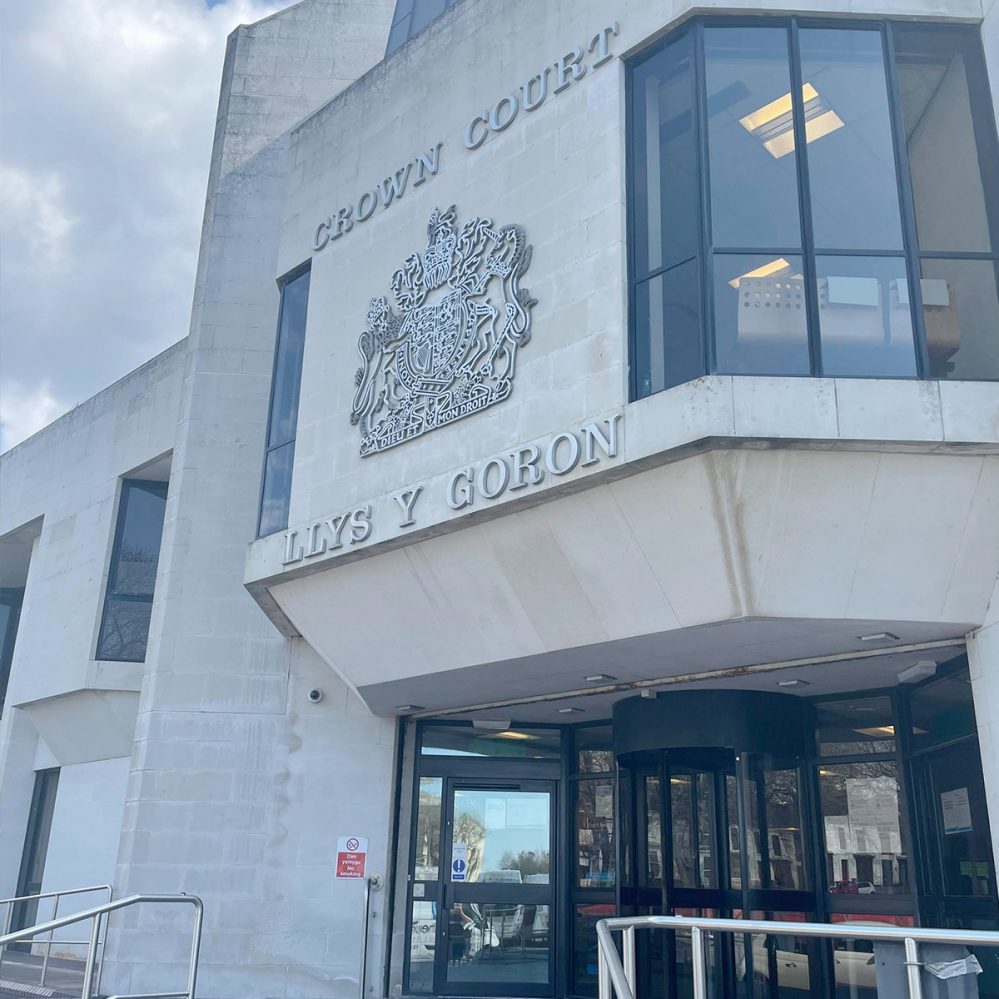
The jury was not sure the teenager intended to kill his teacher, but found that he deliberately intended to cause her really serious harm
TO MANY people, the verdicts returned in the Milford Haven School stabbing trial may initially appear contradictory.
How could a teenager be cleared of attempting to murder his teacher, but convicted of causing grievous bodily harm with intent over the same incident?
The answer comes down to one precise legal distinction.
The jury was not sure that the teenager intended to kill Vicki Williams.
However, by an 11-1 majority, jurors were sure that he intended to wound her or cause her really serious harm.

The verdict therefore does not mean the jury considered the incident accidental, minor or simply reckless.
It means the prosecution proved a deliberate intention to cause serious injury, but did not prove an intention to kill beyond reasonable doubt.
The crucial difference between the charges
Attempted murder is a particularly difficult offence to prove because the prosecution must establish a specific intention to kill.
It is not enough to show that someone used a deadly weapon, carried out an extremely dangerous act or created an obvious risk of death.

The jury must be sure that death was the intended outcome.
By contrast, causing grievous bodily harm with intent, an offence under section 18 of the Offences Against the Person Act 1861, requires proof that the defendant intended to wound someone or cause really serious bodily harm.
That distinction is confirmed by Crown Prosecution Service guidance. Attempted murder requires an intention to kill, while a section 18 offence requires an intention to cause grievous bodily harm or a wound.

In straightforward terms, the verdict means:
The jury was sure he meant to cause serious injury, but was not sure he meant to cause death.
Why the attempted murder acquittal does not mean the jury believed it was an accident
The defence argued that Mrs Williams was injured during a struggle after she saw the knife and attempted to take control of it.
The guilty verdict on the section 18 charge means the majority of the jury cannot have accepted that the injuries were entirely accidental.
Nor did jurors merely find that the teenager had behaved recklessly or intended only to frighten the teacher.
To convict on count two, they had to be sure that he possessed the higher intention required for one of the most serious non-fatal offences in law.
The verdict therefore establishes that the teenager deliberately intended to wound Mrs Williams or cause her really serious harm.
What it does not establish is that he intended her to die.
What might have caused doubt about an intention to kill?
Juries do not explain their verdicts, and it would be wrong to claim that we know exactly what happened during their discussions.
However, the competing arguments presented during the trial show where the distinction may have arisen.
The prosecution relied on evidence that the teenager had brought a large kitchen knife into school, carried it in his bag, returned to Mrs Williams’ classroom and closed the door before the incident.
Mrs Williams suffered an injury to her head and wounds to her hands, which the prosecution said were defensive injuries.
The Crown argued that the teenager had selected the knife and deliberately waited until the end of the school day to attack her while she was alone.
The defence pointed to the absence of an obvious motive, disputed the prosecution’s interpretation of the physical evidence and argued that the teenager had not continued the alleged attack when he could have done so.
His barrister told jurors that, if the teenager had genuinely intended to kill Mrs Williams, there had been opportunities to inflict further injuries.
The jury may have accepted that the knife was deliberately used to cause serious harm while remaining unsure that the teenager had formed a settled intention to end Mrs Williams’ life.
That is an inference from the verdict, rather than a known account of the jury’s deliberations.
Does not guilty mean innocent?
A not guilty verdict means the prosecution failed to make the jury sure of the particular offence charged.
It does not necessarily mean every juror was convinced that the defendant had no intention to kill.
There may simply have been reasonable doubt.
In this case, the jury’s decision on count two makes clear that it did not regard the classroom incident as innocent conduct.
The teenager was convicted of intentionally causing the type of harm covered by section 18.
Why was the guilty verdict 11-1?
Criminal juries are initially directed to try to reach unanimous verdicts.
After jurors have deliberated for a sufficient period, a judge may permit them to return a majority verdict.
Judge Paul Thomas KC indicated that he was prepared to accept a verdict on which at least ten jurors agreed.
When the jury initially reported that ten members were in agreement, he asked them to return to the jury room and make another effort to reach unanimity.
They later returned and convicted the teenager on count two by a majority of 11 to one.
That verdict is every bit as valid as a unanimous verdict.
It tells us that 11 jurors were sure he intended to cause really serious harm. It does not tell us why the remaining juror disagreed.
The division on the attempted murder charge has not been publicly stated and should not be assumed.
What sentence could he receive?
Causing grievous bodily harm with intent carries a maximum adult sentence of life imprisonment.
That maximum, however, gives little indication of the sentence likely to be imposed in this case.
The adult sentencing guideline contains an overall range of between two and 16 years. It categorises cases according to the offender’s culpability and the physical and psychological harm caused to the victim.
Planning or premeditation and the use of a highly dangerous weapon can indicate high culpability. The guideline specifically states that a knife may be considered a highly dangerous weapon, depending on the circumstances.
Where the injury falls within the lowest of the three adult harm categories but culpability is high, the adult starting point is five years, with a range of four to seven years.
A higher category could apply if the judge finds that Mrs Williams suffered grave, permanent or substantial long-term physical or psychological harm.
But the teenager must not be sentenced as an adult.
He was 15 at the time of the incident and is now 16. The court must consider his chronological age, maturity, emotional and developmental age, mental health, personal circumstances and capacity to understand the consequences of his actions.
The youth sentencing guideline says courts may use roughly one-half to two-thirds of the equivalent adult sentence for offenders aged 15 to 17. It stresses that this is only a broad guide and must never be applied mechanically.
No reduction will be available for a guilty plea to count two because the teenager denied that charge and was convicted following a trial.
A sentence of several years in youth detention is therefore a realistic possibility.
It would, however, be premature to give a firm prediction such as three, four or five years.
The final result will depend on matters that have not yet been made public, including the pre-sentence report, any psychological or psychiatric assessments, the victim impact evidence and the judge’s conclusions about planning, maturity and future risk.
Could he receive a life sentence?
A life sentence is legally possible for the section 18 offence, but it is not the normal or automatic result.
For a child to receive extended detention or detention for life under the dangerous offender provisions, the court would have to find a significant risk that he would cause serious harm by committing further specified offences.
An extended sentence also requires the appropriate custodial term to be at least four years. Detention for life is regarded as a last resort where an extended sentence would not provide sufficient public protection.
There is currently not enough public information to suggest that such a finding will be made.
The more likely sentencing question is how many years of youth detention are required to reflect the seriousness of the offence while also recognising the defendant’s age and prospects of rehabilitation.
The judge cannot sentence him for attempted murder
The attempted murder acquittal places an important limit on sentencing.
Judge Thomas must sentence the teenager for the offence of which he was convicted.
He cannot impose punishment on the basis that the teenager intended to kill Mrs Williams, because the jury did not find that allegation proved.
The judge may consider planning, the use of the knife, the intended level of injury, the effect on Mrs Williams and the wider consequences for the school.
But those findings must remain consistent with the verdict that the teenager intended serious harm, not that he intended death.
Why has sentencing been adjourned?
The teenager is due to be sentenced on Thursday, September 3.
The adjournment allows reports to be prepared examining his background, maturity, mental health, risk, behaviour and prospects of rehabilitation.
The court will also consider the physical and psychological consequences for Mrs Williams and the wider impact of the incident.
Youth sentencing must be individualised. Custody is formally described as a last resort for children, although the seriousness of this conviction means a custodial sentence appears highly likely.
The verdict explained in one sentence
The jury was sure the teenager deliberately intended to cause Mrs Williams really serious harm, but was not sure that he intended to kill her.
That is why the two verdicts are legally consistent.
The attempted murder acquittal does not mean the incident was considered accidental. The section 18 conviction means the majority of the jury found that serious injury was intended.
The teenager will be sentenced at Swansea Crown Court on September 3.


Jury returns 11-1 majority verdict on charge of causing grievous bodily harm with intent, with sentencing set for September 3
A TEENAGE boy has been cleared of attempting to murder a teacher at Milford Haven School but found guilty of causing grievous bodily harm with intent.
The 16-year-old, who cannot be named for legal reasons, was convicted at Swansea Crown Court on Monday afternoon following a trial lasting more than two weeks.
The jury returned a not guilty verdict on count one, attempted murder.
On count two, causing grievous bodily harm with intent, the teenager was found guilty by a majority verdict of 11 to one.
Before the verdicts were delivered, Judge Paul Thomas KC warned those inside the courtroom that they must remain silent regardless of the outcome.
He said: “Those verdicts must be met in absolute silence, whether it is the verdict you want or don’t want. The dignity of the court must be maintained.”
The judge had earlier indicated that he was prepared to accept majority verdicts after the jury was unable to reach unanimous decisions.
At one stage, the court was told that ten jurors were in agreement. Judge Thomas asked the jury to return to the deliberation room and make a further effort to reach unanimous verdicts.
The jury later returned to court and delivered the not guilty verdict on the attempted murder charge and the 11-1 guilty verdict on the second count.
The case relates to a knife incident at Milford Haven School on February 5, 2026, in which teacher Vicki Williams suffered injuries inside a classroom.
During the trial, the prosecution alleged that the teenager had brought a large kitchen knife into school and deliberately attacked the teacher.
The defence denied that the boy had intended to kill or seriously injure her and argued that the injuries occurred during a struggle over the weapon.

The teenager had previously admitted possessing a knife on school premises.
He will be sentenced at Swansea Crown Court on Thursday, September 3.
Further details from the hearing will follow.

Battle scenes, cavalry displays and a surrender procession brought one of Pembrokeshire’s most extraordinary stories back to the streets
MUSKET fire, mounted soldiers and marching French troops transformed Fishguard and Goodwick at the weekend as Britain’s last invasion was brought dramatically back to life.
Visitors gathered across the twin towns on Saturday and Sunday (July 18 and 19) for a large-scale re-enactment of the failed French invasion of 1797, the last occasion on which a hostile foreign army landed on mainland Britain.

The free two-day event featured living-history camps, military demonstrations, cavalry displays and staged fighting before reaching its climax with the surrender of the invading French force.
Costumed soldiers representing the French and British armies established military camps where visitors could see the clothing, equipment and living conditions experienced by troops at the end of the eighteenth century.
The action then moved to Goodwick’s foreshore, where mounted displays were followed by a recreation of the fighting which took place after the French landed on the north Pembrokeshire coast.
The defeated French forces later formed a procession through Fishguard, recreating their march into the town before the surrender negotiations associated with the historic Royal Oak.
The pub, which still stands on Fishguard Square, served as the headquarters of the British commander Lord Cawdor during the invasion and remains one of the most important surviving locations connected to the story.
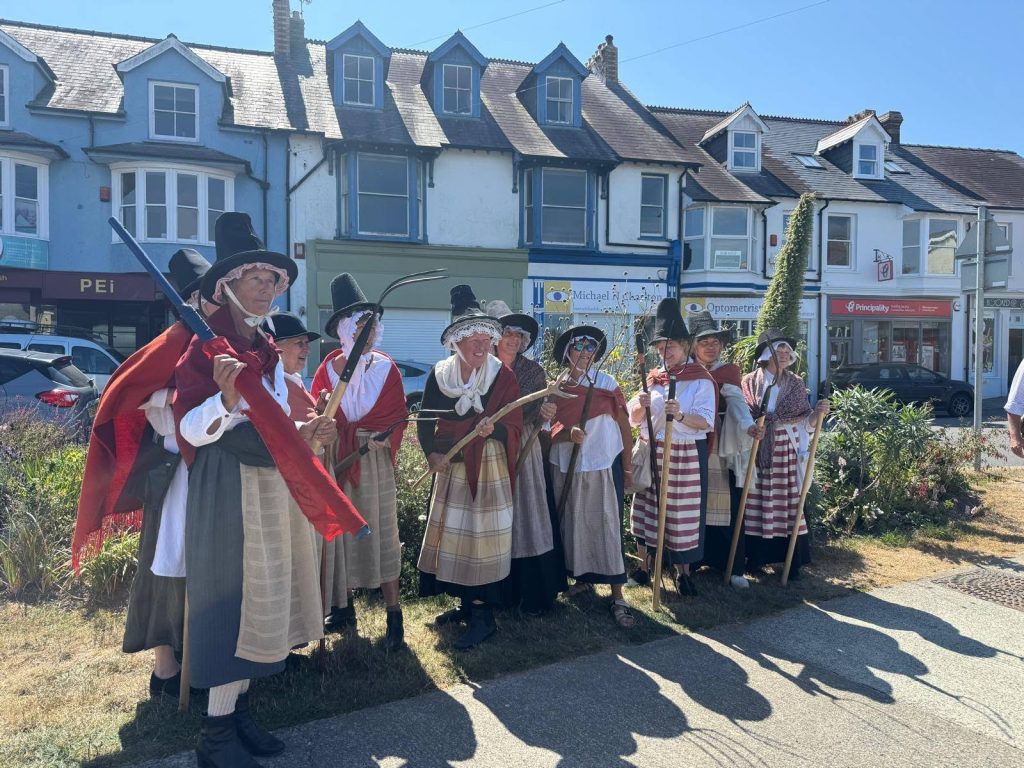
The weekend marked 229 years since around 1,400 French troops landed beneath the cliffs at Carreg Wastad Point, near Llanwnda, on February 22, 1797.
Led by the Irish-American Colonel William Tate, the force had crossed the sea as part of a wider French Revolutionary plan to undermine Britain and encourage an uprising against the government.
Many of the troops belonged to the Légion Noire, or Black Legion, so called because of the dark uniforms they wore.
The French expected to receive support from the local population. Instead, their arrival caused alarm across Pembrokeshire as news of the landing spread through Fishguard, St Davids, Haverfordwest, Milford Haven, Pembroke and the surrounding countryside.
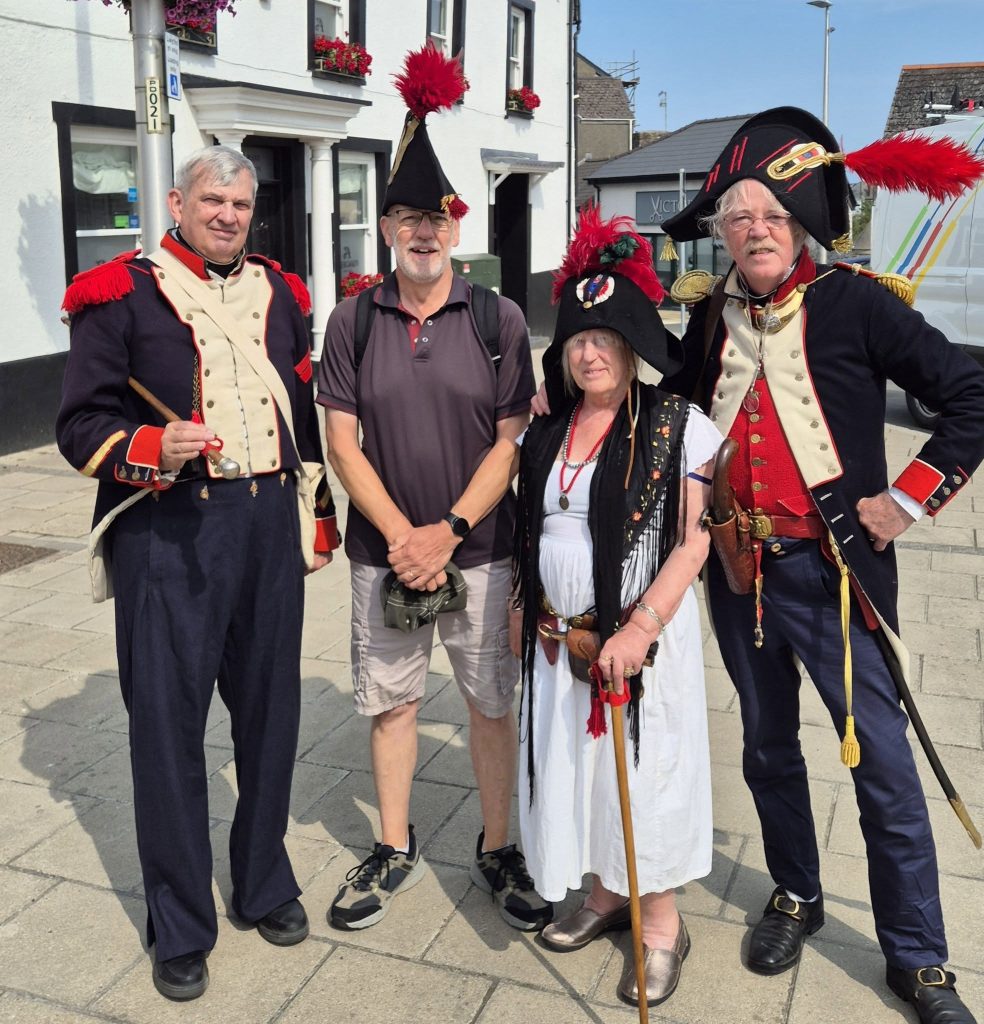
Residents armed themselves with whatever was available, while militia, sailors, volunteers and cavalry began assembling to confront the invaders.

The French operation soon descended into disorder.
Some soldiers left their positions to search local farms and homes for food and drink, while others abandoned their units altogether. The ships which had carried them to Pembrokeshire also departed, leaving Tate and his men without an easy means of escape.
British forces were gathered under Lord Cawdor, who established his headquarters at the Royal Oak after marching north with local volunteers, militia, sailors and members of the Pembroke Yeomanry Cavalry.
The gathering of troops and civilians on the hills surrounding Fishguard may have created the impression that the defending force was far larger than it really was.

According to one of the best-known versions of the story, local women wearing traditional red shawls and tall black hats were mistaken by the French for additional British soldiers.
The tale has become deeply woven into Fishguard folklore, although historians continue to debate exactly how much influence the women’s appearance had on Tate’s decision to surrender.
Another central figure in the story is Jemima Nicholas, remembered in Fishguard as Jemima Fawr, or Jemima the Great.
Tradition holds that Jemima armed herself with a pitchfork, confronted a group of French soldiers and marched 12 of them back into Fishguard, where they were confined inside St Mary’s Church.
Although the precise details cannot be fully verified through contemporary records, Jemima became a celebrated symbol of the courage and determination shown by local people during the invasion.
Her story featured prominently during the weekend’s re-enactment, which included a recreation of the French surrender to local forces and Jemima Nicholas.
By the evening of February 23, 1797, Tate’s position had become increasingly desperate.
Two French officers were sent into Fishguard seeking terms, but Lord Cawdor refused to accept a conditional agreement. He demanded the complete and unconditional surrender of the invasion force.
The following day, the French marched down towards Goodwick Sands, laid down their weapons and became prisoners.
The campaign had lasted little more than two days.
Despite its short duration, the invasion secured Fishguard’s place in British military history and created a story which continues to shape the identity of the town more than two centuries later.
That history is permanently recorded in the Last Invasion Tapestry, housed inside Fishguard Town Hall.
Created to commemorate the bicentenary of the invasion in 1997, the 100-foot embroidered work depicts the French landing, the response of local people and the eventual surrender.
Its narrative style was inspired by the Bayeux Tapestry, with dozens of local volunteers spending several years creating a detailed visual record of the invasion.
Visitors attending the re-enactment were also encouraged to explore the wider history of Fishguard and Goodwick through a heritage trail linking 46 locations across the twin towns.
The trail covers more than 2,000 years of history, ranging from Iron Age settlement and the French invasion to the suffragette movement and the filming of the 1956 screen adaptation of Moby Dick.
For Fishguard and Goodwick, the re-enactment is more than a military display.
It gives residents and visitors an opportunity to walk through the locations where the events unfolded, see the uniforms and weapons of the period and understand the role played by ordinary Pembrokeshire people.
It also ensures that the history is passed to a new generation in a form which is immediate, accessible and entertaining.
More than two centuries after Tate’s army appeared off the Pembrokeshire coast, the sight of French troops marching through Fishguard once again showed why the last invasion remains one of the county’s most remarkable and enduring stories.



Crime2 hours ago
Teen cleared of attempted murder but guilty of GBH after Milford teacher stabbed
Jury returns 11-1 majority verdict on charge of causing grievous bodily harm with intent, with sentencing set for September 3...


Community3 hours ago
French troops march through Fishguard as Britain’s last invasion returns to life
Battle scenes, cavalry displays and a surrender procession brought one of Pembrokeshire’s most extraordinary stories back to the streets MUSKET...


News3 hours ago
Andy Burnham promises new politics as he enters Downing Street
New Prime Minister admits politicians have “not been good enough” as he sets out a ten-year plan for Britain and...


Health1 day ago
Two new surgeons appointed as Hywel Dda admits orthopaedic waits remain too long
Health board says it is increasing capacity after figures revealed hip replacement patients waited an average of 64 weeks HYWEL...


Community2 days ago
84-year-old man rescued after falling overboard near Tenby
A MAYDAY call sparked a major nighttime rescue after an 84-year-old man fell from a tender and was swept towards...


Crime3 days ago
Jury hears final arguments in Milford Haven teacher stabbing trial
Defence says there was no motive or intention to kill as judge reviews competing accounts of classroom knife incident SPECIAL...


News3 days ago
Andy Burnham becomes Labour leader and prepares to enter No 10
Former Greater Manchester mayor promises an ‘unashamedly Labour’ government after completing extraordinary return to Westminster ANDY BURNHAM has been formally...


News3 days ago
Motorcyclist dies following collision near Narberth
Police appeal for witnesses and footage after fatal crash on B4313 at Redstone A MOTORCYCLIST has died following a collision...


Local Government4 days ago
Stepaside school saved as council abandons closure proposal
Governors welcome decision but maintain original plans were based on outdated information STEPASIDE Community Primary School will remain open after...

Crime4 days ago
Footballer given 200 hours’ unpaid work for eye-gouging assault during match
Magistrates heard Robert Hedley put an opposing player in a headlock before gouging at his eyes during a match in...
-
Community2 days ago
84-year-old man rescued after falling overboard near Tenby
-

 Health4 hours ago
Welsh Ambulance Service invites public to AGM and Board meeting
-
Crime2 hours ago
Teen cleared of attempted murder but guilty of GBH after Milford teacher stabbed
-
News21 hours ago
Andy Burnham set for No 10 as Wales awaits change
-
Health1 day ago
Two new surgeons appointed as Hywel Dda admits orthopaedic waits remain too long
-

 Business1 day ago
First look at plans for new Llanelli indoor market
-

 Crime2 hours ago
What the Milford Haven School stabbing verdict really means
-

 Business6 hours ago
Port appoints two new directors as energy and regeneration projects advance
AlvinRoash
July 6, 2026 at 9:17 am
Farmacia Besurica: acquisto farmaci a domicilio Italia – farmacia online Italia