


News
Egnedol: ‘Proof will be in the pudding’

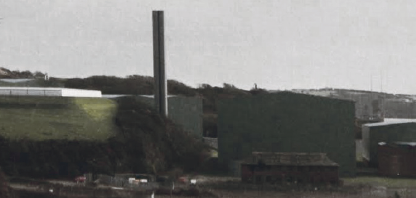
 A PUBLIC consultation was held by Egnedol on Thursday (Feb 18) in Milford Haven. The company promised to bring to the table an ambitious which it claimed would bring hundreds of millions of pounds into the Haven.
If Egnedol’s plans get the go ahead, the biomass plant at Blackbridge will be the biggest of its kind in the world. However, Egnedol has no track record of either building or running such a plant.
Mark Evans of Pembs TV conducted an exclusive interview with Egnedol’s director, Steve Whitehouse. The Herald pointed out that a far smaller plant in Newport is up and running and it has had numerous problems with health and safety breaches – even fire.
The Herald asked Mr Whitehouse, how Egnedol would succeed where others have failed.
Steve Whitehouse told us: “We’re using a very large South African company. They’re used to building biomass plants, and energy plants petro-chemical facilities around the world. It’s a large global company.

“We’re using them to provide us with a design, build, maintain, operate contract. So, they’ll be responsible for completing the details design of the plant, for building the plant, operating and maintaining it, using local people.
“They’ve just completed a large project in South Africa which we’ve checked the details of, so we’re quite confident. All we’re really doing is providing the facility, the cash and linking in with other technologies, so that they can come along and help us to operate this.
“So, it’s not our own staff actually, that’s going to be operating this facility. We’re going to be taking on local people who will be managed by a South African firm.”
The Herald also asked about the trees that are going to be used at the plant, which will be coming from plantations in Morocco and Greece. However, the website of the company says they’re still waiting for permission to plant in Greece and have no current plans to plant in Morocco.

When asked where the pellets will come from, Mr Whitehouse said: “We’ve got two options. They’re called option agreements – they’re legal agreements – with landowners in Greece and landowners in Morocco, so subject to getting permission and taking the project forward, we’ll be planting these plantations at that point.
“We’ll also be bringing in some wood from WDF, which 50% of our feed stock will come from that, which will be locally sourced, probably from Wales and other parts of the UK.”
When asked to explain about the emissions of the wood, as to whether or not they are chemically treated, Mr Whitehouse responded saying: “When we consume the wood, we consume it in a process called gasification, so the wood particles are heated up to a high temperature, which breaks down the molecules of the wood into smaller molecules, and we control that process so that we make methane, carbon monoxide, hydrogen – things like that.

“Then that gas we’ve made is called a syngas – it’s a synthetic gas. We clean that, go through several cleaning processes, because, we have to get it to a very clean state in order to inject it into normal gas engines – big German gas engines.
“So, it has to be very very clean before it goes into that gas engine. So if you can imagine the gas engine is then consuming a clean gas, the emission from that goes from the engine, goes through a catalytic converter and goes through an oxidation process – the same as it would on a car, and then it goes up a stack.
“So, the actual emission is just a normal emission that you’d get from consuming gas. Just carbon dioxide, things like that.”
A statement by Gareth Chubb, Director of The Friends of the Earth was put to Mr Whitehouse. Mr Chubb had said that the people of Pembrokeshire won’t like being “guinea pigs” for an unproven technology with uncertain risks to human health, and said: “We’ve never seen a successful venture of this nature in the UK.”
When asked how he felt about those comments, he replied: “The technology choice is still under close review. We’ve chosen what we think is the best gasification technology that is currently available – it’s been through a very detailed due diligence process, with one of the largest insurance companies in the UK called Marsh, in London.
“All of their technical experts – which are world experts, they’re not just local UK experts – have looked at the process. Studies have been done by large UK and European consultancies; they’re all happy with the technology, and that’s why we can attract the funding.
“Marsh, actually, are happy to underwrite its process, underwrite its operation, time and all of those sorts of issues, so we’ve gone through a very rigorous due diligence process with the technology.”
Mr Whitehouse concluded: “You know, the proof will be in the pudding really, once we get funding and build it. That’s where the proof will be.”
The Herald spoke to Mayor of Milford Haven, Cllr Stephen Jospeh regarding Egnedol’s plans, to see what his thoughts were. He said: “It’s very difficult, but anything that can help the economy is good.
“We’ve got to look on the positive side. Of course, we’ve got to make sure it’s safe. There’s lots of different impressions, and I wouldn’t for a minute pretend I know who has conducted these studies, but I hope it works because the benefits are huge.
“We need to keep an eye on the environment and if it is how they say it is. However, just because it hasn’t worked for other people, doesn’t mean it won’t work for them.”


Narberth favourite retains title after overwhelming public support
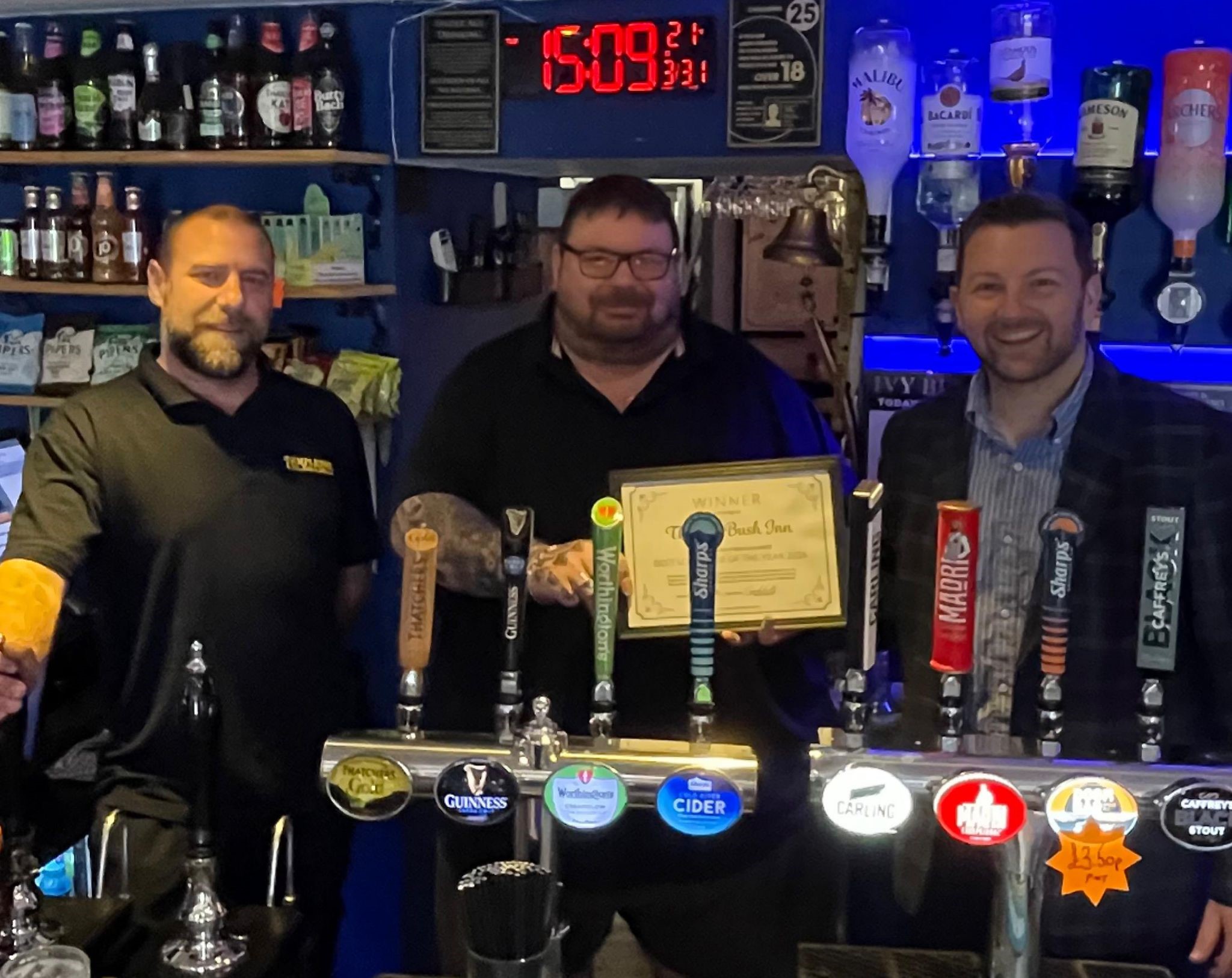
THE IVY BUSH Inn has been crowned Best Local Pub 2026, retaining its title after receiving an overwhelming show of support from the community.
The popular Narberth venue dominated this year’s competition, attracting more than 150 nominations—far surpassing all other entrants and cementing its place at the heart of local life.
The annual competition, organised by Conservative Senedd Member Samuel Kurtz MS and supported by Templeton Beer Wine and Spirit Co, celebrates the vital role pubs play across Pembrokeshire. Now in its second year, the initiative highlights how pubs continue to bring communities together.
More than 1,000 nominations were submitted by the public this year, with over 70 pubs across the county taking part.
In second place was the Highgate Inn in Hundleton, followed by the Watermans Arms in Pembroke, both praised for their strong community focus and welcoming atmosphere.

Other highly commended venues included The Bunker, The Cross Saws and The Cresselly Arms, showcasing the strength and diversity of Pembrokeshire’s pub scene.
The Ivy Bush Inn was presented with a free keg of beer and a winner’s certificate on Tuesday (Mar 31).
Voters were quick to praise the Narberth pub for its atmosphere and inclusivity.
“It’s the heart of Narberth—always something going on and everyone is welcome,” said one.
Another added: “From the moment you walk in, you feel like family,” while others described it as having a “brilliant atmosphere, great staff and the best nights out around.”
The strength of feeling extended across the competition, with many highlighting the wider role pubs play in their communities.
“Not just a pub—it’s the hub of the village,” one voter said of the Highgate Inn, while the Watermans Arms was described as “a place where everyone feels welcome and supported.”

The Cresselly Arms also received praise, with one nomination stating: “Always a warm welcome from Steve and his staff in this unspoilt, special pub.”
Samuel Kurtz MS said: “This competition has once again shown just how important our local pubs are to communities across Pembrokeshire. The response has been incredible.
“The Ivy Bush Inn’s level of support was exceptional and a testament to the role it plays in Narberth. But every single pub nominated should be proud. They are the backbone of our communities, and the comments about each establishment have been a joy to read.”
Jason Vaughan, owner of The Ivy Bush Inn, added: “We’re absolutely thrilled to win again. This means so much because it comes directly from our customers and community. Thank you to everyone who voted—we’re incredibly grateful for your support.”
Lyndon Belt of Templeton Beer Wine and Spirit Co said: “It’s fantastic to see so many people getting behind their local pubs. They are such an important part of our communities and deserve to be recognised.”

Motorist fled scene after colliding with fence and hedge near Clunderwen
A LLANDISSILIO motorist has been handed an interim driving disqualification after failing to stop following a collision on the A478.
Haverfordwest magistrates heard this week that Dean Duffy, 31, collided with a fence and hedge while driving his Ford Puma at Clunderwen on Tuesday (Mar 4). His failure to stop and report the incident led to his court appearance.
Duffy, of Maesybryn, Llandissilio, pleaded guilty to failing to stop after a road traffic collision, failing to report the accident, driving without third party insurance and driving while disqualified.
Crown Prosecutor Sian Vaughan told the court: “A vehicle collided with a fence and hedge and the bumper came off. The vehicle was abandoned, but correspondence on the seat identified the defendant as possibly being the person responsible.”
Magistrates adjourned sentencing until Tuesday (Apr 28) to allow for the preparation of a pre-sentence report by the probation service.
Duffy was disqualified from driving on an interim basis pending sentence.

A PEMBROKE DOCK motorist has narrowly avoided a custodial sentence after taking his mother’s car without permission and crashing into a wall, causing damage to a parked BMW.
Haverfordwest magistrates heard this week that on September 27, 2025, Tony Brundrett, 21, took his mother’s Vauxhall Astra from her home and drove off without her consent.
Crown Prosecutor Sian Vaughan told the court that Brundrett lost control of the vehicle and collided with a wall.
“The wall collapsed as a result of the impact, causing damage to a parked BMW,” she said.
The owner of the BMW said the vehicle suffered bodywork damage and scratching following the incident.
When arrested, Brundrett was found to have 253 micrograms of benzoylecgonine – a cocaine metabolite – in his system, more than five times the legal limit of 50.
The court heard that although Brundrett’s mother confirmed the car was hers, she did not wish to criminalise her son.
Brundrett, of Kavanagh Court, Pembroke Dock, pleaded guilty to aggravated vehicle taking, driving without insurance, driving otherwise than in accordance with a licence, criminal damage, and drug-driving.
Defending, Alaw Harries said: “He accepts his behaviour was foolish and irresponsible and wishes to apologise to the court for what took place.
“At the time of the offence, he was experiencing significant personal difficulties. This was the first and last time he has taken drugs, and he was not thinking clearly. While that is not an excuse, it provides context. He is now in a much better place.”
Magistrates sentenced Brundrett to 18 weeks’ custody, suspended for 24 months. He was disqualified from driving for two years and ordered to pay £100 compensation, a £154 surcharge and £85 costs.


Charity7 hours ago
Milford Haven charity honoured with King’s Award for voluntary service
A PEMBROKESHIRE charity supporting vulnerable young people has received one of the highest honours in the UK for voluntary work....


News1 day ago
Plaid Cymru launches bid to lead next Welsh Government
Party positions itself as ‘government-in-waiting’ ahead of May election PLAID CYMRU has formally launched its campaign for the 2026 Senedd...


Crime1 day ago
Police appeal after attempted child abduction in Haverfordwest
DYFED-POWYS POLICE has launched an appeal for witnesses following a reported attempted abduction of a 12-year-old girl in Haverfordwest. The...


Crime2 days ago
Gunshot fired by police during incident in Milford Haven
A POLICE officer discharged a firearm during an incident in Milford Haven on Saturday evening (March 28), prompting an investigation...


Community3 days ago
Three Amigos Easter Run roars through Pembrokeshire
MOTORCYCLE enthusiasts turned out in force today (Saturday, March 28) as the popular Three Amigos Easter Run returned to the...


Education4 days ago
Ysgol Henry Tudor reassures parents over Sikh ceremonial kirpan
School says religious item worn by pupil is secured, symbolic and non-functional YSGOL HENRY TUDOR has moved to reassure parents...


Crime5 days ago
Teen jailed after starting fire while others slept
Fire set in shared home left sleeping residents at risk and caused £130,000 damage A TEENAGER who started a fire...

Health5 days ago
GP crisis driving NHS pressure in Wales, Senedd report warns
Falling GP numbers and funding gaps blamed for worsening hospital delays THE NHS crisis highlighted earlier this week is being...


News6 days ago
Reform reveals west Wales candidates for Senedd battle
Monkton councillor tops Pembrokeshire list as party confirms Carmarthenshire names and includes Haverfordwest councillor in unwinnable Swansea spot REFORM UK...


Health6 days ago
Clash over Withybush Hospital services as Paul Davies challenges First Minister
A HEATED exchange in the Senedd has laid bare growing tensions over the future of hospital services in west Wales....
-

 News6 days ago
Welsh Government outlines progress on flood resilience plans
-

 Community5 days ago
Hero female officer keeps job after sexual touching finding
-
Education4 days ago
Ysgol Henry Tudor reassures parents over Sikh ceremonial kirpan
-
 Business5 days ago
Popular Italian restaurant hit with £278,000 tax bill plus £186,000 fine
-
Health6 days ago
Clash over Withybush Hospital services as Paul Davies challenges First Minister
-

 Crime6 days ago
Hakin motorist banned after drink-drive crash
-

 Farming6 days ago
Experts warn Senedd of ‘systemic failure’ to enforce animal welfare laws in Wales
-

 Entertainment6 days ago
Duffy to tell her story in new Disney+ documentary