


News
Plaid launches commissioner manifestos



Critical of Christopher: Dafydd Llywelyn did not pull his punches
PLAID CYMRU candidates and members gathered in Carmarthen to launch the party’s national manifesto for the upcoming Police and Crime Commissioner election on May 5 – the same day as the Assembly election.
The Party of Wales ‘ candidates for the role of Police and Crime Commissioner (PCC) in the four policing forces are Arfon Jones (North Wales), Linet Purcell (South Wales), Darren Jones (Gwent) and Dafydd Llywelyn (Dyfed Powys).
The candidate for Dyfed Powys, Dafydd Llywelyn, who is the former Principal Crime and Intelligence Analyst for Dyfed Powys police force, said that the manifesto was designed to create ‘a strong, just and safe Wales’ and that this ambition would be fulfilled with three main priorities.
He added that Plaid Cymru Police and Crime Commissioners would focus on creating strong neighbourhood policing teams to cut crime in communities, protecting vulnerable groups and supporting victims, and breaking the cycle of crime to reduce future offending.
Speaking at the launch, Dafydd Llywelyn added: “Our manifesto for the Police and Crime Commissioner elections is designed to secure a strong, just and safe Wales. At the heart of our proposals lie a commitment to community safety, victim support and breaking the cycle of reoffending.”

The former police analyst went on to say: “If elected, Plaid Cymru Police and Crime Commissioners would work to ensure that all parts of Wales have strong neighbourhood policing teams that will cut crime in our communities, that vulnerable groups and victims are protected and supported so that they’re not just statistics, and that the cycle of crime is broken as often as possible.
“Plaid Cymru puts the best interests of Wales first – nationally and locally. Our PCCs would champion the needs of communities as well as continue to campaign against further Westminster cuts which have led to severely depleted frontline services.”
Looking at local policing priorities, Dafydd Llywelyn published his 10 personal pledges under the themes of Trust and Efficiency and Security and Safety as his platform to be elected as the new Police Commissioner for Dyfed Powys.
Following his address to the gathered audience and members of the press, he spoke to The Herald.

We began by asking the Plaid candidate why he had put himself forward for election.
He told us: “As many people will be aware I used to work for Dyfed Powys for thirteen and a half years. When Police and Crime Commissioners were put in post I did feel that there was a change in the way that the police were being run. I found frustrating working under that set up. As a result of that I thought perhaps I needed to be looking outside in terms of employment.
“I now lecture in criminology at Aberystwyth University. Plaid Cymru hadn’t put anyone forward the first time round, so I felt that I wasn’t represented on the ballot paper. It was a chance discussion last year when I heard the decision had changed and that Plaid Cymru were going to field candidates. I decided then to put my name forward. My background in the Police stands me in good stead.”

Dafydd Llewellyn was very direct in his criticism of the current Police and Crime Commissioner Christopher Salmon: “We have a police commissioner who has zero policing experience and that was very apparent in his first tenure.
“While I haven’t served as a police officer I did work as a support staff member in the Dyfed Powys force. Being a lecturer I am able to look at it in a critical way. I very often do research and I look at the issues of crime. I think my former colleagues appreciate that my experience does give me an insight into real policing issues.”
Given the financial difficulties facing local authorities and the Dyfed Powys- Police force we asked the Mr Llywelyn how he planned to tackle drug and alcohol related crime in the area.
He responded by identifying the range of stakeholders that a PCC needs to work with: “Drugs and alcohol-related crimes are issues you can only tackle in partnership with unitary authorities. The authority here in Carmarthenshire has called time after time for CCTV and he (Christopher Salmon) has not fulfilled that requirement. As far as social economic issues, which are often seen as the causes of crime, they are issues the Police Commissioners cannot deal with in isolation. They have to work with partner agencies, with charities and unitary authorities themselves.”
He added that it was time for Wales to be in control of its own policing policy and priorities: “We would like for recommendations in the Silk report two years for the devolving powers of policing to Cardiff to be followed through.”
The Herald asked Dafydd Llywelyn if there was a greater role to be played in crime prevention rather than crime busting.
He said: “Community work and work within the community is critical in terms of prevention and intervention. There are good examples of crime prevention undertaken by people like the youth service. I mentioned in my speech that there is a fragmentation of funding in terms of youth services. We can address that and give for the five and ten year period a strategy in terms funding for some of these agencies. It would give them a stronger footing in terms of some of the activities they want to carry out.”
With an implied criticism of a decision reached by Mr Salmon, Dafydd Llywelyn continued: “The prevention aspect is very important. I mentioned CCTV as preventing incidents from happening because they are spotted. CCTV doesn’t work as a deterrent if people understand that it isn’t being monitored. For town centre violence in particular alcohol related violent crime the deterrent is there: especially if you understand it is being monitored.”
He went on to announce further plans as Police and Crime Commissioner if elected saying that he would include investment in a modern CCTV infrastructure, road safety and ensuring victims are properly supported.
We suggested that some people might believe that the cost of employing Police and Crime Commissioners would be better spent on front line policing services.
Without hesitation the candidate explained: “If you tot the cost of their offices up it amounts to around £3m. I would agree with you that it would be better spent on front line policing. My first course of action would be to scrap the role of Deputy Police Commissioner – an unelected role which costs tens of thousands of pounds a year.”



Cash machine at High Street NatWest branch was broken into during an early-hours burglary
POLICE have launched an investigation after an estimated £55,000 was stolen from a cash machine at a bank in Brecon.
Dyfed-Powys Police received a report at around 1.15am on Monday (July 20) that the ATM at the NatWest branch on High Street had been broken into.
Cash was taken from the machine, with investigating officers estimating the total amount stolen to be approximately £55,000.
Police tape was placed across the entrance to the bank and around the outside cash machine during Monday as officers carried out inquiries at the scene.
Members of the public reported seeing a police presence on the high street, with officers entering and leaving the building throughout the day.
No arrests have been made and the investigation remains ongoing.
Officers are appealing for witnesses, including anyone who noticed suspicious people or vehicles in Brecon town centre during the early hours of Monday morning.
Police would also like to hear from anybody who may have CCTV, doorbell-camera or dashcam footage which could assist the investigation.
Information can be provided to Dyfed-Powys Police online, by emailing [email protected] or by calling 101.
Those contacting police should quote reference 26*586801.
Information can also be given anonymously to the independent charity Crimestoppers by calling 0800 555 111.
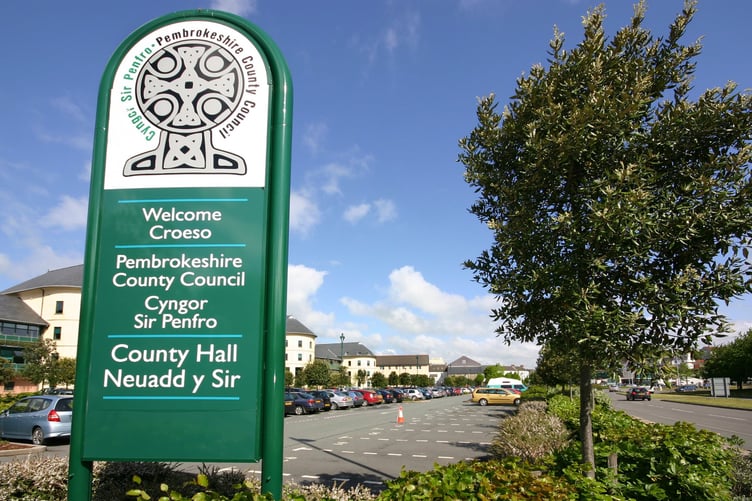
Residents are being asked for their views on proposed changes affecting councillor numbers and electoral arrangements in communities across the county
PEMBROKESHIRE COUNTY COUNCIL is inviting residents, organisations and other interested parties to have their say on proposed changes to the electoral arrangements of eight community councils across the county.
The consultation follows recommendations published by the Democracy and Boundary Commission Cymru in January 2025 as part of a wider review of Pembrokeshire’s community boundaries and local electoral arrangements.
The Commission’s review considered whether the county’s existing communities and community wards continued to provide effective and convenient local government.
It examined issues including community boundaries, the number of councillors serving each area, the distribution of councillors between community wards and whether existing arrangements continued to reflect local populations and community identities.
While a number of the Commission’s recommendations involved changes to community boundaries, it also proposed alterations to the electoral arrangements of some community councils where no boundary changes were recommended.
Those particular proposals could not be introduced through the original community review process and must now be considered separately by Pembrokeshire County Council.
The latest consultation concerns the following communities:
- Lamphey
- Llanrhian
- Martletwy
- Nolton and Roch
- Pencaer
- St Dogmaels
- Stackpole and Castlemartin
- Wolfscastle
The proposals could affect matters such as the number of councillors elected to individual community councils and how council seats are distributed between community wards.
Community and town councils form the most local tier of elected government. They represent the interests of their communities and may be responsible for services and facilities including public spaces, community buildings, play areas, noticeboards and local events.
The County Council said it was seeking views from residents and organisations with connections to the communities affected to ensure that local perspectives were considered before any decisions were made.
The consultation will open on Tuesday, July 28, and close on Friday, September 11, 2026.
Full details of the proposed changes and supporting documents will be available through Pembrokeshire County Council’s Have Your Say consultation portal.

Residents will be able to review the proposals affecting their community and submit comments online.
Paper copies of the consultation documents can also be requested by contacting the Council’s Customer Contact Centre on 01437 764551 or emailing [email protected].
Anyone with questions about the proposals or the review process is encouraged to contact the Council’s electoral services team.

Community support and a £2,000 contribution from Narberth Town Council help committee achieve its fundraising goal
Narberth Eisteddfod Fundraising Committee is celebrating after successfully reaching its £8,000 fundraising target.
The milestone follows a busy programme of events organised by the committee, each of which received strong support from residents, businesses and community groups across the Narberth area.

Committee chair Glinys Meredydd thanked everyone who had helped make the campaign a success.
She said: “I would like to thank all members of the Narberth Eisteddfod team for their hard work and commitment.
“They organised some fantastic events, which were extremely well supported by the local community.
“I would also like to thank Narberth Town Council, which donated £2,000 on behalf of the people of Narberth.”

The committee will hold one final fundraising event with a last sale of its locally produced and hand-printed Eisteddfod Garreg Las 2026 T-shirts.
Members of the public are invited to visit the committee at Narberth Carnival Field on Saturday, July 25, where they will have a final opportunity to buy or win one of the T-shirts and join the celebrations ahead of the Eisteddfod’s return to Pembrokeshire.
The committee has thanked everyone who attended an event, made a donation, volunteered their time, purchased a T-shirt or helped promote the campaign.
Reaching the £8,000 target has been described as a powerful example of what can be achieved when the Narberth community comes together in support of Welsh language and culture.




Crime7 hours ago
Man, 37, found dead following major police response in Pembroke Dock
Death not being treated as suspicious as police make statutory referral to IOPC following active investigation A 37-YEAR-OLD man has...


Community10 hours ago
Household Cavalry drum horse returns home to Pembrokeshire for final farewell
Dyfed Willa Rose, who became Major Juno and the first mare to serve as a Household Cavalry Drum Horse, was...


News1 day ago
Jo Stevens out as Welsh Secretary as Burnham reshapes government
Cardiff East MP repeatedly visited Pembrokeshire to champion clean energy jobs, but her successor inherits unresolved questions over Milford Haven’s...


Crime1 day ago
Teen cleared of attempted murder but guilty of GBH after Milford teacher stabbed
Jury returns 11-1 majority verdict on charge of causing grievous bodily harm with intent, with sentencing set for September 3...


Community1 day ago
French troops march through Fishguard as Britain’s last invasion returns to life
Battle scenes, cavalry displays and a surrender procession brought one of Pembrokeshire’s most extraordinary stories back to the streets MUSKET...


News1 day ago
Andy Burnham promises new politics as he enters Downing Street
New Prime Minister admits politicians have “not been good enough” as he sets out a ten-year plan for Britain and...


Health2 days ago
Two new surgeons appointed as Hywel Dda admits orthopaedic waits remain too long
Health board says it is increasing capacity after figures revealed hip replacement patients waited an average of 64 weeks HYWEL...


Community3 days ago
84-year-old man rescued after falling overboard near Tenby
A MAYDAY call sparked a major nighttime rescue after an 84-year-old man fell from a tender and was swept towards...


Crime4 days ago
Jury hears final arguments in Milford Haven teacher stabbing trial
Defence says there was no motive or intention to kill as judge reviews competing accounts of classroom knife incident SPECIAL...


News4 days ago
Andy Burnham becomes Labour leader and prepares to enter No 10
Former Greater Manchester mayor promises an ‘unashamedly Labour’ government after completing extraordinary return to Westminster ANDY BURNHAM has been formally...
-

 Health1 day ago
Welsh Ambulance Service invites public to AGM and Board meeting
-

 featured7 hours ago
From a father-and-son project to an award-winning campervan business
-
Crime1 day ago
Teen cleared of attempted murder but guilty of GBH after Milford teacher stabbed
-

 Crime1 day ago
What the Milford Haven School stabbing verdict really means
-

 Business2 days ago
Port appoints two new directors as energy and regeneration projects advance
-

 Entertainment1 day ago
Imperial Hotel announces four-day Bank Holiday celebration in Tenby
-
Community10 hours ago
Household Cavalry drum horse returns home to Pembrokeshire for final farewell
-

 Entertainment2 days ago
VegOut West brings food, music and festival atmosphere to Pembrokeshire