


News
Puppy farming


A brutal trade: Puppy farming
IT IS sometimes observed that the British are prepared to allow humans to live in conditions that they would not allow their own pets to endure.
But imagine what it is like to be a breeding bitch on a puppy farm.
Puppy farms are large-scale breeding premises. The aim of puppy farms is to make money, no matter the cost to the dogs, who are kept in cramped and cruel conditions. The puppies are sold through pet shops, internet and newspaper ads.
Puppy farms in the UK have been found to have as many as 200 breeding dogs, most kept locked inside 24 hours a day, often in complete darkness. They are usually located on farms in barns, disused chicken houses garages or any disused outbuilding.
The dogs are forced to eat, sleep and give birth in the same area they urinate and defecate; something they would never do given the choice. In some cases they are treated worse than animals bred for the food chain.

The general public keep up the demand for pups and so the cruelty continues, day after miserable day.
Dogs on puppy farms are often neglected; matted coats, infected eyes and ears and rotten teeth are just a few of the painful conditions the dog suffer. When breeding dogs become too old and exhausted to continue producing puppies they are killed or a lucky few are given to rescues.
The puppies also often have behavioural and psychological problems, such as aggression and fearfulness, because they are not exposed to the outside world.
The puppies are generally removed from their mothers far too early and sent by rail or van to ‘dealers’ or pet shops to satisfy the public’s demands.
Many are severely traumatised by the transition, and some do not make it out alive. Puppies from these sources will have had the worst possible start in life, and are far more likely to have health and temperament problems.
THE COST OF BUYING FROM A PUPPY FARM CAN BE SIGNIFICANT
Almost half of dog owners are spending more on vets’ fees than they had accounted for, as more than one in four people (27%) say that they suspect that their puppy came from a cruel puppy farm. The rising cost of owning a puppy comes as people opt to buy ‘mail order pups’ online or from newspaper ads

Many of these pups will go on to develop diseases and conditions common in puppy farmed pups. One fifth of pups purchased online, without being seen by their new owner first, ended up with serious gastro intestinal problems, 15%with the potentially deadly parvovirus and one in ten developed kennel cough.
WHY ARE PUPPIES FARMED?
And make no mistake, puppy farming is big and profitable business. While there are around 10 licensed dog breeders in Ceredigion, Pembrokeshire and Carmarthenshire, there are many more unscrupulous breeders doing the canine equivalent of stacking ‘em high and selling ‘em not so cheap.
As an example if a commercial breeder with 50 bitches – a not unusual figure – that produce one litter a year of four pups and the pups sold for £200 each, that would be an annual income of around £40,000. If one multiplied that by the number of licensed breeders in one county, Carmarthenshire, that is £3.2m of gross income each year.
Add in Ceredigion, another 40 licensed establishments and you are up to £4.8m a year.
Those figures are startling enough, but the true figures may be even higher. An investigation by The Dog Rescue Federation has suggested that Carmarthenshire alone produces 28,000 puppies a year from licensed breeding establishments.
Moreover, some of the puppy farms are co-located with farms that receive significant sums in European subsidies, and the Welsh Government has neither the resources nor the capacity to determine whether funds intended to assist agriculture are being used to fund the factory farming of family pets.
As for any assurance that might be given by the statutory provisions in Wales, a Daily Mirror investigation into Carmarthenshire puppy farms in January of this year revealed that even licensed dog breeders are reluctant to allow purchasers to follow a key part of purchase advice; namely, allowing buyers to see their purchases with their mothers.
KENNEL CLUB SPEAKS
With west Wales being a centre for both legitimate dog breeding and puppy farming, The Herald asked the Kennel Club for their view on the issue.
Caroline Kisko, Kennel Club Secretary, said: “Puppy farmers exploit the UK’s love of dogs by breeding for profit, without any consideration for health and welfare. The sad fact is that puppy buyers can inadvertently keep irresponsible breeders in business if they do not do the necessary research before they buy a puppy.
“By far the simplest message the Kennel Club can give those looking for a dog is to always go to a Kennel Club Assured Breeder and to always see the pup interacting with its mother in its home environment.
“The Kennel Club established the Kennel Club Assured Breeder Scheme to help guide puppy buyers to responsible breeders and it carries out its own inspections on breeders to ensure they are adhering to high standards of practice.
“It is the only scheme in the UK where dog breeders have to follow high standards for caring for the health and welfare of their dogs and they have to agree to have their premises inspected before they join the scheme and at least every three years thereafter.
“We are extremely concerned about any breeders, large or small scale, who put the health and welfare of the dogs and puppies secondary to profit, or do not even consider it at all, and we would recommend anyone who has concerns that someone may be a puppy farmer to make their local authority aware and report any dog welfare concerns to the RSPCA.
“Prospective puppy buyers can help put irresponsible breeders out of business by doing their research and ensuring they buy a dog responsibly. “There are a few simple things people can do to ensure they buy a puppy as responsibly as they can, such as always seeing the puppy with its mother, checking out the breeding environment and asking to see relevant health test certificates for the puppy’s parents. “There are lots of tips and advice on finding a healthy, happy dog on the Kennel Club website and we would strongly suggest prospective dog owners start there when doing their research.”
WHAT DOES RSPCA CYMRU HAVE TO SAY
RSPCA Cymru superintendent Martyn Hubbard told us: “Puppy trafficking is big business and dealers are getting rich from duping members of the public and leaving a trail of sick and dead puppies behind them, not to mention the heartache of families that have bought puppies. “Many irresponsible breeders who breed puppies for sale, are based on maximising profit with little regard for animal welfare. “RSPCA Cymru welcomed the introduction of new legislation in Wales in 2015 to regulate dog breeding establishments.
However, though this marks a significant improvement, we remain concerned that the regulations don’t go far enough in some areas. “For example, they fail to address the need to prioritise health, welfare and temperament over appearance when choosing which animals to breed, in order to protect the welfare of both the parents and the offspring, or to tackle the issues of inherited diseases and exaggerated physical features which compromise the welfare of many dogs of numerous breeds and types. “Parts of Wales have an unenviable reputation for poor breeding practices.
It is vital Local Authorities in Wales feel equipped to tackle this serious problem, and are in a position to stamp out such incidences and ensure breeders protect the welfare of dogs and puppies involved. “This is particularly important where dog breeding is exceptionally prevalent, such as in Carmarthenshire and other parts of west Wales. “Given the overpopulation of companion animals in Wales, we’d urge people to strongly consider adopting a dog or puppy in need of a second chance.”
THE PROBLEM ISN’T CONFINED TO BUYING DOGS FROM WALES. There was a 61% increase in pups coming into the UK from abroad in the first year since the controls were relaxed under changes to the Pet Travel Scheme in 2012, and that does not account for the undeclared dogs that are being smuggled illegally into the country. People opt to buy ‘mail order pups’ online or from newspaper ads, not realising that many pups being sold through these routes have been illegally smuggled from abroad.
One in ten people bought a ‘mail order pup’ from the internet online or from a newspaper advert, without seeing it first. This is a classic sign that the puppy has come from a puppy farm, as the breeder does not want buyers to see the state of the pup or the conditions it was raised in. Local authorities have a key role in taking action against puppy farmers, both through Trading Standards investigations and in animal welfare. DOES YOUR COUNTY COUNCIL HAVE ANYTHING TO SAY? The Herald asked each of the County Councils in our circulation area to tell our readers what they were doing to curb the puppy farm trade.
We asked for details of any prosecutions and rogue breeders. Ceredigion Ceredigion County Council directed our enquiry to the Chief Veterinary Officer for the Welsh Government. Carmarthenshire Carmarthenshire County Council was a little more forthcoming: ‘All reports of potential unlicensed dog breeding are investigated and followed up and appropriate action taken. Several of these have resulted in licences being issued when appropriate and conditions allowed. ‘A very small number of unlicensed dog breeding resulted in offenders receiving an official caution. ‘There are currently four ongoing investigations’.
Pembrokeshire Pembrokeshire County Council told us: ‘In 2015 Welsh Government brought in new legislation relating to the licensing of dog breeders in Wales. Licensed breeders are required by law to: • Have a staff to dog ratio of one full time attendant to not more than 20 dogs • Submit enrichment and socialisation plans to local authorities • Conform to statutory licensing requirements • Have regard to specific guidance published by Welsh Ministers. Pembrokeshire County Council’s spokesperson continued: ‘The Council has always been proactive in trying ensure good standards are followed by licensed dog breeders.’
Three years ago it introduced a scheme that rewarded good licensed dog breeders with an Award scheme. The scheme aims to recognise and encourage high standards at licensed premises and this year six out of 13 licensed breeders have achieved the Award. Pembrokeshire County Council actively looks for people advertising puppies for sale on a regular basis and will investigate all complaints relating to the breeding of dogs. The Council’s Cabinet Member for Environmental and Regulatory Services, Huw George, said he welcomed the stance taken by the new Chief Executive of the RSPCA who said the organisation would be ‘less adversarial’ under his leadership. Councillor George added: “We also support the recommendation in the recent RSPCA Report on the Review of Responsible Dog Ownership. Commissioned by the Welsh Government, it calls for an annual dog registration fee scheme for Wales, to help fund sustainable dog welfare and control services.”


THE SENEDD has rejected a Reform UK motion calling for an end to all Welsh Government international spending, after a heated debate which saw several Members walk out of the chamber.
The motion, tabled by Reform MS Llŷr Powell, was defeated by 48 votes to 37 on Wednesday (Jun 17).

An amended motion, backing Wales’ reputation as an “internationalist, tolerant and outward-looking nation”, was then passed by the same margin.
The debate followed warnings from Hub Cymru Africa and other campaigners that ending international spending would damage Wales’ global reputation and undermine projects linking Welsh communities with partners overseas.
Reform argued that Welsh Government money should be focused on domestic pressures, including the NHS, schools, transport and the cost of living.
Welsh Conservative leader Darren Millar backed the Reform motion, saying foreign relations and international development were matters for the UK Government rather than Cardiff Bay.
But Plaid Cymru and Welsh Government speakers rejected that argument, saying Wales’ international work supported trade, public services, education, health partnerships and the country’s reputation abroad.

The debate became heated after comments by Reform MS Joe Martin, who criticised overseas schemes including beekeeping and tree-planting projects in Uganda.
Several MSs left the Siambr during his contribution, with the Llywydd later urging Members to reflect on the tone of the debate.
Hub Cymru Africa had said before the vote that Wales’ international solidarity budget represented a tiny fraction of overall spending and helped deliver work in public health, climate action, women’s empowerment and sustainable development.
The organisation said the vote was an opportunity for the Senedd to reaffirm Wales’ place in the world.

Met Office warns of oppressive heat, sleepless nights and potential disruption as rare amber alert extended
A RARE amber weather warning has been issued for large parts of England and Wales as forecasters predict what could become one of the hottest June heatwaves ever recorded in the UK.
The Met Office has extended its Extreme Heat Warning from Monday (June 22) through to Thursday (June 25), with temperatures expected to climb well above 35C and potentially reach 38C by the middle of the week.
Forecasters say the heatwave will intensify rapidly, with temperatures reaching around 32C on Monday before climbing to 35C and beyond on Tuesday and Wednesday. Parts of southeast Wales could see temperatures of around 35C, while southern England is expected to experience the highest values.
The warning covers much of England and Wales and has been described by the Met Office as a potentially significant weather event due to the combination of extreme temperatures and unusually high humidity.
June records under threat
Meteorologists say there is now a strong possibility that the UK’s June temperature record of 35.6C, set in Southampton in 1976, could be broken this week.
The current forecast suggests Wednesday and Thursday will be the hottest days, with temperatures approaching 38C in some areas.
Tropical nights expected
One of the biggest concerns is the lack of overnight relief.
The Met Office is forecasting widespread “tropical nights” across southern parts of Britain, where temperatures remain above 20C throughout the night. High humidity levels are expected to make conditions feel particularly oppressive and may make sleeping difficult.
Health experts warn that prolonged hot nights can increase the risk of heat-related illness because the body has less opportunity to cool down and recover.
Health and travel concerns
The UK Health Security Agency has issued amber heat-health alerts, warning of increased pressure on health and care services and elevated risks for older people, young children and those with existing health conditions.
The Met Office has also warned of possible impacts on transport networks, power supplies and water resources, with roads, railways and public infrastructure potentially affected by the prolonged heat.
Advice for Pembrokeshire residents
While coastal areas of west Wales are likely to remain somewhat cooler than inland locations, temperatures are still expected to be significantly above average for June.

Residents are being advised to:
- Drink plenty of water throughout the day.
- Avoid strenuous activity during the hottest hours.
- Check on elderly relatives, neighbours and vulnerable people.
- Keep homes shaded during the day.
- Take extra care around rivers, lakes and the coast, where cold water shock remains a risk despite the hot weather.
The heat is expected to ease later in the week, although forecasters say temperatures will remain above average and there remains some uncertainty over whether thunderstorms could develop as the hot spell breaks down.

A DIAMOND-set Welsh gold necklace donated by Clogau will headline a special fundraising raffle marking 60 years of Cancer Research Wales.
The award-winning jewellery brand has gifted the necklace as the grand prize in the charity’s inaugural 60th Anniversary Diamond Raffle, which will raise funds for research, diagnosis and treatment projects across Wales.
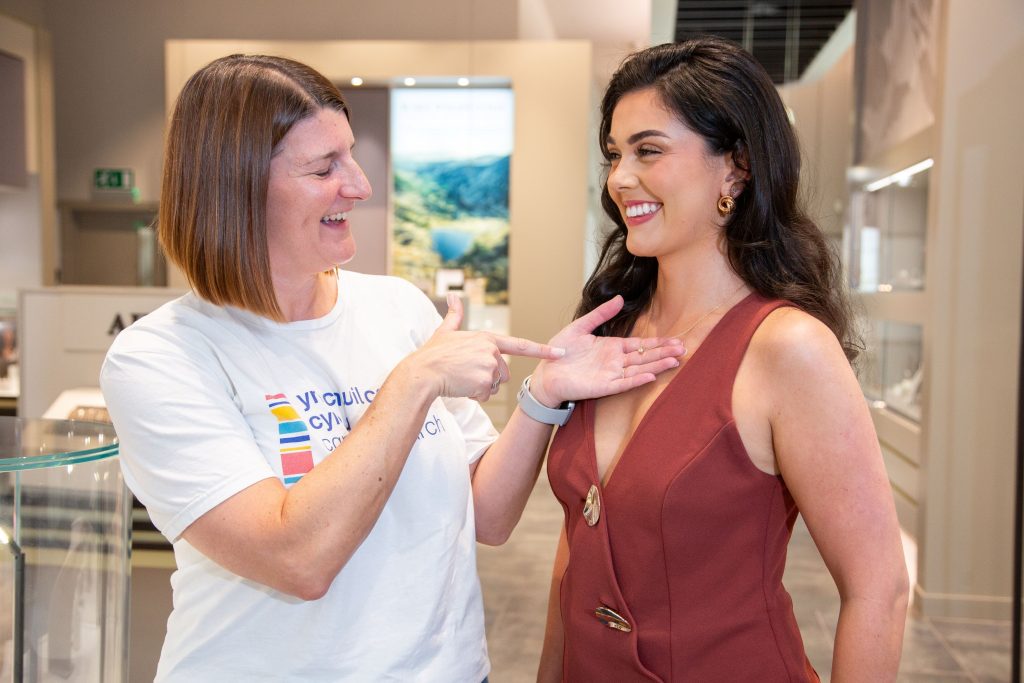
The prize was unveiled at Clogau’s Cardiff store by Cancer Research Wales ambassador and Miss United Kingdom Millie-Mae Adams, who received it on behalf of the charity.
Clogau, founded in North Wales, is internationally known for jewellery containing rare Welsh gold. Its heritage is closely linked to the Royal Family, with Welsh gold from the Clogau St David’s mine used in royal wedding rings for more than a century.
Ben Roberts, Managing Director of Clogau, said: “We are incredibly proud to support Cancer Research Wales as it celebrates this remarkable 60-year milestone.
“As a Welsh business with deep roots in our communities, we recognise the impact cancer has on families across the country and the importance of investing in research that can save and improve lives.
“We hope this beautiful Welsh gold necklace will help generate significant support for the raffle and encourage people to get behind the charity’s vital work.”
Millie-Mae, a proud Welsh speaker and doctor in training, is also the founder of Exeter Street Doctors, a charity which equips young people with lifesaving first aid skills.
She said: “As a proud ambassador of the charity, it is my privilege to play my part in Cancer Research Wales’s 60th anniversary and be here today to unveil the first prize in the 60 Anniversary Diamond Raffle – a stunning, diamond-set gold necklace, generously donated by Clogau.
“The gift of life and time with our loved ones is the most precious thing in the world, so please show your support for Cancer Research Wales’s life-saving and life-prolonging work today by entering the raffle.
“You could win this stunning Clogau gold necklace while helping to fund vital cancer research here in Wales.”

Millie-Mae also advocates for health education through her Medic Millie Mondays social media series and delivered the first Welsh-language Street Doctors session. Her work with Cancer Research Wales is shaped in part by her own family’s experience of cancer.

Lisa Buckley, Head of Income Generation at Cancer Research Wales, said: “I’m very grateful to Clogau and Millie-Mae Adams for supporting us to launch our 60 Anniversary Diamond Raffle – our first ever raffle, as we celebrate 60 years as the independent Welsh cancer research charity and 60 years of innovation in cancer diagnosis and treatment.
“Since 1966, we have invested £41.68 million to push the boundaries of cancer research discoveries here in Wales and we couldn’t have done that without the kindness of the Welsh public and our fantastic business community.
“Thank you for your support over the years and together we will unite Wales against cancer.”
Cancer Research Wales says the raffle will help support projects aimed at improving cancer outcomes for people across the country.
To enter the raffle, visit www.cancerresearch.wales.
Prize unveiled:
Miss United Kingdom Millie-Mae Adams received the necklace on behalf of Cancer Research Wales at Clogau’s Cardiff store (Pic: Paul Fears).



News2 hours ago
Long Course Weekend set to bring thousands to Pembrokeshire
Three days of swimming, cycling and running will once again transform Tenby into one of the UK’s biggest endurance sporting...


Community8 hours ago
The gentle giant behind the tattoos
Pembrokeshire security worker Josh Davies praised for professionalism, kindness and proving first impressions can be wrong JOSH Davies is hard...


Charity1 day ago
Toy Story fans fill charity toy box at Haverfordwest cinema
Donations pour in for SNAP Specialist Play as families embrace Toy Story 5 launch A TOY STORY-themed charity appeal at...


Community2 days ago
Lord Rhys emerges from the mist in St Davids
Giant puppet begins historic journey marking 850 years since the first Eisteddfod MIST swirled around St Davids Cathedral on Friday...


News2 days ago
Tragic tribute paid to Haverfordwest man after A4075 collision
FAMILY REMEMBERS “KIND AND LOVING” CALLUM HANSON THE FAMILY of a 22-year-old man from Haverfordwest who died following a road...

News3 days ago
Motorcyclist, 22, dies in A4075 crash in Pembrokeshire
A 22-year-old woman remains in hospital after two-vehicle collision A MOTORCYCLIST has died following a serious two-vehicle crash on the...

Community3 days ago
Why police will be visiting every home in Pembrokeshire
New operation aims to knock on more than 257,000 doors across Dyfed-Powys over the next three years DYFED-POWYS POLICE has...


Crime4 days ago
Prisons at breaking point: MPs warn Wales is paying the price of a failing system
Frozen healthcare budgets, overcrowded jails, homelessness on release and mounting pressure on staff are undermining rehabilitation across Wales, according to...


News4 days ago
Brexit at 10: How Britain was sold a dream that cost us dearly
A decade after the referendum, the promised benefits remain hard to find while the economic costs are increasingly difficult to...


Crime4 days ago
Worcestershire man jailed after violent attack on woman in Tenby
Defendant was already serving a suspended sentence when serious assault took place A WORCESTERSHIRE man has been jailed for more...
-

 Crime4 days ago
Milford Haven man jailed for breaching domestic violence protection order
-

 Local Government5 days ago
Security privately arranged by Mayor at Beating of the Bounds
-

 News3 days ago
Crash on Freeman’s Way causes school-run chaos across Haverfordwest
-

 Crime5 days ago
Man wanted by court after failing to attend hearing over alleged shop thefts
-
 Crime5 days ago
Man banned from roads after drink-driving offence
-

 Crime5 days ago
Man jailed after admitting strangulation and assaults
-

 Crime5 days ago
Drug trafficker must repay £33,000 after court rules he made nearly £500,000
-

 Crime5 days ago
Man sentenced over stalking campaign and lock knife offence