


Business
Construction output falls as productivity shrinks


THE GOVERNMENT and Parliament must break the Brexit deadlock and find a way forward warns the Federation of Master Builder (FMB), in response to the latest Construction PMI data, which shows another drop in construction output.
The March 2019 PMI data revealed an Index score of 49.7, up slightly from 49.5 in February, against the no change threshold of 50.0. This points to a sustained decline in construction output, representing the first back-to-back fall in construction output since 2016. While the residential building sector enjoyed an upturn, commercial construction was the worst performing area.
Commenting on the results, published this morning, Sarah McMonagle, Director of Communications at the FMB, said: “The construction industry is being seriously affected by Brexit uncertainty as evidenced by two very worrying sets of results for construction output in the first quarter of 2019.
“Businesses have been waiting for politicians to come to some resolution for far too long now, and it’s time that this deadlock was broken. It’s not surprising employers are finding it hard to plan for the future, when we don’t even know when, or indeed if, we’re leaving the EU. Today’s results are a reminder of just how vulnerable the construction industry is to political turmoil as confidence among consumers and contractors continues to wobble.”
Ms McMonagle concluded: “Brexit uncertainty and the construction skills shortage have created a perfect storm in our industry.

“Around 9 per cent of construction workers in the UK are from EU countries, but we know from speaking to small construction employers that many of these skilled workers are starting to return, whether that’s because of strengthening economies elsewhere, or that they simply don’t feel welcome anymore. This is compounding an already severe construction skills shortage, and I’m worried that the Government’s post-Brexit immigration system will make it even worse. For example, the system will not allow Level 2 tradespeople to live and work in the UK for more than 12 months at a time. At the same time, the Government’s figures last week show that the number of Level 2 apprenticeship starts among our domestic workforce is dropping.
“It’s quite simply not possible to build the homes and infrastructure we need without bricklayers, carpenters and plasterers. The Government and industry must work together to attract more people into the industry, by offering them high quality training with clear career pathways for progression but in the meantime we need sustained access to tradespeople of all skill levels for the industry to continue being open for business.”
Elsewhere in the economy, the Federation of Small Businesses has expressed concern at the UK’s productivity growth in Q4 of 2018 decreasing for the second consecutive quarter.
Federation of Small Businesses (FSB) National Chairman Mike Cherry, said: “Today’s data highlights yet again the impact of the political and economic uncertainty to the economy.

“Small business confidence has fallen through the floor as firms face a trying time amid a fragile economy.
“While there were some positives in the data such as a 0.4% productivity increase in services, there was a significant 1.1% decrease for manufacturing.
“Small firms are not only contending with unprecedented uncertainty, they are also dealing with a raft of new cost increases and reporting requirements.

“Rising labour costs have continued with the introduction of Making Tax Digital, fresh hikes to business rates and a further increase in auto-enrolment pension contributions.
“In order to improve productivity, key areas that must be addressed include management and leadership, broadband connectivity and the scourge of late payments.
“All this amid the ongoing uncertainty over the future of the UK’s relationship with the EU which shows no sign of reaching a resolution.
“Productivity will only continue to decline unless the Government can do more to step up and back British businesses.”



A CALL for works to Tenby’s listed building sailing club to improve energy efficiency for the community organisation has been given the go-ahead.
In an application to Pembrokeshire Coast National Park, Harrison Richards of Tenby Sailing Club sought permission for replacing 24 timber windows at the Grade-II-listed Tenby Sailing Club, Penniless Cove Hill, with new Accoya timber double-glazed units.
The application added: “An energy survey conducted by Dragon Energy Consultants highlighted the existing single glazing and rotten window frames as a significant contributor to the club’s energy consumption.
“Tenby Sailing Club is a community organisation which seeks to organise activities year-round but faces significant energy costs being housed in a historic building. The current windows are beyond repair, with cracked glazing, decay, water ingress, and poor energy efficiency.
“The two windows at balcony level are not included, as they were previously replaced and remain in good condition. All new units will replicate the existing profiles, dimensions, glazing patterns, and overall appearance, ensuring no visual change to the building’s character.
“The neighbouring three-storey harbour stores occupied by Tenby Sea Cadets have previously replaced the building’s windows with double glazing. This like-for-like replacement in appearance will improve durability, weather resistance, and thermal performance while preserving the special architectural and historic interest of the listed building.”
An officer report recommending approval said: “The Sailing Club was built as a warehouse c. 1825, abutting the C17 sluice. Originally wine stores, it was later used by the local fishermen for stores and is now the home to Tenby Sailing Club, established in 1936.”
It said no adverse comments to the proposals had been received.
It added: “The proposal is to replace the majority (24 total) of windows in painted timber, double-glazed with face-mounted glazing bars of traditional scale and profile. Whilst a modern practice of glazing, the proposal involves no loss of historic fabric, provides an obvious visual improvement and addresses concerns as to heating costs.”

It finished: “The scheme is considered to be in keeping with the character of the listed building, and its setting in terms of design and form. As such, the application can be supported subject to conditions.”
The application was conditionally approved by planners.

TAXI passengers in Milford Haven are facing a sudden jump in fares, as drivers increasingly switch on their meters and charge full council-approved rates.
One Herald reader said a short return trip from Milford Haven to Neyland cost £30 — around double what he expected to pay.
But drivers insist the prices are not new — they are simply the official tariff now being applied.
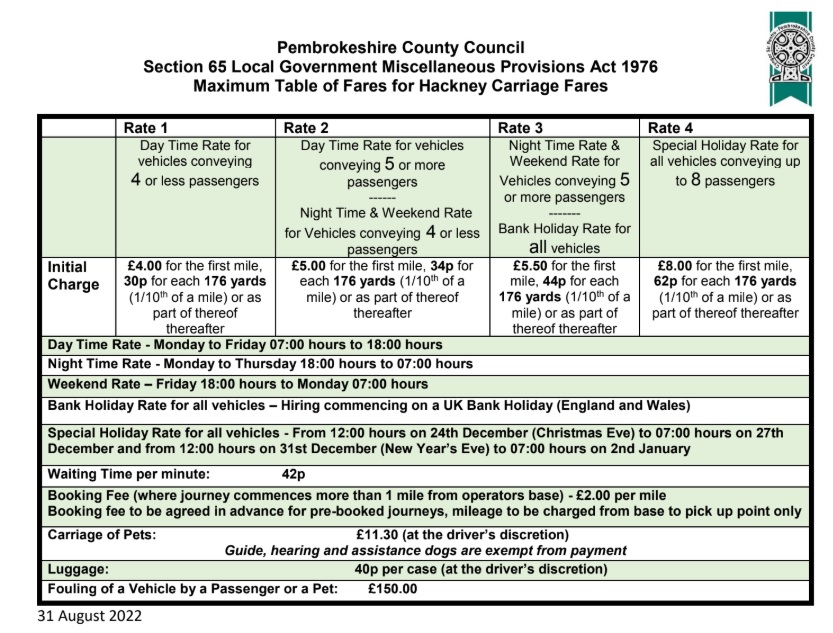
Under Pembrokeshire County Council rules, the standard daytime fare starts at £4 for the first mile (£5 after 6pm), rising by around £3 per mile thereafter. Waiting time is also charged, meaning even short return journeys can quickly add up.
Higher rates apply in the evenings, at weekends and on bank holidays.
End of the £3 taxi
Milford Haven has long been known for cheap taxis, with short in-town journeys often costing as little as £3 — far below official rates.
That was down to competition, older vehicles, and the need to keep prices low in a town where many rely on affordable transport.
Drivers say those days are now over.
One local driver told The Herald: “People got used to cheap fares, but that was never the real price. Now we have to use the meter or we’re losing money.”

Fuel costs biting
Most taxis run on diesel, now around 170p per litre locally. For drivers covering long distances each day, the increase has hit hard.
Global tensions in the Middle East have pushed up oil prices, feeding directly into higher fuel costs in the UK.
With fare increases requiring a lengthy council process, many drivers say they have no option but to charge the full tariff.

Vulnerable hit hardest
The change is being felt most by those who rely on taxis the most.
Elderly residents, people on low incomes and those without access to a car are now facing higher everyday travel costs.
There has been no recent increase in Pembrokeshire’s official taxi fares, which have remained broadly unchanged since 2022.
The difference is simple: drivers are now charging them.
As one put it: “We’re not putting prices up — we’re just finally charging what we’re supposed to be charging.”

CARDIFF AIRPORT is preparing for a busy Easter getaway, with more than 46,000 passengers expected to travel through the airport over the holiday period.
The figure represents an 18% increase compared to the same period last year, reflecting growing demand for both sunshine destinations and European city breaks.
The busiest routes this Easter are set to be Alicante, Dublin and Málaga, with flights operated by airlines including Ryanair, Vueling and TUI Airways.
Travellers heading for warmer weather can also take advantage of direct flights to the Canary Islands, including Tenerife, Lanzarote, Gran Canaria and Fuerteventura, alongside popular destinations such as Faro and Palma.
The airport says the increase builds on a strong start to 2026, with passenger numbers continuing to rise.

Chief executive Jon Bridge said the airport is approaching the one million passenger mark and expects the summer season to be its busiest since the pandemic.
He said: “It’s been an incredibly positive start to the year, and we’re looking forward to welcoming more passengers over the Easter period.
“Our teams are working hard to ensure travellers can start their holidays smoothly.”
Passengers travelling over Easter are being advised to allow extra time for their journey and check with airlines for the latest updates.
A total of 46,158 passengers are expected to pass through the airport between March 27 and April 12, with arrivals and departures almost evenly split.
Cardiff Airport said it continues to expand its range of destinations, including the addition of a direct service to Toronto, as it looks to strengthen its role in connecting Wales to international travel.



Health4 hours ago
Clash over Withybush Hospital services as Paul Davies challenges First Minister
A HEATED exchange in the Senedd has laid bare growing tensions over the future of hospital services in west Wales....


Crime21 hours ago
Police stop car in Pennar as three arrested in drugs investigation
Suspected drug driver report leads to major police response and multiple arrests DRAMATIC scenes were reported in Pennar on Monday...


Business1 day ago
New pilot vessel Llanion arrives at Milford Haven
State-of-the-art 22-metre craft marks reset after £3.6m pilot boat controversy THE PORT OF MILFORD HAVEN has taken delivery of a...


Business2 days ago
Could Primark be coming to Haverfordwest? Major retailer in talks for former Wilko site
Council confirms advanced discussions as speculation grows over high street boost HAVERFORDWEST could soon see a major high street revival,...


Business2 days ago
Rail investment ‘could unlock 40,000 jobs and £11bn for Wales’ says new report
RAILWAY stations across Wales could help unlock around 40,000 jobs and more than £11 billion for the economy by 2036,...


Local Government2 days ago
Milford Haven set for £200m investment with schools, leisure centre and rail upgrade
Council outlines major plans for town with backing from Welsh Government MILFORD HAVEN is set for a major transformation with...


Community3 days ago
Broad Haven volunteers secure ‘national asset’ status for nature reserve
A SMALL stretch of woodland and former opencast coal mine has been transformed into a nationally recognised biodiversity site, in...


Entertainment4 days ago
Tenby steams up in spectacular style as crowds flock to festival
Colourful parade, towering creations and Victorian flair bring town centre to life TENBY was transformed into a vibrant Victorian fantasy...


Crime5 days ago
Publican jailed for six years for supplying cocaine and cannabis
Milford Haven man sentenced at Swansea Crown Court following drug dealing operation A MILFORD HAVEN publican has been jailed for...


Local Government5 days ago
Poverty summit highlights support efforts across Pembrokeshire
A SUMMIT bringing together key organisations from across Pembrokeshire has highlighted both the scale of local poverty and the work...
-

 Crime7 days ago
Mother given community order after admitting child cruelty offence
-

 Health6 days ago
NHS waiting list falls — but cancer delays and diagnostic backlog worsen
-

 Crime7 days ago
Woman stole from pharmacy despite ban, court hears
-

 Crime6 days ago
Illegal workers found at Cardigan takeaway after immigration raid
-

 Crime5 days ago
Pembroke man remanded in custody over knife threat, assault and damage allegations
-

 Crime5 days ago
Broad Haven man remanded in custody over sexual harm prevention order breach
-

 Crime7 days ago
Man pleads guilty in illegal ‘smokies’ food safety case
-

 News6 days ago
Council unveils plans for new state-of-the-art secondary school in Milford Haven