


Health
Covid-19 vaccine approved for use next week in the United Kingdom


THE UK has become the first country in the world to approve the Pfizer-BioNTech coronavirus vaccine.
The paves the way for mass vaccination.
Britain’s medicines regulator, the MHRA, says the jab, which offers up to 95% protection against Covid-19 illness, is safe to be rolled out.
The first 800,000 doses will be available in the UK from next week, Health Secretary Matt Hancock said.
People should wait to be contacted by the NHS, he added.
Elderly people in care homes and care home staff are top of the priority list, followed by over-80s and health and care staff.
But because of the limited stocks and need to store at -70C, the very first vaccinations are likely to take place at hospitals so care home residents may not be immunised until later.

ID cards for those vaccinated
PEOPLE who have received a coronavirus vaccine in Wales will be given a card detailing the date and type of the vaccination.
The announcement came from health minister Vaughan Gething after Pfizer/BioNTech’s Covid-19 vaccine was approved by the independent Medicines and Healthcare products Regulatory Agency (MHRA).
In a written statement Mr Gething said: “Those receiving a COVID-19 vaccination will be given a credit card-sized NHS Wales immunisation card which will have the vaccine name, date of immunisation and batch number of each of the doses given handwritten on them.
“These will act as a reminder for a second dose and for the type of vaccine, and it will also give information about how to report side effects.”

Responding to the announcement that a COVID-19 vaccine has been approved by the MHRA, Darren Hughes, Director of the Welsh NHS Confederation said: “It’s excellent news and a very significant milestone in the country’s battle to get COVID-19 under control. This vaccine will help us to save many lives over the coming months.
“However, we can’t be complacent now. We will need to continue with the measures we’ve all become familiar with such as social distancing, hand hygiene and wearing a mask where it is appropriate. We know people have made a significant effort this year and made incredible sacrifices as well, but there is light at the end of the tunnel.
“We are ready to deliver the largest vaccination programme the NHS in Wales has ever undertaken. This will be a huge logistical challenge, which has been thoroughly prepared for and tested.”
How will the vaccine be delivered in Wales?
DUE to the specific requirements of the vaccine it is not just a case of sending it all over Wales. The vaccine is going to be stored in two sites in Wales where health boards will have to pick it up from.
“We are aware of the challenges of storing, distributing and handling the Pfizer/BioNTech vaccine,” said Mr Gething. “In particular its need for storage at very low temperatures of below minus -75ºC +/- 15ºC.
“Two specialist sites have been identified as appropriate delivery sites for the vaccine and local Health Boards will collect the vaccines directly from the two sites.”

The first group to get the vaccine will be older adults resident in a care home and care home workers though it not just a matter of distributing directly to care settings. “In practical terms at this stage that we cannot deliver this vaccine to care homes.” said Mr Gething.
The Welsh Government will be using the advice from the Joint Committee on Vaccination and Immunisation to decide who will be the first people to be vaccinated.
The order advised is:
- Older adults’ resident in a care home and care home workers
- All those 80 years of age and over and health and social care workers
- All those 75 years of age and over
- All those 70 years of age and over
- All those 65 years of age and over
- High-risk adults under 65 years of age
- Moderate-risk adults under 65 years of age
- All those 60 years of age and over
- All those 55 years of age and over
- All those 50 years of age and over
- Rest of the population


Health Minister tells Paul Davies MS that decisions remain a matter for Hywel Dda University Health Board
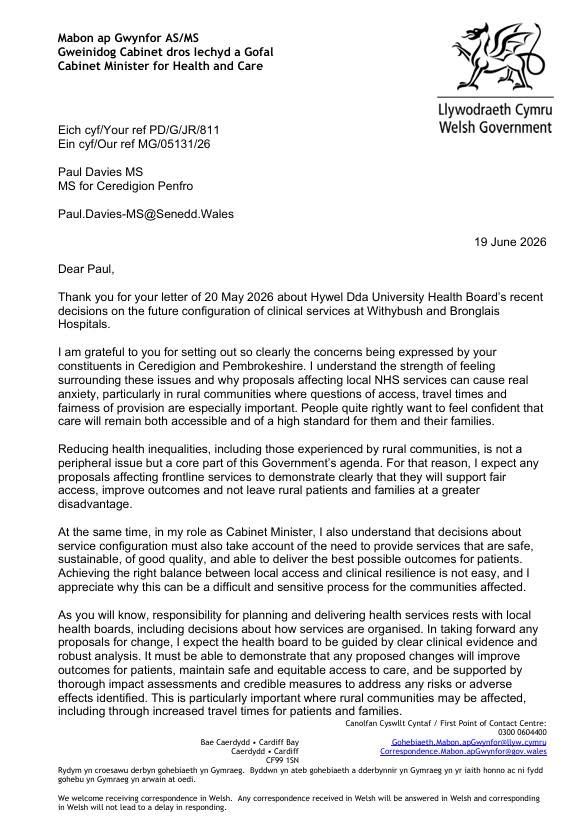
THE WELSH GOVERNMENT has declined to intervene in controversial plans affecting services at Withybush and Bronglais hospitals, prompting fresh criticism from local Senedd Member Paul Davies.
In a letter dated June 19, Health and Care Cabinet Secretary Mabon ap Gwynfor said responsibility for planning and delivering NHS services rests with local health boards and confirmed that Hywel Dda University Health Board should continue its consultation process on proposed service changes.
The response follows concerns raised by Mr Davies on behalf of constituents in Pembrokeshire and Ceredigion over the future configuration of clinical services, including stroke care.
While acknowledging strong public concern about access to healthcare in rural communities, the Minister stopped short of offering any commitment to block or reverse the Health Board’s proposals.
Instead, he stressed that any changes must be supported by robust evidence, maintain patient safety and demonstrate improved outcomes.
The Minister wrote: “Responsibility for planning and delivering health services rests with local health boards, including decisions about how services are organised.”
He added that proposals must improve outcomes for patients, maintain safe and equitable access to care and be supported by thorough impact assessments.
Paul Davies MS described the response as disappointing.
Posting the letter on social media, he said: “This letter tells me that the Welsh Government is not going to stand in the way of the Health Board’s plans.”
He added that he would raise the issue in the Senedd chamber next week and continue pressing ministers to intervene.
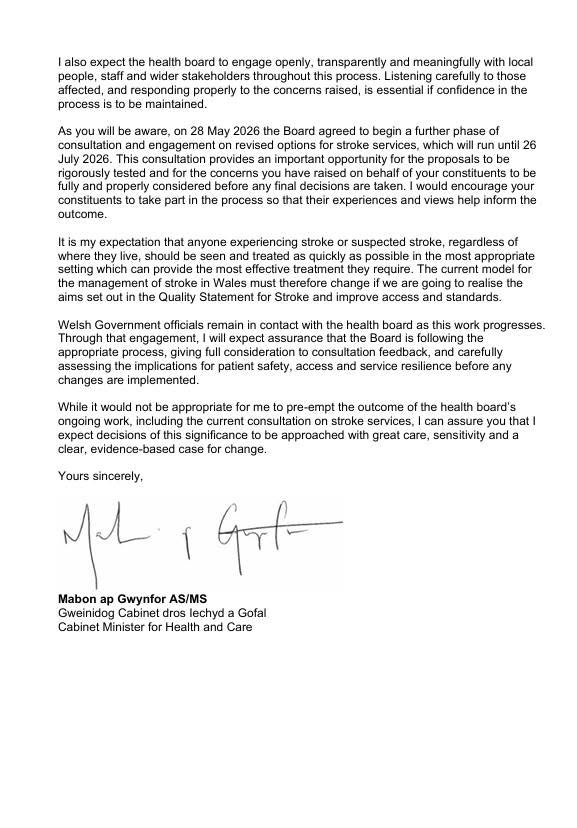
The exchange comes as Hywel Dda University Health Board continues a public consultation on proposed changes to stroke services across west Wales.
The consultation, which opened on May 28, is due to run until July 26.

In his response, the Minister stated that anyone suffering a stroke should receive treatment “as quickly as possible in the most appropriate setting” and said the current model of stroke care in Wales must evolve if national standards are to be achieved.
The comments are likely to fuel concern among campaigners opposed to the proposed changes, who fear services could become increasingly centralised and further away from rural communities in Pembrokeshire and Ceredigion.

PATIENTS are facing some of the worst medicine shortages ever seen in the UK, with pharmacists warning the situation now poses a serious risk to safety.
The National Pharmacy Association said shortages affecting commonly used medicines are becoming more frequent, lasting longer, and causing increasing disruption for patients, GP surgeries and pharmacies.
The warning comes as Serious Shortage Protocols for Creon, used by people with pancreatic cancer and cystic fibrosis to help digest food, have been in place since May 2024 and have now been extended until July 10, 2026.
HRT treatment Estradot has also been under a Serious Shortage Protocol since December 2024, with the current extension also running until July 10.
Patients travelling between pharmacies
A survey by the National Pharmacy Association found that 98 per cent of pharmacies had encountered patients who had visited several pharmacies in one day to find a prescription.
It also found that 96 per cent of pharmacies believed the current situation posed a serious risk to patient safety, while 89 per cent said they had been unable to dispense a medicine at least once a day because of supply problems.
Some pharmacy teams have also faced anger and abuse from patients unable to obtain medication.
Olivier Picard, Chair of the National Pharmacy Association, said: “Medicine shortages are becoming more frequent, lasting longer and causing increasing disruption for patients.
“These shortages are some of most severe the UK has experienced.
“It is deeply distressing to find patients who have travelled from pharmacy to pharmacy to find the medicines they need without success.”
Calls for urgent taskforce
The NPA is calling on the government to convene an emergency taskforce involving manufacturers, wholesalers, clinicians and pharmacists.
It also wants changes to rules which currently stop pharmacists from making simple substitutions, such as changing a tablet to a capsule or a cream to an ointment, even where a safe alternative is available.

Professor Victoria Tzortziou Brown, President of the Royal College of GPs, said medicine shortages were frustrating for patients, GPs and pharmacists, and added pressure to already stretched services.
She said the College supported pharmacists being able to make limited changes to prescriptions where a medicine is unavailable and a safe alternative exists.
She added: “The most important thing is that patients are able to access the medication they need safely and without delay.”
The Cystic Fibrosis Trust and Pancreatic Cancer UK have also raised concerns about the impact of shortages of pancreatic enzyme replacement therapy, including Creon, on people who rely on the medication to digest food, maintain weight and stay well enough for treatment.

A CARMARTHEN woman has been jailed after admitting a lengthy catalogue of offences including assaults on police officers, harassment, breaching a Community Protection Notice, shop theft, possession of an XL Bully dog and assaulting a paramedic.
Tilly Rees, 25, of Llys Caermedi, Carmarthen, appeared before Llanelli Magistrates’ Court on Wednesday (Jun 18).
The court heard that Rees admitted multiple breaches of a Community Protection Notice issued in 2025, including incidents in which she shouted abuse in public, caused distress to residents and repeatedly targeted individuals named in court proceedings.
Harassment campaign
Among the offences was a harassment charge relating to a course of conduct against a Carmarthen man between March and May this year.
Prosecutors said Rees approached him on multiple occasions, shouted abuse, called him a paedophile and video-recorded him and his home.
She also admitted a series of Community Protection Notice breaches linked to the same behaviour.
Police assaults
The court heard that Rees assaulted a number of police officers during incidents in Llanelli on May 1 and May 5.
Several assault charges against serving police constables were taken into account by the court when sentence was passed.
A further charge of assaulting a paramedic at Dafen Police Station on June 12 was also admitted.
Shop theft and XL Bully
Rees also admitted stealing items including sanitary products, deodorant, skincare products and reading glasses from a Carmarthen pharmacy.
In a separate matter, she admitted possessing an XL Bully dog contrary to the Dangerous Dogs Act. The court ordered the dog to be forfeited and destroyed after Rees relinquished her rights to it.
Restraining orders imposed
District Judge M Layton imposed a number of restraining orders preventing Rees from contacting named individuals or referring to them online.

The orders prohibit direct or indirect contact and restrict social media activity relating to those protected by the orders.
Jailed for 26 weeks
Magistrates concluded that only an immediate custodial sentence could be justified.
Rees was sentenced to a total of 26 weeks’ imprisonment.
The court heard that some of the offences were committed while she was already subject to a suspended sentence, while others involved assaults on emergency workers carrying additional aggravating factors.



Community6 hours ago
The gentle giant behind the tattoos
Pembrokeshire security worker Josh Davies praised for professionalism, kindness and proving first impressions can be wrong JOSH Davies is hard...


Charity1 day ago
Toy Story fans fill charity toy box at Haverfordwest cinema
Donations pour in for SNAP Specialist Play as families embrace Toy Story 5 launch A TOY STORY-themed charity appeal at...


Community1 day ago
Lord Rhys emerges from the mist in St Davids
Giant puppet begins historic journey marking 850 years since the first Eisteddfod MIST swirled around St Davids Cathedral on Friday...


News2 days ago
Tragic tribute paid to Haverfordwest man after A4075 collision
FAMILY REMEMBERS “KIND AND LOVING” CALLUM HANSON THE FAMILY of a 22-year-old man from Haverfordwest who died following a road...


News3 days ago
Motorcyclist, 22, dies in A4075 crash in Pembrokeshire
A 22-year-old woman remains in hospital after two-vehicle collision A MOTORCYCLIST has died following a serious two-vehicle crash on the...


Community3 days ago
Why police will be visiting every home in Pembrokeshire
New operation aims to knock on more than 257,000 doors across Dyfed-Powys over the next three years DYFED-POWYS POLICE has...


Crime4 days ago
Prisons at breaking point: MPs warn Wales is paying the price of a failing system
Frozen healthcare budgets, overcrowded jails, homelessness on release and mounting pressure on staff are undermining rehabilitation across Wales, according to...


News4 days ago
Brexit at 10: How Britain was sold a dream that cost us dearly
A decade after the referendum, the promised benefits remain hard to find while the economic costs are increasingly difficult to...


Crime4 days ago
Worcestershire man jailed after violent attack on woman in Tenby
Defendant was already serving a suspended sentence when serious assault took place A WORCESTERSHIRE man has been jailed for more...


Climate4 days ago
Offshore wind ‘could bring new generation of jobs to Milford Haven’
Pembrokeshire ports and Celtic Sea projects placed at centre of Wales’ green energy ambitions MILFORD HAVEN and Pembroke Dock could...
-

 Crime4 days ago
Milford Haven man jailed for breaching domestic violence protection order
-

 Local Government5 days ago
Security privately arranged by Mayor at Beating of the Bounds
-

 News3 days ago
Crash on Freeman’s Way causes school-run chaos across Haverfordwest
-

 Crime5 days ago
Man wanted by court after failing to attend hearing over alleged shop thefts
-
 Crime5 days ago
Man banned from roads after drink-driving offence
-

 Crime5 days ago
Man jailed after admitting strangulation and assaults
-

 Crime5 days ago
Drug trafficker must repay £33,000 after court rules he made nearly £500,000
-

 Crime5 days ago
Man sentenced over stalking campaign and lock knife offence